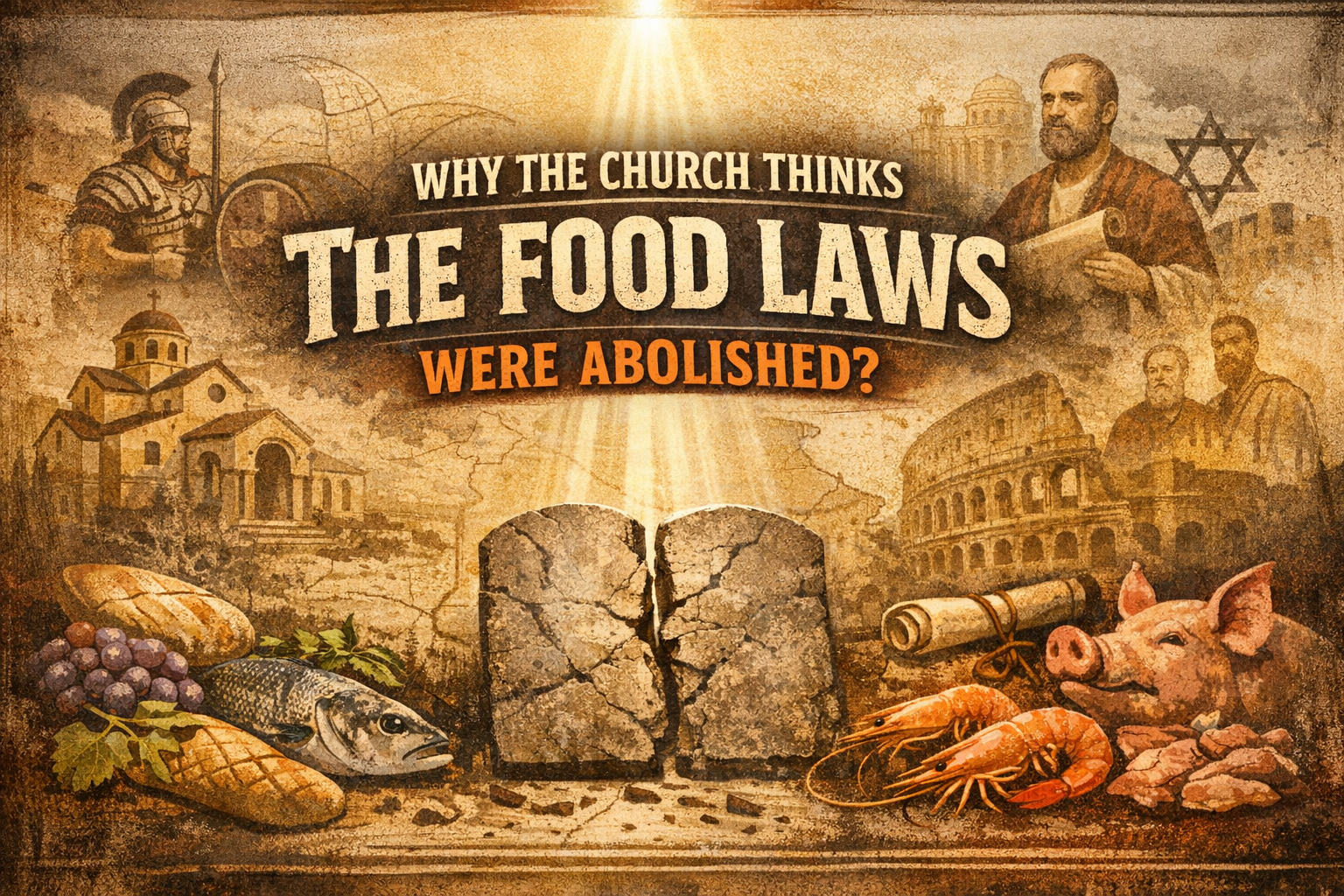
I. Opening Truth: What Scripture Actually Says
- The New Testament never records God abolishing His food laws.
- Jesus never ate unclean animals, never taught others to, and never declared the food laws void.
- Peter, long after the resurrection, still says:
“I have never eaten anything unclean.” (Acts 10:14) - Acts 10 is about people, not food.
- The early church continued kosher practices for over a century.
So why does the modern church teach something different?
To answer that, we must look at history, not Scripture.
II. Stage One: After the Apostles — A Gentile Majority Emerges (100–150 AD)
A. The demographic shift
- The first generation of believers was almost entirely Jewish.
- By 100–150 AD, the church became overwhelmingly Gentile.
- Most Gentile believers had no background in Torah or Jewish customs.
B. The result
- Practices like Sabbath, Passover, and kosher laws felt “foreign” to Gentile converts.
- Instead of learning Jewish roots, many simply abandoned them.
C. The key misunderstanding
Gentile believers assumed:
“If we are not Jews, we don’t need Jewish practices.”
This was not the teaching of Acts 15, but it became the assumption of the Gentile church.
III. Stage Two: Rising Anti‑Jewish Sentiment in the Roman Empire (100–300 AD)
A. Historical pressure
- Jewish revolts against Rome (66–135 AD) made Judaism politically dangerous.
- Rome punished Jews heavily and viewed Jewish customs with suspicion.
B. Christians wanted to avoid persecution
To distance themselves from Jews, many Christians began saying:
- “We are not Jews.”
- “We do not keep Jewish laws.”
- “We do not follow Jewish customs.”
C. The theological shift
Some early church fathers began teaching:
- The food laws were symbolic.
- They were temporary.
- They were only for the Jews.
- They were fulfilled and therefore unnecessary.
These ideas were not based on Scripture — they were reactions to political pressure and cultural hostility.
IV. Stage Three: The Romanization of Christianity (300–400 AD)
A. Constantine’s influence
When Christianity became legal and then favored:
- The church sought unity across the empire.
- Anything “Jewish” was discouraged to create a uniform Roman Christianity.
B. Official church decisions
Church councils and bishops:
- Replaced Passover with Easter
- Replaced Sabbath with Sunday
- Discouraged kosher practices
- Promoted separation from Jewish identity
C. The food laws were swept away
Not by Scripture.
Not by Jesus.
Not by the apostles.
But by Roman church policy.
V. Stage Four: Tradition Becomes Doctrine (400–1500 AD)
A. The church’s reasoning solidifies
Over centuries, the church taught:
- “The food laws were abolished.”
- “The Old Testament laws were for Jews only.”
- “Christians are free from all dietary restrictions.”
B. The problem
These teachings were based on:
- Tradition
- Philosophy
- Anti‑Jewish sentiment
- Misinterpretation of passages like Acts 10 and Mark 7
Not on the actual text of Scripture.
VI. Stage Five: The Reformation Inherits the Same Assumptions (1500–Present)
A. Reformers corrected many doctrines — but not this one
Luther, Calvin, and others:
- Rejected Catholic authority
- Rejected many traditions
- But kept Rome’s interpretation of the food laws
B. Modern churches inherited the same teaching
Most pastors today:
- Were taught that the food laws were abolished
- Never studied the Jewish context
- Never examined Acts 10 carefully
- Simply repeated inherited tradition
VII. What the Bible Actually Teaches
A. Acts 10 is about people, not food
Peter’s Own Interpretation (Acts 10:28)
This is the verse people skip, but it is the Holy Spirit’s interpretation through Peter:
“God hath shewed me that I should not call any man common or unclean.”
Not food. People.
Peter does not say:
- “God showed me I can eat anything now.”
- “The food laws are abolished.”
He says:
- “God showed me not to call any man unclean.”
The vision was symbolic.
Just like:
- Joseph’s sheaves bowing (symbolic of his brothers)
- Daniel’s beasts (symbolic of kingdoms)
- Ezekiel’s scroll (symbolic of God’s message)
Peter’s sheet is symbolic of Gentile inclusion.
The cultural problem God was solving was NOT dietary — it was social
In the first century:
- Jews did not enter Gentile homes
- Jews did not eat with Gentiles
- Jews considered Gentiles “unclean” because of idolatry, not food
- Jews believed table fellowship = spiritual fellowship
So the real question in Acts 10 was:
Can Gentiles be fully accepted by God without becoming Jews first?
God’s answer: YES.
The sheet vision is God saying:
“Do not call the Gentiles unclean. I am cleansing them.”
In Acts 11, Peter retells the story to the Jerusalem believers.
They do not conclude:
- “Oh, the food laws are gone.”
They conclude:
“Then hath God also to the Gentiles granted repentance unto life.” (Acts 11:18)
Again—people, not food.
B. Acts 15 still gives Gentiles food restrictions
If the food laws were abolished, this makes no sense. When the apostles met to decide what to require of Gentile believers, they said:
- avoid idolatry
- avoid sexual immorality
- avoid blood
- avoid strangled animals
These are food-related instructions.
If the food laws were abolished, why give Gentiles food restrictions at all?
Because the issue was unity, not diet.
C. Jesus upheld the Torah
He said:
“I did not come to abolish the Law.” (Matt 5:17)
D. Paul upheld the Torah
Paul’s letters are often misunderstood, but Paul himself says:
- “The law is holy, just, and good.” (Rom 7:12)
- “Do we then make void the law through faith? God forbid.” (Rom 3:31)
- “I believe all things written in the Law and the Prophets.” (Acts 24:14)
Paul’s discussions about food are about:
- meat sacrificed to idols
- table fellowship
- conscience
- unity between Jewish and Gentile believers
Not about abolishing God’s dietary instructions.
E. The early church lived Torah‑faithfully
This is the part most people never hear.
For the first 100+ years:
- Jewish believers continued keeping kosher
- Gentile believers were not required to become Jewish
- But Gentiles also avoided blood, strangled animals, and idolatrous meat (Acts 15)
- Peter still kept the food laws long after the resurrection
- Paul kept them (Acts 21)
- James and the Jerusalem church kept them
- No apostle ever taught “eat whatever you want”
The early church was a Jewish movement with Gentile inclusion, not a new religion.
VIII. Closing Summary
The church teaches the food laws were abolished because:
- The early Gentile church abandoned Jewish practices.
- Anti‑Jewish attitudes pushed Christians away from anything Jewish.
- Rome enforced a non‑Jewish Christianity.
- Tradition hardened into doctrine.
- Later churches inherited these assumptions without re‑examining Scripture.
But Scripture itself never abolishes God’s food laws.
