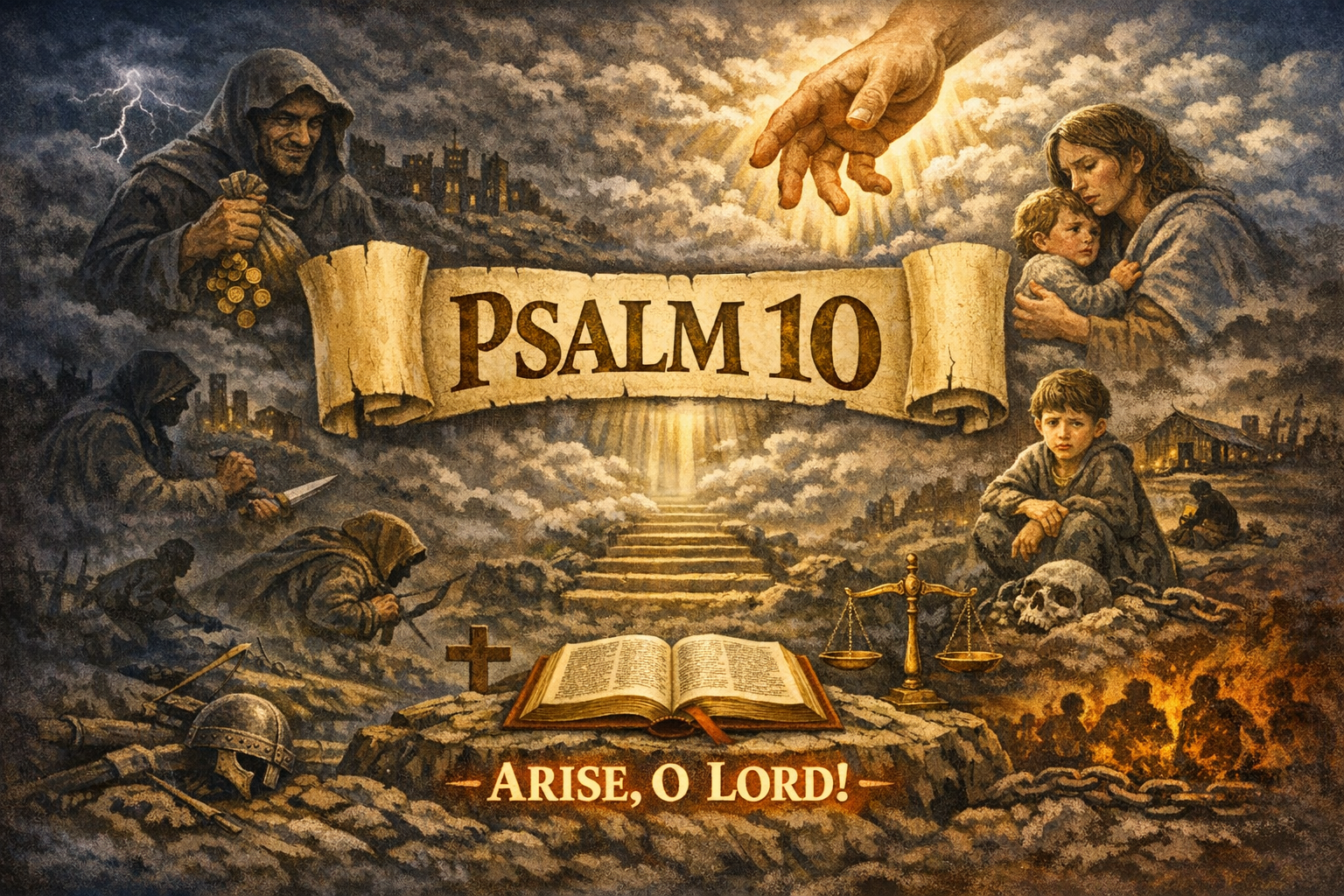
Psalm 10
- Why standest thou afar off, O Lord? why hidest thou thyself in times of trouble?
- The wicked in his pride doth persecute the poor: let them be taken in the devices that they have imagined.
- For the wicked boasteth of his heart’s desire, and blesseth the covetous, whom the Lord abhorreth.
- The wicked, through the pride of his countenance, will not seek after God: God is not in all his thoughts.
- His ways are always grievous; thy judgments are far above out of his sight: as for all his enemies, he puffeth at them.
- He hath said in his heart, I shall not be moved: for I shall never be in adversity.
- His mouth is full of cursing and deceit and fraud: under his tongue is mischief and vanity.
- He sitteth in the lurking places of the villages: in the secret places doth he murder the innocent: his eyes are privily set against the poor.
- He lieth in wait secretly as a lion in his den: he lieth in wait to catch the poor: he doth catch the poor, when he draweth him into his net.
- He croucheth, and humbleth himself, that the poor may fall by his strong ones.
- He hath said in his heart, God hath forgotten: he hideth his face; he will never see it.
- Arise, O Lord; O God, lift up thine hand: forget not the humble.
- Wherefore doth the wicked contemn God? he hath said in his heart, Thou wilt not require it.
- Thou hast seen it; for thou beholdest mischief and spite, to requite it with thy hand: the poor committeth himself unto thee; thou art the helper of the fatherless.
- Break thou the arm of the wicked and the evil man: seek out his wickedness till thou find none.
- The Lord is King for ever and ever: the heathen are perished out of his land.
- Lord, thou hast heard the desire of the humble: thou wilt prepare their heart, thou wilt cause thine ear to hear:
- To judge the fatherless and the oppressed, that the man of the earth may no more oppress.
Psalm 10 opens with a cry that feels painfully familiar: “Why standest thou afar off, O Lord?” It is the voice of one who sees injustice and wonders where God’s hand has gone. Yet beneath the lament lies deep faith — the psalmist believes that God does see, that He will arise, and that His justice will prevail.
This psalm exposes the arrogance of the wicked, who imagine themselves untouchable, and contrasts it with the quiet trust of the humble who commit their cause to God. It reminds us that divine silence is never divine absence. The Lord observes every deceitful word, every hidden snare, and every cry of the oppressed.
Psalm 10 teaches that faith must sometimes wait through mystery — trusting that the King who reigns forever will judge rightly and defend the fatherless and the oppressed. It is a prayer for courage when evil seems bold, and a declaration that righteousness will not be forgotten.
I. The Cry of Divine Distance (v. 1)
Core idea: The psalm begins with honest lament — the feeling that God seems far away in moments of deep trouble.
- “Why standest thou afar off… why hidest thou thyself?”
- Psalm 22:1 — “Why hast thou forsaken me?”
- Isaiah 45:15 — “Verily thou art a God that hidest thyself.”
- Habakkuk 1:2–4 — The prophet wrestles with God’s seeming silence.
- Faith allows honest questions; lament is not unbelief but relationship.
II. The Character of the Wicked (vv. 2–11)
Core idea: The psalmist describes the arrogance, violence, and deceit of the wicked — a portrait of pride that refuses God.
A. Pride that persecutes (vv. 2–3)
- “The wicked in his pride doth persecute the poor.”
- Proverbs 16:18 — Pride goes before destruction.
- James 4:6 — God resists the proud.
- “Blesseth the covetous, whom the Lord abhorreth.”
- Luke 12:15 — Beware of covetousness.
B. God is not in his thoughts (v. 4)
- “Will not seek after God.”
- Romans 3:11 — None naturally seeks after God.
- “God is not in all his thoughts.”
- Psalm 14:1 — The fool says in his heart, “There is no God.”
C. False security and arrogance (vv. 5–6)
- “I shall not be moved… never in adversity.”
- Psalm 73:6–9 — The wicked imagine themselves secure.
- Luke 12:19–20 — The rich fool’s false confidence.
D. A mouth full of destruction (v. 7)
- “Cursing and deceit and fraud.”
- James 3:6–10 — The tongue is a fire.
- Romans 3:14 — “Whose mouth is full of cursing and bitterness.”
E. Violence against the vulnerable (vv. 8–10)
- “He sitteth in the lurking places… to murder the innocent.”
- Proverbs 1:11 — The wicked lie in wait for blood.
- “As a lion… he lieth in wait to catch the poor.”
- 1 Peter 5:8 — The adversary as a roaring lion.
F. The wicked’s false theology (v. 11)
- “God hath forgotten… He will never see it.”
- Psalm 94:7–9 — “He that planted the ear, shall he not hear?”
- Ecclesiastes 8:11 — Delay in judgment emboldens evil.
III. The Plea for God to Act (vv. 12–15)
Core idea: The psalmist moves from lament to intercession, calling on God to rise and defend the humble.
A. “Arise, O Lord” (v. 12)
- A prayer of faith, not despair.
- Psalm 3:7 — “Arise, O Lord; save me.”
- Psalm 35:23 — “Stir up thyself, and awake to my judgment.”
B. God will require it (v. 13)
- The wicked think God will not call them to account.
- Romans 14:12 — Every one shall give account to God.
- Hebrews 4:13 — All things are naked before Him.
C. God sees and defends (v. 14)
- “Thou hast seen it… thou art the helper of the fatherless.”
- Exodus 22:22–23 — God hears the cry of the fatherless.
- Psalm 68:5 — Father of the fatherless, defender of widows.
D. Break the arm of the wicked (v. 15)
- Symbolic of destroying their power.
- Job 38:15 — The arm of the proud is broken.
- Psalm 37:17 — The arms of the wicked shall be broken.
IV. The Lord Reigns Forever (v. 16)
Core idea: Human wickedness is temporary; God’s kingship is eternal.
- “The Lord is King for ever and ever.”
- Psalm 29:10 — The Lord sits King forever.
- Daniel 4:34 — His dominion is everlasting.
V. God Hears the Humble (vv. 17–18)
Core idea: The psalm ends with confidence — God hears, strengthens, and defends the oppressed.
- “Thou hast heard the desire of the humble.”
- Psalm 34:17–18 — The Lord hears and delivers.
- Isaiah 57:15 — God dwells with the humble and contrite.
- “To judge the fatherless and the oppressed.”
- Psalm 146:7–9 — God executes judgment for the oppressed.
- James 1:27 — Pure religion cares for the fatherless.
VI. Summary Theme of Psalm 10
Psalm 10 teaches us how to pray when evil seems bold and God seems silent. It invites us to lament honestly, intercede boldly, and trust deeply — knowing that the God who sees will act, the God who reigns will judge, and the God who hears will strengthen the humble.
