I. Elijah Appears Before Ahab (vv. 1)
Key theme: God raises a prophet to confront idolatry.
- Elijah the Tishbite appears suddenly—no genealogy, no introduction—because God’s word is the authority, not Elijah’s background.
- He declares judgment: “There shall not be dew nor rain… but according to my word.”
- This directly confronts Baal, the supposed storm and fertility god.
Cross‑References
- Deut. 11:16–17 — God warned Israel that idolatry would bring drought.
- James 5:17–18 — Elijah prayed earnestly and the heavens were shut.
- Luke 4:25–26 — Jesus references this exact drought and Elijah’s mission.
II. God Sends Elijah to Cherith (vv. 2–7)
Key theme: God sustains His servant in hidden places.
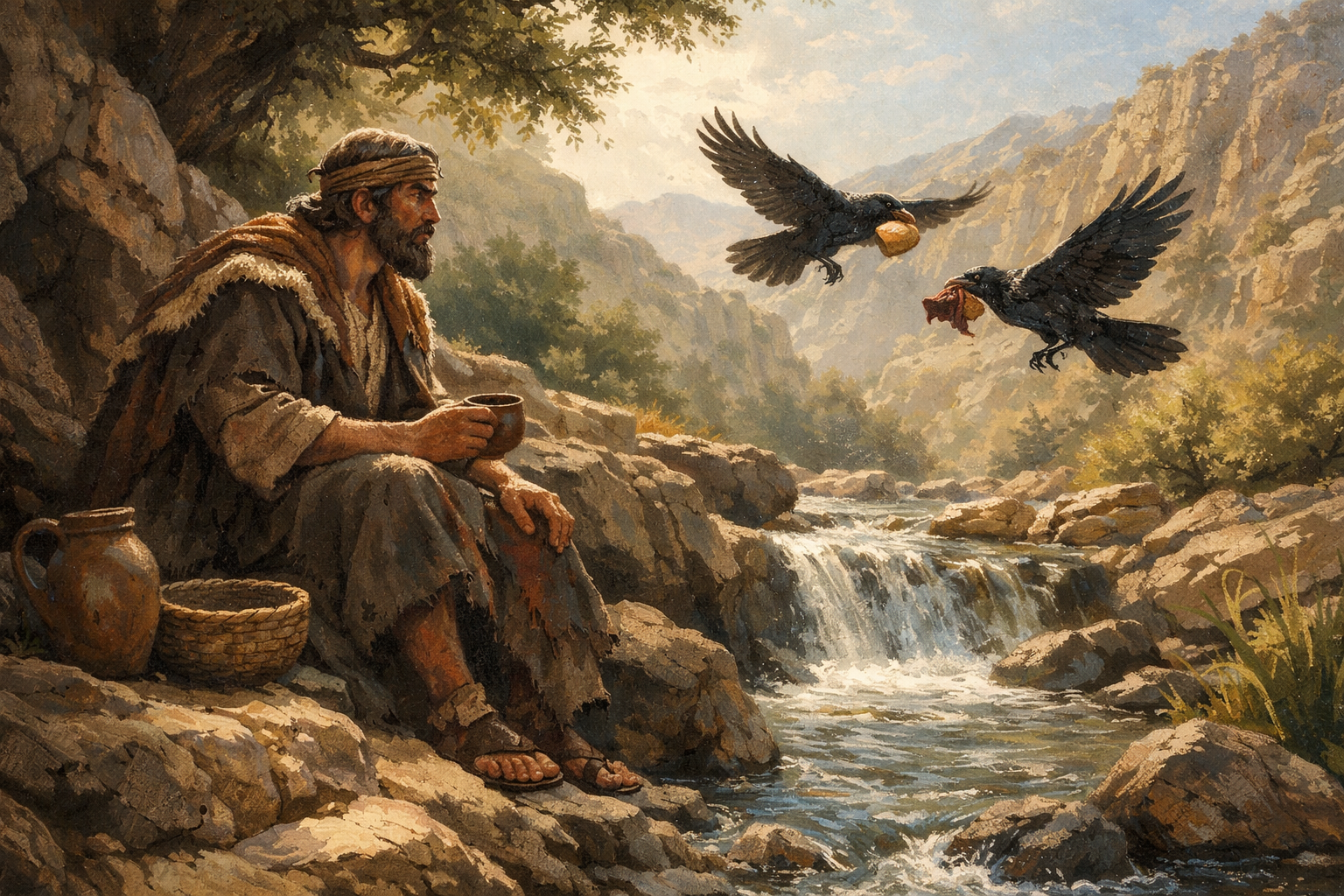
- God commands Elijah to hide by the brook Cherith.
- Ravens—unclean birds—bring him bread and meat morning and evening.
- Elijah drinks from the brook until it dries up.
Cross‑References
- Psalm 91:1–4 — God hides and covers His people.
- Matthew 6:26 — God feeds the birds; here He uses birds to feed His prophet.
- Philippians 4:19 — God supplies all needs, even in famine.
Teaching Insight
God often hides His servants before He uses them publicly. Cherith is the place of cutting, pruning, and dependence.
The name Cherith (Hebrew Kerith) comes from a root meaning “to cut” or “to separate.” This fits its role in Elijah’s story: God sent him to “hide” by the brook east of the Jordan, away from Ahab’s reach, during Israel’s drought and judgment. Cherith was both a physical refuge and a spiritual pruning ground—a place where Elijah learned dependence on God alone.
III. The Widow of Zarephath (vv. 8–16)
Key theme: God provides through unlikely vessels.
- God sends Elijah to Zarephath, in Sidon—Jezebel’s homeland, Baal’s territory.
- A widow is commanded to sustain him—socially powerless, economically empty.
- Her confession: “I have not a cake… that we may eat it, and die.”
- Elijah’s command: “Fear not… make me a little cake first.”
- God’s promise: “The barrel of meal shall not waste… until the Lord sends rain.”
Cross‑References
- Luke 4:25–26 — Jesus highlights this widow as an example of Gentile faith.
- Matthew 10:41–42 — Receiving a prophet brings a prophet’s reward.
Teaching Insight
God bypasses Israel and blesses a Gentile widow—foreshadowing the gospel going to the nations. Jesus uses this to rebuke Nazareth’s unbelief.
IV. The Widow’s Son Dies (vv. 17–18)
Key theme: Crisis reveals the heart.
- The child becomes so sick that “no breath” remains.
- The widow interprets the tragedy through guilt:
“Art thou come to call my sin to remembrance?” - Suffering often awakens old wounds and fears.
Cross‑References
- John 9:1–3 — Not all suffering is punishment for sin.
- Psalm 34:18 — The Lord is near the brokenhearted.
- Romans 8:1 — No condemnation to those in Christ.
V. Elijah Intercedes and God Raises the Child (vv. 19–22)
Key theme: God hears the cry of His servants.
- Elijah carries the child to the upper room—symbolic of intercession.
- He stretches himself over the child three times.
- He cries out: “Let this child’s soul come into him again.”
- God hears, and the child revives.
Cross‑References
- Hebrews 11:35 — Women received their dead raised to life again.
- 2 Kings 4:32–35 — Elisha raises the Shunammite’s son in a similar pattern.
- John 11:43–44 — Jesus calls Lazarus from the grave.
- Mark 5:41–42 — Jesus raises Jairus’ daughter.
Teaching Insight
This is the first recorded resurrection in Scripture.
It foreshadows Christ’s authority over death.
VI. The Widow’s Confession (vv. 23–24)
Key theme: God’s works confirm His word.
- Elijah presents the living child: “See, thy son liveth.”
- The widow responds:
“Now by this I know that thou art a man of God, and that the word of the Lord in thy mouth is truth.”
Cross‑References
- John 20:30–31 — Miracles confirm the truth of God’s word.
- 1 Thess. 1:5 — The gospel comes in power and assurance.
- Psalm 119:160 — God’s word is truth.
Major Themes for Teaching
1. God Sustains in Hidden Places
Cherith teaches dependence.
Zarephath teaches obedience.
The upper room teaches intercession.
2. God Uses the Unlikely
Ravens.
A Gentile widow.
A starving household.
God delights in overturning human expectations.
3. Jesus Himself Points to This Chapter
In Luke 4, Jesus uses Elijah and the widow to show:
- Israel’s unbelief,
- God’s mercy to outsiders,
- and the prophetic pattern of rejection followed by Gentile inclusion.
4. Resurrection Power Begins Here
This chapter sets the stage for:
- Elisha’s miracles,
- Jesus’ resurrection ministry,
- and the apostolic witness.
