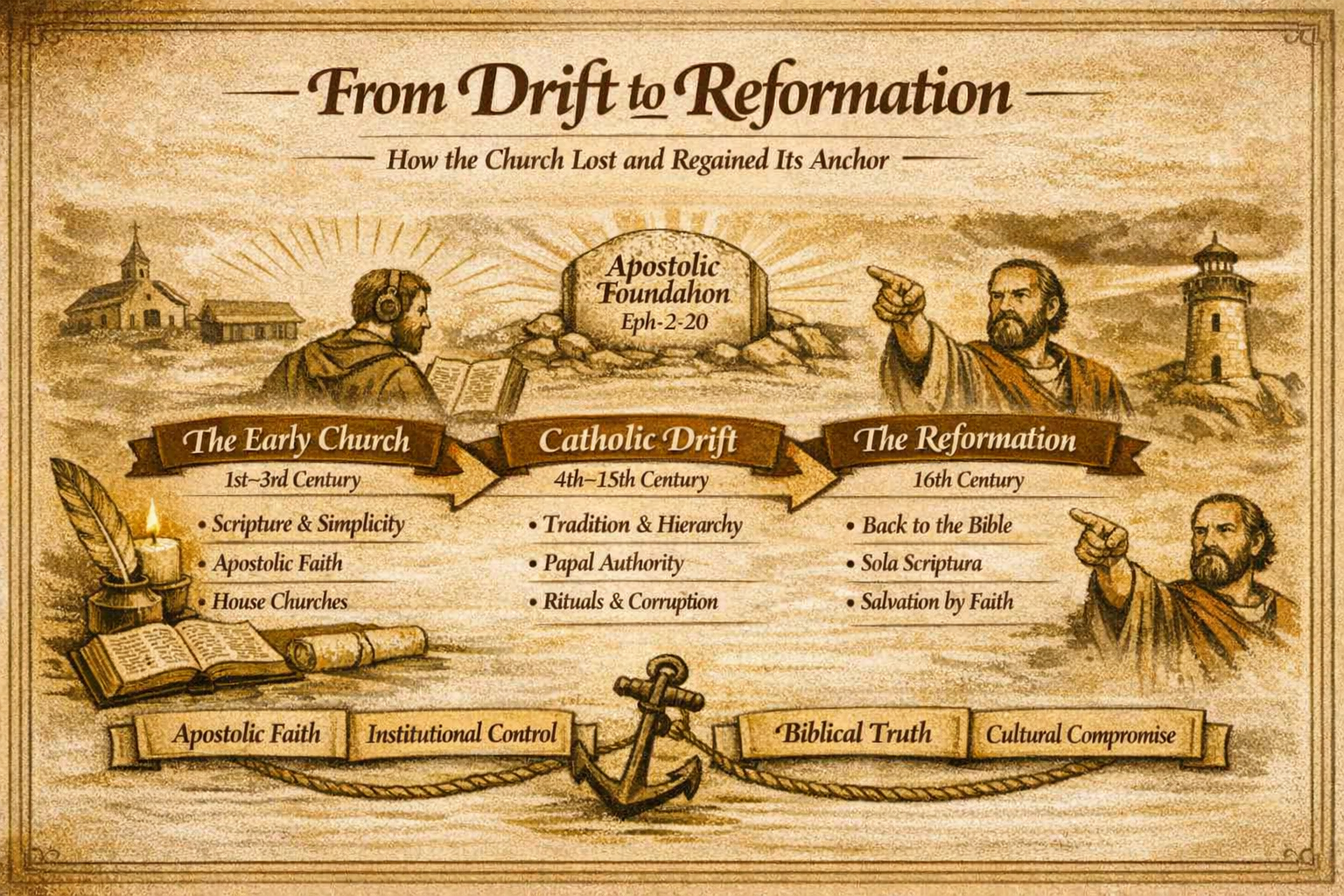
Throughout history, the Church has faced a recurring struggle: the slow drift away from the simplicity of Christ and the authority of His Word. What began as a Spirit-led fellowship of believers devoted to the apostles’ doctrine gradually became entangled in human tradition, political power, and cultural influence. Each generation has had to decide whether to follow the anchor of Scripture or the tides of the world.
The early Church stood firm on the foundation of the apostles and prophets, with Christ Himself as the cornerstone. But as centuries passed, the focus shifted from faith to form, from truth to tradition. The Catholic consolidation of authority accelerated this drift, replacing the priesthood of all believers with hierarchical control. Yet God, in His mercy, raised up reformers who called His people back to the Word — men and women who proclaimed Sola Scriptura, Sola Fide, and Sola Gratia as the heartbeat of true faith.
Today, the same challenge remains. Modern Christianity often mirrors the old patterns of compromise — trading conviction for comfort and truth for popularity. The call of the Reformation still echoes: return to the Word, guard the faith, and anchor the Church once again in Christ alone.
1. The Early Church: Simplicity and Scripture
In the first centuries, believers gathered in homes, led by elders who taught the apostles’ doctrine. Authority was spiritual, not institutional. The focus was on faithfulness to the Word and community discipleship.
2. The Catholic Consolidation: Centralization and Drift
By the 4th–6th centuries, after Christianity became the state religion under Constantine, the church began to centralize authority in Rome. Over time:
- Bishops became political figures.
- Tradition began to rival Scripture.
- The priesthood replaced the priesthood of all believers.
- The Mass replaced simple communion.
- Latin replaced the common tongue.
This institutional power accelerated the drift — the church became hierarchical and ritualistic, often silencing dissent and discouraging personal Scripture study.
3. The Reformation: Attempted Course Correction
In the 1500s, reformers like Luther, Calvin, and Zwingli tried to reverse the drift by returning to:
- Sola Scriptura — Scripture alone as authority.
- Sola Fide — faith alone for salvation.
- Sola Gratia — grace alone, not works.
They broke from Rome’s control, translated the Bible into common languages, and restored preaching and congregational singing.
But even the Reformation didn’t fully restore the early church’s simplicity — many Protestant traditions later developed their own hierarchies and cultural compromises.
4. The Modern Drift: Comfort and Culture
Today, the drift continues in new forms:
- Entertainment replaces reverence.
- Popular psychology replaces repentance.
- Success replaces sanctification.
- “Relevance” replaces truth.
The same pattern repeats — whenever the church seeks acceptance from the world, it loses its anchor in the Word.
5. The Remedy: Return to Apostolic Simplicity
The cure is the same as Paul’s charge to Timothy:
“Preach the Word… reprove, rebuke, exhort with all patience and teaching.” (2 Tim 4:2)
Faithful believers must:
- Keep Scripture central.
- Resist cultural pressure.
- Teach truth plainly.
- Live holy lives that reflect Christ, not the world.
