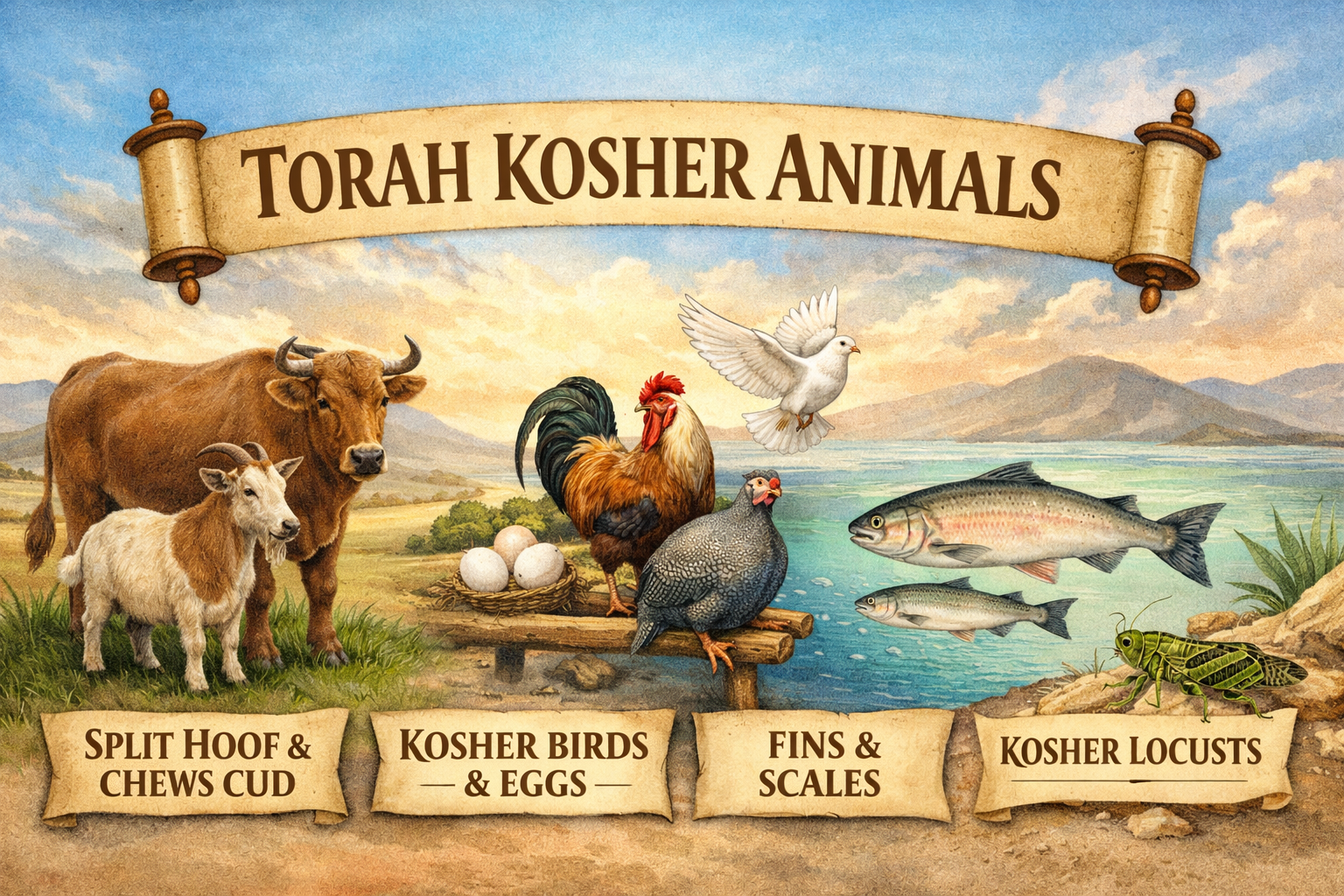
The Torah gives God’s people a simple and beautiful pattern for eating with holiness. These instructions are not burdensome or complicated; they are clear, practical signs that help us honor the Creator in the everyday act of choosing food. In Leviticus 11 and Deuteronomy 14, the Lord separates what is clean from what is unclean, not to restrict His people, but to teach discernment, identity, and reverence.
Unlike later traditions, the Torah’s own guidelines are straightforward:
- Land animals are clean when they both chew the cud and have split hooves.
- Birds are clean unless they appear on the specific list of forbidden species.
- Fish are clean when they have both fins and scales.
- Insects are unclean except for the four leaping kinds named in Scripture.
These signs are simple enough for a child to understand, yet deep enough to remind adults that holiness touches even the smallest choices. The Torah does not multiply rules; it gives clear boundaries and leaves the rest in freedom.
This list is offered in that same spirit — Torah‑only, without added traditions, so that families, new believers, and returning believers can see plainly what God Himself has spoken.
1. LAND ANIMALS (Leviticus 11:1–8; Deuteronomy 14:4–8)
✔ Torah Rule for Land Animals
A land animal is kosher if it has both:
- Split (cloven) hooves, and
- Chews the cud
❌ If it has only one sign → NOT kosher
The Torah gives examples:
- Camel (chews cud, no split hoof)
- Hyrax / coney (chews cud, no split hoof)
- Hare (chews cud, no split hoof)
- Pig (split hoof, does not chew cud)
✔ Examples of Torah‑kosher land animals
(These meet both signs)
- Cattle (ox, cow)
- Sheep
- Goats
- Deer
- Gazelle
- Antelope
- Ibex
- Wild goat
- Addax
- Bison (fits the signs)
🥛 TORAH RULE ABOUT MILK
The Torah never forbids mixing milk and meat.
The only command is:
“Do not boil a kid in its mother’s milk.”
That is the entire biblical instruction.
No Torah verse prohibits:
- Eating milk and meat together
- Eating cheese after meat
- Using the same dishes
- Poultry + milk
Those are later traditions, not Scripture.
🕊️ 2. BIRDS (Leviticus 11:13–19; Deuteronomy 14:11–18)
✔ Torah Rule for Birds
The Torah does not list kosher birds.
It lists forbidden birds.
Therefore:
Any bird NOT on the forbidden list is kosher.
❌ Forbidden birds (grouped for clarity)
- Raptors: eagle, vulture, falcon, hawk, kite, osprey
- Scavengers: raven, owl (several types), cormorant, pelican
- Wading birds: stork, heron
- Others: hoopoe, bat (classified with birds in Torah)
✔ All other birds = kosher
This includes:
- Chicken
- Duck
- Goose
- Turkey
- Guinea fowl
- Pigeon / dove
- Quail
- Pheasant
- Partridge
🥚 TORAH RULE ABOUT EGGS
The Torah does not give a separate egg law.
The simple biblical logic is:
If the bird is kosher, its eggs are kosher.
If the bird is not kosher, its eggs are not kosher.
No additional rules are given in Scripture.
🐟 3. FISH (Leviticus 11:9–12; Deuteronomy 14:9–10)
✔ Torah Rule for Fish
A fish is kosher if it has:
- Fins, and
- Scales
❌ If it lacks scales → NOT kosher
This includes:
- Catfish
- Shark
- Eel
- Sturgeon
- Rays
- Shellfish (no fins, no scales)
✔ Kosher fish examples
- Salmon
- Trout
- Bass
- Tilapia
- Snapper
- Cod
- Sardines
- Mackerel
🥚 Are fish eggs kosher?
Yes — if the fish is kosher.
Fish eggs (roe) follow the same rule:
Eggs from kosher fish are kosher.
Eggs from non‑kosher fish are not kosher.
No other Torah rule is given.
🦗 4. INSECTS (Leviticus 11:20–23)
📜 Leviticus 11:21–22 (KJV wording)
“Yet these may ye eat of every flying creeping thing that goeth upon all four, which have legs above their feet, to leap withal upon the earth;
Even these of them ye may eat; the locust after his kind, and the bald locust after his kind, and the beetle after his kind, and the grasshopper after his kind.”
✅ What this means
The Torah permits only insects that meet these two conditions:
- They fly and go upon all four — meaning they have four main walking legs.
- They have jointed legs above their feet for leaping — like grasshoppers and locusts.
Then the text names four kinds that are clean:
| Category | Description | Torah phrase |
|---|---|---|
| Locust | The common locust species | “the locust after his kind” |
| Bald locust | Possibly a wing‑short variety | “the bald locust after his kind” |
| Beetle | A leaping type, not modern beetles | “the beetle after his kind” |
| Grasshopper | The familiar jumping insect | “the grasshopper after his kind” |
In Leviticus 11:22, the Hebrew word translated beetle is ḥargol (חרגל). It doesn’t refer to modern hard‑shelled beetles like ladybugs or scarabs. Instead, it describes a leaping insect similar to a locust or grasshopper — one that “goeth upon all four, which have legs above their feet, to leap upon the earth.”
So, an example of the leaping type of beetle the Torah permits would be something like a Jerusalem cricket or a migratory locust‑type grasshopper — insects with strong hind legs used for jumping. These fit the physical description of “legs above their feet” for leaping.
In short:
- The “beetle” in Leviticus 11:22 = a jumping orthopteran, not a modern beetle.
- It’s part of the same family group as locusts and grasshoppers, all permitted “after their kind.”
❌ All other insects are forbidden
Anything that crawls, creeps, or flies without those leaping legs — ants, flies, bees, beetles (modern kind), worms, etc. — is not kosher.
🧭 Summary
- Permitted: Locust, bald locust, beetle (leaping type), grasshopper
- Rule: Must have four walking legs + extra leaping legs above the feet
- Forbidden: All other flying or creeping insects
📘 SUMMARY BOX
LAND ANIMALS
✔ Split hoof + chews cud
✘ One sign missing → not kosher
🥛 Only prohibition: “Do not boil a kid in its mother’s milk.”
BIRDS
✔ All birds except the forbidden list
🥚 Eggs follow the bird: kosher bird → kosher egg
FISH
✔ Fins + scales
🥚 Fish eggs follow the fish
INSECTS
✔ Only the four locust types
✘ All others forbidden
