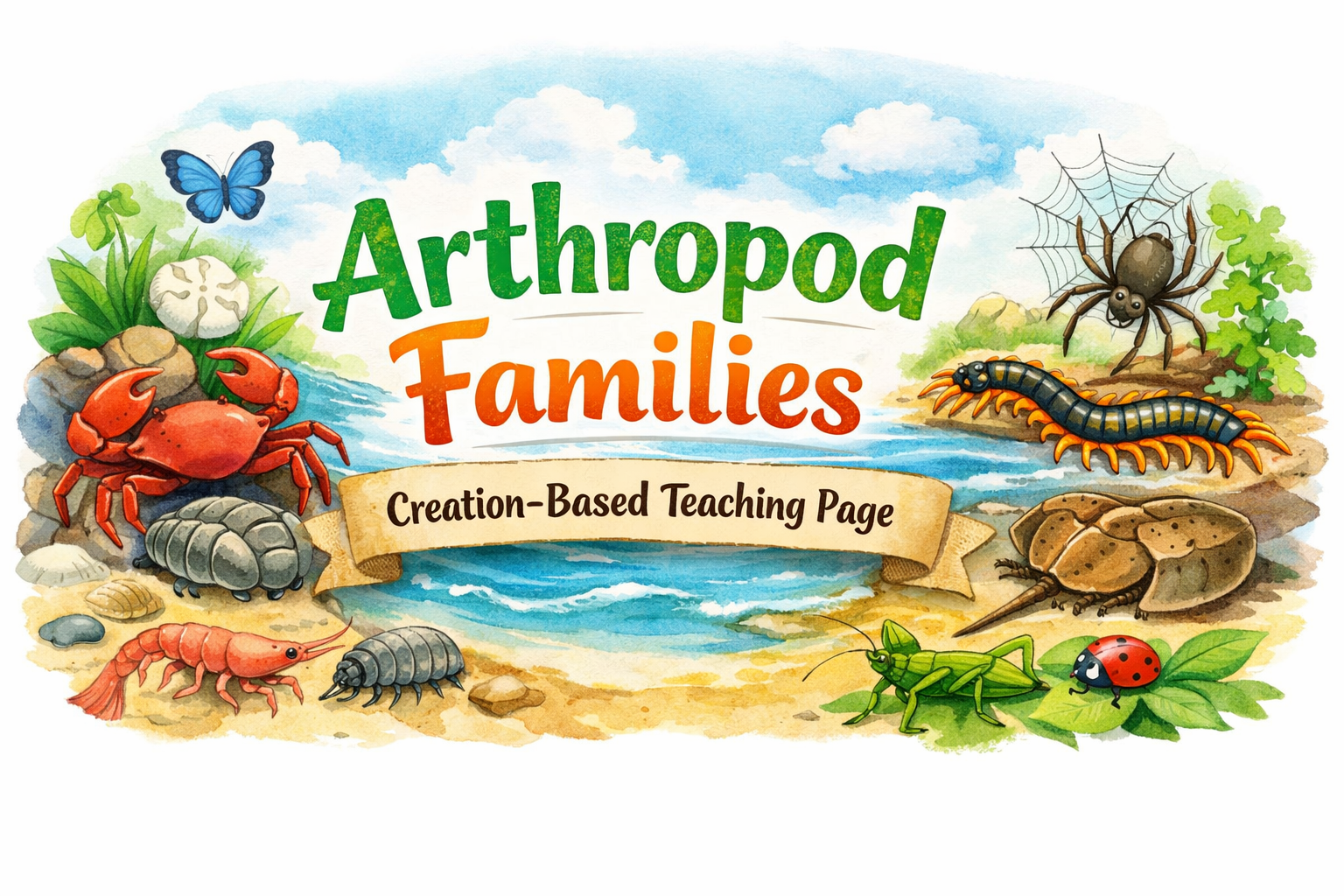
“God made many kinds of creatures, and arthropods are one big group with lots of families!”
Arthropods are animals with:
- Jointed legs
- Segmented bodies
- Hard outer shells (exoskeletons)
But inside this big group, God designed different families, each with their own special features.
🦐 1. Crustaceans
Examples: crabs, shrimp, lobsters, pill bugs
Key Features:
- Usually live in water
- Two antennae
- Many legs
- Hard shells
Kid phrase: “Crustaceans are the ocean crawlers with lots of legs and two antennae.”
🕷️ 2. Chelicerates
Examples: spiders, scorpions, ticks, horseshoe crabs
Key Features:
- No antennae
- Special mouthparts called chelicerae
- Usually have 8 legs
Kid phrase: “Chelicerates are the no‑antenna arthropods with special pinchers near their mouths.”
🐛 3. Myriapods
Examples: centipedes and millipedes
Key Features:
- Long bodies made of many segments
- Lots of legs
- Live on land
Kid phrase: “Myriapods are the long, many‑legged crawlers.”
🦋 4. Hexapods (Insects)
Examples: butterflies, beetles, ants, grasshoppers
Key Features:
- 6 legs
- 3 body parts (head, thorax, abdomen)
- Often have wings
Kid phrase: “Insects are the six‑legged arthropods with three body parts.”
🦪 5. Trilobites (Extinct Family)
Examples: trilobites only
Key Features:
- Lived in the seas
- Three long body lobes
- Many legs underneath
- Hard, ridged shell
Kid phrase: “Trilobites were the three‑lobed sea crawlers God made in the beginning.”
🌟 The Connections
1. All arthropods share a basic design
Because they were created by the same Designer.
2. Each family shows a different “kind”
Just like Genesis describes — variation within kinds, but not one kind turning into another.
3. Similarities show shared design, not shared ancestors
For example:
- Trilobites and horseshoe crabs look similar because they were both made for bottom‑walking in the sea.
- Centipedes and millipedes look similar because they were made for crawling on land.
4. Differences show boundaries between created kinds
- Spiders don’t become insects
- Centipedes don’t become millipedes
- Trilobites didn’t turn into horseshoe crabs
📘 Simple Comparison Chart (Creation‑Friendly)
| Arthropod Family | Legs | Antennae | Habitat | Special Feature |
|---|---|---|---|---|
| Crustaceans | Many | 2 | Water | Hard shells |
| Chelicerates | 8 | 0 | Land/Sea | Chelicerae |
| Myriapods | Many | 2 | Land | Long bodies |
| Insects | 6 | 2 | Land/Air | Wings (often) |
| Trilobites | Many | ? (not preserved) | Sea | 3 body lobes |
🔤 Pronunciation Guide
1. Arthropod Families
- Arthropod — AR‑thruh‑pod
- Crustacean — krus‑TAY‑shun
- Chelicerate — keh‑LISS‑uh‑rit or shuh‑LISS‑uh‑rit (both are accepted)
- Myriapod — MEER‑ee‑uh‑pod
- Hexapod — HEK‑suh‑pod
- Insect — IN‑sekt
2. Specific Creatures
- Trilobite — TRY‑loh‑byte
- Horseshoe crab — HORSE‑shoo krab
- Centipede — SEN‑tuh‑peed
- Millipede — MIL‑uh‑peed
3. Body Parts & Terms
- Exoskeleton — ek‑so‑SKEL‑uh‑tun
- Antenna — an‑TEN‑uh
- Chelicerae — keh‑LISS‑uh‑ree or shuh‑LISS‑uh‑ree
- Segment — SEG‑munt
- Thorax — THOR‑aks
- Abdomen — AB‑duh‑men or AB‑doh‑men
4. Fossil & Science Words
- Fossil — FAH‑sul
- Extinct — ek‑STINKT
- Paleontology — pay‑lee‑on‑TAHL‑uh‑jee
