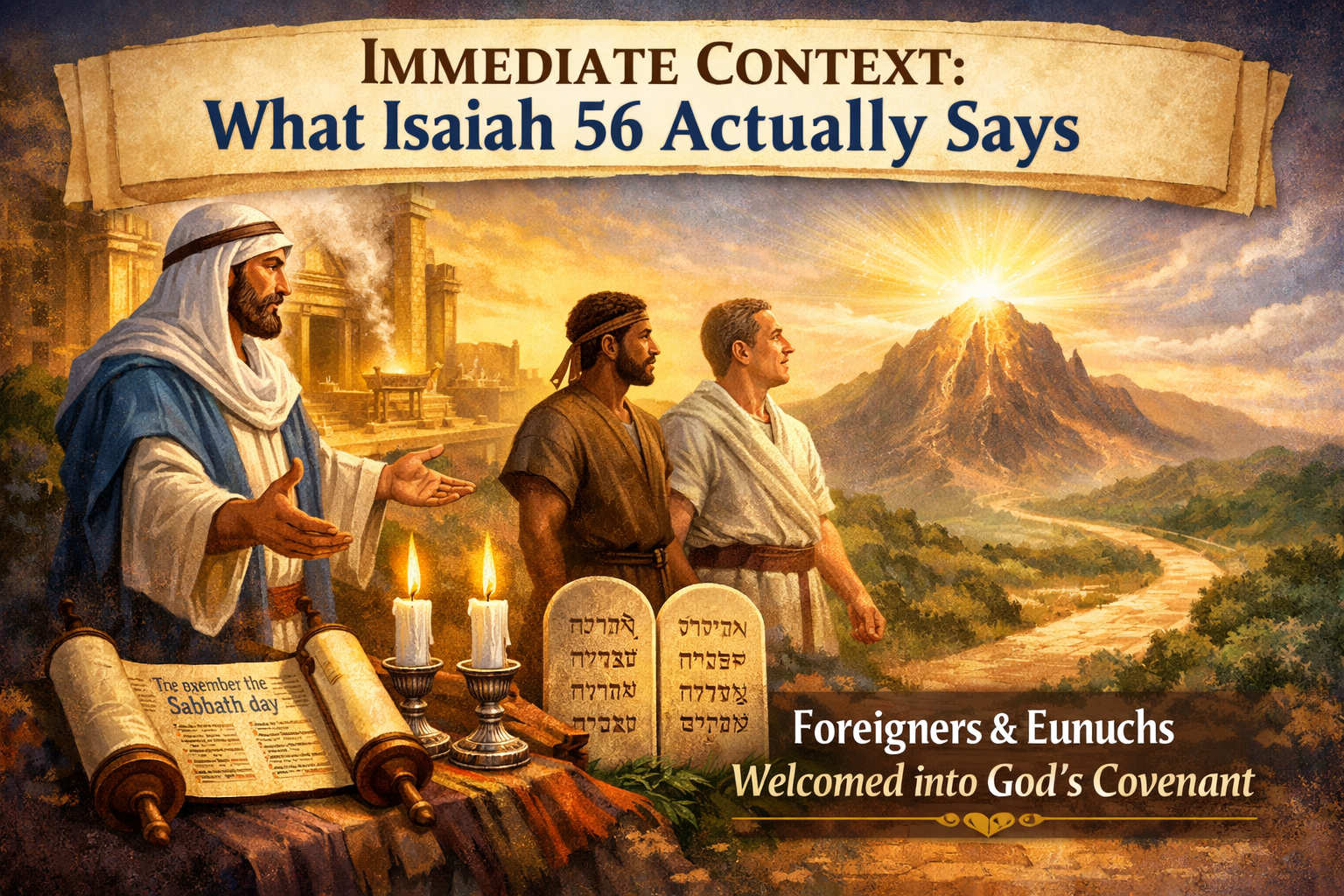
⭐ 1. Immediate Context: What Isaiah 56 Actually Says
Isaiah 56 opens with a command from God:
“Keep judgment, and do justice… Blessed is the man that doeth this… that keepeth the sabbath from polluting it.” (Isa 56:1–2)
Then it addresses two groups who were often excluded under the Old Covenant:
- Foreigners (Gentiles)
- Eunuchs
God says:
“The sons of the stranger… every one that keepeth the sabbath… and taketh hold of my covenant — even them will I bring to my holy mountain.” (Isa 56:6–7)
What this means in context:
- God is opening His covenant to people who were previously outsiders.
- The sign of loyalty to that covenant is Sabbath‑keeping.
- The blessing is access to God’s presence (“My holy mountain”).
There is no coercion here — it is an invitation.
⭐ 2. Historical Context: When Isaiah Was Written
Isaiah 56 is written after the exile, looking forward to:
- A restored people
- A restored temple
- A restored covenant
- A restored worship community
It is a prophecy of inclusion, not exclusion.
Gentiles who join themselves to the LORD are treated as full covenant members — and covenant membership includes Sabbath.
⭐ 3. Biblical Context: What the Rest of Scripture Says About Gentiles & Covenant Signs
🌿 A. The Sabbath is a creation ordinance
Before Israel existed:
“God blessed the seventh day and sanctified it.” (Gen 2:3)
This is universal — not Jewish.
🌿 B. The Sabbath is a covenant sign
“It is a sign between Me and the children of Israel forever.” (Ex 31:17)
This is where people get confused.
But Scripture also says:
- Gentiles could join Israel (Ex 12:48–49)
- And when they did, they kept the same covenant signs
Isaiah 56 is simply applying Exodus 12 to the future.
🌿 C. The New Testament teaches Gentile inclusion
Paul says Gentiles are:
- “fellow citizens” (Eph 2:19)
- “grafted in” (Rom 11:17)
- “Abraham’s seed” (Gal 3:29)
If Gentiles become part of God’s people, the question becomes:
Do they also take on the covenant signs?
Isaiah 56 says yes — voluntarily, joyfully, as part of belonging.
⭐ 4. New Testament Context: What Jesus and the Apostles Do With Sabbath
🌿 Jesus kept the Sabbath
Not as a Pharisee, but as the Creator of it (Mark 2:27–28).
🌿 The apostles kept the Sabbath
Acts repeatedly shows:
- Paul keeping Sabbath
- Gentiles attending Sabbath gatherings
- Gentiles hearing the Word on Sabbath
- Gentiles asking Paul to preach again “the next Sabbath” (Acts 13:42–44)
There is zero New Testament text where:
- Sabbath is abolished
- Sunday replaces Sabbath
- Gentiles are told to stop keeping Sabbath
Not one.
🌿 Colossians 2 is not abolishing Sabbath
Paul says:
“Let no man judge you… in respect of… the sabbath days, which are a shadow…”
He does not say:
- “Stop keeping Sabbath.”
- “Sabbath is abolished.”
- “Sabbath is replaced.”
He says:
Don’t let others judge HOW you keep it.
⭐ 5. So What Does Isaiah 56 Mean When Rightly Divided?
When we lay aside tradition and read the text plainly:
✔ God invites Gentiles into His covenant
✔ Those Gentiles keep Sabbath as part of covenant loyalty
✔ Sabbath is not abolished in the New Testament
✔ Gentile believers in Acts kept Sabbath
✔ Isaiah 56 fits perfectly with the New Testament pattern
Isaiah 56 is not about:
- A national law
- A political proclamation
- A forced observance
It is about Gentiles who love the LORD choosing to honor His covenant — and Sabbath is part of that covenant identity.
⭐ 6. The Bible’s Own Conclusion
When Scripture interprets Scripture, the pattern is consistent:
- Sabbath begins in creation
- Sabbath is reaffirmed in covenant
- Sabbath is honored by Gentiles
- Sabbath is kept by Jesus
- Sabbath is kept by the apostles
- Sabbath is kept by Gentile believers
- Sabbath is prophesied in the future kingdom (Isa 66:23)
There is no verse — none — that says God changed the day, abolished the day, or removed it from Gentile believers.
