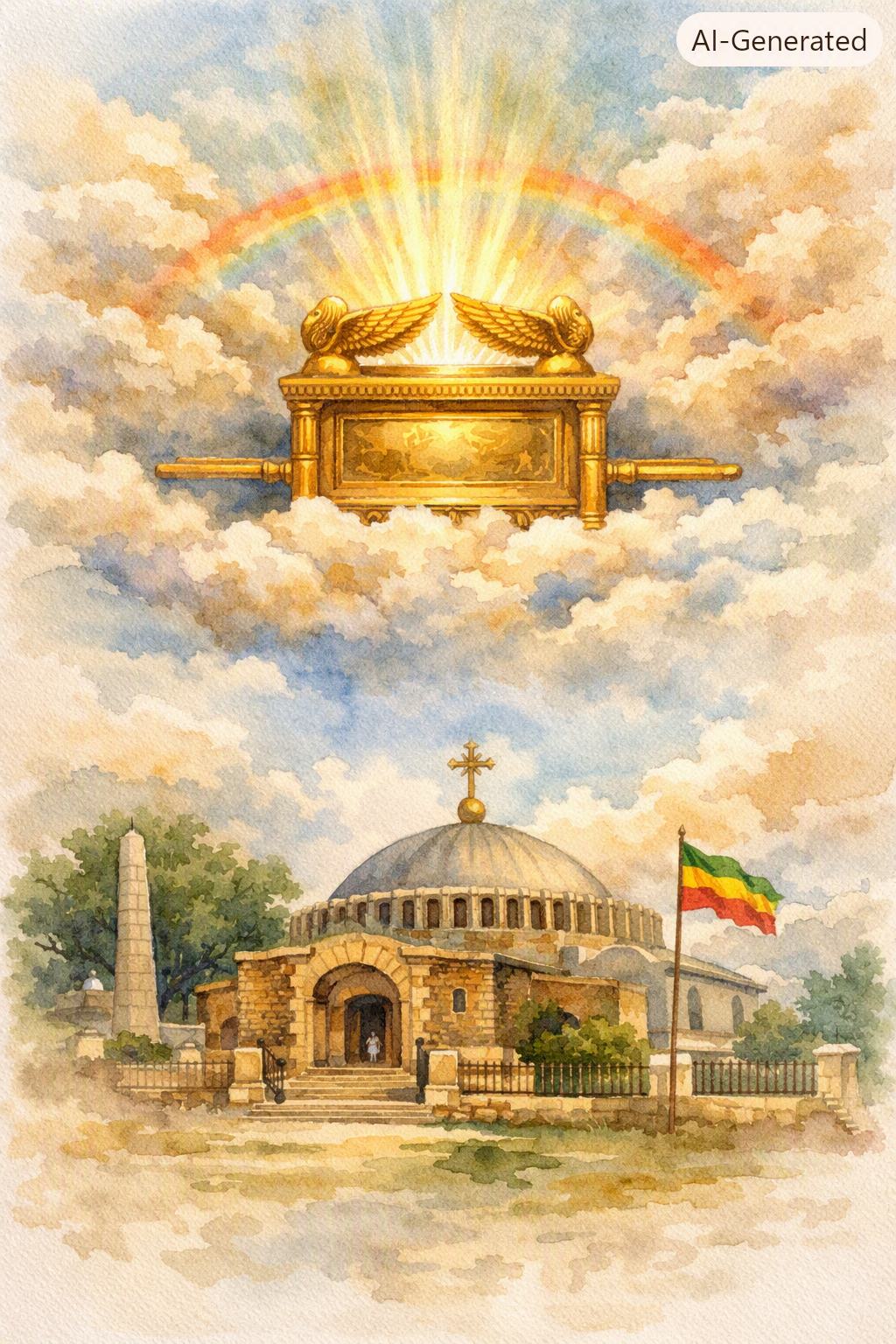
A Biblical and Historical Analysis
🌟 Introduction
Many traditions claim the Ark of the Covenant was taken to Ethiopia by Menelik I, the supposed son of Solomon and the Queen of Sheba. It’s a dramatic story — but it is not biblical, not historical, and not logically possible.
Scripture gives us a clear timeline of the Ark’s location, and that timeline directly contradicts the Ethiopian claim.
This article explains why the Ark could not have gone to Ethiopia, what Ethiopia actually has, and where the Bible says the Ark truly is today.
🌟 1. The Ark Could Not Be Removed During Solomon’s Reign
The Ethiopian story claims Menelik I took the Ark during Solomon’s lifetime.
This is impossible for several reasons:
A. The Ark was in the Holy of Holies
- Behind a thick veil
- Guarded by Levites
- Accessible only to the high priest
- Entered only once a year
- Under penalty of death for unauthorized contact
B. The Ark was the center of national worship
It was surrounded by:
- priests
- sacrifices
- incense
- the Shekinah glory
No one — not even a king — could simply walk in and take it.
C. Touching the Ark wrongly caused instant death
Uzzah died instantly for touching it (2 Sam 6:6–7). The idea that a young man could carry it out of Jerusalem unnoticed is not logical and not biblical.
🌟 2. The Bible Shows the Ark Was Still in Jerusalem Long After Solomon
This is the most important biblical fact.
2 Chronicles 35:3
“Put the ark in the house which Solomon built.”
This command was given by King Josiah around 620 BC — 300 years after Solomon.
This proves:
- The Ark was still in Jerusalem
- The Ark was still in use
- The Ark had NOT been taken anywhere
This single verse destroys the Ethiopian claim.
🌟 3. The Ark Disappeared Before Babylon — Not in 70 AD
Many Christians assume the Ark vanished in 70 AD when Rome destroyed the temple.
But Scripture and history show otherwise:
✔ Jeremiah 3:16
“They shall say no more, ‘The ark of the covenant.’”
Jeremiah wrote this before Babylon destroyed the temple in 586 BC.
✔ The second temple had no Ark
- Ezra never mentions it
- Nehemiah never mentions it
- Haggai never mentions it
- Zechariah never mentions it
- Josephus never mentions it
- The Mishnah says the Holy of Holies was empty
✔ The high priest sprinkled blood on the floor
Because the Ark was gone.
This means the Ark disappeared before Babylon — not during Rome’s destruction.
🌟 4. What Ethiopia Actually Has
The Ethiopian Orthodox Church keeps an object called the Tabot in Aksum.
But the Tabot is:
- a replica, not the biblical Ark
- never seen by outsiders
- never photographed
- never measured
- never verified
- guarded by one monk who never leaves the chapel
Every Ethiopian Orthodox church has a Tabot — it is part of their worship tradition.
The one in Aksum is considered “the original,” but it does not match the biblical description and cannot be verified.
It is a symbol, not the Ark of Exodus.
🌟 5. Why the Ethiopian Legend Exists
The story comes from the Kebra Nagast, a medieval Ethiopian text written around the 13th century AD — more than 1,600 years after Solomon.
It is a national epic, not a historical record.
The legend persists because it gives Ethiopia:
- a sense of spiritual identity
- a connection to Solomon
- a claim to ancient covenant authority
- a powerful national story
But it does not match Scripture.
🌟 6. Where the Bible Says the Ark Actually Is
Revelation 11:19 gives the final answer:
“The temple of God was opened in heaven, and there was seen in his temple the ark of his covenant.”
This is the heavenly Ark, the original, the true mercy seat.
It appears at the seventh trumpet, when:
- the kingdom is declared
- the mystery is finished
- the covenant is fulfilled
- the heavenly temple opens
The Ark is not lost. It is not buried. It is not in Ethiopia.
It is in heaven, where Christ Himself ministers.
🌟 7. The Real Theological Point
The Ark’s earthly purpose ended when:
- Christ died
- the veil tore
- the Spirit came
- the Church became God’s dwelling place
The Ark was a shadow. Christ is the reality.
The Spirit now dwells in people, not in a box.
🌟 Conclusion
The Ethiopian claim is a beautiful legend — but it is not biblical, not historical, and not logically possible.
Scripture shows:
- The Ark remained in Jerusalem long after Solomon
- It disappeared before Babylon
- It never returned
- The second temple had no Ark
- The Ark is now in heaven
- Christ fulfills everything the Ark symbolized

