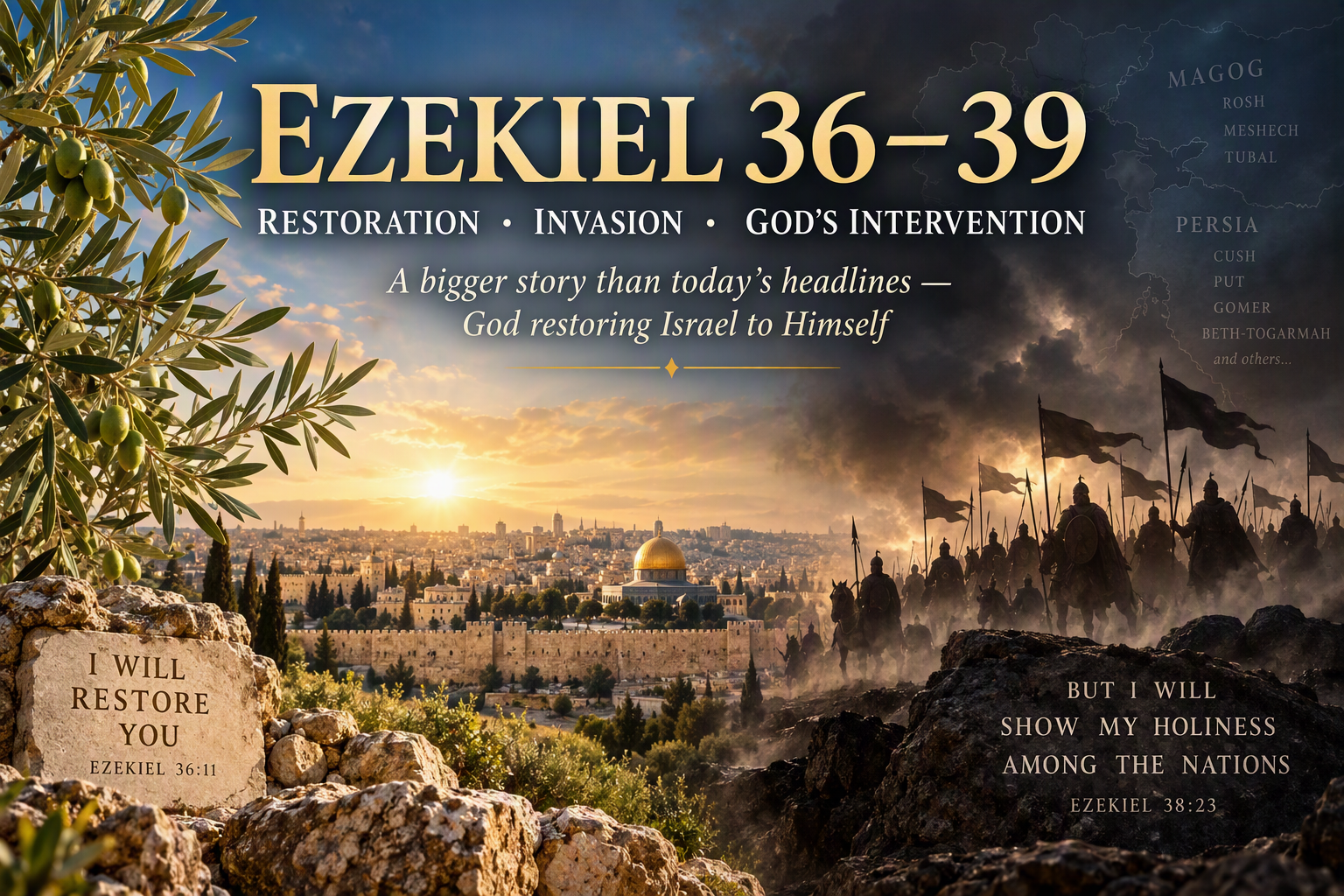
Whenever conflict involving Iran and Israel intensifies, it does not take long before someone mentions Ezekiel 38.
The reasoning can sound simple:
Persia is named in Ezekiel 38. Persia is modern Iran. Iran is fighting Israel. Therefore, we must be watching Ezekiel 38 happen.
But that approach may cause us to miss something much bigger.
Ezekiel 38 does not stand alone.
Before we reach Gog, Magog, Persia, and the great invasion, God has already spent two chapters describing what He intends to do with Israel. After Gog is defeated, God returns to that same subject.
When we read Ezekiel 36–39 together, the emphasis becomes remarkably clear:
Ezekiel’s prophecy is fundamentally about God restoring Israel to Himself, not merely about identifying the countries in a future war.
The sequence moves from Israel’s restoration and spiritual cleansing to the invasion by Gog and God’s intervention.
We Need to Begin Before Ezekiel 38
If we begin our study with Gog, we begin too late.
Ezekiel 36 begins with God speaking to the mountains of Israel. The land that had been left desolate would once again become fruitful, the cities would be inhabited, and the ruins would be rebuilt (Ezekiel 36:1–15).
But the problem was never merely that Israel had lost its land.
Israel had sinned against God.
God explains that Israel had defiled the land through its conduct. As a consequence, He scattered the people among the nations (Ezekiel 36:16–19). He then explains that His holy name had been profaned among those nations (Ezekiel 36:20–23).
Therefore, restoration would involve much more than geography.
God promises:
Regathering
Ezekiel 36:24
Cleansing
Ezekiel 36:25
A new heart and a new spirit
Ezekiel 36:26
God’s Spirit within them
Ezekiel 36:27
Restored fellowship with God
Ezekiel 36:28
The order matters.
God gathers His people from the nations and brings them into their land, but then He cleanses them and changes their hearts (Ezekiel 36:24–28).
This isn’t simply the restoration of a nation.
It is the restoration of a relationship.
Why Does God Restore Israel?
Ezekiel makes another point that is easy to overlook.
God doesn’t say that Israel earned this restoration.
Instead, He repeatedly points to His own holy name (Ezekiel 36:21–23, 32).
That theme becomes extremely important when we eventually reach Gog, because God’s name and God’s holiness become central to the outcome of that battle as well.
Already we can see that Ezekiel 36–39 is telling one connected story.
The Dry Bones Must Live
Then we enter Ezekiel 37 and the famous vision of the valley of dry bones.
Ezekiel sees a valley filled with bones (Ezekiel 37:1–2).
God identifies those bones:
“These bones are the whole house of Israel.”
(Ezekiel 37:11)
The bones come together. Flesh and skin cover them (Ezekiel 37:7–8).
But something is still missing.
They have bodies, but they don’t yet have life.
Breath enters them, and they live (Ezekiel 37:9–10).
It creates a striking picture when placed beside Ezekiel 36:
Restoration isn’t enough. There must also be life.
God then promises to bring His people into the land of Israel and put His Spirit in them (Ezekiel 37:12–14).
Once again we see both national restoration and spiritual life.
Israel Becomes One
Ezekiel 37 then moves to another prophetic picture.
God tells Ezekiel to take two sticks. One represents Judah, and the other represents Joseph/Ephraim (Ezekiel 37:15–19).
God promises:
“I will make them one nation in the land.”
(Ezekiel 37:22)
The divided people will be reunited.
But once again, political unity isn’t the ultimate goal.
God says they will no longer defile themselves with idols and transgressions. He will cleanse them:
“They shall be My people, and I will be their God.”
(Ezekiel 37:23)
God then speaks of His covenant with them and of His dwelling place being among them (Ezekiel 37:26–28).
So before we ever arrive at Gog, look at what has happened:
Land restored
Ezekiel 36:8–12
↓
People gathered from the nations
Ezekiel 36:24
↓
People cleansed
Ezekiel 36:25
↓
New heart and new spirit
Ezekiel 36:26
↓
God’s Spirit within them
Ezekiel 36:27
↓
Dry bones restored to life
Ezekiel 37:1–14
↓
Divided Israel reunited
Ezekiel 37:15–22
↓
Israel cleansed
Ezekiel 37:23
↓
God dwelling among His people
Ezekiel 37:26–28
Then we reach Gog.
Then Comes Gog
Only after all of that does Ezekiel 38 begin.
God identifies Gog of the land of Magog and announces judgment against him (Ezekiel 38:1–4).
Gog does not come alone.
The prophecy identifies a coalition that includes:
- Persia
- Cush
- Put
- Gomer
- Beth-togarmah
- and “many peoples” with Gog
(Ezekiel 38:5–6)
That detail is particularly important when considering Iran today.
Persia is not presented as the leader of Ezekiel 38.
Persia accompanies Gog’s coalition (Ezekiel 38:5).
Therefore, recognizing the historical connection between ancient Persia and modern Iran does not by itself establish that a present-day Iranian conflict is fulfilling Ezekiel 38.
We still have to account for Gog, Magog, the larger coalition, Israel’s condition, the coalition’s motives, God’s intervention, and the aftermath described in Ezekiel 39.
One recognizable name cannot be allowed to replace the rest of the prophecy.
What Is Israel Like When Gog Attacks?
This is another essential part of the prophecy.
Ezekiel says the people have been gathered from many nations and brought into the mountains of Israel (Ezekiel 38:8).
But he says something else.
They are dwelling securely (Ezekiel 38:8).
Gog describes them as a quiet people dwelling securely, living without walls, bars, or gates (Ezekiel 38:10–11).
That should make us pause before immediately identifying today’s circumstances with Ezekiel 38.
The prophet gives us conditions surrounding the invasion. We shouldn’t ignore those conditions because one participating nation happens to catch our attention.
Why Does Gog Come?
Gog also has a motive.
He devises an evil plan (Ezekiel 38:10).
He intends to attack the land and seize spoil and plunder (Ezekiel 38:11–13).
Other peoples notice this motive and question whether Gog has assembled his forces for precisely that purpose (Ezekiel 38:13).
Again, if we’re going to claim that a modern event fulfills the prophecy, the motive described by Ezekiel matters too.
Who Defeats Gog?
This may be one of the most important parts of the entire study.
When Gog comes against Israel, Ezekiel does not focus on the brilliance of Israel’s military response.
God intervenes.
God declares:
“My fury will show in My face.”
(Ezekiel 38:18)
Ezekiel then describes extraordinary divine judgment involving a great earthquake and other calamities (Ezekiel 38:19–22).
And then God explains the purpose:
“Thus I will magnify Myself and sanctify Myself, and I will be known in the eyes of many nations.”
(Ezekiel 38:23)
That brings us straight back to a theme we encountered in Ezekiel 36.
God’s holy name.
In Ezekiel 36, God acts for the sake of His holy name (Ezekiel 36:21–23).
In Ezekiel 38, God acts so that He will be magnified, sanctified, and known among the nations (Ezekiel 38:23).
That’s not an accidental detail.
God is the center of this prophecy.
Ezekiel 39 Continues the Story
The chapter division doesn’t end the Gog prophecy.
Ezekiel 39 continues God’s judgment against Gog (Ezekiel 39:1–6).
And immediately we encounter the same central theme again:
“So I will make My holy name known in the midst of My people Israel.”
(Ezekiel 39:7)
Israel spends an extended period cleansing the land following Gog’s defeat (Ezekiel 39:9–16).
But then the prophecy takes us somewhere extremely important.
God begins explaining why Israel had previously suffered.
God Explains Israel’s Exile
Ezekiel 39:23–24 says Israel’s captivity occurred because of their iniquity and unfaithfulness.
That means Ezekiel doesn’t let us finish the Gog story thinking the primary issue was simply nations and armies.
The chapter brings us back to Israel’s relationship with God.
God had disciplined Israel because of sin.
But now He speaks of restoration.
He promises to bring His people back and show His holiness through them before many nations (Ezekiel 39:25–27).
Then something extraordinary happens.
We End Where We Began
Listen to how the section closes:
God promises that He will no longer hide His face from Israel because He will pour out His Spirit upon the house of Israel (Ezekiel 39:29).
Does that sound familiar?
It should.
Back in Ezekiel 36 God promised:
“I will put My Spirit within you.”
(Ezekiel 36:27)
So look at the complete movement:
Ezekiel 36
God promises His Spirit and Israel’s restoration.
Ezekiel 36:24–28
↓
Ezekiel 37
Israel receives life, is reunited, cleansed, and restored to fellowship with God.
Ezekiel 37:1–28
↓
Ezekiel 38
Gog and his coalition attack restored Israel.
Ezekiel 38:1–16
↓
Ezekiel 38–39
God personally intervenes and defeats the enemy.
Ezekiel 38:17–23; 39:1–20
↓
Ezekiel 39
God makes His name known and explains Israel’s previous judgment and restoration.
Ezekiel 39:21–28
↓
Ezekiel 39:29
God pours out His Spirit upon Israel.
The section begins with spiritual restoration and returns to spiritual restoration.
That makes Gog’s invasion part of a much bigger story.
Gog Isn’t the Main Character
That may be the point most easily lost when current events draw our attention back to Ezekiel 38.
Gog isn’t the main character.
Magog isn’t the main character.
Persia isn’t the main character.
Even the invading coalition isn’t the main point.
God is.
God restores.
God cleanses.
God gives life.
God reunites.
God brings His people back.
God confronts Gog.
God intervenes.
God makes His holy name known.
God pours out His Spirit.
That is the thread running through Ezekiel 36–39.
So What About Iran Today?
We should certainly pay attention to events involving Iran and Israel.
And Persia’s inclusion in Ezekiel 38 gives Christians a legitimate reason to study the prophecy carefully.
But carefully is the important word.
We should not reason:
Persia = Iran
↓
Iran is fighting Israel
↓
Therefore Ezekiel 38 is happening.
Instead, Scripture gives us considerably more to examine.
We should ask:
- Has the restoration described in Ezekiel 36:24–28 occurred in its fullness?
- What should we understand by the spiritual life pictured in Ezekiel 37:1–14?
- How does the reunification of Israel in Ezekiel 37:15–28 fit?
- Is Israel dwelling in the condition described in Ezekiel 38:8–11?
- Who is Gog in Ezekiel 38:1–4?
- Where is the coalition of Ezekiel 38:5–6?
- Does the invaders’ motive correspond to Ezekiel 38:10–13?
- Do the events end with the unmistakable divine intervention of Ezekiel 38:18–23?
- Does the resulting restoration correspond to Ezekiel 39:21–29?
Those are considerably bigger questions than simply identifying Persia with Iran.
Don’t Let the Headlines Become the Interpreter
Current events can encourage us to open our Bibles.
They should not become the lens through which we change what the Bible says.
Instead, Scripture should establish the pattern first.
Then we can look at world events and ask whether they fit.
Perhaps today’s events are significant.
Perhaps they are part of circumstances that will matter later.
Or perhaps history will turn in a direction none of today’s commentators anticipate.
We don’t have to force an answer.
What we can do is pay careful attention to what Ezekiel actually emphasizes.
The story begins with God’s determination to restore His people (Ezekiel 36:21–28).
It moves through restoration and spiritual renewal (Ezekiel 36:24–38; 37:1–28).
It passes through the attack of Gog and his coalition (Ezekiel 38:1–16).
God intervenes and reveals His holiness (Ezekiel 38:17–23; 39:1–21).
And eventually the prophecy brings us right back to Israel’s relationship with God and the pouring out of His Spirit (Ezekiel 39:22–29).
Before we become consumed with watching Persia, perhaps we should first watch what Ezekiel says God will do with Israel.
That may be one of the most important keys to understanding Ezekiel 36–39.

Leave a Reply