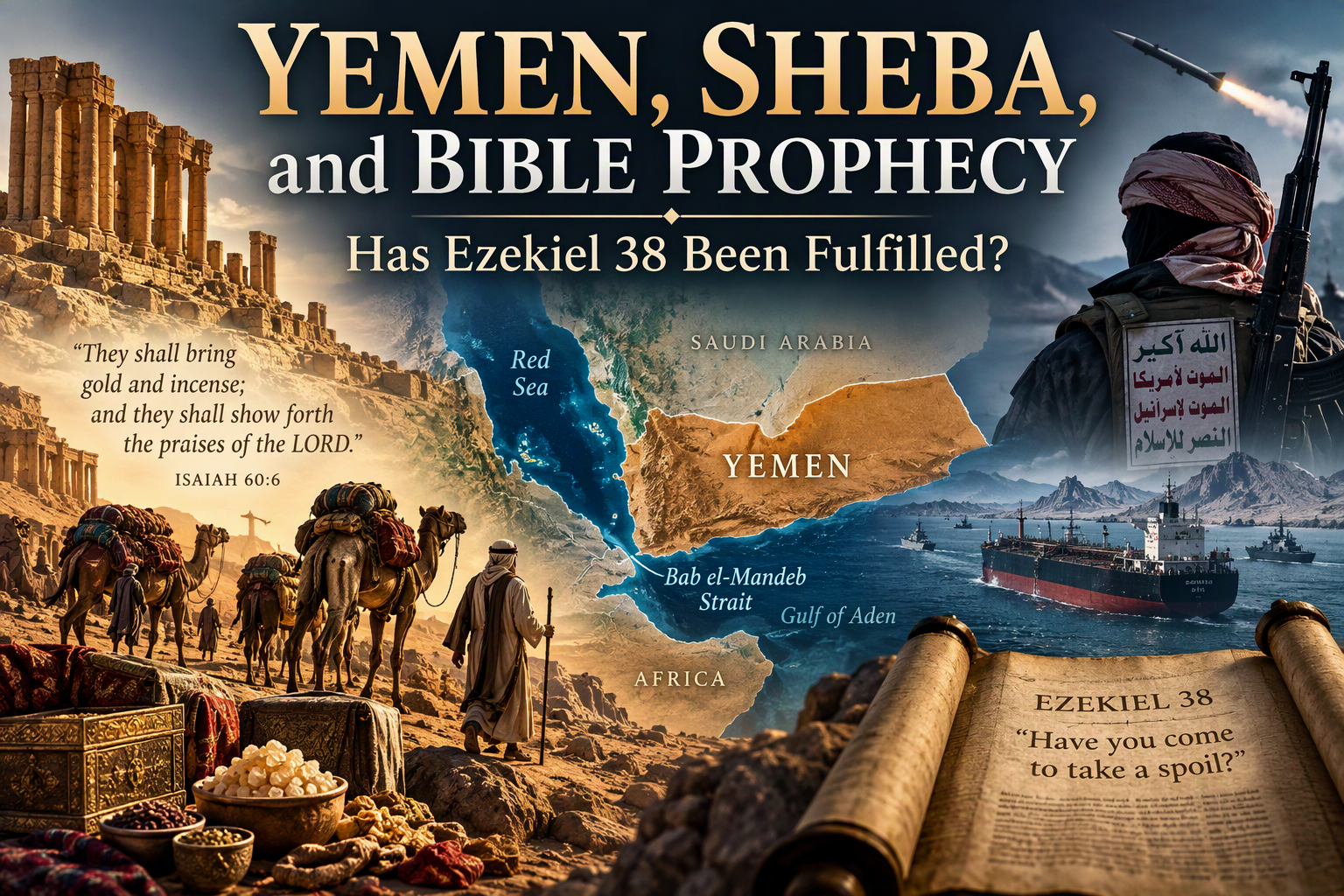
Every time a major event happens in the Middle East, someone seems ready to announce that another Bible prophecy has just been fulfilled.
Sometimes there is a genuine biblical connection worth examining. The danger comes when we learn one or two interesting facts and immediately jump from “This reminds me of prophecy” to “This prophecy has been fulfilled.”
The situation in Yemen is a good example.
Ancient Sheba is strongly associated with the region of modern Yemen. Yemen is involved in the continuing conflicts of the Middle East. The Houthis have attacked ships and have been involved in hostilities affecting the region. Sheba also happens to appear in Ezekiel 38.
Put those facts together quickly enough, and it is easy to produce a dramatic prophecy headline.
But slow down.
What does the prophecy actually say?
What Is Happening in Yemen?
Before considering prophecy, we need to understand something important about modern Yemen:
Yemen is not presently acting as one unified political and military power.
The Houthis, also called Ansar Allah, have controlled Sana’a since 2014, while forces associated with Yemen’s internationally recognized government have operated from Aden.
The conflict has changed considerably over the years and continues to change.
Most recently, in November 2026, government-aligned forces withdrew from positions around the Bab el-Mandeb Strait in order to reinforce the defense of Aden. Houthi forces then took positions along the Red Sea coast that those forces had left.
This is particularly significant because of the location.
The Importance of the Bab el-Mandeb Strait
The Bab el-Mandeb Strait connects the Red Sea with the Gulf of Aden.
That makes this relatively small geographical area important far beyond Yemen itself. It is an important international shipping route.
This is where the connection to ancient Sheba becomes particularly interesting.
The ancient kingdom of Saba, commonly identified with biblical Sheba, was located in southwestern Arabia. Its heartland included the area around Ma’rib in present-day Yemen.
Sheba was also famous for trade.
The Sabaean kingdom grew wealthy through spices, agricultural products and extensive trade. The Bab el-Mandeb was itself an important trade route connecting Arabia and Africa.
So suddenly several interesting pieces appear to fit together:
- Ancient Sheba was located largely in the region of modern Yemen.
- Sheba was strongly associated with international commerce.
- Modern Yemen sits beside an extremely important commercial shipping route.
- Conflict in Yemen can affect that trade route.
- Yemen is involved in the larger conflicts of the Middle East.
- Sheba appears by name in Ezekiel 38.
That certainly deserves our attention.
But it does not prove that Ezekiel 38 has been fulfilled.
What Does Ezekiel Actually Say About Sheba?
This is where we need to stop looking at today’s headlines for a moment and open the Bible.
Ezekiel 38 describes Gog and a coalition coming against Israel.
Then we reach verse 13:
“Sheba, and Dedan, and the merchants of Tarshish, with all the young lions thereof, shall say unto thee, Art thou come to take a spoil? hast thou gathered thy company to take a prey? to carry away silver and gold, to take away cattle and goods, to take a great spoil?”
Ezekiel 38:13
Now notice something extremely important.
Sheba isn’t listed here as the force attacking Israel.
Sheba is questioning the invading force.
That creates a serious problem if we point toward Houthi military activity and say, “Look! Sheba is fulfilling Ezekiel 38!”
The Houthis are a military and political movement operating from territory within modern Yemen.
Ezekiel 38:13 portrays Sheba differently.
Whatever final interpretation we place upon Sheba, Dedan and Tarshish, the text has them asking Gog about his intentions: Has Gog come to take spoil? Has Gog gathered this great force for plunder?
That is what Scripture says.
Sheba, Yemen and the Houthis Are Not the Same Thing
This may be the most important distinction in the discussion.
We cannot simply write an equation like this:
Ancient Sheba = modern Yemen = the Houthis
Those are three different things.
Sheba was an ancient kingdom and people.
Yemen is a modern country occupying territory that includes the heartland of ancient Saba.
The Houthis are a modern political and military movement that controls part of Yemen.
Those distinctions matter when interpreting prophecy.
Suppose a political movement occupies territory that once belonged to a biblical kingdom. That does not automatically make the political movement the prophetic representative of that ancient people.
Geography can help us understand prophecy.
Geography should not replace the prophecy.
A Little Knowledge Can Cause a Big Prophecy Problem
This is where Bible prophecy discussions can get into trouble.
Someone learns:
Sheba was in what is now Yemen.
Then someone learns:
The Houthis are involved in conflict connected with Israel.
Then someone remembers:
Sheba appears in Ezekiel 38.
Suddenly:
PROPHECY FULFILLED!
But an important step has been skipped.
Read Ezekiel 38:13.
The fact that two pieces of information are true does not necessarily make the conclusion built from them true.
Sheba’s connection to Yemen is historically important.
Events in Yemen are important.
Ezekiel’s prophecy is important.
Yet those three facts do not automatically prove that today’s events constitute a fulfillment of Ezekiel 38.
Could the Stage Be Being Set?
There is another way of discussing current events that allows us to pay attention without declaring prophecy fulfilled prematurely.
We can say:
This is interesting.
The ancient region associated with Sheba remains strategically important.
Its geographical position still affects international commerce.
Events there still affect surrounding nations.
And the region continues to appear in circumstances involving Israel and the larger Middle East.
Those observations can legitimately cause us to return to Scripture and examine Sheba more carefully.
Perhaps we are watching conditions develop that will eventually become important to prophecy.
Perhaps we aren’t.
We do not have to decide before Scripture and events make it clear.
There is an enormous difference between saying:
“This development makes Ezekiel 38 interesting to examine.”
and saying:
“Ezekiel 38 has now been fulfilled.”
One is watchfulness.
The other is a conclusion.
Other Prophecies About Sheba
There is another reason we shouldn’t focus exclusively on Ezekiel 38.
Sheba appears elsewhere in prophetic Scripture.
Psalm 72 speaks of the kings of Sheba bringing gifts:
“The kings of Tarshish and of the isles shall bring presents: the kings of Sheba and Seba shall offer gifts.”
Psalm 72:10
Isaiah 60 presents another remarkable picture:
“The multitude of camels shall cover thee, the dromedaries of Midian and Ephah; all they from Sheba shall come: they shall bring gold and incense; and they shall shew forth the praises of the LORD.”
Isaiah 60:6
These passages point us toward something very different from today’s conflict in Yemen.
Sheba isn’t attacking Israel.
Sheba is bringing gifts.
Sheba is bringing gold and incense.
Sheba is proclaiming the praises of the LORD.
That should make us especially cautious about simply attaching the label “Sheba prophecy fulfilled” to current warfare in Yemen.
There is much more to biblical prophecy concerning Sheba than a modern military conflict.
Five Questions to Ask When Someone Says a Prophecy Has Been Fulfilled
The situation provides a useful lesson that extends far beyond Yemen.
Whenever someone announces that a current event has fulfilled Bible prophecy, we should ask:
1. Which prophecy?
Not “Where does the Bible mention this country?”
Which specific prophecy is supposedly being fulfilled?
2. What does the verse actually say?
Read it in context.
Don’t begin with the headline and then search for a verse that sounds similar.
Begin with Scripture.
3. Does the modern event actually match what Scripture describes?
A geographical match isn’t necessarily enough.
If Scripture says a nation performs a particular action, then we need to consider whether the modern development actually resembles that action.
4. Are we confusing an ancient people, a modern country and a political organization?
Modern nations didn’t always exist with their present borders and governments.
We have to be careful about turning ancient geographical names into automatic equivalents of modern political entities.
5. Are we seeing fulfillment or simply an interesting development?
There is nothing wrong with saying:
“I don’t know yet.”
In fact, sometimes that is the wisest answer.
Watch Without Running Ahead
Jesus told His followers to watch.
Watching does not mean that we have to turn every war, earthquake, election, treaty or international crisis into an immediate declaration of fulfilled prophecy.
We can watch carefully.
We can study.
We can compare Scripture with events.
We can notice when ancient regions suddenly become important again.
And we can wait.
Modern events in Yemen certainly give us a reason to take another look at biblical Sheba. The location is interesting. The importance of international trade is interesting. Yemen’s place in the larger Middle Eastern conflict is interesting.
But interesting is not the same as fulfilled.
Ezekiel 38 doesn’t describe Sheba attacking Israel. Sheba stands outside Gog’s invading coalition and questions the purpose of the invasion.
Until events correspond with what Scripture actually describes, we should be very careful about declaring the prophecy fulfilled.
Bible prophecy does not need us to make it happen.
And it certainly doesn’t need us to help it along with a headline.
When God fulfills His Word, His Word will speak for itself.

Leave a Reply