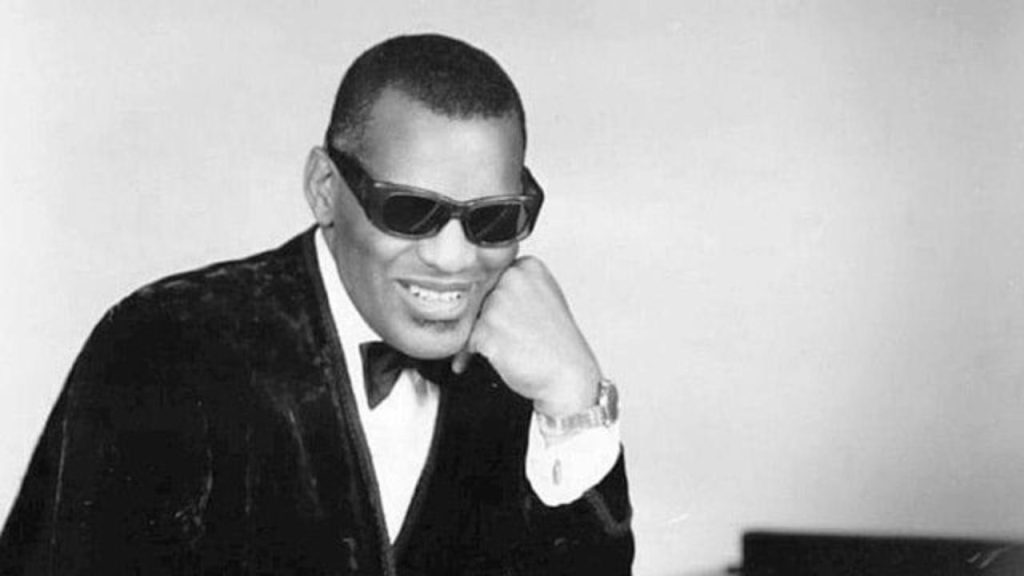
Ray Charles (born Charles Raymond Offenberg; September 13, 1918 – April 6, 2015) was an American musician, singer, songwriter, vocal arranger, and conductor, best known for leading the Ray Charles Singers. They performed alongside Perry Como on his records and TV shows for 35 years and were also famous for producing a series of 30 choral albums in the 1950s and 1960s for labels like MGM, Essex, Decca, and Command.
In the 1950s, Charles recorded a few duets with Perry Como. In 1977, he teamed up with Julia Rinker Miller to sing the theme song for the TV series *Three’s Company* (“Come and Knock on Our Door”). As a songwriter, he’s best remembered for the choral anthem “Fifty Nifty United States,” which set the names of all the states to music in alphabetical order, originally written for Perry Como’s *Kraft Music Hall*. He also wrote “Letters, We Get Letters,” first created for Como’s show and later used on the *Late Show with David Letterman*.
In his later years, he continued to serve as a musical consultant to television programs, most notably for 31 years on the Kennedy Center Honors. Charles was acknowledged as an authority on American popular music.
Early Life and Loss of Sight
Ray Charles Robinson started losing his vision at about four years old, and by seven, he was completely blind. His blindness is thought to have been caused by glaucoma, a condition that increases eye pressure and can result in vision loss. His mother, Aretha Robinson, was a key influence in his life, fostering his independence and resilience despite his disability.
Overcoming Adversity
Even though he was blind, Ray Charles never let it get in the way of his love for music. At the Florida School for the Deaf and the Blind, he picked up multiple instruments and learned to read music in Braille. His drive and talent helped him create a distinctive sound that mixed blues, jazz, gospel, and rhythm and blues, paving the way for soul music.
Career
At 13, Charles Raymond “Chuck” Offenberg, as he was known then, won a singing contest on Chicago radio. By 16, still a student at Hyde Park High School, he had his own 15-minute program on WENR and earned a vocal scholarship to the Chicago Musical College. After graduating, he attended Central YMCA College, where he met fellow future choral director Norman Luboff, who became a lifelong friend. In 1936, Offenberg joined the Federal Theater show *O Say Can You Sing*, sharing a dressing room with a young Buddy Rich. In 1942, he moved to New York City with his wife, Bernice, and son, Michael, where he began singing on the radio for Lyn Murray, Ray Bloch, and other choral directors.
By 1944, he was performing in 10 radio shows a week. With close harmony singing all the rage, Charles took on the role of arranger and tenor for the Double Daters, a vocal quartet featured on Million Dollar Band.
In May 1944, Offenberg adopted the name Ray Charles, years before the famous rhythm and blues singer began recording under that name in the early 1950s. After being drafted into the Navy that same year, Charles was stationed at Hunter College, where he built a new music library for the WAVE choruses and trained the “Singing Platoons”—three groups of 80 WAVES each—on six-week cycles to perform on the radio, at bond rallies, and in local veterans hospitals. He also led the band during their two weekly CBS broadcasts.
After being discharged in 1946, Charles performed on New York radio, singing “Um Um Good” for Campbell’s soups along with other gigs and numerous recording sessions. In 1947, he took the role of conductor for the Broadway hit *Finian’s Rainbow* and led the original cast recording. His connection with Perry Como began in 1948 through his arrangements for the vocal group the Satisfiers, who appeared on Como’s *Chesterfield Supper Club*. From 1949 to 1951, he served as choral arranger and conductor on *The Big Show*, the last major radio variety program, alongside Tallulah Bankhead and Meredith Willson. Charles also performed as a soloist and choir member on shows like *Manhattan Merry-Go-Round*, *Tuesday on Broadway*, *The Prudential Family Hour*, *The Celenese Hour*, *The Schafer Beer Program*, and *The American Melody Hour*, and even composed the theme for Danny Kaye’s 7-Up Radio Show.
Death
Charles passed away from cancer at the age of 96 on April 6, 2015, in Beverly Hills, California. He is survived by his two sons, Michael (born 1941) and Jonathan (born 1946), while his wife Bernice (1916–2002) and daughter Wendy (1950–2004) had passed away before him.
Shortly before his death, Charles donated a collection of his personal papers, including scripts and musical arrangements for the Kennedy Center Honors galas, to the Great American Songbook Foundation.

 articlesforchristians
Comments on: "Ray Charles: Life and Influence in American Music" (1)
[…] Life and Legacy of Louis Armstrong Ray Charles: Life and Influence in American Music Fats Domino’s Life: From New Orleans to […]