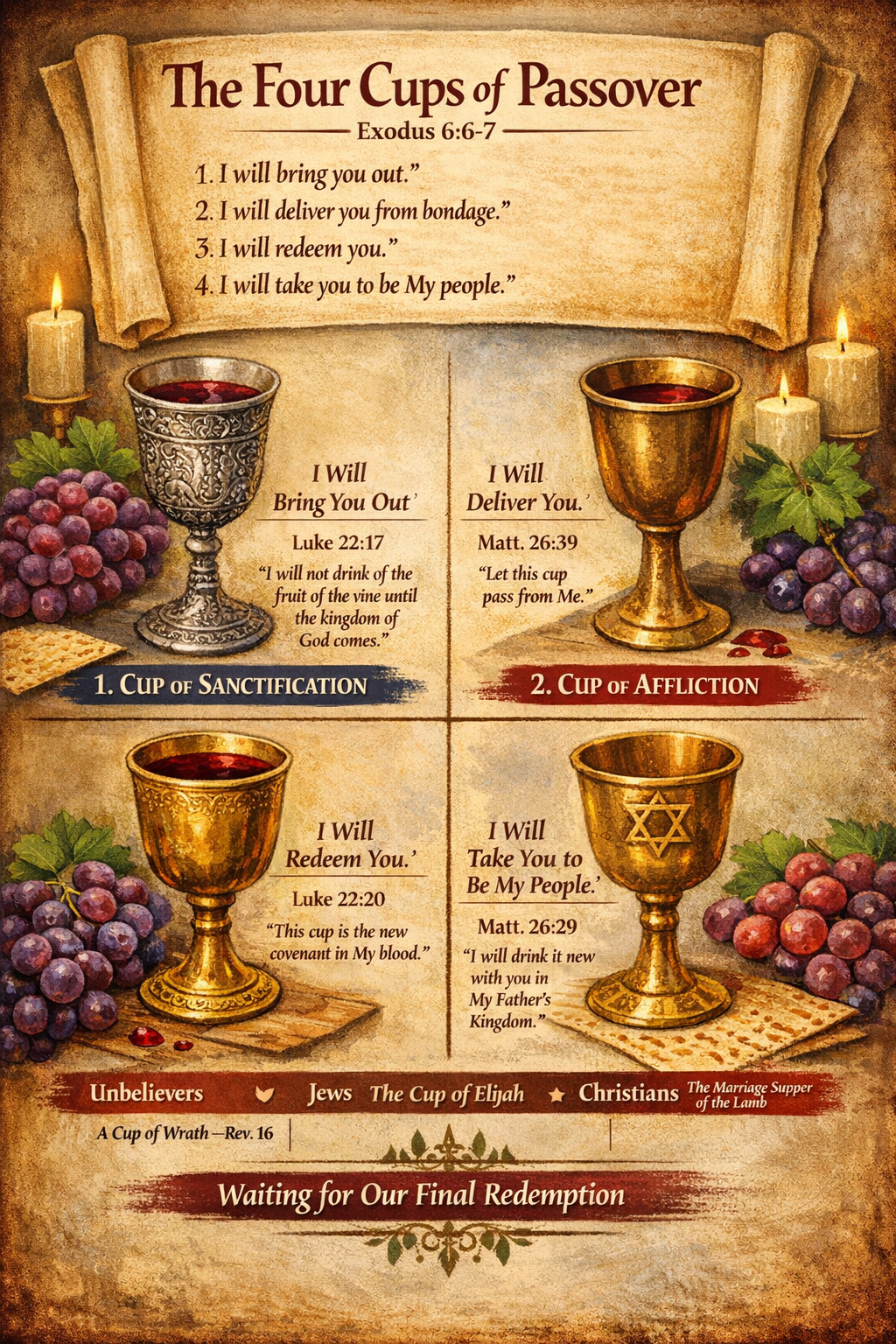
✨ The Four Cups of Passover (Exodus 6)
During the Jewish Passover Seder, four cups of wine (or grape juice) are used to symbolize the four promises God made to Israel in Exodus 6:6–7. These promises outline God’s complete work of redemption for His people—and they also foreshadow the spiritual redemption Christ brings to believers.

📜 The Four Promises in Exodus 6
God declares:
- “I will bring you out”
- “I will deliver you from bondage”
- “I will redeem you with an outstretched arm”
- “I will take you to be My people”
Jewish tradition associates each promise with one of the four cups of the Passover meal. Christians see in these cups a prophetic picture of Christ’s redemptive work—from salvation to the final resurrection.
🍷 The Four Cups Explained
1. Cup of Sanctification
This cup corresponds to God’s promise: “I will bring you out.”
It represents being set apart—sanctified—by God.
At the Last Supper, Jesus took this cup and said:
- “Take this, and divide it among yourselves… I will not drink of the fruit of the vine until the kingdom of God shall come.” (Luke 22:17–18)
Jesus also prayed:
- “For their sakes I sanctify myself, that they also might be sanctified through the truth.” (John 17:19)
This was the first cup Jesus shared with His disciples.
2. Cup of Affliction
This cup corresponds to God’s promise: “I will deliver you.”
It symbolizes suffering and deliverance.
Jesus referred to this cup when speaking of His coming suffering:
- “Are ye able to drink of the cup that I shall drink of?” (Matthew 20:22)
In Gethsemane, He prayed:
- “O my Father, if it be possible, let this cup pass from me…” (Matthew 26:39)
During the Seder, the father dips his finger into this cup and drops wine onto the table—symbolizing the plagues on Egypt. Many see in this a picture of Christ’s agony, when His sweat became “as great drops of blood” (Luke 22:44).
3. Cup of Redemption
This cup corresponds to God’s promise: “I will redeem you.”
It is the cup Jesus used to institute the New Covenant.
After supper, Jesus took this cup and said:
- “This cup is the new testament in my blood, which is shed for you.” (Luke 22:20)
Paul echoes this redemption:
- “Who gave himself for us, that he might redeem us from all iniquity…” (Titus 2:14)
This cup represents Christ’s sacrificial death—the price of our redemption.
4. Cup of Consummation
This cup corresponds to God’s promise: “I will take you to be My people.”
It is also called the Cup of Praise, Cup of Completion, or Cup of Elijah.
Jesus did not drink this cup at the Last Supper. Instead, He said:
- “I will not drink henceforth of this fruit of the vine, until that day when I drink it new with you in my Father’s kingdom.” (Matthew 26:29)
This cup points forward to:
- the future Kingdom
- the marriage supper of the Lamb (Revelation 19:7–9)
- the final redemption of our bodies (Romans 8:23; Ephesians 1:13–14)
Three Applications of the Fourth Cup
| Group | Meaning of the Fourth Cup |
|---|---|
| Unbelievers | A cup of wrath, as seen in the plagues of Egypt and the judgments of Revelation (Rev. 16). |
| Jews | The Cup of Elijah—anticipating Elijah’s return before “the great and dreadful day of the Lord” (Malachi 4:5). |
| Christians | The Cup of Consummation—pointing to the marriage supper of the Lamb and Christ’s return. |
🌿 Where We Are Now
Prophetically, the Church is living between the third and fourth cups:
- The Cup of Redemption — Christ has redeemed us by His blood.
- The Cup of Consummation — we await the final redemption when Christ returns.
As Peter writes:
- “Ye were redeemed… with the precious blood of Christ, as of a lamb without blemish and without spot.” (1 Peter 1:18–19)
And Paul reminds us that our full redemption will be completed when our mortal bodies are raised in glory (1 Corinthians 15:52–54).
