¡Qué insensato debió ser el constructor de la casa que vemos en la imagen! Claro que, cuando sopló el viento y las olas azotaron la casa, esta se derrumbó. ¡Miren cómo el mar ha erosionado los cimientos y cómo se está cayendo el tejado! Y la gente, ¡miren cómo huye para salvar sus vidas! Y toda esta calamidad por haber construido su casa sobre la arena. Pero la otra casa, la que se ve a lo lejos: ¡qué firme se mantiene! ¡Qué imponente resiste las olas y con qué seguridad soporta la furia de la tormenta! Sus cimientos son sólidos, porque descansan sobre roca firme.
La Casa Construida Sobre la Arena
Jesús había estado enseñando a la gente. Les había enseñado muchas verdades maravillosas, que encontrarán escritas en los capítulos quinto, sexto y séptimo de Mateo; y al concluir, dijo: «Cualquiera que oye estas palabras mías y las pone en práctica, será semejante a un hombre prudente que edificó su casa sobre la roca. Cayó la lluvia, vinieron los torrentes, soplaron los vientos y golpearon contra aquella casa; pero no cayó, porque estaba fundada sobre la roca. Y cualquiera que oye estas palabras mías y no las pone en práctica, será semejante a un hombre insensato que edificó su casa sobre la arena. Cayó la lluvia, vinieron los torrentes, soplaron los vientos y golpearon contra aquella casa; y cayó, y grande fue su ruina». La lección que Jesús quiso inculcar a la gente con esta parábola era que no basta con simplemente oír lo que Él dice. Muchos lo harán; pero solo aquellos que recuerdan los mandamientos de Cristo y los cumplen, verán que su obra perdurará cuando llegue el tiempo de la prueba.
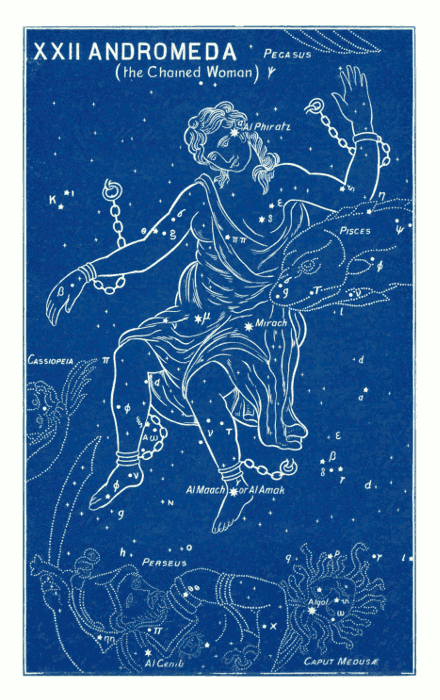
This is a peculiar picture to set in the heavens. A woman with chains fastened to her feet and arms, in misery and trouble; and bound, helpless, to the sky. Yet this is the ancient foreshowing of the truth.
In the Denderah Zodiac her name is Set, which means set, set up as a queen. In Hebrew it is Sirra, the chained, and Persea, the stretched out.
Plate 22: ANDROMEDA (the Chained Woman)
There are 63 stars in this constellation, three of which are of the 2nd magnitude, two of the 3rd, twelve of the 4th, etc.
The brightest star, α (in the head), is called Al Phiratz (Arabic), the broken down. The star β (in the body) is called Mirach (Hebrew), the weak. The star γ (in the left foot) is called Al Maach, or Al Amak (Arabic), struck down.
The names of other stars, not identified, are Adhil, the afflicted; Mizar, the weak; Al Mara (Arabic), the afflicted. Aratus speaks of Desma, which means the bound, and says—
“Her feet point to her bridegroom
Perseus, on whose shoulder they rest.”
Thus, with one voice, the stars of Andromeda speak to us of the captive daughter of Zion. And her coming Deliverer thus addresses her:—
“O thou afflicted, tossed with tempest, and not comforted,
Behold, … in righteousness shalt thou be established:
Thou shalt be far from oppression; for thou shalt not fear:
And from terror; for it shall not come nigh thee.”
(Isa. liv. 11-14.)
“Hear now this, thou afflicted….
Awake, awake; put on thy strength, O Zion;
Put on thy beautiful garments, O Jerusalem….
Shake thyself from the dust;
Arise, and sit down, O Jerusalem:
Loose thyself from the bands of thy neck, O captive daughter of Zion.
For thus saith the Lord, Ye have sold yourselves for nought;
And ye shall be redeemed without money.”
(Isa. li. 21-lii. 3.)
“The virgin daughter of My people is broken with a great breach, with a very grievous blow” (Jer. xiv. 17).
The picture which sets forth her deliverance is reserved for the next chapter (or Sign), where it comes in its proper place and order. We are first shown her glorious Deliverer; for we never, in the heavens or in the Word, have a reference to the sufferings without an immediate reference to the glory.
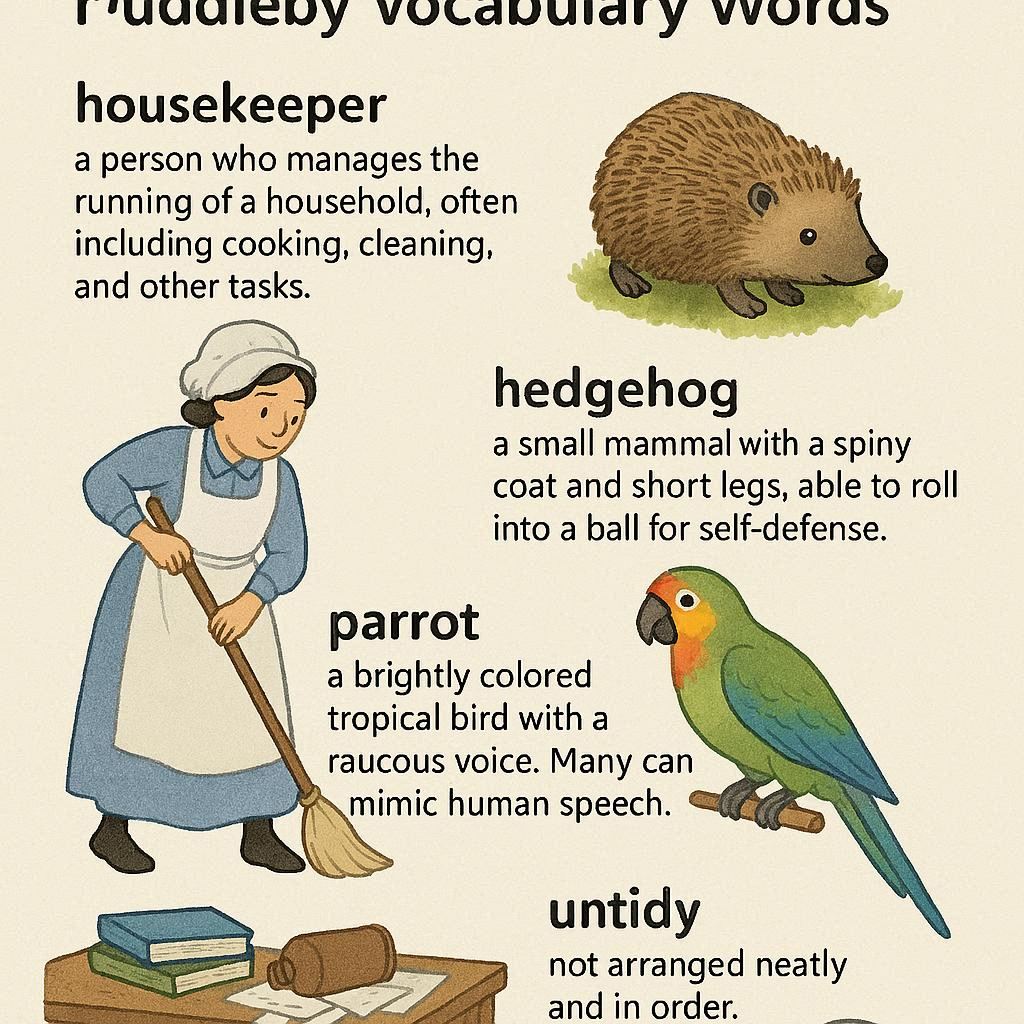
Dungeon: A strong underground prison cell, especially in a castle. Invisible: Unable to be seen. Latch-key: A key of an outer door of a house. Ruse: A trick. Mimic: To imitate the appearance, words, or actions of something or someone else.
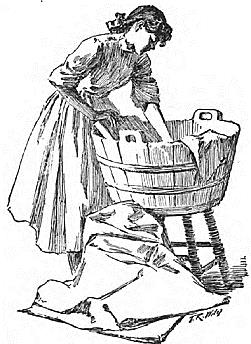
Queen of my tub, I merrily sing, While the white foam rises high, And sturdily wash and rinse and wring, And fasten the clothes to dry. Then out in the free fresh air they swing, Under the sunny sky.
I wish we could wash from our hearts and souls The stains of the week away, And let water and air by their magic make Ourselves as pure as they. Then on the earth there would be indeed, A glorious washing day!
Along the path of a useful life, Will heartsease ever bloom. The busy mind has no time to think Of sorrow or care or gloom. And anxious thoughts may be swept away, As we bravely wield a broom.
I am glad a task to me is given, To labor at day by day, For it brings me health and strength and hope, And I cheerfully learn to say, “Head, you may think, Heart, you may feel, But, Hand, you shall work alway!”
When they had gone a little way through the thick forest, they came to a wide, clear space; and they saw the King’s palace which was made of mud.
This was where the King lived with his Queen, Ermintrude, and their son, Prince Bumpo. The Prince was away fishing for salmon in the river. But the King and Queen were sitting under an umbrella before the palace door. And Queen Ermintrude was asleep.
When the Doctor had come up to the palace the King asked him his business; and the Doctor told him why he had come to Africa.
“You may not travel through my lands,” said the King. “Many years ago a white man came to these shores; and I was very kind to him. But after he had dug holes in the ground to get the gold, and killed all the elephants to get their ivory tusks, he went away secretly in his ship- without so much as saying ‘Thank you.’ Never again shall a white man travel through the lands of Jolliginki.”
Then the King turned to some of the black men who were standing near and said, “Take away this medicine-man-with all his animals, and lock them up in my strongest prison.”
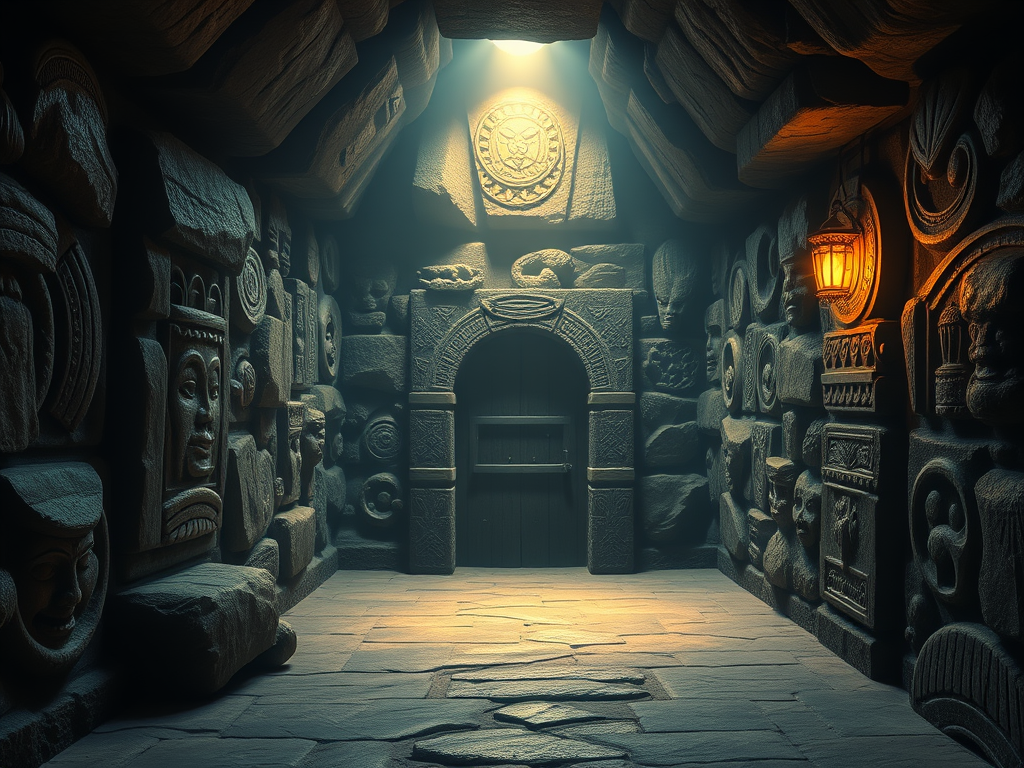
So six of the black men led the Doctor and all his pets away and shut them up in a stone dungeon. The dungeon had only one little window, high up in the wall, with bars in it; and the door was strong and thick.
Then they all grew very sad; and Gub-Gub, the pig, began to cry. But Chee-Chee said he would spank him if he didn’t stop that horrible noise; and he kept quiet.
“Are we all here?” asked the Doctor, after he had got used to the dim light.
“Yes, I think so,” said the duck and started to count them.
“Where’s Polynesia?” asked the crocodile. “She isn’t here.”
“Are you sure?” said the Doctor. “Look again. Polynesia! Polynesia! Where are you?”
“I suppose she escaped,” grumbled the crocodile. “Well, that’s just like her! -Sneaked off into the jungle as soon as her friends got into trouble.”
“I’m not that kind of a bird,” said the parrot, climbing out of the pocket in the tail of the Doctor’s coat. “You see, I’m small enough to get through the bars of that window; and I was afraid they would put me in a cage instead. So while the King was busy talking, I hid in the Doctor’s pocket-and here I am! That’s what you call a ‘ruse,'” she said, smoothing down her feathers with her beak.
“Good Gracious!” cried the Doctor. “You’re lucky I didn’t sit on you.”
“Now listen,” said Polynesia, “tonight, as soon as it gets dark, I am going to creep through the bars of that window and fly over to the palace. And then-you’ll see-I’ll soon find a way to make the King let us all out of prison.”
“Oh, what can you do?” said Gub-Gub, turning up his nose and beginning to cry again. “You’re only a bird!”
“Quite true,” said the parrot. “But do not forget that although I am only a bird, I can talk like a man-and I know these people.”
So that night, when the moon was shining through the palm-trees and all the King’s men were asleep, the parrot slipped out through the bars of the prison and flew across to the palace. The pantry window had been broken by a tennis ball the week before; and Polynesia popped in through the hole in the glass.
She heard Prince Bumpo snoring in his bedroom at the back of the palace. Then she tip-toed up the stairs till she came to the King’s bedroom. She opened the door gently and peeped in.
The Queen was away at a dance that night at her cousin’s; but the King was in bed fast asleep.
Polynesia crept in, very softly, and got under the bed.
Then she coughed-just the way Doctor Dolittle used to cough. Polynesia could mimic any one.
The King opened his eyes and said sleepily: “Is that you, Ermintrude?” (He thought it was the Queen come back from the dance.)
Then the parrot coughed again-loud, like a man. And the King sat up, wide awake, and said, “Who’s that?”
“I am Doctor Dolittle,” said the parrot-just the way the Doctor would have said it.
“What are you doing in my bedroom?” cried the King. “How dare you get out of prison! Where are you?-I don’t see you.”
But the parrot just laughed-a long, deep jolly laugh, like the Doctor’s.
“Stop laughing and come here at once, so I can see you,” said the King.
“Foolish King!” answered Polynesia. “Have you forgotten that you are talking to John Dolittle, M.D.-the most wonderful man on earth? Of course you cannot see me. I have made myself invisible. There is nothing I cannot do. Now listen: I have come here tonight to warn you. If you don’t let me and my animals travel through your kingdom, I will make you and all your people sick like the monkeys. For I can make people well, and I can make people ill-just by raising my little finger. Send your soldiers at once to open the dungeon door, or you shall have mumps before the morning sun has risen on the hills of Jolliginki.”
Then the King began to tremble and was very much afraid.
“Doctor,” he cried, “it shall be as you say. Do not raise your little finger, please!” And he jumped out of bed and ran to tell the soldiers to open the prison door.
As soon as he was gone, Polynesia crept downstairs and left the palace by the pantry window.
But the Queen, who was just letting herself in at the backdoor with a latch-key, saw the parrot getting out through the broken glass. And when the King came back to bed she told him what she had seen.
Then the King understood that he had been tricked, and he was dreadfully angry. He hurried back to the prison at once.
But he was too late. The door stood open. The dungeon was empty. The Doctor and all his animals were gone.
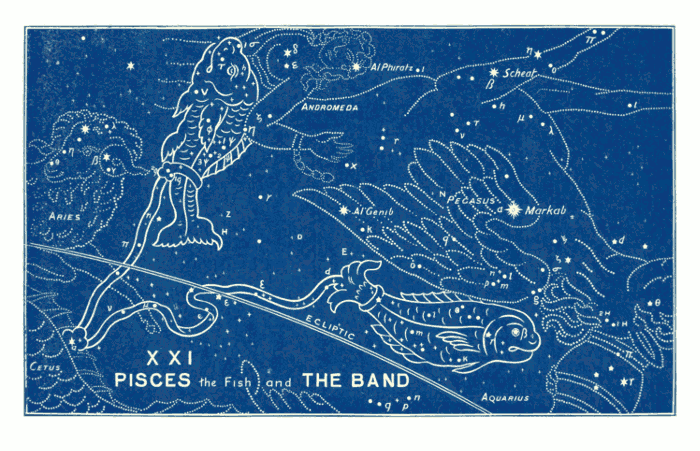
The band that unites these two fishes has always formed a separate constellation. It is shown in Plate XXI. The Arabian poems of Antarah frequently mention it as distinct from the Sign with which it is so closely connected. Antarah was an Arabian poet of the sixth century.
Its ancient Egyptian name was U-or, which means He cometh. Its Arabic name is Al Risha, the band, or bridle.
It speaks of the Coming One, not in His relation to Himself, or to His enemies, but in His relation to the Redeemed. It speaks of Him who says:
“I drew them with cords of a man,
With bands of love;
And I was to them as they that take off the yoke on their jaws.”
(Hosea xi. 4, r.v.)
But it speaks also of His unloosing the bands with which they have been so long bound.
In the picture these fishes are bound. One end of the band is fastened securely round the tail of one fish, and it is the same with the other. Moreover, this band is fastened to the neck of Cetus, the sea monster, while immediately above is seen a woman chained as a captive. These both tell the same story, and, indeed, all are required to set forth the whole truth. The fishes are bound to Cetus; the woman (Andromeda) is chained; but the Deliverer of both is near. Cepheus, the Crowned King, the Redeemer, “the Breaker,” the Branch, is seen coming quickly for the deliverance of His redeemed. These are the three constellations of this sign, and all three are required to set forth the story.
Israel now is bound. The great enemy still oppresses, but deliverance is sure. Aries, the Ram, is seen with his paws on this band, as though about to loosen the bands and set the captives free, and to fast bind their great oppressor.
During three centuries there had been peace between Christians and Muslims except in Spain and in the eastern Roman Empire, the two states defending the gateways of Europe. The Muslims having conquered Syria in the seventh century were in possession of the Holy Land. But they regarded Jesus as a great prophet (though not quite as great as Mohammed), and they did not interfere with the pilgrims who wished to pray in the church which Saint Helena, the mother of the Emperor Constantine, had built on the spot of the Holy Grave. But early in the eleventh century, a Tartar tribe from the wilds of Asia, called the Seljuks or Turks, became masters of the Muslim state in western Asia and then the period of tolerance came to an end. The Turks took all of Asia Minor away from the eastern Roman Emperors and they made an end to the trade between east and west.
Alexis, the Emperor, who rarely saw anything of his Christian neighbors of the west, appealed for help and pointed to the danger which threatened Europe should the Turks take Constantinople.
The Italian cities which had established colonies along the coast of Asia Minor and Palestine, in fear for their possessions, reported terrible stories of Turkish atrocities and Christian suffering. All Europe got excited.
Pope Urban II, a Frenchman from Reims, who had been educated at the same famous cloister of Cluny which had trained Gregory VII, thought that the time had come for action. The general state of Europe was far from satisfactory. The primitive agricultural methods of that day (unchanged since Roman times) caused a constant scarcity of food. There was unemployment and hunger and these are apt to lead to discontent and riots. Western Asia in older days had fed millions. It was an excellent field for the purpose of immigration.
Therefore at the council of Clermont in France in the year 1095 the Pope arose, described the terrible horrors which the infidels had inflicted upon the Holy Land, gave a glowing description of this country which ever since the days of Moses had been overflowing with milk and honey, and exhorted the knights of France and the people of Europe in general to leave wife and child and deliver Palestine from the Turks.
A wave of religious hysteria swept across the continent. All reason stopped. Men would drop their hammer and saw, walk out of their shop and take the nearest road to the east to go and kill Turks. Children would leave their homes to “go to Palestine” and bring the terrible Turks to their knees by the mere appeal of their youthful zeal and Christian piety. Fully ninety percent of those enthusiasts never got within sight of the Holy Land. They had no money. They were forced to beg or steal to keep alive. They became a danger to the safety of the highroads and they were killed by the angry country people.
An unofficial crusade, a wild mob of honest Christians, defaulting bankrupts, penniless noblemen and fugitives from justice, following the lead of half-crazy Peter the Hermit and Walter-without-a-Cent, began their campaign against the Infidels by murdering all the Jews whom they met by the way. They got as far as Hungary and then they were all killed.
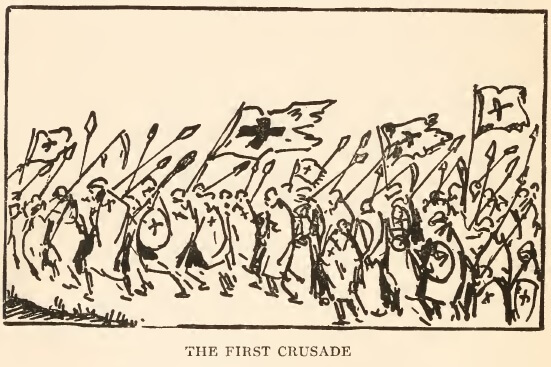
This experience taught the Church a lesson. Enthusiasm alone would not set the Holy Land free. Organization was as necessary as good-will and courage. A year was spent in training and equipping an army of 200,000 men. They were placed under command of Godfrey of Bouillon, Robert, duke of Normandy, Robert, count of Flanders, and a number of other noblemen, all experienced in the art of war.
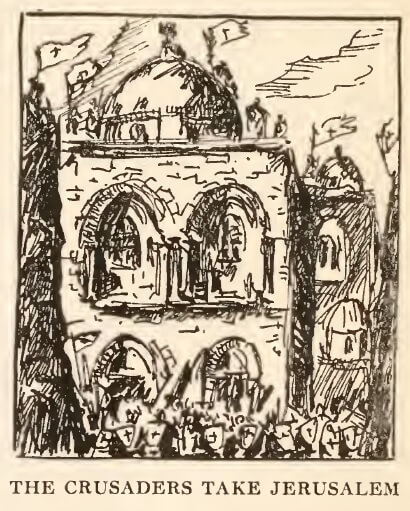
In the year 1096 this official First Crusade started upon its long voyage. At Constantinople the knights did homage to the Emperor. (For as I have told you, traditions die hard, and a Roman Emperor, however poor and powerless, was still held in great respect). Then they crossed into Asia, killed all the Muslims who fell into their hands, stormed Jerusalem, massacred the Muslim population, and marched to the Holy Sepulcher to give praise and thanks amidst tears of piety and gratitude. But soon the Turks were strengthened by the arrival of fresh troops. Then they retook Jerusalem and in turn killed the faithful followers of the Cross.
During the next two centuries, seven other crusades took place. Gradually the Crusaders learned the technique of the trip. The land voyage was too tedious and too dangerous. They preferred to cross the Alps and go to Genoa or Venice where they took ship for the east. The Genoese and the Venetians made this trans-Mediterranean passenger service a very profitable business. They charged exorbitant rates, and when the Crusaders (most of whom had very little money) could not pay the price, these Italian “profiteers” kindly allowed them to “work their way across.” In return for a fare from Venice to Acre, the Crusader undertook to do a stated amount of fighting for the owners of their vessel. In this way Venice greatly increased her territory along the coast of the Adriatic and in Greece, where Athens became a Venetian colony, and in the islands of Cyprus and Crete and Rhodes.
All this, however, helped little in settling the question of the Holy Land. After the first enthusiasm had worn off, a short crusading trip became part of the liberal education of every well-bred young man, and there never was any lack of candidates for service in Palestine. But the old zeal was gone. The Crusaders, who had begun their warfare with deep hatred for the Muslims and great love for the Christian people of the eastern Roman Empire and Armenia, suffered a complete change of heart. They came to despise the Greeks of Byzantium, who cheated them and frequently betrayed the cause of the Cross, and the Armenians and all the other Levantine races, and they began to appreciate the virtues of their enemies who proved to be generous and fair opponents.
Of course, it would never do to say this openly. But when the Crusader returned home, they were likely to imitate the manners which he had learned from their foe, compared to whom the average western knight was still a good deal of a country bumpkin. They also brought with them several new food-stuffs, such as peaches and spinach which he planted in their garden and grew for their own benefit. They gave up the barbarous custom of wearing a load of heavy armor and appeared in the flowing robes of silk or cotton which were the traditional habit of the followers of the Prophet and were originally worn by the Turks. Indeed the Crusades, which had begun as a punitive expedition against their religious adversaries, became a course of general instruction in civilization for millions of young Europeans.
From a military and political point of view the Crusades were a failure. Jerusalem and a number of cities were taken and lost. A dozen little kingdoms were established in Syria and Palestine and Asia Minor, but they were re-conquered by the Turks and after the year 1244 (when Jerusalem became definitely Turkish) the status of the Holy Land was the same as it had been before 1095.
But Europe had undergone a great change. The people of the west had been allowed a glimpse of the light and the sunshine and the beauty of the east. Their dreary castles no longer satisfied them. They wanted a broader life. Neither Church nor State could give this to them.
“The Story of Doctor Dolittle” by Hugh Lofting is a children’s novel published in 1920. When a kindly physician learns to speak with animals, he abandons his failing medical practice to become a veterinarian. His new calling leads him on an extraordinary voyage to Africa to cure a monkey epidemic. Along the way, he faces shipwrecks, imprisonment, pirates, and exotic creatures—including the rare pushmi-pullyu. This tale of adventure and animal communication became the first in a beloved series, though it has sparked controversy for its colonial-era themes.
Warning to Parents: Chapters 11 and 12 of the original Dr. Dolittle contain objectionable content. These chapters were modernized by Under the Home, but the Gutenberg link on the textbook page leads to an original copy of Dr. Dolittle with the objectionable content.
VII The Bridge of Apes VIII The Leader of the Lions IX The Monkeys’ Council X The Rarest Animal of All XI The Black Prince XII Medicine and Magic XIII Red Sails and Blue Wings XIV The Rats’ Warning XV The Barbary Dragon XVI Too-Too, the Listener XVII The Ocean Gossips XVIII Smells XIX The Rock XX The Fisherman’s Town XXI Home Again
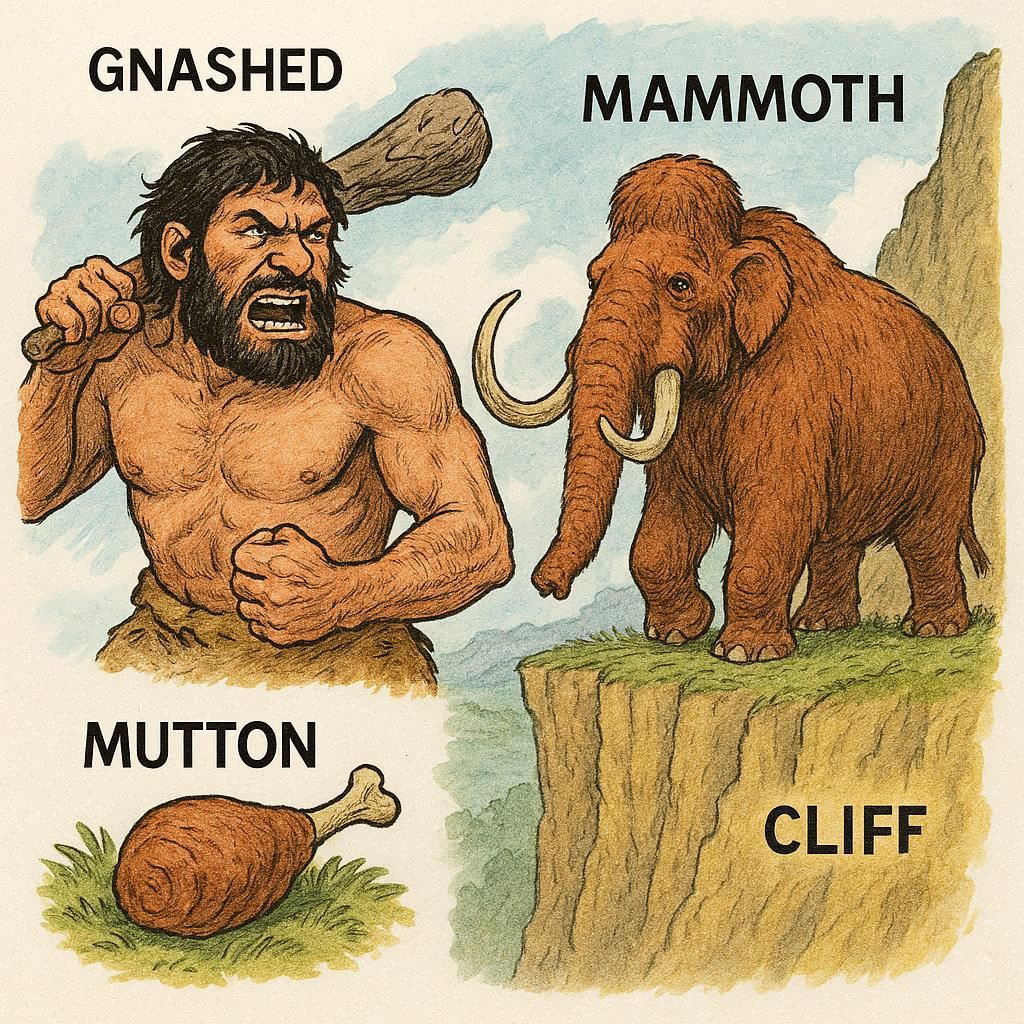
Gnashed: Grind (one’s teeth) together. Rage: Violent anger. Mutton: The meat of mature sheep. Mammoth: A large hairy extinct elephant with curved tusks. Cliff: A steep rock face.
It is very difficult to understand the people of bygone ages. Your own grandfather, whom you see every day, is a mysterious being who lives in a different world of ideas and clothes and manners. I am now telling you the story of some of your grandfathers who are twenty-five generations removed, and I do not expect you to catch the meaning of what I write without re-reading this chapter a number of times.
The average person of the Middle Ages lived a very simple and uneventful life. Even free citizens, able to come and go at will, rarely left their own neighborhoods. There were no printed books and only a few manuscripts. Here and there, a small band of industrious monks taught reading and writing and some arithmetic. But science and history and geography lay buried beneath the ruins of Greece and Rome.
Whatever people knew about the past they had learned by listening to stories and legends. Such information, which goes from parent to child, is often slightly incorrect in details, but it will preserve the main facts of history with astonishing accuracy. After more than two thousand years, the mothers of India still frighten their naughty children by telling them that “Iskander will get them,” and Iskander is none other than Alexander the Great, who visited India in the year 330 before the birth of Christ, but whose story has lived through all these ages.
The people of the early Middle Ages never saw a textbook of Roman history. They were ignorant of many things which every schoolboy today knows before he has entered the third grade. But the Roman Empire, which is merely a name to you, was to them something very much alive. They felt it. They willingly recognized the Pope as their spiritual leader because he lived in Rome and represented the idea of the Roman superpower. And they were profoundly grateful when Charlemagne, and afterwards Otto the Great, revived the idea of a world-empire and created the Holy Roman Empire, that the world might again be as it always had been.
But the fact that there were two different heirs to the Roman tradition placed the faithful burghers of the Middle Ages in a difficult position. The theory behind the medieval political system was both sound and simple. While the worldly master (the emperor) looked after the physical well-being of his subjects, the spiritual master (the Pope) guarded their souls.
In practice, however, the system worked very badly. The Emperor invariably tried to interfere with the affairs of the church and the Pope retaliated and told the Emperor how he should rule his domains. Then they told each other to mind their own business in very unceremonious language and the inevitable end was war.
Under those circumstances, what were the people to do, A good Christian obeyed both the Pope and his King. But the Pope and the Emperor were enemies. Which side should a dutiful subject and an equally dutiful Christian take?
It was never easy to give the correct answer. When the Emperor happened to be a man of energy and was sufficiently well provided with money to organize an army, he was very apt to cross the Alps and march on Rome, besiege the Pope in his own palace if need be, and force His Holiness to obey the imperial instructions or suffer the consequences.
But more frequently the Pope was the stronger. Then the Emperor or the King together with all his subjects was excommunicated. This meant that all churches were closed, that no one could be baptized, that no dying person could be given absolution—in short, that half of the functions of medieval government came to an end.
More than that, the people were absolved from their oath of loyalty to their sovereign and were urged to rebel against their master. But if they followed this advice of the distant Pope and were caught, they were hanged by their nearby Liege Lord and that too was very unpleasant.
Indeed, the poor fellows were in a difficult position and none fared worse than those who lived during the latter half of the eleventh century, when the Emperor Henry IV of Germany and Pope Gregory VII fought a two-round battle which decided nothing and upset the peace of Europe for almost fifty years.
In the middle of the eleventh century there had been a strong movement for reform in the church. The election of the Popes, thus far, had been a most irregular affair. It was to the advantage of the Holy Roman Emperors to have a well-disposed priest elected to the Holy See. They frequently came to Rome at the time of election and used their influence for the benefit of one of their friends.
In the year 1059 this had been changed. By a decree of Pope Nicholas II, the principal priests and deacons of the churches in and around Rome were organized into the so-called College of Cardinals, and this gathering of prominent churchmen (the word “Cardinal” meant principal) was given the exclusive power of electing the future Popes.
In the year 1073 the College of Cardinals elected a priest by the name of Hildebrand, the son of very simple parents in Tuscany, as Pope, and he took the name of Gregory VII. His energy was unbounded. His belief in the supreme powers of his Holy Office was built upon a granite rock of conviction and courage. In the mind of Gregory, the Pope was not only the absolute head of the Christian church, but also the highest Court of Appeal in all worldly matters. The Pope who had elevated simple German princes to the dignity of Emperor could depose them at will. He could veto any law passed by duke or king or emperor, but whosoever should question a papal decree, let him beware, for the punishment would be swift and merciless.
Gregory sent ambassadors to all the European courts to inform the potentates of Europe of his new laws and asked them to take due notice of their contents. William the Conqueror promised to be good, but Henry IV, who since the age of six had been fighting with his subjects, had no intention of submitting to the Papal will. He called together a college of German bishops, accused Gregory of every crime under the sun and then had him deposed by the council of Worms.
The Pope answered with excommunication and a demand that the German princes rid themselves of their unworthy ruler. The German princes, only too happy to be rid of Henry, asked the Pope to come to Augsburg and help them elect a new Emperor.
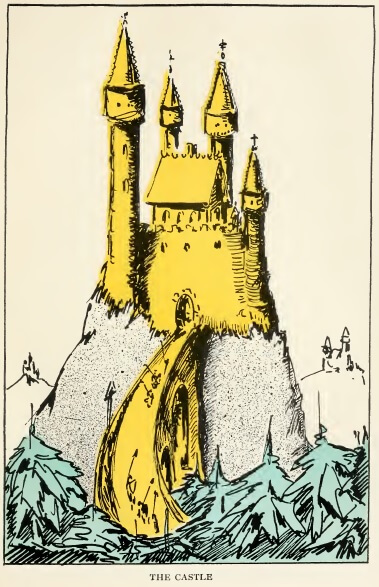
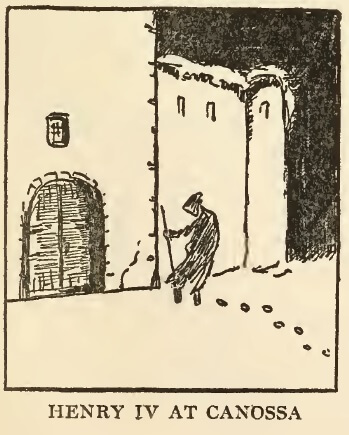
Gregory left Rome and travelled northward. Henry, who was no fool, appreciated the danger of his position. At all costs he must make peace with the Pope, and he must do it at once. In the midst of winter, he crossed the Alps and hastened to Canossa where the Pope had stopped for a short rest. Three long days, from the 25th to the 28th of January of the year 1077, Henry, dressed as a penitent pilgrim (but with a warm sweater underneath his monkish garb), waited outside the gates of the castle of Canossa. Then he was allowed to enter and was pardoned for his sins. But the repentance did not last long. As soon as Henry had returned to Germany, he behaved exactly as before. Again, he was excommunicated. For the second time a council of German bishops deposed Gregory, but this time, when Henry crossed the Alps, he was at the head of a large army, besieged Rome and forced Gregory to retire to Salerno, where he died in exile. This first violent outbreak decided nothing. As soon as Henry was back in Germany, the struggle between Pope and Emperor was continued.
The Hohenstaufen family which got hold of the Imperial German Throne shortly afterwards, were even more independent than their predecessors. Gregory had claimed that the Popes were superior to all kings because they (the Popes) at the Day of Judgement would be responsible for the behavior of all the sheep of their flock, and in the eyes of God, a king was one of that faithful herd.
Frederick of Hohenstaufen, commonly known as Barbarossa or Red Beard, set up the counter-claim that the Empire had been bestowed upon his predecessor “by God himself” and as the Empire included Italy and Rome, he began a campaign which was to add these “lost provinces” to the northern country. Barbarossa was accidentally drowned in Asia Minor during the second Crusade, but his son Frederick II, a brilliant young man who in his youth had been exposed to the civilization of the Muslims of Sicily, continued the war. The Popes accused him of heresy. It is true that Frederick seems to have felt a deep and serious contempt for the rough Christian world of the North, for the boorish German Knights and the intriguing Italian priests. But he held his tongue, went on a Crusade and took Jerusalem from the infidel and was duly crowned as King of the Holy City. Even this act did not placate the Popes. They deposed Frederick and gave his Italian possessions to Charles of Anjou, the brother of that King Louis of France who became famous as Saint Louis. This led to more warfare. Conrad V, the son of Conrad IV, and the last of the Hohenstaufens, tried to regain the kingdom, and was defeated and decapitated at Naples. But twenty years later, the French who had made themselves thoroughly unpopular in Sicily were all murdered during the so-called Sicilian Vespers, and so it went.
The quarrel between the Popes and the Emperors was never settled, but after a while the two enemies learned to leave each other alone.
In the year 1278, Rudolph of Hapsburg was elected Emperor. He did not take the trouble to go to Rome to be crowned. The Popes did not object and in turn they kept away from Germany. This meant peace but two entire centuries which might have been used for the purpose of internal organization had been wasted in useless warfare.
It is an ill wind however that bloweth no good to someone. The little cities of Italy, by a process of careful balancing, had managed to increase their power and their independence at the expense of both Emperors and Popes. When the rush for the Holy Land began, they were able to handle the transportation problem of the thousands of eager pilgrims who were clamoring for passage, and at the end of the Crusades they had built themselves such strong defenses of brick and of gold that they could defy Pope and Emperor with equal indifference.
Church and State fought each other and a third party—the medieval city—ran away with the spoils.



 articlesforchristians