A place to grow your relationship with God

Archive for the ‘From the New Testament’ Category

The Pharisee and the Tax Gatherer

THE PHARISEE AND THE TAX-GATHERER

The tax-gatherers in those days were called Publicans. They were reputed to be very unjust, exacting from people more than the law required them to pay, and other wickedness was charged against them. Of course, there were good men among them; St. Matthew was a tax-gatherer before Jesus called him to follow Him. The Pharisees studied the Scriptures and explained them to the people, but they did not follow the teachings of Scripture. They were proud, and pretended they were more religious than other men, but it was only pretense. Jesus compared them to whited sepulchres, and said they were hypocrites, who led the people astray.

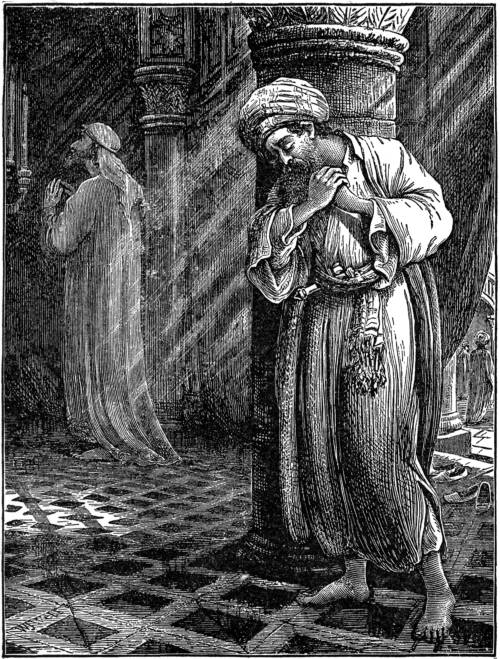
A Pharisee and a Publican went up into the Temple to pray. The Pharisee stood in a part of the Temple where all could see him, and prayed thus: “O God, I thank Thee that I am not like other men, who are unjust, and who take more than belongs to them. I thank Thee that I am not like this Publican. I fast twice a week; I give to the priests and Levites a tenth part of all I possess.” But the Publican, who knew that he was wicked, and felt sorry for it, stood afar off in a quiet part of the Temple where none would see him. He bowed his head and beat upon his breast, saying, “God be merciful to me a sinner.”

Jesus said that this Publican went to his home more forgiven than the Pharisee, for every one that is proud and thinks much of himself shall be put down, and he that humbleth himself and is sorry for his sins, shall be exalted. “Blessed are the meek, for they shall inherit the earth,” says Jesus.
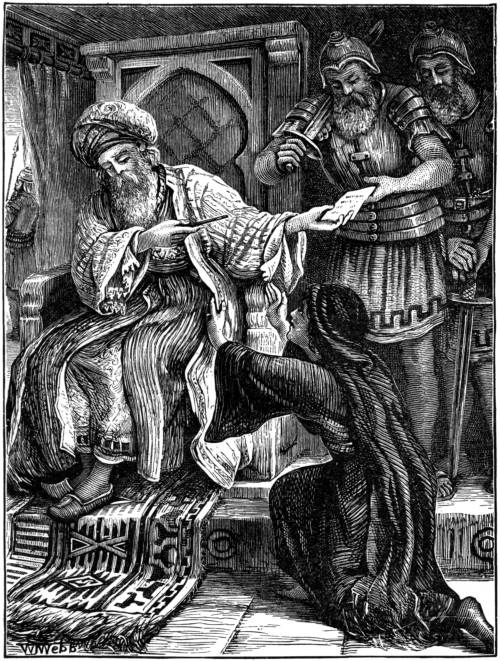
“Avenge me of my Adversary” Parable

“AVENGE ME OF MY ADVERSARY”

In a certain city there was a judge who neither feared God nor cared for man. And in the same city there was a widow that had an enemy, and he had done her an injury. And she came to the judge and implored him, saying, “Give me justice; avenge me of my adversary.” But he would not. Then the widow came to him every day and cried, “Give me justice;” but still he would not for a long while. At last he became wearied of her constant cry, and he said within himself, “Though I fear not God nor care for man, yet, because this widow troubleth me with her complaint, I will avenge her; lest by her continual coming she weary me.”

And Jesus said, “Hear what the unjust judge saith. And if he, who was an unjust judge and a wicked man, would grant the widow’s petition, because she asked so often, will not God, who is good and just, give His children what is good and right for them? Shall not God avenge His own elect, which cry day and night unto Him, though He bear long with them?”

In this parable Jesus impressed upon his disciples the truth that, although great trials might come upon them, and their lives be in peril, yet they were not to lose faith in God, or be disappointed because their prayers were not answered at once. They were to keep on praying; asking God for such things as were right, and trusting that He would preserve them amidst all their enemies; and in His own way make them to triumph over their foes. Whatever is best for His people, God will give them. He cares for the sparrows, and, even more, for those who love Him.

The Rich Man and the Beggar

THE RICH MAN AND THE BEGGAR

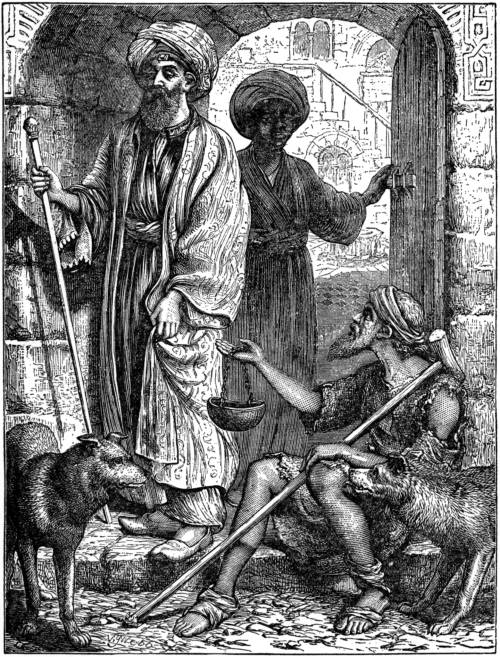
There was a certain rich man who was clothed in rich silks and fine linen, and feasted on costly food each day. There was also a poor beggar, who was ragged and hungry, and covered with sores. His name was Lazarus, and they laid him at the rich man’s gate, for he desired to be fed with the crumbs which fell from the well-supplied table. And even the dogs had pity on him, for they came and licked his sores.

And it came to pass that the beggar died, and the angels carried him away to heaven, where he was no longer clothed in rags, but in glorious array. Neither was he hungry, for he sat with Abraham and leaned upon his bosom.

The rich man also died, and was buried. He was not carried to heaven, but went to a place of torment, where he lifted up his eyes, and in the distance saw Abraham with Lazarus on his bosom. And he cried and said, “Father Abraham, have mercy on me, and send Lazarus, that he may dip the tip of his finger in water, and cool my tongue; for I am tormented in these flames.” But Abraham said, “Son, remember that thou in thy lifetime receivedst thy good things, whilst Lazarus had only evil things; and now he is comforted, and thou art tormented. Beside all this, between us and you there is a great gulf fixed.”

Then said the rich man, “I pray thee therefore, father, that thou wouldest send him to my father’s house; for I have five brethren. Let him go to them and testify unto them, that they may repent, lest they also come into this place of torment.” Abraham said unto him, “They have Moses and the prophets; let them hear them.” And he said, “Nay, father Abraham: but if one went unto them from the dead, they will repent.” But Abraham said, “If they hear not Moses and the prophets, neither will they be persuaded, though one rose from the dead.”

The Unjust Steward

THE UNJUST STEWARD

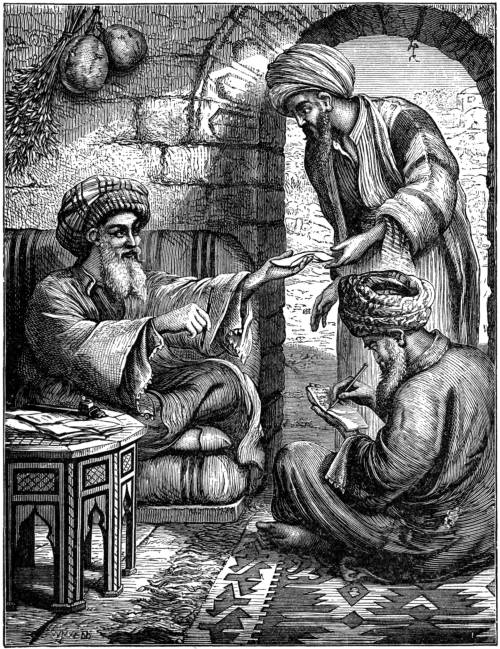
See where the steward, worldly wise,

With wicked cunning in his eyes,

Shows his lord’s debtors how to cheat

His master of his oil and wheat.

“A hundred measures dost thou owe

Of oil? My friend, ’tis scarcely so:

Here, take thy bill and quick indite

Fifty: that puts the matter right.”

“A hundred measures is thy debt

Of corn? My friend, thou dost forget:

Here, take thy bill, and write fourscore;

Surely thou owest nothing more.”

Thus wickedly he would provide

Houses in which he might abide,

When for his former acts unjust

He from his stewardship was thrust.

And when his master heard, he smiled,

Though of his goods he was beguiled:

Nor did he e’en forbear to praise

The crafty foresight of his ways.

The children of this world, alas!

The children of the light surpass,

In planning methods to provide

For ills from which they cannot hide.

And so our Master bids us take

The money which He gives, and make

Friends with our riches for the day

When earthly treasures flee away.

That when we leave our house below,

And into unknown regions go,

Through Jesus, we may find above

An everlasting home of love.

Do I my little store expend

For such a wise and prudent end;

Or only think of my own gain,

And not of others’ want and pain?

Lord, by Thy Spirit, make me wise

Above my selfishness to rise,

And something daily give away

To find again in Thy great day!

by Richard Wilton, M.A.

MAN WITH THE WITHERED HAND

MAN WITH THE WITHERED HAND

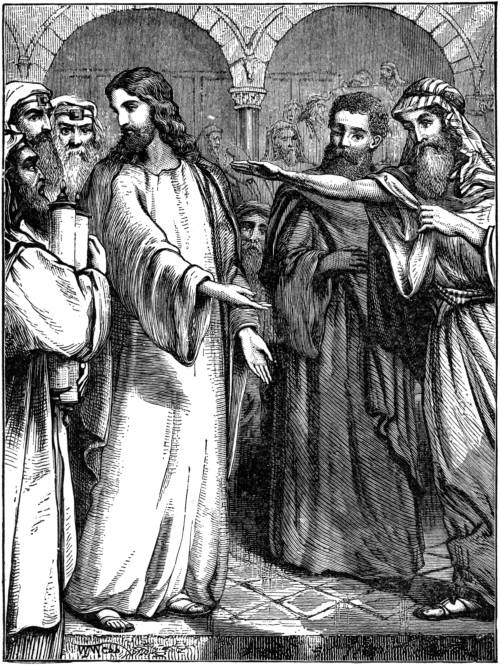
One Sabbath-day Jesus went into the synagogue, and there He saw a man that had a withered hand. By some means the muscles had lost their power, and he could neither use his hand nor stretch it out. And the Pharisees watched Jesus, to see if He would heal this man on the Sabbath, that they might bring a charge against Him of breaking the law. They asked Him, “Is it lawful to heal on the Sabbath-day?” and He replied by asking who among them, if he had a sheep which had fallen into a pit on the Sabbath-day, would not lay hold on it, and lift it out. “How much then is a man better than a sheep? Wherefore it is lawful to do good on the Sabbath-day.”

Then said He to the man, “Stretch forth thine hand.” And he stretched it forth, and it was made whole and healthy like the other.

Then the Pharisees went out and held a council against Him, to consider how they might destroy Him; but when Jesus knew it, He withdrew Himself from that part, and great multitudes followed Him, and He healed them all.

Weekly Recap of Articles for Christians Dec 21st to Dec 27th

Peter’s Wife’s Mother Cured

PETER’S WIFE’S MOTHER CURED

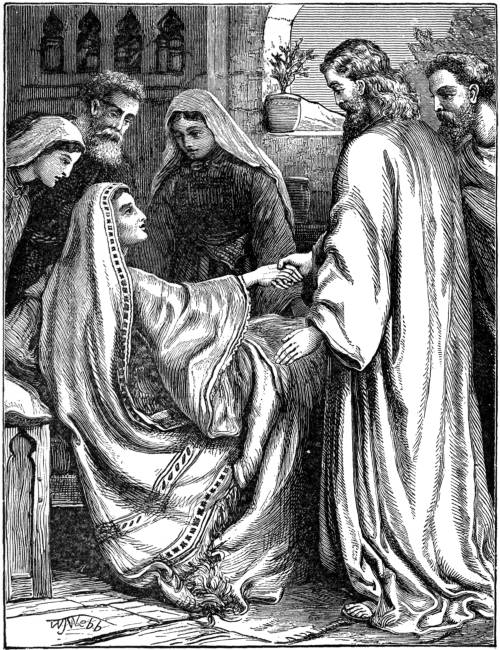
After Jesus had left the Centurion He went to the house of his disciple Peter, and there He saw Peter’s wife’s mother, laid on a bed, sick with fever. And He took her by the hand and lifted her up. The fever left her and she was cured. She rose up from her bed and attended upon them.

That evening, when the sun was setting, they brought to Jesus all those that were ill, and many that were possessed with devils. And He cast out the devils by His word, and healed all those that were sick.


“At even, ere the sun had set, The sick, O Lord, around Thee lay; Oh, in what divers pains they met, Oh, with what joy they went away!”

The Prodigal Son

THE PRODIGAL SON

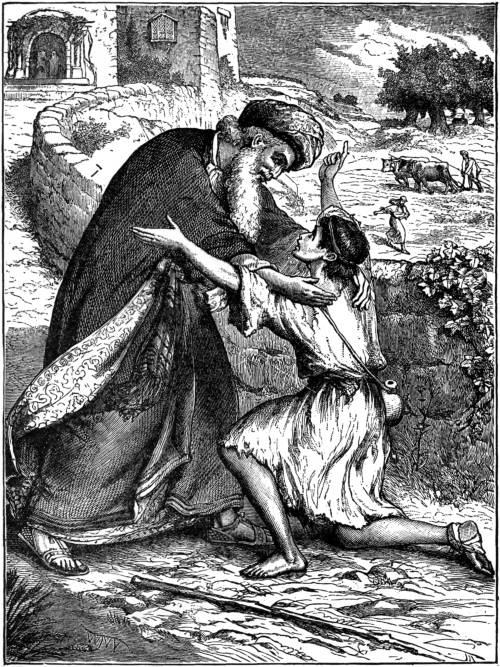
A certain man had two sons, and the younger of them said to his father, “Father, give me the portion of thy wealth that would fall to me at thy death.” He did so, and a few days after the younger son gathered all his wealth together and journeyed into a far country. There he met with evil companions, and wasted his money in riotous living. When he had spent all, there arose a mighty famine in that land, and he began to be in want of bread to eat. So he went and hired himself to a man of that country, who sent him into the fields to feed his pigs. And he was so hungry that he would have been glad to have eaten the coarse food such as the swine eat; but no one gave it to him.

His sufferings brought him to his senses, and he thought how foolish he had been, for he remembered that his father’s servants had food enough and to spare, whilst his father’s son was perishing with hunger. He said, “I will leave this land and go to my father and tell him how I have sinned against heaven and him. I will tell him I am no longer worthy to be called his son, and will implore him to make me one of his hired servants.” And he arose and went towards his father’s house, but when he was still a great way off, his father saw him, and was sorry for him, and ran and embraced him. Then he told his father how he had sinned and had lost his title to be called the old man’s son, but the father was so glad to have his son come back repentant, that he told his servants to bring the best clothing and a ring to put on his son. And he made a great feast, and they were merry, for he said, “This is my son that was as one dead to me and is now alive again; he was lost and is found.”

But the elder son was very angry, and would not go in to the feast, but said to his father, “Lo, these many years have I served thee, and never offended or disobeyed thee, and thou hast never made a feast for me and my friends; but now this thy other son has come back, that has wasted thy wealth in riotous living, thou hast made a great feast for him.” And his father said, “Son, thou art ever with me, and all I have is thine. It is right that we should make merry and be glad, for this thy brother was as one dead to us and is alive again; he was lost and is found.”

The Lost Piece of Money

THE LOST PIECE OF MONEY

Jesus had been preaching to a crowd of publicans and sinners. The publicans of those days were the collectors of taxes for the Romans, and it was a constant complaint against them that they exacted more from the people than they had any right to do. So they were looked upon as wicked men, although they were not all bad. Now the Scribes and Pharisees, who made a great show of religion, so far as outward forms went, were greatly shocked at seeing Christ sitting with publicans, and said, “This man receiveth sinners and eateth with them.”

Then Jesus asked them, “What man of you, if he has a hundred sheep, and loses one of them, does not leave the ninety and nine in the wilderness, and go after the lost one, until he has found it? And when he has found it, he lays it upon his shoulders and takes it home, rejoicing; and calls together his friends and neighbours, saying unto them, ‘Rejoice with me, for I have found my sheep that was lost.’

“I say unto you, that likewise joy shall be in heaven over one sinner that repenteth, more than over ninety and nine just persons which need no repentance.

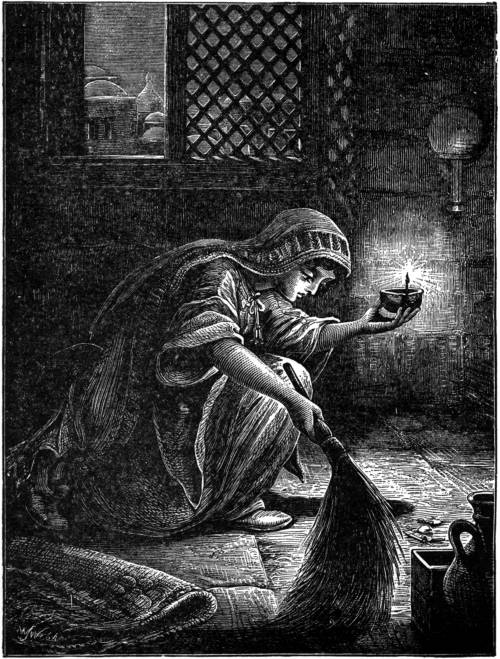
“Again, what woman if she has ten pieces of money, and loses one, does not light a candle, and sweep the house, and seek diligently until she finds it? And when she has found it, she calls together her friends and neighbours, saying, ‘Rejoice with me, for I have found the piece of money which I had lost.’

“Likewise, I say unto you, there is joy in the presence of God’s angels over one sinner that repenteth.”

The Good Shepherd

THE GOOD SHEPHERD

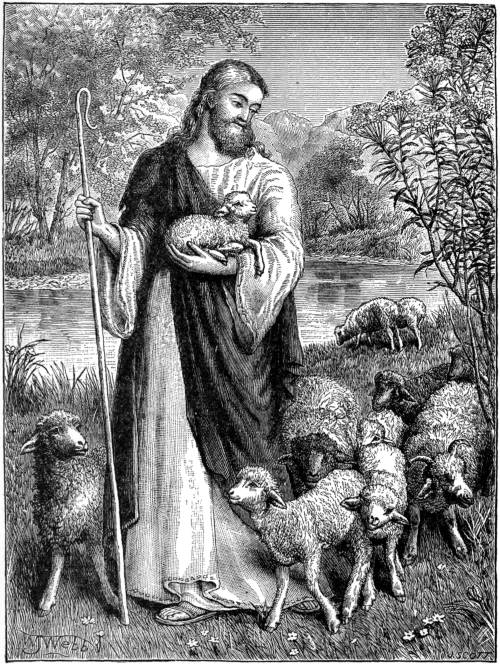
In one of His beautiful parables, Jesus compares Himself to a shepherd. “I am the good shepherd,” says He, “the good shepherd giveth his life for the sheep.” And Jesus tells how the hired servant who cares for nothing but his wages, runs away when the wolf comes; but how the faithful shepherd, when robbers threaten his flock, or wild beasts attack them, defends his sheep bravely, often laying down his life for their sake. Jesus also speaks of how the shepherd knows his sheep by name; and how, when he goes before them, they will follow him, because they know his voice, but that they will not follow strangers. And the Bible, speaking of Jesus Himself, says, “He shall carry the lambs in His bosom,” or His arms, like the kind shepherd is doing in our picture.

Now, why does Jesus call Himself the “good shepherd,” and the Bible speak of Him as carrying the little lambs? Is it not because He loves us; because He knows each one of us; because He gave His life for us when He died on the cross, and has gone to heaven showing us the way thither; because He calls us to follow Him; and because He is so willing to lead even the tiny ones, and shield them from harm, just like the good shepherd carries the poor wee lamb? But Jesus asks one thing of us in return for all His kindness and care, and that one thing is our love. Are we giving Him our love now? Are we asking Him to lead us, and keep us safe from harm? May we seek to follow Him and to know His voice.