A place to grow your relationship with God

Archive for the ‘The Story of Mankind’ Category

Ancient Greek Life

Greek Life

But how, you will ask, did the ancient Greeks have time to look after their families and their business if they were forever running to the marketplace to discuss affairs of state? In this chapter I shall tell you.

In all matters of government, the Greek democracy recognized only one class of citizens—the freemen. Every Greek city was composed of a small number of free born citizens, a large number of slaves and a sprinkling of foreigners.

The Greek city, therefore, whenever it was not ruled by a king or a tyrant, was run by and for the freemen, and this would not have been possible without a large army of slaves who outnumbered the free citizens at the rate of six or five to one and who performed those tasks to which we modern people must devote most of our time and energy if we wish to provide for our families and pay the rent of our apartments. The slaves did all the cooking and baking and candlestick making of the entire city. They were the tailors and the carpenters and the jewelers and the school-teachers and the bookkeepers and they tended the store and looked after the factory while the master went to the public meeting to discuss questions of war and peace or visited the theater to see the latest play of Aeschylus or hear a discussion of the revolutionary ideas of Euripides, who had dared to express certain doubts upon the omnipotence of the great god Zeus.

Indeed, ancient Athens resembled a modern club. All the freeborn citizens were hereditary members and all the slaves were hereditary servants, and waited upon the needs of their masters.

The slaves also took care of those tasks which nowadays are performed by the business people and the professional people. As for those household duties which take up so much of the time of your parents, the Greeks, who understood the value of leisure, had reduced such duties to the smallest possible minimum by living amidst surroundings of extreme simplicity.

To begin with, their homes were very plain. Even the rich nobles spent their lives in a sort of adobe barn, which lacked all the comforts which a modern workers expects as their natural right. A Greek home consisted of four walls and a roof. There was a door which led into the street but there were no windows. The kitchen, the living rooms and the sleeping quarters were built around an open courtyard in which there was a small fountain, or a statue and a few plants to make it look bright. Within this courtyard the family lived when it did not rain or when it was not too cold. In one corner of the yard the cook (who was a slave) prepared the meal and in another corner, the teacher (who was also a slave) taught the children the alpha beta gamma and the tables of multiplication and in still another corner the lady of the house, who rarely left her domain (since in those ancient times it was not considered good form for a married woman to be seen on the street too often) was repairing her husband’s coat with her seamstresses (who were slaves,) and in the little office, right off the door, the master was inspecting the accounts which the overseer of his farm (who was a slave) had just brought to him.

When dinner was ready the family came together but the meal was a very simple one and did not take much time. The Greeks seem to have regarded eating as an unavoidable evil and not a pastime, which kills many dreary hours and eventually kills many dreary people. They lived on bread and on wine, with a little meat and some green vegetables. They drank water only when nothing else was available because they did not think it very healthy. They loved to call on each other for dinner, but our idea of a festive meal, where everybody is supposed to eat much more than is good for him, would have disgusted them. They came together at the table for the purpose of a good talk and a good glass of wine and water, but as they were moderate people they despised those who drank too much.

The same simplicity which prevailed in the dining room also dominated their choice of clothes. They liked to be clean and well groomed, to have their hair and beards neatly cut, to feel their bodies strong with the exercise and the swimming of the gymnasium, but they never followed the Asiatic fashion which prescribed loud colors and strange patterns. They wore a long white coat and they managed to look as smart as a modern Italian officer in his long blue cape.

They loved to wear ornaments but they thought it very vulgar to display their wealth (or their wives) in public and whenever the women left their home they were as inconspicuous as possible.

In short, the story of Greek life is a story not only of moderation but also of simplicity. “Things,” chairs and tables and books and houses and carriages, are apt to take up a great deal of their owner’s time. In the end they invariably make him their slave and their hours are spent looking after their wants, keeping them polished and brushed and painted. The Greeks, before everything else, wanted to be “free,” both in mind and in body. That they might maintain their liberty, and be truly free in spirit, they reduced their daily needs to the lowest possible point.
Greek Self-Government

In the beginning, all the Greeks had been equally rich and equally poor. Every person had owned a certain number of cows and sheep. Their mud-hut had been their castle. They had been free to come and go as they wished. Whenever it was necessary to discuss matters of public importance, all the citizens had gathered in the marketplace. One of the elders of the village was elected chairman and it was their duty to see that everybody had a chance to express their views. In case of war, a particularly energetic and self-confident villager was chosen commander-in-chief, but the same people who had voluntarily given this person the right to be their leader, claimed an equal right to deprive them of their job, once the danger had been averted.

But gradually the village had grown into a city. Some people had worked hard and others had been lazy. A few had been unlucky and still others had been just plain dishonest in dealing with their neighbors and had gathered wealth. As a result, the city no longer consisted of a number of people who were equally well-off. On the contrary it was inhabited by a small class of very rich people and a large class of very poor ones.

These nobles enjoyed many advantages over the common crowd of freemen. They were able to buy the best weapons which were to be found on the market of the eastern Mediterranean. They had much spare time in which they could practice the art of fighting. They lived in strongly built houses and they could hire soldiers to fight for them. They were constantly quarrelling among each other to decide who should rule the city. The victorious noble then assumed a sort of Kingship over all their neighbors and governed the town until they in turn was killed or driven away by still another ambitious noble.

Such a King or Queen, by the grace of their soldiers, was called a “Tyrant” and during the seventh and sixth centuries before our era every Greek city was for a time ruled by such Tyrants, many of whom, by the way, happened to be exceedingly capable rulers. But in the long run, this state of affairs became unbearable. Then attempts were made to bring about reforms and out of these reforms grew the first democratic government of which the world has a record.

It was early in the seventh century that the people of Athens decided to do some housecleaning and give the large number of freemen once more a voice in the government as they were supposed to have had in the days of their Achaean ancestors. They asked a man by the name of Draco to provide them with a set of laws that would protect the poor against the aggressions of the rich. Draco set to work. Unfortunately, he was a professional lawyer and very much out of touch with ordinary life. In his eyes a crime was a crime and when he had finished his code, the people of Athens discovered that these Draconian laws were so severe that they could not possibly be put into effect. There would not have been rope enough to hang all the criminals under their new system of jurisprudence which made the stealing of an apple a capital offence.

The Athenians looked about for a more humane reformer. At last they found someone who could do that sort of thing better than anybody else. His name was Solon. He belonged to a noble family and he had travelled all over the world and had studied the forms of government of many other countries. After a careful study of the subject, Solon gave Athens a set of laws which bore testimony to that wonderful principle of moderation which was part of the Greek character. He tried to improve the condition of the peasant without however destroying the prosperity of the nobles who were (or rather who could be) of such great service to the state as soldiers. To protect the poorer classes against abuse on the part of the judges (who were always elected from the class of the nobles because they received no salary) Solon made a provision whereby a citizen with a grievance had the right to state their case before a jury of thirty of their fellow Athenians.

Most important of all, Solon forced the average freeman to take a direct and personal interest in the affairs of the city. No longer could they stay at home and say “oh, I am too busy today” or “it is raining and I had better stay indoors.” They was expected to do their share; to be at the meeting of the town council; and carry part of the responsibility for the safety and the prosperity of the state.

This government by the “demos,” the people, was often far from successful. There was too much idle talk. There were too many hateful and spiteful scenes between rivals for official honor. But it taught the Greek people to be independent and to rely upon themselves for their salvation and that was a very good thing.

The Story of Mankind: The Greek Cities

We modern people love the sound of the word “big.” We pride ourselves upon the fact that we belong to the “biggest” country in the world and possess the “biggest” navy and grow the “biggest” oranges and potatoes, and we love to live in cities of “millions” of inhabitants and when we are dead, we are buried in the “biggest cemetery of the whole state.”

A citizen of ancient Greece, could they have heard us talk, would not have known what we meant. “Moderation in all things” was the ideal of Greek life and mere bulk did not impress them at all. And this love of moderation was not merely a hollow phrase used upon special occasions: it influenced the life of the Greeks from the day of their birth to the hour of their death. It was part of their literature, and it made them build small but perfect temples. It found expression in the clothes and jewelry which the people wore. It followed the crowds that went to the theater and made them hoot down any playwright who dared to sin against the iron law of good taste or good sense.

The Greeks even insisted upon this quality in their politicians and in their most popular athletes. When a powerful runner came to Sparta and boasted that he could stand longer on one foot than any other man in Hellas the people drove him from the city because he prided himself upon an accomplishment at which he could be beaten by any common goose. “That is all very well,” you will say, “and no doubt it is a great virtue to care so much for moderation and perfection, but why should the Greeks have been the only people to develop this quality in olden times?” For an answer I shall point to the way in which the Greeks lived.

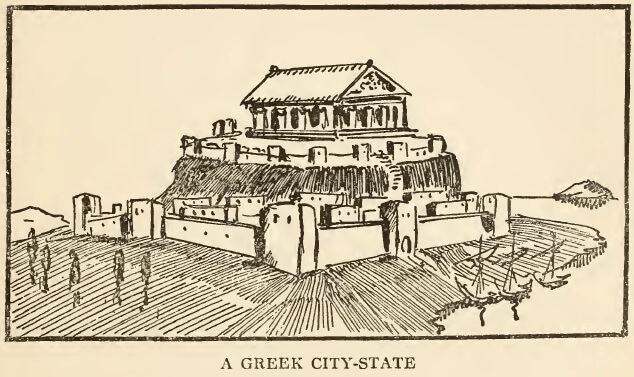
The people of Egypt or Mesopotamia had been the “subjects” of a mysterious Supreme Ruler who lived miles and miles away in a dark palace and who was rarely seen by the masses of the population. The Greeks on the other hand, were “free citizens” of a hundred independent little “cities” the largest of which counted fewer inhabitants than a large modern village. When a peasant who lived in Ur said that he was a Babylonian he meant that he was one of millions of other people who paid tribute to the king who at that particular moment happened to be master of western Asia. But when a Greek said proudly that he was an Athenian or a Theban he spoke of a small town, which was both his home and his country, and which recognized no master but the will of the people in the marketplace.

To the Greek, their homeland was the place where they were born; where they had spent their earliest years playing hide and seek amidst the forbidden rocks of the Acropolis; where they had grown into adulthood with a thousand other boys and girls, whose nicknames were as familiar to him as those of your own schoolmates. Their homeland was the holy soil where their father and mother lay buried. It was the small house within the high city walls where their families lived in safety. It was a complete world which covered no more than four or five acres of rocky land. Don’t you see how these surroundings must have influenced people in everything they did and said and thought? The people of Babylon and Assyria and Egypt had been part of a vast mob. They had been lost in the multitude. The Greek on the other hand had never lost touch with their immediate surroundings. They never ceased to be part of a little town where everybody knew everyone else. They felt that their intelligent neighbors were watching them. Whatever they did, whether they wrote plays or made statues out of marble or composed songs, they remembered that their efforts were going to be judged by all the free-born citizens of their hometown who knew about such things. This knowledge forced them to strive after perfection, and perfection, as they had been taught from childhood, was not possible without moderation.

In this hard school, the Greeks learned to excel in many things. They created new forms of government and new forms of literature and new ideals in art which we have never been able to surpass. They performed these miracles in little villages that covered less ground than four or five modern city blocks.

And look, what finally happened!

In the fourth century before our era, Alexander of Macedonia conquered the world. As soon as he had done with fighting, Alexander decided that he must bestow the benefits of the true Greek genius upon all mankind. He took it away from the little cities and the little villages and tried to make it blossom and bear fruit amidst the vast royal residences of his newly acquired Empire. But the Greeks, removed from the familiar sight of their own temples, removed from the well-known sounds and smells of their own crooked streets, at once lost the cheerful joy and the marvelous sense of moderation which had inspired the work of their hands and brains while they labored for the glory of their old city-states. They became cheap artisans, content with second-rate work. The day the little city-states of old Hellas lost their independence and were forced to become part of a big nation, the old Greek spirit died. And it has been dead ever since.

The Story of Mankind: The Greeks

The Pyramids were a thousand years old and were beginning to show the first signs of decay, and Hammurabi, the wise king of Babylon, had been dead and buried several centuries, when a small tribe of shepherds left their homes along the banks of the River Danube and wandered southward in search of fresh pastures. They called themselves Hellenes, after Hellen, the son of Deucalion and Pyrrha. According to the old myths these were the only two human beings who had escaped the great flood, which countless years before had destroyed all the people of the world, when they had grown so wicked that they disgusted Zeus, the mighty god, who lived on Mount Olympus.

Of these early Hellenes we know nothing. Thucydides, the historian of the fall of Athens, describing his earliest ancestors, said that they “did not amount to very much,” and this was probably true. They were very ill-mannered. They lived like pigs and threw the bodies of their enemies to the wild dogs who guarded their sheep. They had very little respect for other people’s rights, and they killed the natives of the Greek peninsula (who were called the Pelasgians) and stole their farms and took their cattle and made their children slaves and wrote endless songs praising the courage of the clan of the Achaeans, who had led the Hellenic advance-guard into the mountains of Thessaly and the Peloponnesus.

But here and there, on the tops of high rocks, they saw the castles of the Aegeans and those they did not attack for they feared the metal swords and the spears of the Aegean soldiers and knew that they could not hope to defeat them with their clumsy stone axes.

For many centuries they continued to wander from valley to valley and from mountain side to mountain side Then the whole of the land had been occupied and the migration had come to an end.

That moment was the beginning of Greek civilization. The Greeks, living within sight of the Aegean colonies, were finally driven by curiosity to visit their haughty neighbors. They discovered that they could learn many useful things from the people who dwelt behind the high stone walls of Mycenae, and Tiryns.

The Greeks were clever pupils. Within a short time, they mastered the art of handling those strange iron weapons which the Aegeans had brought from Babylon and from Thebes. They came to understand the mysteries of navigation. They began to build little boats for their own use.

And when the Greeks had learned everything the Aegeans could teach them, they turned upon their teachers and drove them back to their islands. Soon afterwards they ventured forth upon the sea and conquered all the cities of the Aegean. Finally, in the fifteenth century before our era, they plundered and ravaged Cnossus and ten centuries after their first appearance upon the scene the Hellenes were the undisputed rulers of Greece, of the Aegean and of the coastal regions of Asia Minor. Troy, the last great commercial stronghold of the older civilization, was destroyed in the eleventh century B.C. European history was to begin in all seriousness.

The Story of Mankind: The Aegean Sea

When Heinrich Schliemann was a little boy his father told him the story of Troy. He liked that story better than anything else he had ever heard and he made up his mind, that as soon as he was big enough to leave home, he would travel to Greece and “find Troy.” That he was the son of a poor country parson in a Mecklenburg village did not bother him. He knew that he would need money but he decided to gather a fortune first and do the digging afterwards. As a matter of fact, he managed to get a large fortune within a very short time, and as soon as he had enough money to equip an expedition, he went to the northwest corner of Asia Minor, where he supposed that Troy had been situated.

In that particular nook of old Asia Minor, stood a high mound covered with grain fields. According to tradition it had been the home of Priamus the king of Troy. Schliemann, whose enthusiasm was somewhat greater than his knowledge, wasted no time in preliminary explorations. At once he began to dig. And he dug with such zeal and such speed that his trench went straight through the heart of the city for which he was looking and carried him to the ruins of another buried town which was at least a thousand years older than the Troy of which Homer had written.

Then something very interesting occurred. If Schliemann had found a few polished stone hammers and perhaps a few pieces of crude pottery, no one would have been surprised. Instead of discovering such objects, which people had generally associated with the prehistoric men who had lived in these regions before the coming of the Greeks, Schliemann found beautiful statuettes and very costly jewelry and ornamented vases of a pattern that was unknown to the Greeks.

He ventured the suggestion that fully ten centuries before the great Trojan war, the coast of the Aegean had been inhabited by a mysterious race of people who in many ways had been the superiors of the wild Greek tribes who had invaded their country and had destroyed their civilization or absorbed it until it had lost all trace of originality. And this proved to be the case.

In the late seventies of the last century, Schliemann visited the ruins of Mycenae, ruins which were so old that Roman guide-books marveled at their antiquity. There again, beneath the flat slabs of stone of a small round enclosure, Schliemann stumbled upon a wonderful treasure-trove, which had been left behind by those mysterious people who had covered the Greek coast with their cities and who had built walls, so big and so heavy and so strong, that the Greeks called them the work of the Titans, those god-like giants who in very olden days had used to play ball with mountain peaks.

A very careful study of these many relics has done away with some of the romantic features of the story. The makers of these early works of art and the builders of these strong fortresses were no sorcerers, but simple sailors and traders. They had lived in Crete, and on the many small islands of the Aegean Sea. They had been hardy mariners and they had turned the Aegean into a center of commerce for the exchange of goods between the highly civilized east and the slowly developing wilderness of the European mainland.

For more than a thousand years they had maintained an island empire which had developed a very high form of art. Indeed their most important city, Cnossus, on the northern coast of Crete, had been entirely modern in its insistence upon hygiene and comfort. The palace had been properly drained and the houses had been provided with stoves and the Cnossians had been the first people to make a daily use of the hitherto unknown bathtub. The palace of their King had been famous for its winding staircases and its large banqueting hall. The cellars underneath this palace, where the wine and the grain and the olive-oil were stored, had been so vast and had so greatly impressed the first Greek visitors, that they had given rise to the story of the “labyrinth,” the name which we give to a structure with so many complicated passages that it is almost impossible to find our way out, once the front door has closed upon our frightened selves.

But what finally became of this great Aegean Empire and what caused its sudden downfall, that I cannot tell.

The Cretans were familiar with the art of writing, but no one has yet been able to decipher their inscriptions. Their history therefore is unknown to us. We have to reconstruct the record of their adventures from the ruins which the Aegeans have left behind. These ruins make it clear that the Aegean world was suddenly conquered by a less civilized race which had recently come from the plains of northern Europe. Unless we are very much mistaken, the savages who were responsible for the destruction of the Cretan and the Aegean civilization were none other than certain tribes of wandering shepherds who had just taken possession of the rocky peninsula between the Adriatic and the Aegean seas and who are known to us as Greeks.

The Story of Mankind: The Indo-Europeans

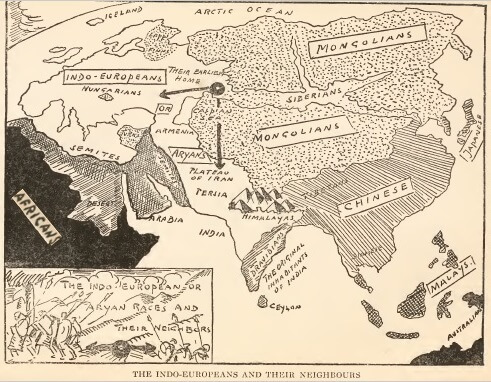
The world of Egypt and Babylon and Assyria and Phoenicia had existed almost thirty centuries, and the venerable races of the Fertile Valley were getting old and tired. Their doom was sealed when a new and more energetic race appeared upon the horizon. We call this race the Indo-European race, because it conquered not only Europe but also made itself the ruling class in the country which is now known as British India.

These Indo-Europeans were Caucasians like the Semites, but they spoke a different language which is regarded as the common ancestor of all European tongues with the exception of Hungarian and Finnish and the Basque dialects of Northern Spain.

When we first hear of them, they had been living along the shores of the Caspian Sea for many centuries. But one day they had packed their tents and they had wandered forth in search of a new home. Some of them had moved into the mountains of Central Asia and for many centuries they had lived among the peaks which surround the plateau of Iran and that is why we call them Aryans. Others had followed the setting sun and they had taken possession of the plains of Europe as I shall tell you when I give you the story of Greece and Rome.

For the moment we must follow the Aryans. Under the leadership of Zarathustra (or Zoroaster) who was their great teacher many of them had left their mountain homes to follow the swiftly flowing Indus river on its way to the sea.

Others had preferred to stay among the hills of western Asia and there they had founded the half-independent communities of the Medes and the Persians, two peoples whose names we have copied from the old Greek history-books. In the seventh century before the birth of Christ, the Medes had established a kingdom of their own called Media, but this perished when Cyrus, the chief of a clan known as the Anshan, made himself king of all the Persian tribes and started upon a career of conquest which soon made him and his children the undisputed masters of the whole of western Asia and of Egypt.

Indeed, with such energy did these Indo-European Persians push their triumphant campaigns in the west that they soon found themselves in serious difficulties with certain other Indo-European tribes which centuries before had moved into Europe and had taken possession of the Greek peninsula and the islands of the Aegean Sea.

These difficulties led to the three famous wars between Greece and Persia during which King Darius and King Xerxes of Persia invaded the northern part of the peninsula. They ravaged the lands of the Greeks and tried very hard to get a foothold upon the European continent.

But in this they did not succeed. The navy of Athens proved unconquerable. By cutting off the lines of supplies of the Persian armies, the Greek sailors invariably forced the Asiatic rulers to return to their base.

It was the first encounter between Asia, the ancient teacher, and Europe, the young and eager pupil. A great many of the other chapters of this book will tell you how the struggle between east and west has continued until this very day.

The Story of Mankind: The Phoenicians

The Phoenicians, who were the neighbors of the Jews, were a Semitic tribe which at a very early age had settled along the shores of the Mediterranean. They had built themselves two well-fortified towns, Tyre and Sidon, and within a short time they had gained a monopoly of the trade of the western seas. Their ships went regularly to Greece and Italy and Spain, and they even ventured beyond the straits of Gibraltar to visit the Scilly islands where they could buy tin. Wherever they went, they built themselves small trading stations, which they called colonies. Many of these were the origin of modern cities, such as Cadiz and Marseilles.

They bought and sold whatever promised to bring them a good profit. They were not troubled by a conscience. If we are to believe all their neighbors, they did not know what the words honesty or integrity meant. They regarded a well-filled treasure chest the highest ideal of all good citizens. Indeed, they were very unpleasant people and did not have a single friend. Nevertheless, they have rendered all coming generations one service of the greatest possible value. They gave us our alphabet.

The Phoenicians had been familiar with the art of writing, invented by the Sumerians. But they regarded these pothooks as a clumsy waste of time. They were practical businessmen and could not spend hours engraving two or three letters. They set to work and invented a new system of writing which was greatly superior to the old one. They borrowed a few pictures from the Egyptians, and they simplified a number of the wedge-shaped figures of the Sumerians. They sacrificed the pretty looks of the older system for the advantage of speed, and they reduced the thousands of different images to a short and handy alphabet of twenty-two letters.

In due course of time, this alphabet travelled across the Aegean Sea and entered Greece. The Greeks added a few letters of their own and carried the improved system to Italy. The Romans modified the figures somewhat and in turn taught them to the wild barbarians of western Europe. Those wild barbarians were our own ancestors, and that is the reason why this book is written in characters that are of Phoenician origin and not in the hieroglyphics of the Egyptians or in the nail-script of the Sumerians.

The Story of Mankind: Moses

Some time during the twentieth century before our era, a small and unimportant tribe of Semitic shepherds had left its old home, which was situated in the land of Ur on the mouth of the Euphrates, and had tried to find new pastures within the domain of the Kings of Babylonia. They had been driven away by the royal soldiers and they had moved westward looking for a little piece of unoccupied territory where they might set up their tents.

This tribe of shepherds was known as the Hebrews or, as we call them, the Jews. They had wandered far and wide, and after many years of dreary peregrinations they had been given shelter in Egypt. For more than five centuries they had dwelt among the Egyptians and when their adopted country had been overrun by the Hyksos marauders (as I told you in the story of Egypt) they had managed to make themselves useful to the foreign invader and had been left in the undisturbed possession of their grazing fields. But after a long war of independence the Egyptians had driven the Hyksos out of the valley of the Nile and then the Jews had come upon evil times for they had been degraded to the rank of common slaves and they had been forced to work on the royal roads and on the Pyramids. And as the frontiers were guarded by the Egyptian soldiers it had been impossible for the Jews to escape.

After many years of suffering they were saved from their miserable fate by a young Jew, called Moses, who for a long time had dwelt in the desert and there had learned to appreciate the simple virtues of his earliest ancestors, who had kept away from cities and city-life and had refused to let themselves be corrupted by the ease and the luxury of a foreign civilization.

Moses decided to bring his people back to a love of the ways of the patriarchs. He succeeded in evading the Egyptian troops that were sent after him and led his fellow tribesmen into the heart of the plain at the foot of Mount Sinai. During his long and lonely life in the desert, he had learned to revere the strength of the great God of the Thunder and the Storm, who ruled the high heavens and upon whom the shepherds depended for life and light and breath. This God, one of the many divinities who were widely worshipped in western Asia, was called Jehovah, and through the teaching of Moses, he became the sole Master of the Hebrew race.

One day, Moses disappeared from the camp of the Jews. It was whispered that he had gone away carrying two tablets of rough-hewn stone. That afternoon, the top of the mountain was lost to sight. The darkness of a terrible storm hid it from the eye of man. But when Moses returned, behold! there stood engraved upon the tablets the words which Jehovah had spoken unto the people of Israel amidst the crash of his thunder and the blinding flashes of his lightning. And from that moment, Jehovah was recognized by all the Jews as the Highest Master of their Fate, their only True God, who had taught them how to live holy lives when he bade them to follow the wise lessons of his Ten Commandments.

They followed Moses when he bade them continue their journey through the desert. They obeyed him when he told them what to eat and drink and what to avoid that they might keep well in the hot climate.


And finally after many years of wandering they came to a land which seemed pleasant and prosperous. It was called Palestine, which means the country of the “Pilistu” the Philistines, a small tribe of Cretans who had settled along the coast after they had been driven away from their own island.

Unfortunately, the mainland, Palestine, was already inhabited by another Semitic race, called the Canaanites. But the Jews forced their way into the valleys and built themselves cities and constructed a mighty temple in a town which they named Jerusalem, the Home of Peace.

As for Moses, he was no longer the leader of his people. He had been allowed to see the mountain ridges of Palestine from afar. Then he had closed his tired eyes for all time. He had worked faithfully and hard to please Jehovah. Not only had he guided his brethren out of foreign slavery into the free and independent life of a new home but he had also made the Jews the first of all nations to worship a single god.

The Story of Mankind: Lesson 8: The Sumerians

The fifteenth century was an age of great discoveries. Columbus tried to find a way to the island of Kathay and stumbled upon a new and unsuspected continent. An Austrian bishop equipped an expedition which was to travel eastward and find the home of the Grand Duke of Muscovy, a voyage which led to complete failure, for Moscow was not visited by western men until a generation later. Meanwhile a certain Venetian by the name of Barbero had explored the ruins of western Asia and had brought back reports of a most curious language which he had found carved in the rocks of the temples of Shiraz and engraved upon endless pieces of baked clay.

But Europe was busy with many other things and it was not until the end of the eighteenth century that the first “cuneiform inscriptions” (so-called because the letters were wedge-shaped and wedge is called “Cuneus” in Latin) were brought to Europe by a Danish surveyor, named Niebuhr. Then it took thirty years before a patient German schoolmaster by the name of Grotefend had deciphered the first four letters, the D, the A, the R and the SH, the name of the Persian King Darius. And another twenty years had to go by until a British officer, Henry Rawlinson, who found the famous inscription of Behistun, gave us a workable key to the nail-writing of western Asia.

Compared to the problem of deciphering these nail-writings, the job of Champollion had been an easy one. The Egyptians used pictures. But the Sumerians, the earliest inhabitants of Mesopotamia, who had hit upon the idea of scratching their words in tablets of clay, had discarded pictures entirely and had evolved a system of V-shaped figures which showed little connection with the pictures out of which they had been developed.

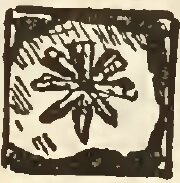
A few examples will show you what I mean. In the beginning a star, when drawn with a nail into a brick looked as follows:
This sign however was too cumbersome and after a short while when the meaning of “heaven” was added to that of star the picture was simplified which made it even more of a puzzle.
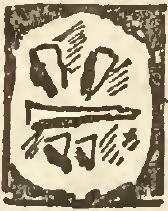
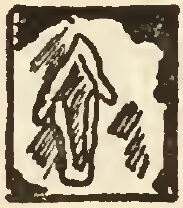
In the same way an ox changed from
into
and a fish changed from
into
The sun was originally a plain circle
and became
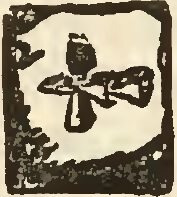
If we were using the Sumerian script today we would make an
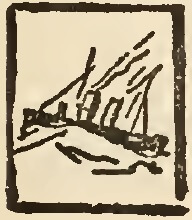
look like
This system of writing down our ideas looks rather complicated but for more than thirty centuries it was used by the Sumerians and the Babylonians and the Assyrians and the Persians and all the different races which forced their way into the fertile valley. The story of Mesopotamia is one of endless warfare and conquest. First the Sumerians came from the North. They were a Caucasian people who had lived in the mountains. They had been accustomed to worship their gods on the tops of hills. After they had entered the plain, they constructed artificial little hills on top of which they built their altars. They did not know how to build stairs, and they therefore surrounded their towers with sloping galleries. Our engineers have borrowed this idea, as you may see in our big railroad stations where ascending galleries lead from one floor to another. We may have borrowed other ideas from the Sumerians, but we do not know it.
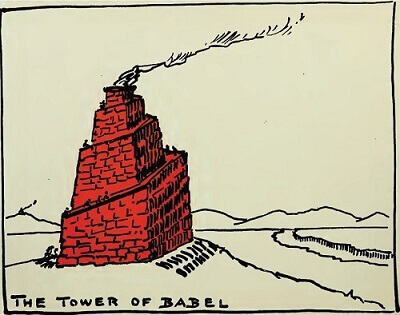
The Sumerians were entirely absorbed by those races that entered the fertile valley at a later date. Their towers however still stand amidst the ruins of Mesopotamia. The Jews saw them when they went into exile in the land of Babylon and they called them towers of Babillli, or towers of Babel. In the fortieth century before our era, the Sumerians had entered Mesopotamia. They were soon afterwards overpowered by the Akkadians, one of the many tribes from the desert of Arabia who speak a common dialect and who are known as the “Semites,” because in the olden days people believed them to be the direct descendants of Shem, one of the three sons of Noah. A thousand years later, the Akkadians were forced to submit to the rule of the Amorites, another Semitic desert tribe whose great King Hammurabi built himself a magnificent palace in the holy city of Babylon and who gave his people a set of laws which made the Babylonian state the best administered empire of the ancient world. Next the Hittites, whom you will also meet in the Old Testament, over-ran the Fertile Valley and destroyed whatever they could not carry away. They in turn were vanquished by the followers of the great desert god, Ashur, who called themselves Assyrians and who made the city of Nineveh the center of a vast and terrible empire which conquered all of western Asia and Egypt and gathered taxes from countless subject races until the end of the seventh century before the birth of Christ when the Chaldeans, also a Semitic tribe, re-established Babylon and made that city the most important capital of that day. Nebuchadnezzar, the best known of their Kings, encouraged the study of science, and our modern knowledge of astronomy and mathematics is all based upon certain first principles which were discovered by the Chaldeans. In the year 538 B.C. a crude tribe of Persian shepherds invaded this old land and overthrew the empire of the Chaldeans. Two hundred years later, they in turn were overthrown by Alexander the Great, who turned the Fertile Valley, the old melting-pot of so many Semitic races, into a Greek province. Next came the Romans and after the Romans, the Turks, and Mesopotamia, the second center of the world’s civilization, became a vast wilderness where huge mounds of earth told a story of ancient glory.

THE STORY OF MANKIND

By Hendrik Van Loon, Ph.D.

“The Story of Mankind” by Hendrik Willem Van Loon is a historical account written in the early 20th century. This work aims to present the journey of humanity from prehistoric times through ancient civilizations up to the author’s contemporary era, exploring the significant events, cultures, and figures that have shaped human history. By utilizing vivid imagery and an engaging storytelling style, the author invites readers to reflect on both the challenges faced by humanity and the creative ingenuity that has propelled human advancement. Because this is a Christian website, we skip forward in the book and start a chapter 4. For the full book click here.