A place to grow your relationship with God

Posts tagged ‘Ancient History’

The Roman Empire Part II

As for Sulla, he became “Dictator,” which meant sole and supreme ruler of all the Roman possessions. He ruled Rome for four years, and he died quietly in his bed, having spent the last year of his life tenderly raising his cabbages, as was the custom of so many Romans who had spent a lifetime killing their fellowmen.
But conditions did not grow better. On the contrary, they grew worse. Another general, Gnaeus Pompeius, or Pompey, a close friend of Sulla, went east to renew the war against the ever troublesome Mithridates. He drove that energetic potentate into the mountains where Mithridates took poison and killed himself, well knowing what fate awaited him as a Roman captive. Next, he re-established the authority of Rome over Syria, destroyed Jerusalem, roamed through western Asia, trying to revive the myth of Alexander the Great, and at last (in the year 62) returned to Rome with a dozen shiploads of defeated Kings and Princes and Generals, all of whom were forced to march in the triumphal procession of this enormously popular Roman who presented his city with the sum of forty million dollars in plunder.

It was necessary that the government of Rome be placed in the hands of a strong ruler. Only a few months before, the town had almost fallen into the hands of a good-for-nothing young aristocrat by the name of Catiline, who had gambled away his money and hoped to reimburse himself for his losses by a little plundering. Cicero, a public-spirited lawyer, had discovered the plot, had warned the Senate, and had forced Catiline to flee. But there were other young men with similar ambitions and it was no time for idle talk.

Pompey organized a triumvirate which was to take charge of affairs. He became the leader of this Vigilante Committee. Gaius Julius Caesar, who had made a reputation for himself as governor of Spain, was the second in command. The third was an indifferent sort of person by the name of Crassus. He had been elected because he was incredibly rich, having been a successful contractor of war supplies. Crassus soon went upon an expedition against the Parthians and was killed.

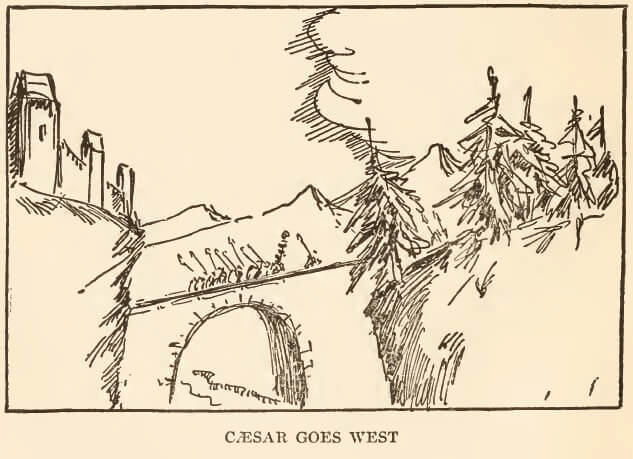
As for Caesar, who was by far the ablest of the three, he decided that he needed a little more military glory to become a popular hero. He crossed the Alps and conquered that part of the world which is now called France. Then he hammered a solid wooden bridge across the Rhine and invaded the land of the wild Teutons. Finally, he took ship and visited England. Heaven knows where he might have ended if he had not been forced to return to Italy. Pompey, so he was informed, had been appointed dictator for life. This of course meant that Caesar was to be placed on the list of the “retired officers,” and the idea did not appeal to him. He remembered that he had begun life as a follower of Marius. He decided to teach the Senators and their “dictator” another lesson. He crossed the Rubicon River which separated the province of Cis-alpine Gaul from Italy. Everywhere he was received as the “friend of the people.” Without difficulty Caesar entered Rome and Pompey fled to Greece. Caesar followed him and defeated his followers near Pharsalus. Pompey sailed across the Mediterranean and escaped to Egypt. When he landed he was murdered by order of young king Ptolemy. A few days later Caesar arrived. He found himself caught in a trap. Both the Egyptians and the Roman garrison which had remained faithful to Pompey, attacked his camp.

Fortune was with Caesar. He succeeded in setting fire to the Egyptian fleet. Incidentally the sparks of the burning vessels fell on the roof of the famous library of Alexandria (which was just off the water front,) and destroyed it. Next, he attacked the Egyptian army, drove the soldiers into the Nile, drowned Ptolemy, and established a new government under Cleopatra, the sister of the late king. Just then word reached him that Pharnaces, the son and heir of Mithridates, had gone on the war-path. Caesar marched northward, defeated Pharnaces in a war which lasted five days, sent word of his victory to Rome in the famous sentence “veni, vidi, vici,” which is Latin for “I came, I saw, I conquered,” and returned to Egypt where he fell desperately in love with Cleopatra, who followed him to Rome when he returned to take charge of the government, in the year 46. He marched at the head of not less than four different victory-parades, having won four different campaigns.

Then Caesar appeared in the Senate to report upon his adventures, and the grateful Senate made him “dictator” for ten years. It was a fatal step.

The new dictator made serious attempts to reform the Roman state. He made it possible for freemen to become members of the Senate. He conferred the rights of citizenship upon distant communities as had been done in the early days of Roman history. He permitted “foreigners” to exercise influence upon the government. He reformed the administration of the distant provinces which certain aristocratic families had come to regard as their private possessions. In short, he did many things for the good of the majority of the people but which made him thoroughly unpopular with the most powerful men in the state. Half a hundred young aristocrats formed a plot “to save the Republic.” On the Ides of March (the fifteenth of March according to that new calendar which Caesar had brought with him from Egypt) Caesar was murdered when he entered the Senate. Once more Rome was without a master.

There were two men who tried to continue the tradition of Caesar’s glory. One was Antony, his former secretary. The other was Octavian, Caesar’s grand-nephew and heir to his estate. Octavian remained in Rome, but Antony went to Egypt to be near Cleopatra with whom he too had fallen in love, as seems to have been the habit of Roman generals.

A war broke out between the two. In the battle of Actium, Octavian defeated Antony. Antony killed himself and Cleopatra was left alone to face the enemy. She tried very hard to make Octavian her third Roman conquest. When she saw that she could make no impression upon this very proud aristocrat, she killed herself, and Egypt became a Roman province.

As for Octavian, he was a very wise young man and he did not repeat the mistake of his famous uncle. He knew how people will shy at words. He was very modest in his demands when he returned to Rome. He did not want to be a “dictator.” He would be entirely satisfied with the title of “the Honorable.” But when the Senate, a few years later, addressed him as Augustus—the Illustrious—he did not object and a few years later the person in the street called him Caesar, or Kaiser, while the soldiers, accustomed to regard Octavian as their Commander-in-chief referred to him as the Chief, the Imperator or Emperor. The Republic had become an Empire, but the average Roman was hardly aware of the fact.

In 14 A.D. his position as the Absolute Ruler of the Roman people had become so well established that he was made an object of that divine worship which hitherto had been reserved for the gods. And his successors were true “Emperors”—the absolute rulers of the greatest empire the world had ever seen.

If the truth be told, the average citizen was sick and tired of anarchy and disorder. They did not care who ruled them provided the new master gave them a chance to live quietly and without the noise of eternal street riots. Octavian assured his subjects forty years of peace. Octavian had no desire to extend the frontiers of his domains, In the year 9 A.D. he had contemplated an invasion of the northwestern wilderness which was inhabited by the Teutons. But Varrus, his general, had been killed with all his men in the Teutoburg Woods, and after that the Romans made no further attempts to civilize these wild people.

The Roman people concentrated their efforts upon the gigantic problem of internal reform. But it was too late to do much good. Two centuries of revolution and foreign war had repeatedly killed the best people among the younger generations. It had ruined the class of the free farmers. It had introduced slave labor, against which no freeman could hope to compete. It had turned the cities into beehives inhabited by pauperized and unhealthy mobs of runaway peasants. It had created a large bureaucracy—petty officials who were underpaid and who were forced to take graft in order to buy bread and clothing for their families. Worst of all, it had accustomed people to violence, to bloodshed, to a barbarous pleasure in the pain and suffering of others.

Outwardly, the Roman state during the first century of our era was a magnificent political structure, so large that Alexander’s empire became one of its minor provinces. Underneath this glory there lived millions upon millions of poor and tired human beings, toiling like ants who have built a nest underneath a heavy stone. They worked for the benefit of someone else. They shared their food with the animals of the fields. They lived in stables. They died without hope.

It was the seven hundred and fifty-third year since the founding of Rome. Gaius Julius Caesar Octavianus Augustus was living in the palace of the Palatine Hill, busily engaged upon the task of ruling his empire.

In a little village of distant Syria, Mary, the wife of Joseph the Carpenter, was tending her little boy, born in a stable of Bethlehem.

This is a strange world.

Before long, the palace and the stable were to meet in open combat.

And the stable was to emerge victorious.
Athens vs. Sparta

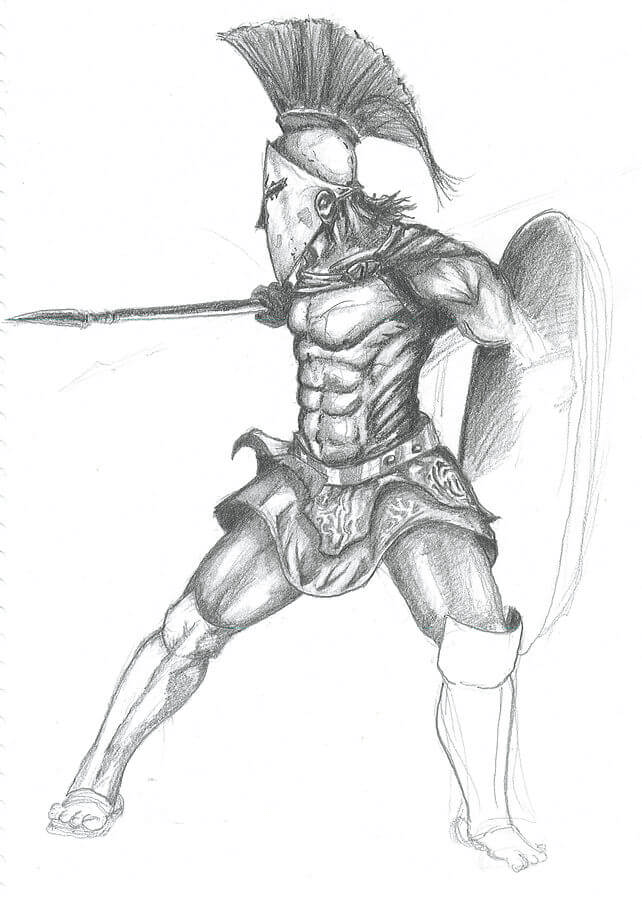
Athens and Sparta were both Greek cities and their people spoke a common language. In every other respect they were different. Athens rose high from the plain. It was a city exposed to the fresh breezes from the sea, willing to look at the world with the eyes of a happy child. Sparta, on the other hand, was built at the bottom of a deep valley, and used the surrounding mountains as a barrier against foreign thought. Athens was a city of busy trade. Sparta was an armed camp where people were soldiers for the sake of being soldiers. The people of Athens loved to sit in the sun and discuss poetry or listen to the wise words of a philosopher. The Spartans, on the other hand, never wrote a single line that was considered literature, but they knew how to fight, they liked to fight, and they sacrificed all human emotions to their ideal of military preparedness.

No wonder that these somber Spartans viewed the success of Athens with malicious hate. The energy which the defense of the common home had developed in Athens was now used for purposes of a more peaceful nature. The Acropolis was rebuilt and was made into a marble shrine to the goddess Athena. Pericles, the leader of the Athenian democracy, sent far and wide to find famous sculptors and painters and scientists to make the city more beautiful and the young Athenians more worthy of their home. At the same time, he kept a watchful eye on Sparta and built high walls which connected Athens with the sea and made her the strongest fortress of that day.

An insignificant quarrel between two little Greek cities led to the final conflict. For thirty years the war between Athens and Sparta continued. It ended in a terrible disaster for Athens.

During the third year of the war the plague had entered the city. More than half of the people and Pericles, the great leader, had been killed. The plague was followed by a period of bad and untrustworthy leadership. A brilliant young fellow by the name of Alcibiades had gained the favor of the popular assembly. He suggested a raid upon the Spartan colony of Syracuse in Sicily. An expedition was equipped and everything was ready. But Alcibiades got mixed up in a street brawl and was forced to flee. The general who succeeded him was a bungler. First he lost his ships and then he lost his army, and the few surviving Athenians were thrown into the stone-quarries of Syracuse, where they died from hunger and thirst.

The expedition had killed all the young men of Athens. The city was doomed. After a long siege the town surrendered in April of the year 404. The high walls were demolished. The navy was taken away by the Spartans. Athens ceased to exist as the center of the great colonial empire which it had conquered during the days of its prosperity. But that wonderful desire to learn and to know and to investigate which had distinguished her free citizens during the days of greatness and prosperity did not perish with the walls and the ships. It continued to live. It became even more brilliant.

Athens no longer shaped the destinies of the land of Greece. But now, as the home of the first great university the city began to influence the minds of intelligent people far beyond the narrow frontiers of Hellas.

Key Events in Ancient History: A Comprehensive Timeline

Ancient History is a fascinating subject. Here is a timeline of many of the major events that happened in History. An approximate date is also given next to the event. With the list of events will be links to articles giving more information about the event. Some of the resources are from secular sources such as The Story of Mankind.

The Persian Wars

The Greeks had learned the art of trading from the Aegeans who had been the pupils of the Phoenicians. They had founded colonies after the Phoenician pattern. They had even improved upon the Phoenician methods by a more general use of money in dealing with foreign customers. In the sixth century before our era they had established themselves firmly along the coast of Asia Minor and they were taking away trade from the Phoenicians at a fast rate. This the Phoenicians of course did not like but they were not strong enough to risk a war with their Greek competitors. They sat and waited nor did they wait in vain.

In a former chapter, I have told you how a humble tribe of Persian shepherds had suddenly gone upon the warpath and had conquered the greater part of western Asia. The Persians were too civilized to plunder their new subjects. They contented themselves with a yearly tribute. When they reached the coast of Asia Minor they insisted that the Greek colonies of Lydia recognize the Persian Kings as their overlords and pay them a stipulated tribute. The Greek colonies objected. The Persians insisted. Then the Greek colonies appealed to the home-country and the stage was set for a quarrel.

For if the truth be told, the Persian Kings regarded the Greek city-states as very dangerous political institutions and bad examples for all other people who were supposed to be the patient slaves of the mighty Persian Kings.

Of course, the Greeks enjoyed a certain degree of safety because their country lay hidden beyond the deep waters of the Aegean. But here their old enemies, the Phoenicians, stepped forward with offers of help and advice to the Persians. If the Persian King would provide the soldiers, the Phoenicians would guarantee to deliver the necessary ships to carry them to Europe. It was the year 492 before the birth of Christ, and Asia made ready to destroy the rising power of Europe.

As a final warning the King of Persia sent messengers to the Greeks asking for “earth and water” as a token of their submission. The Greeks promptly threw the messengers into the nearest well where they would find both “earth and water” in large abundance and thereafter of course peace was impossible.

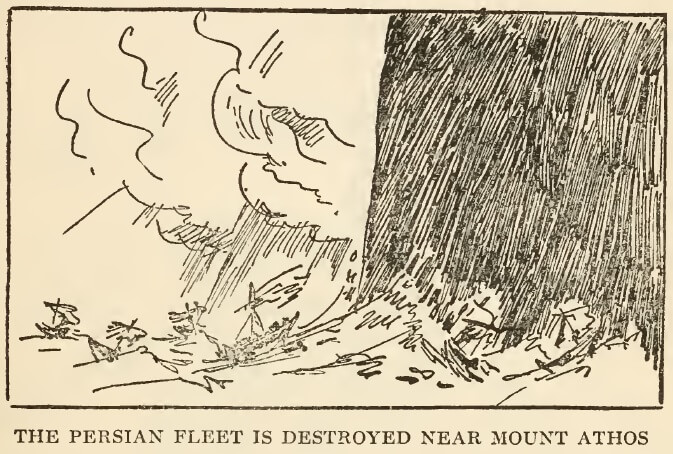
But the gods of High Olympus watched over their children and when the Phoenician fleet carrying the Persian troops was near Mount Athos, the Storm-god blew his cheeks until he almost burst the veins of his brow, and the fleet was destroyed by a terrible hurricane and the Persians were all drowned.

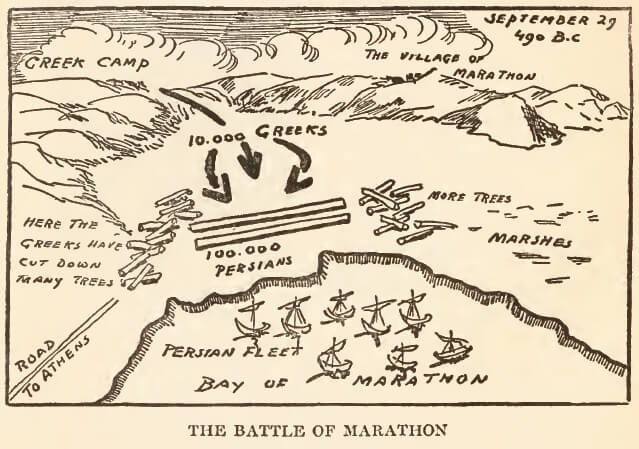
Two years later they returned. This time they sailed straight across the Aegean Sea and landed near the village of Marathon. As soon as the Athenians heard this they sent their army of ten thousand men to guard the hills that surrounded the Marathonian plain. At the same time, they dispatched a fast runner to Sparta to ask for help. But Sparta was envious of the fame of Athens and refused to come to her assistance. The other Greek cities followed her example with the exception of tiny Plataea which sent a thousand men. On the twelfth of September of the year 490, Miltiades, the Athenian commander, threw this little army against the hordes of the Persians. The Greeks broke through the Persian barrage of arrows and their spears caused terrible havoc among the disorganized Asiatic troops who had never been called upon to resist such an enemy.

That night the people of Athens watched the sky grow red with the flames of burning ships. Anxiously they waited for news. At last a little cloud of dust appeared upon the road that led to the North. It was Pheidippides, the runner. He stumbled and gasped for his end was near. Only a few days before had he returned from his errand to Sparta. He had hastened to join Miltiades. That morning he had taken part in the attack and later he had volunteered to carry the news of victory to his beloved city. The people saw him fall and they rushed forward to support him. “We have won,” he whispered and then he died, a glorious death which made him envied of all men.

As for the Persians, they tried, after this defeat, to land near Athens but they found the coast guarded and disappeared, and once more the land of Hellas was at peace.

Eight years they waited and during this time the Greeks were not idle. They knew that a final attack was to be expected but they did not agree upon the best way to avert the danger. Some people wanted to increase the army. Others said that a strong fleet was necessary for success. The two parties led by Aristides (for the army) and Themistocles (the leader of the bigger-navy men) fought each other bitterly and nothing was done until Aristides was exiled. Then Themistocles had his chance and he built all the ships he could and turned the Piraeus into a strong naval base.

In the year 481 B.C. a tremendous Persian army appeared in Thessaly, a province of northern Greece. In this hour of danger, Sparta, the great military city of Greece, was elected commander-in-chief. But the Spartans cared little what happened to northern Greece provided their own country was not invaded. They neglected to fortify the passes that led into Greece.

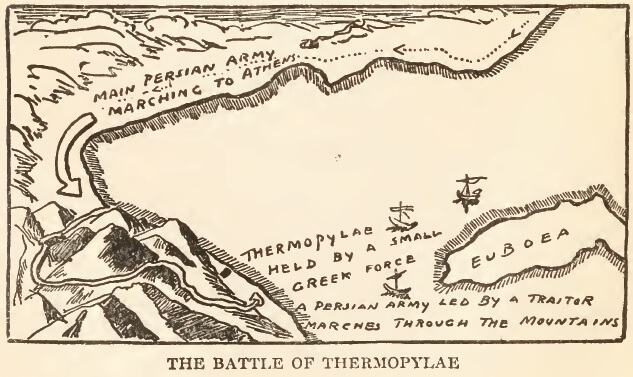
A small detachment of Spartans under Leonidas had been told to guard the narrow road between the high mountains and the sea which connected Thessaly with the southern provinces. Leonidas obeyed his orders. He fought and held the pass with unequalled bravery. But a traitor by the name of Ephialtes who knew the little byways of Malis guided a regiment of Persians through the hills and made it possible for them to attack Leonidas in the rear. Near the Warm Wells—the Thermopylae—a terrible battle was fought.

When night came Leonidas and his faithful soldiers lay dead under the corpses of their enemies.

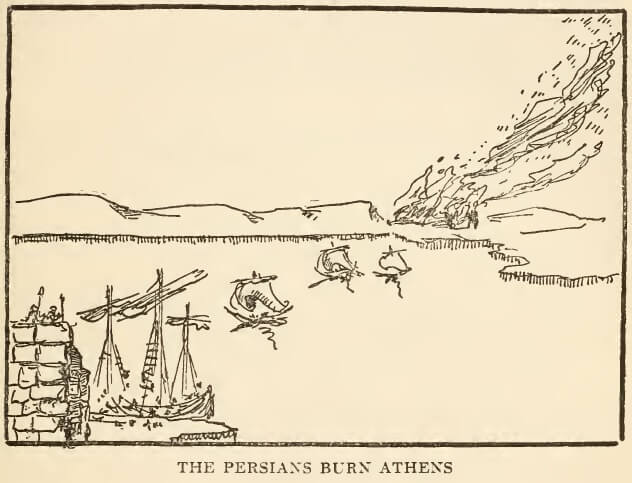
But the pass had been lost and the greater part of Greece fell into the hands of the Persians. They marched upon Athens, threw the garrison from the rocks of the Acropolis and burned the city.

The people fled to the Island of Salamis. All seemed lost. But on the 20th of September of the year 480 Themistocles forced the Persian fleet to give battle within the narrow straits which separated the Island of Salamis from the mainland and within a few hours he destroyed three quarters of the Persian ships.

In this way the victory of Thermopylae came to naught. The Persian leader Xerxes was forced to retire. The next year, so he decreed, would bring a final decision. He took his troops to the Greek region of Thessaly and there he waited for spring.

But this time the Spartans understood the seriousness of the hour. They left the safe shelter of the wall which they had built across the isthmus of Corinth and under the leadership of Pausanias they marched against Mardonius the Persian general. The united Greeks (some one hundred thousand men from a dozen different cities) attacked the three hundred thousand men of the enemy near Plataea. Once more the heavy Greek infantry broke through the Persian barrage of arrows. The Persians were defeated, as they had been at Marathon, and this time they left for good. By a strange coincidence, the same day that the Greek armies won their victory near Plataea, the Athenian ships destroyed the enemy’s fleet near Cape Mycale in Asia Minor.

Thus did the first encounter between Asia and Europe end. Athens had covered herself with glory and Sparta had fought bravely and well. If these two cities had been able to come to an agreement, if they had been willing to forget their little jealousies, they might have become the leaders of a strong and united Hellas.

But alas, they allowed the hour of victory and enthusiasm to slip by, and the same opportunity never returned.