A place to grow your relationship with God

Posts tagged ‘Bible Study’

Melchizedek and Christ: Unraveling the Theological Mystery

Who was Melchizedek (sometimes spelled Melchisedec). Paul refers to him in Hebrews chapter 7

  • Hebrews 7:1-3
    • For this Melchisedec, king of Salem, priest of the most high God, who met Abraham returning from the slaughter of the kings, and blessed him;
    • To whom also Abraham gave a tenth part of all; first being by interpretation King of righteousness, and after that also King of Salem, which is, King of peace;
    • Without father, without mother, without descent, having neither beginning of days, nor end of life; but made like unto the Son of God; abideth a priest continually.

The writer of Hebrews noted that Melchizedek had no recorded genealogy in the priesthood, possibly because records weren’t kept in Abraham’s time. Moses later wrote about this meeting (see Gen. 14) when he composed the Torah in the wilderness, centuries after Abraham’s encounter with Melchizedek.

The writer of Hebrews and his audience understood that the Jewish priesthood began during Moses’ time in the wilderness, following the revelation of the Ten Commandments and the building of the tabernacle. Aaron was the first high priest, succeeded by his sons, and from then on, the names of all high priests serving in the tabernacle and later in the temple were carefully recorded and preserved. Hebrews 7 refers to Psalm 110:4.

  • “You are a priest forever, after the order of Melchizedek.”

When the writer of Hebrews said Melchizedek was without father, mother, or genealogy,

  • it meant there was no written record of his origins, unlike the documented lineage of the sons of Levi from Aaron, who served in the tabernacle.

Hebrews compares the ministries of Christ and Melchizedek.

  • Melchizedek appeared without a recorded past and was both king and priest,
  • Christ also belonged to that same priestly order, having no earthly father and not coming from the tribe of Levi, from which the sons of Aaron descended.
    • All priests came from the tribe of Levi, but Christ was from the tribe of Judah.
    • Being from Judah connected Him to the lineage of David and gave Him the rights of royalty, yet it also meant He was not from the priestly line.
  • The writer of Hebrews emphasized this uniqueness:
    • Christ was the High Priest from the tribe of Judah.
      • Christ is both a priest and a King.
    • Melchizedek was a king-priest.

Now here is a simple yet complicated theological question:

If Melchizedek was a pre-incarnation of Jesus Christ, then how could he be after the order of what he already was?

  • This would make him an order of himself.
  • Secondly, this would imply that Christ lived in the flesh more than 1,800 years before He became flesh, meaning that He became flesh twice.
    • This would justify the heretical teaching of reincarnation that is part of the Hindu religion.

I believe there is a simple yet very interesting possibility as to who this mysterious first king and priest of Jerusalem was. The story begins with Noah.

Remember that Noah had 3 sons.
The three sons of Noah Shem, Ham, and Japheth would eventually settle in different parts of the world and begin repopulating the earth. The book of Genesis lists the names of the descendants of Noah’s sons, and researchers identify the early nations with the parts of the earth.

  • Ham’s descendants settled in the area of northern Africa.
  • Japheth’s descendants settled in Russia and northern Europe
  • Shem’s descendants chose Arabia, Palestine, and Syria.

Of the three sons of Noah, there is one through whom the lineage of the Messiah came – the lineage of Shem. Noah gave a powerful prophecy to Shem in Genesis 9:26:

  • “And he said, Blessed be the Lord God of Shem; and Canaan shall be his servant.”

Noah continues this prophecy in Genesis 9:27:

  • “God shall enlarge Japheth, and he shall dwell in the tents of Shem; and Canaan shall be his servant.”

This prophecy is very revealing.

  • Noah mentions Canaan, the fourth son of Ham, twice.
    • Canaan became the father of the Canaanites, who are mentioned throughout the Old Testament.
      • The many tribes living in Israel during the time of Joshua and the judges were descendants of Canaan.
    • Since Canaan would serve Shem, it seems that Shem or his descendants would rule over Canaan.
      • Noah also refers to the tents of Shem, meaning the children of Shem dwelling near Canaan.
      • It’s possible that Shem himself settled in the land of Canaan, known today as Israel.
    • The Hebrew people descended from Shem’s lineage through his great-grandson Eber (see Gen. 10:21-24).
      • Terah, Abraham’s father, was also from Shem’s line, making him part of the She tribal identity. Abraham’s descendants were called Hebrews, from the word “Ibriy,” meaning “an Eberite,” referring to their descent from Eber in Shem’s lineage.

The Shem Connection
For centuries, Jewish sages have believed that the Melchizedek mentioned in Scripture was actually Shem, the righteous son of Noah who settled in Canaan, particularly in a place called Salem, later known as Jerusalem.

  • Genesis 14:18 And Melchizedek king of Salem brought forth bread and wine: and he was the priest of the most high God.

This view is reflected in the book of Jasher, which says that Shem and Eber lived in Jerusalem and ran a special teaching academy there. According to Jasher, several patriarchs sent their sons to this academy for spiritual instruction.

  • Jasher XVI, 11 “And Anonizedek, king of Jerusalem, who was Shem, went out with his men to meet Abram and his people with bread and wine, and they remained together in the valley of Melech”.

The book also says Shem and Eber were present at Sarah’s burial:

  • Jasher XXIV, 14-15 “And Abraham buried Sarah with pomp… And at the bier was Shem, his son Eber…”.

After Sarah’s death, it adds:

  • Jasher XXIV, 17 “When the days of mourning had passed, Abraham sent his son Isaac to the house of Shem and Eber to learn the ways of the Lord and His instructions, and he remained there three years”.

The first argument that arises when we teach that Melchizedek was actually Shem, to whom the lineage of the Hebrews came and the Messiah was promised, is this:

  • Wouldn’t Shem have already died before the time of Abraham and Isaac?

The answer is no.

  • Shem was about one hundred years old when the flood came and covered the earth (compare Gen. 5:32 and Gen. 7:6).
    • Two years after the flood, Shem’s son Arphaxad was born (see Gen. 11:10).
    • Shem was 102 years old at that time.
  • Eber, his great-grandson, was born when Shem was about 173 years old.
  • If we move forward to the time of Abraham and Isaac:
    • Shem died when he was six hundred years of age (see Gen. 11:10-11).
    • According to the chronology of scholars:
      • Abraham lived to the year 2121 BC
      • Shem lived until 2156 BC.

Therefore, Shem was still living in the time of Abraham and into the time of Isaac.

At the time of Shem, Jerusalem (called Salem) was separated into two divisions: the lower slope and the upper slope.

  • The lower slope
    • The lower slope included the eastern slope of the area known as the Temple Mount.
      • The east was called Salem (or in Hebrew Shalem)
  • The upper city (or western area) included the Temple Mount and part of the area where the future altar of the temple would sit.
    • The west was called Yirah (a name given by Abraham in Gen. 22:14).
  • The two names joined together to form the name Jerusalem.

The early city became large enough to be governed by Shem, who was given the title Melchizedek. Under Melchizedek, both slopes of the city were joined together.

When Abraham met Melchizedek, this king-priest was controlling the lower section of the city identified in Scripture as the “king’s dale” (see Gen. 14:17). Today this area is called the Kidron Valley, which runs below the Eastern Gate toward the village of Silwan.
Seeing that Shem would rule over Canaan and that the Hebrews were identified with Shem’s great-grandson Eber (don’t forget that Shem was still living in the time of Abraham and that from his lineage came the Messiah), Melchizedek could have been Shem.

The book of Hebrews emphasizes that Melchizedek was both a king and a priest; he is a picture of the ministry of Christ.

  • Jesus is presently the High Priest of the profession of our faith.
    • Hebrews 8:1 Now of the things which we have spoken this is the sum: We have such an high priest, who is set on the right hand of the throne of the Majesty in the heavens;
    • Hebrews 9:11 But Christ being come an high priest of good things to come, by a greater and more perfect tabernacle, not made with hands, that is to say, not of this building;
  • He will return to earth in the future to be proclaimed the King of kings.
    • Psalms 110:4 The Lord hath sworn, and will not repent, Thou art a priest for ever after the order of Melchizedek.
    • Hebrews 7:1-3
      • For this Melchisedec, king of Salem, priest of the most high God, who met Abraham returning from the slaughter of the kings, and blessed him;
      • To whom also Abraham gave a tenth part of all; first being by interpretation King of righteousness, and after that also King of Salem, which is, King of peace;
      • Without father, without mother, without descent, having neither beginning of days, nor end of life; but made like unto the Son of God; abideth a priest continually.

The writer of Hebrews compares Christ to Melchizedek but never says He was Melchizedek.
Since Melchizedek was a king-priest and Jesus is after the order of Melchizedek (king-priest), then all believers are a part of the same priesthood.

  • We are presently priests unto God offering sacrifices of praise and financial gifts to Christ who receives them in heaven.
    • Hebrews 7:8 And here men that die receive tithes; but there he receiveth them, of whom it is witnessed that he liveth.
  • In the future, we will rule and reign with Christ on earth as kings:
    • Revelation 1:6 “And hath made us kings and priests unto God and his Father; to him be
      glory and dominion for ever and ever. Amen.”
  • As priests we have spiritual authority to approach God in heaven. As kings we will be given spiritual dominion on the earth during the thousand-year reign of Christ. This is why it is important to understand that Christ is after the order of Melchizedek.
Understanding Apologetics: A Defense of Christian Faith

Apologetics is the study and practice of giving answers for the reasonableness and truth of the Christian faith.

  • Apologetics comes from the Greek apologia
    • means “to give a defense.”
      • it refers to a verbal defense or a reasoned statement or argument.
  • Apologetics is the branch of theology which deals with giving a defense of the Christian faith.

In 1 Peter 3:15, Christians are commanded to give an apologia to anyone who asks the reason for our hope.

  • 1 Peter 3:15 But sanctify the Lord God in your hearts: and be ready always to give an answer to every man that asketh you a reason of the hope that is in you with meekness and fear:

In a world where God’s Word often faces criticism both inside and outside the church, we should be ready to share the hope we have. Christianity is grounded in real history—actual people and events that truly happened. While we can counter arguments and explain the reasons for our faith, if we don’t point others to the life-changing gospel of Jesus Christ, we haven’t really defended the faith. Scripture reminds us to do this with meekness and fear, meaning we’re not here just to win arguments. Too often, Christian apologists can come across as loud, unkind, or prideful. We should proclaim the truth boldly, yet with self-control and the mindset of a messenger delivering the King’s message. We also act with reverent fear, knowing it’s only by God’s grace that we’ve been made ambassadors for Him, and that without the Holy Spirit’s work, our efforts alone can’t bring anyone to salvation. Above all, we must be careful not to misrepresent God by misusing the truth He’s entrusted to us.

These days, many Christians lack the discipline and discernment to defend their faith against “the fiery darts of the wicked one” (Ephesians 6:16). Over time, the church has become less effective at reaching those who are lost. While there are several reasons for this, a major one is that many believers have trouble explaining or defending their beliefs. As a result, Christianity is often viewed as a “blind faith,” and its followers are seen as uninformed or easily influenced.

Christianity isn’t a “blind faith” but is rooted in the God and His perfect, revealed Word. Hebrews 11:1 describes faith as “the substance of things hoped for, the evidence of things not seen.” So how can faith involve “evidence”? Because it’s anchored in real history—genuine people and events. While evidence can’t definitively prove the Bible’s truth, it can demonstrate that it supports Scripture. Viewed through the lens of God’s Word instead of human opinion, the evidence fits seamlessly with the Bible.

Throughout the New Testament the Early Leaders of the Church practiced apologetics. The authors of Scripture accurately recorded historical events, including the miracles of our Lord Jesus Christ and His Crucifixion and Resurrection.

  • Peter:
    • Wrote about the early followers of Christ:
      • 2 Peter 1:16 “For we did not follow cunningly devised fables when we made known to you the power and coming of our Lord Jesus Christ, but were eyewitnesses of His majesty”.
      • The Apostle Peter also instructed his readers to
        • “sanctify the Lord God in your hearts, and always be ready to give a defense to everyone who asks you a reason for the hope that is in you, with meekness and fear” (1 Peter 3:15).
  • Jude
    • Informed his readers about the importance of earnestly contending “for the faith which was once for all delivered to the saints” (Jude 3).
  • Paul
    • Practiced apologetics as he regularly went first to a town’s synagogue and “reasoned with them from the Scriptures, explaining and demonstrating that the Christ had to suffer and rise from the dead” (Acts 17:2, 18:4, emphasis added).
    • Paul reasoning with the religious leaders of the day does not sound like the actions of a man who had a blind faith.
    • Knew his faith was defensible.
      • He had encountered Christ on the road to Damascus (Acts 9:1–8)
      • He told the Corinthians that over 500 people had witnessed the resurrected Savior at the same time (1 Corinthians 15:6).

For information on where in history the various event wrote about in the Bible took place, please visit Key Events in Ancient History: A Comprehensive Timeline.

For more information read: The Importance of Knowing Your Christian Faith

Key Judges Before Israelite Kings: A Historical List

Israel had many judges before they got a king. God would raise up a judge to deliver the Israelites from their oppressors. Here is a list of the first 12 judges of Isreal.

JudgeScripture ReferenceOppressorYears in bondageYears of Peace
OthnielJudges 3:7-11The king of Mesopotamia8 Years40 years of rest
EhudJudges 3:12-30Eglon, king of Moab18 Years 80 Years of rest
ShamgarJudges 3:31The Philistines? Doesn’t say? Doesn’t say
Deborah and BarakJudges 4:1-5:31Jabin, king of Canaan20 years40 years of rest
GideonJudges 6:1-8:35The Midianites7 years40 years of rest
TolaJudges 10:1-2? not listed? Doesn’t say23 years that he judged
JairJudges 10:3-5? not listed ? Doesn’t say22 years that he judged
JephthahJudges 10:6-12:7The Ammonites18 years 6 years
IbzanJudges 12:8-10? not listed ? Doesn’t say7 years
ElonJudges 12:11-12? not listed ? Doesn’t say10 years
AbdonJudges 12:13-15? not listed ? Doesn’t say8 years
Samson13:1-16:31The Philistines40 Years20 years

For more information on the Judges read Understanding the Judges of Israel: A Deep Dive

The Pharisee and the Tax Gatherer

THE PHARISEE AND THE TAX-GATHERER

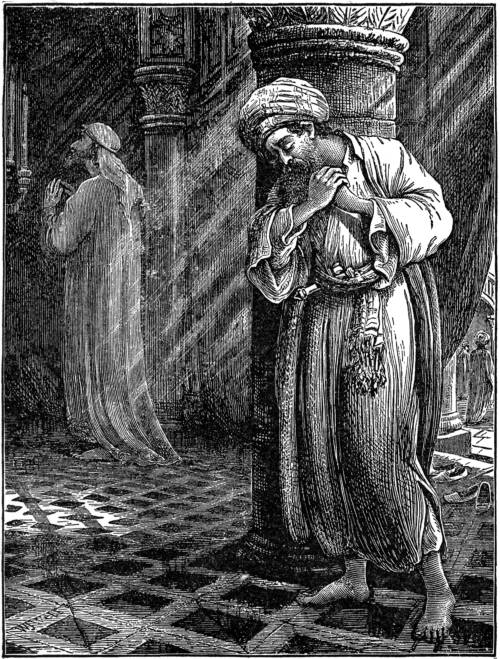
The tax-gatherers in those days were called Publicans. They were reputed to be very unjust, exacting from people more than the law required them to pay, and other wickedness was charged against them. Of course, there were good men among them; St. Matthew was a tax-gatherer before Jesus called him to follow Him. The Pharisees studied the Scriptures and explained them to the people, but they did not follow the teachings of Scripture. They were proud, and pretended they were more religious than other men, but it was only pretense. Jesus compared them to whited sepulchres, and said they were hypocrites, who led the people astray.

A Pharisee and a Publican went up into the Temple to pray. The Pharisee stood in a part of the Temple where all could see him, and prayed thus: “O God, I thank Thee that I am not like other men, who are unjust, and who take more than belongs to them. I thank Thee that I am not like this Publican. I fast twice a week; I give to the priests and Levites a tenth part of all I possess.” But the Publican, who knew that he was wicked, and felt sorry for it, stood afar off in a quiet part of the Temple where none would see him. He bowed his head and beat upon his breast, saying, “God be merciful to me a sinner.”

Jesus said that this Publican went to his home more forgiven than the Pharisee, for every one that is proud and thinks much of himself shall be put down, and he that humbleth himself and is sorry for his sins, shall be exalted. “Blessed are the meek, for they shall inherit the earth,” says Jesus.

The Importance of Keeping Vows in the Bible

THE LAW OF MAKING A VOW

Moses establishes the lawn of making a vow. The Bible clearly states that a vow is a very serious thing and is not be taken lightly.

  • Ecclesiastes 5:4-6  
    • When thou vowest a vow unto God, defer not to pay it; for he hath no pleasure in fools: pay that which thou hast vowed.
    • Better is it that thou shouldest not vow, than that thou shouldest vow and not pay.

In the Bible, a vow is a promise made to God. The first mention of a vow is about Jacob, who dreamed of a ladder reaching from heaven to earth, with angels going up and down on it. He took this as a sign of God’s favor on the place where he slept and named it “Bethel,” meaning “House of God.” Jacob also vowed that if the Lord blessed him, he would return a tenth (tithe) back to God (Genesis 28:10-22).

The Vow: Neder or Issar?

There are two types of Hebrew vows. One is called a neder and the other issar.

  • The neder vow is when a man vows a vow unto God.
    • We would say that tithing is a neder vow
  • The issar vow is when a man swears an oath to bind his soul with a bond
    • marriage between a man and a woman is an issar vow

Nazarite Vow
One of the strongest vows in the Bible was the Nazarite vow. A Nazarite vow could be a voluntary vow
commanded vow. For example, two men in the Bible were to be Nazarites from their mother’s womb-Samson and Samuel (see Judg. 13-1-7; 1 Sam. 1:11). According to Numbers 6, a Nazarite vow consisted of three parts:

  1. A Nazarite was never to drink wine or strong drink.
    • Numbers 6:3 He shall separate himself from wine and strong drink, and shall drink no vinegar of wine, or vinegar of strong drink, neither shall he drink any liquor of grapes, nor eat moist grapes, or dried. All the days of his separation shall he eat nothing that is made of the vine tree, from the kernels even to the husk.
  2. A Nazarite was never to use a razor to shave his hair.
    • Numbers 6:5 All the days of the vow of his separation there shall no razor come upon his head: until the days be fulfilled, in the which he separateth himself unto the Lord, he shall be holy, and shall let the locks of the hair of his head grow.
  3. A Nazarite was never to touch a dead body, human or animal.
    • Numbers 6:6 All the days that he separateth himself unto the Lord he shall come at no dead body.

Samson is a prime example of someone who broke a Nazarite vow.

  • He attended a seven-day feast (believed to be a wedding feast) where no doubt people were drinking wine. Yet he arose and accomplished a great feat through the anointing of the Spirit (see Judg. 14-10-20).
  • He had touched the carcass of a lion (see Judg. 14.8-9) and the jawbone of a donkey (see Judg. 15:15-17).
    • Touching a dead body was forbidden in the vow, yet the Spirit of God touched him again.
  • Finally, he rested in Delilah’s lap and under pressure revealed the final aspect of his vow to God (never to shave his hair).
    • Delilah subsequently cut his hair, breaking the third part of the vow (see Judg. 16:1-19)
    • When Samson awoke, he assumed the Lord would continue to anoint him; however, the Spirit departed from him (see Judg. 16:20
      • God had extended His mercy through two acts of vow breaking, but when the third and final commandment of the vow was broken, God was no longer obligated to anoint Samson.

Foolish Vows

  • The most foolish vow in the Old Testament
    • The vow took place when a judge named Jephthah vowed that if God would help him defeat the descendants of Ammon in battle, the first thing to come out of his house following the conflict would become a burnt offering unto the Lord.
      • Judges 11:30-31
        • And Jephthah vowed a vow unto the Lord, and said, If thou shalt without fail deliver the children of Ammon into mine hands,
        • Then it shall be, that whatsoever cometh forth of the doors of my house to meet me, when I return in peace from the children of Ammon, shall surely be the Lord’s, and I will offer it up for a burnt offering.
    • After a great victory, Jephthah returned home and his only child, a daughter, met him. She was dancing with a tambourine because of her father’s victory.
    • Then the judge remembered his foolish vow. Jephthah knew the power of the vow.
      • He said, “I have opened my mouth unto the Lord, and I cannot go back” (Judg. 11:35).
    • The reason this vow was so serious is that he made a neder vow to God.
  • The most foolish vow in the New Testament
    • This vow took place when a renegade band of forty men with a hateful agenda bound themselves with an oath” that they would not eat or drink until they killed the apostle Paul (Acts 23:21
    • The conspiracy was exposed, and Paul was secretly escorted out of the city (see Acts 23:20-35).
      • Did these forty men eventually starve to death? Probably not. When they realized that Paul was in safe hands, away from their reach, they went back to eating and drinking. Their death vow was made in the heat of the moment.
      • This vow is an issar vow made to men, which is not bound by the Holy Spirit, can be repented of.

All Vows are serious and should never be treated lightly.
Many people make vows to God in times of trouble.

  • For examples:
    • when a child is ill or in an accident, parents may tell God, “let my child live and I will serve you and and attend church.
    • Others my have a companion dying and will cry out, “heal my companion. I can’t live without this person. If you do, I will follow you!”
    • Some end up in prison and will say, “Get me out and I will minister to others.”
    • A businessman about to go bankrupt may promise God, “if you will save and prosper my business, I will tithe and support your work.
  • Sometimes the child recovers, the loved one is healed, the prisoner is released, and the business is saved, but within a few months, the people forget the vow that they had made to the Lord.
  • People do not realize that the Holy Spirit takes the promises they make very seriously.
    • Your promises are not mere words but are equal to a sacrifice laid on the altar for transgression under the Old Covenant.

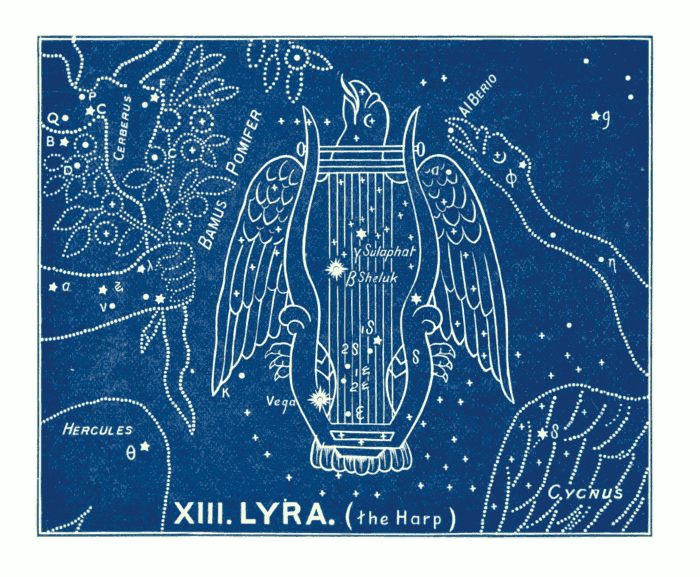
Witness of the Stars: Lyra (the Harp)

1. LYRA (The Harp)

Praise prepared for the Conqueror.

“Praise waiteth for thee, O God, in Zion” (Ps. lxv. 1). And when the waiting time is over, and the Redeemer comes forth, then the praise shall be given. “We give Thee thanks, O Lord God, the Almighty, which art, and which wast, because thou hast taken to Thee Thy great power, and didst reign” (Rev. xi. 17, r.v.). “Let us be glad and rejoice and give honour unto Him” (Rev. xix. 7). The Twenty-first Psalm should be read here, as it tells of the bursting forth of praise on the going forth of this all-gracious Conqueror.

“The King shall rejoice in Thy strength, O Lord;

And in Thy salvation how greatly shall He rejoice!…

Thine hand shall find out all Thine enemies;

Thy right hand shall find out all that hate thee….

Their fruit shalt Thou destroy from the earth;

And their seed from among the children of men.

For they intended evil against Thee;

They imagined a mischievous device which they are not able to perform,

Therefore shalt thou make them turn their back (Heb. Margin, set them as a butt),

When Thou shalt make ready Thine arrows upon Thy strings

[And shoot them] against the face of them.

Be thou exalted, Lord, in thine own strength;

SO WILL WE SING AND PRAISE THY POWER.”

(Ps. xxi. 1, 8, 10-13.)

Beautifully, then, does the harp come in here, following upon the going forth of this victorious Horseman. This Song of the Lamb follows as naturally as does the Song of Moses in Ex. xv. 1: “I will sing unto the Lord, for He hath triumphed gloriously.”

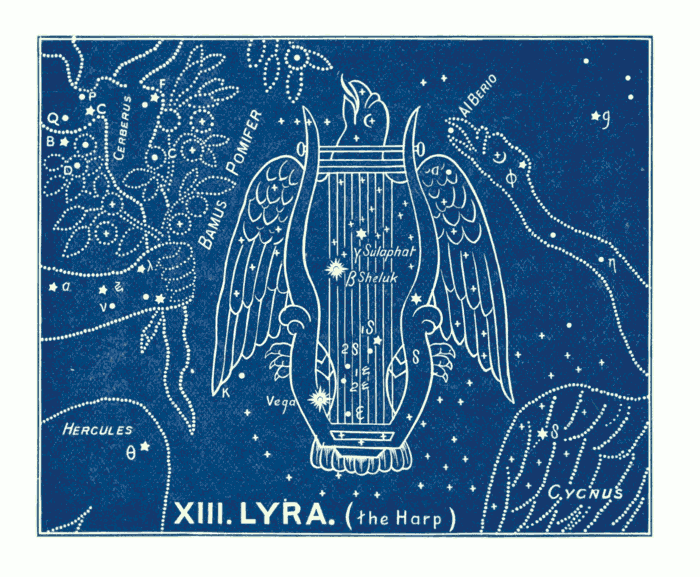
Plate 13: LYRA (the Harp)

Its brightest star, α, is one of the most glorious in the heavens, and by it this constellation may be easily known. It shines with a splendid white lustre. It is called Vega, which means He shall be exalted. Its root occurs in the opening of the Song of Moses, quoted above. Is not this wonderfully expressive?

Its other stars, β and γ, are also conspicuous stars, of the 2nd and 4th magnitude. β is called Shelyuk, which means an eagle (as does the Arabic, Al Nesr); γ is called Sulaphatspringing up, or ascending, as praise.

In the Zodiac of Denderah, this constellation is figured as a hawk or an eagle (the enemy of the serpent) in triumph. Its name is Fent-kar, which means the serpent ruled.

There may be some confusion between the Hebrew נֶשֶׁר, Nesheran eagle, and עָשׂוֹר, Gnasora harp; but there can be no doubt about the grand central truth, that praise shall ascend up “as an eagle toward heaven,” when “every creature which is in heaven, and on the earth, and such as are in the sea, and all that is in them,” shall send up their universal song of praise: “Blessing, and honour, and glory, and power, be unto Him that sitteth upon the throne and unto the Lamb for ever and ever. Amen” (Rev. v. 13, 14).

And for what is all this wondrous anthem of Praise? Listen once again. “Alleluia: Salvation, and glory, and honour, and power, unto the Lord our God; for TRUE AND RIGHTEOUS ARE HIS JUDGMENTS…. And again they said Alleluia” (Rev. xix. 1-3).

With “that blessed hope” before us,

Let no harp remain unstrung,

Let the coming advent chorus

Onward roll from tongue to tongue, Hallelujah,

“Come, Lord Jesus,” quickly come.

The Symbolism of Staffs in Biblical History

In ancient times, it was customary for every man to carry a staff—a large, straight stick used for traveling, walking, and recording information. Often, details were carved along the sides of the staff from top to bottom.

Abraham passed his staff to Isaac, who then gave it to Jacob. In Genesis 32:10, Jacob says, “With my staff I crossed over this Jordan…” This staff may have carried engravings of the family’s history and the covenant promises. Later, as Jacob was dying in Egypt, he leaned on the top of his staff and worshiped God.

  • Hebrew 11:21 By faith Jacob, when he was a dying, blessed both the sons of Joseph; and worshipped, leaning upon the top of his staff.

Traditionally, the family staff would go to the firstborn, Reuben, but because Reuben dishonored his father, it was given instead to the fourth son, Judah (Gen. 49:10).

When the Israelites were given the instructions for how to eat the first Passover, the instructions included a staff.

  • Exodus 12:11 And thus shall ye eat it; with your loins girded, your shoes on your feet, and your staff in your hand; and ye shall eat it in haste: it is the Lord’s passover.

God wanted the Israelites to bring the staffs with the old inscriptions on them. He also wanted them handy to carve the new inscriptions.

Later in Scripture, when the Shunammite woman’s son dies, Elisha tells his servant Gehazi, “Lay my staff on the child’s face” (2 Kings 4:29). Since significant personal events could be recorded on the staff, Elijah likely noted the miraculous birth of this child (see 2 Kings 4:12–17).

When David faces Goliath, he brings his sling, five stones, and his staff (1 Sam. 17:40). He’s ready to mark his victory over Goliath on that wooden staff. Later, as a shepherd writing the twenty-third Psalm, David says, “Thy rod and thy staff they comfort me” (Ps. 23:4). This may refer to the Word of God given to him prophetically or to the idea that God’s promises are inscribed on his staff, reminding him that God is always with him.

When Jesus was preparing his disciples to send them out two by two, he gave them specific instructions.

  • Mark 7:8 And commanded them that they should take nothing for their journey, save a staff only; no scrip, no bread, no money in their purse:

Notice he said, “take nothing for their journey, save a staff only“. I believe that he was telling them take a staff so that you can record the major events.

Today, believers speak the written Word of God and call upon the blessings of the Almighty by reminding Him of His covenant promise.

  • Isaiah 43:25-26  
    • I, even I, am he that blotteth out thy transgressions for mine own sake, and will not remember thy sins.
    • Put me in remembrance: let us plead together: declare thou, that thou mayest be justified.

Chapter IV. The Sign SAGITTARIUS

Chapter IV. The Sign SAGITTARIUS

The Redeemer’s Triumph.

This is the concluding chapter of the first great book of this Heavenly Revelation; and it is occupied wholly with the triumph of the Coming One, who is represented as going forth “conquering and to conquer.”

The subject is beautifully set forth in the written Word (Ps. xlv. 3-5):—

“Gird Thy sword upon Thy thigh, O most mighty,

[Gird Thyself] with Thy glory and Thy majesty,

And in Thy majesty ride prosperously,

Because of truth, and meekness, and righteousness;

And Thy right hand shall teach Thee terrible things.

Thine arrows are sharp in the heart of the King’s enemies;

Whereby the people fall under Thee.”

John, in his apocalyptic vision, sees the same mighty Conqueror going forth. “I saw (he says) a white horse, and He that sat on him had a bow, … and He went forth conquering and to conquer” (Rev. vi. 2).

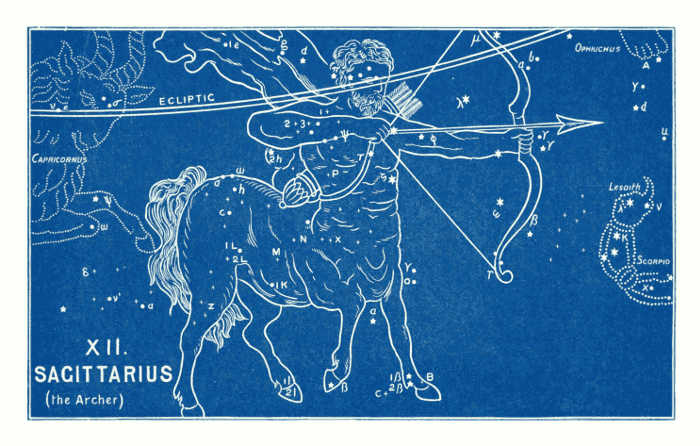
This is precisely what is foreshadowed in the star-pictured sign now called by the modern Latin name Sagittarius, which means the Archer.

The Hebrew and Syriac name of the sign is Kesith, which means the Archer (as in Gen. xxi. 20). The Arabic name is Al Kausthe arrow. In Coptic it is Pimacrethe graciousness, or beauty of the coming forth. In Greek it is Toxotesthe archer, and in Latin Sagittarius.

Plate 12: SAGITTARIUS (the Archer)

There are 69 stars in the sign, viz., five of the 3rd magnitude (all in the bow), nine of the 4th, etc.

The names of the brightest stars are significant: —

Hebrew, Naim, which means the gracious one. This is exactly what is said of this Victor in the same Psalm (xlv.), in the words immediately preceding the quotation above (verse 2):

“GRACE is poured into Thy lips;

Therefore God hath blessed Thee for ever.”

Hebrew, Nehushtathe going or sending forth.

We see the same in the Arabic names which have come down to us: Al Naimthe gracious oneAl Shaulathe dartAl Waridawho comes forthRuchba er ramithe riding of the bowman.

An ancient Akkadian name in the sign is Nun-ki, which means Prince of the Earth.

Again, we have the picture of a Centaur as to his outward form, i.e. a being with two natures. Not now far down in the south or connected with His sufferings and sacrifice as man; but high up, as a sign of the Zodiac itself, on the ecliptic, i.e. in the very path in which the sun “rejoiceth in his going forth as a strong man.”

According to Grecian fable, this Sagittarius is Cheiron, the chief Centaur; noble in character, righteous in his dealings, divine in his power.

Such will be the coming Seed of the woman in His power and glory:—

“The sceptre of Thy kingdom is a right sceptre.

Thou lovest righteousness, and hatest wickedness;

Therefore God, Thy God, hath anointed Thee with the oil of gladness above thy fellows.”

(Ps. xlv. 6, 7.)

In the ancient Zodiac of Denderah he is called (as in Coptic) Pi-macrei.e. graciousness, beauty of the appearing or coming forth. The characters under the hind foot read Knem, which means He conquers.

This is He who shall come forth like as an arrow from the bow, “full of grace,” but “conquering and to conquer.”

In all the pictures he is similarly represented, and the arrow in his bow is aimed directly at the heart of the Scorpion.

Thus Aratus sang of Cheiron:—

“’Midst golden stars he stands refulgent now,

And thrusts the scorpion with his bended bow.”

In this Archer we see a faint reflection of Him who shall presently come forth, all gracious, all wise, all powerful; whose arrows shall be “sharp in the heart of the King’s enemies.”

“God shall shoot at them with an arrow;

Suddenly shall they be wounded.

So they shall make their own tongue to fall upon themselves;

All that see them shall flee away.

And all men shall fear, and shall declare the work of God;

For they shall wisely consider of His doing.

The righteous shall be glad in the Lord, and shall trust in Him;

And all the upright in heart shall glory.”

(Ps. lxiv. 7-10.)

“Christ is coming! let Creation

From her groans and travail cease;

Let the glorious proclamation

Hope restore, and faith increase.

Christ is coming,

Come, thou blessed Prince of peace.”

This brings us to the first of the three constellations or sections of this chapter, which takes up this subject of praise to the Conqueror.

The Significance of Jewish Worship Traditions and How it Relates to the New Testament

The four ways that Jews worship God according to Jewish tradition are:

  1. Daily Prayer: Jews pray three times a day, in the morning (Shaharith), afternoon (Minhah), and evening (Maariv), to honor God and reflect on their daily lives.
  2. Shema: The Shema is recited during morning and evening prayers, emphasizing the unity of God and the importance of faith.
  3. Tefillin and Kippah: During morning prayers, Jewish men wear tefillin (prayer boxes) and cover their heads with a kippah (skullcap) as a sign of reverence for God.
  4. Synagogue Worship: Jewish worship in the synagogue includes daily services, special rites of passage, and the celebration of Jewish festivals, fostering a sense of collective identity and shared purpose.

These practices are integral to Jewish life and are rooted in the teachings of the Torah and the Talmud.

What are these practices and how are these practices carried over to the New Testament?

Daily Prayer:

  • Hours of Prayer
    • In Jewish tradition, prayer has its roots in the practice of the continual burnt offering, made daily at the Temple. These offerings took place at specific times that align with Jewish prayer times. Each morning began with a male lamb offered as a burnt sacrifice, and priests continued presenting lambs throughout the day. The Temple services were structured around this continual offering, setting the pattern for daily worship. Jewish prayer times remain tied to these moments, highlighting the significance of morning worship in the faith.
  • Psalm 55:17 ESV
    • Evening and morning and at noon I utter my complaint and moan, and he hears my voice.
  • Peter and John continued praying at the hours of prayer.
    • Acts 3:1
      • Now Peter and John were going up to the temple at the hour of prayer, the ninth hour (3:00 p.m.),
  • We are commanded to pray.
    • Colossians 4:2 ESV
      • Continue steadfastly in prayer, being watchful in it with thanksgiving.
    • 1 Thessalonians 5:17 ESV
      • Pray without ceasing,

Shema:

  • The Shema prayer is one of the most well-known prayers in the Bible. It was a daily practice for the ancient Israelites and is still recited by Jewish people today. Its first appearance is in the book of Deuteronomy, and its name comes from the first Hebrew word of the prayer—“shema,” meaning “hear” or “listen.” Ancient Jewish tradition combined lines from Deuteronomy 6:4-5 with other passages from the Torah (Deut. 11:13-21; Num. 15:37-41) and recited them every morning and evening. This prayer has been a deeply influential tradition in Jewish history, serving both as a pledge of allegiance and a hymn of praise.
  • At the start of Deuteronomy, where this well-known prayer is first introduced, Moses speaks to the new generation of Israel as they get ready to enter the promised land. He encourages them to avoid repeating the mistakes of their parents, hoping they will enjoy the full blessings awaiting them. To achieve this, they must learn to listen to and love God wholeheartedly, above everything else. Let’s take a closer look at the powerful words of the Shema to see why it held such importance for the Jewish people and how modern Christians can also draw wisdom from this ancient prayer.
  • The Shema:
    • Hear O’ Israel, the Lord is our God, the Lord is One.
    • Blessed be the name of the glory of His kingdom forever and ever.
    • You shall love the Lord your God with all your heart, with all your soul, and with all your might. And these words which I command you today shall be upon your heart. You shall teach them thoroughly to your children, and you shall speak of them when you sit in your house and when you walk on the road, when you lie down and when you rise. You shall bind them as a sign upon your hand, and they shall be for a reminder between your eyes. And you shall write them upon the doorposts of your house and upon your gates.
    • And it will be, if you will diligently obey My commandments which I enjoin upon you this day, to love the Lord your G‑d and to serve Him with all your heart and with all your soul, I will give rain for your land at the proper time, the early rain and the late rain, and you will gather in your grain, your wine and your oil. And I will give grass in your fields for your cattle, and you will eat and be sated. Take care lest your heart be lured away, and you turn astray and worship alien gods and bow down to them. For then the Lord’s wrath will flare up against you, and He will close the heavens so that there will be no rain and the earth will not yield its produce, and you will swiftly perish from the good land which the Lord gives you. Therefore, place these words of Mine upon your heart and upon your soul, and bind them for a sign on your hand, and they shall be for a reminder between your eyes. You shall teach them to your children, to speak of them when you sit in your house and when you walk on the road, when you lie down and when you rise. And you shall inscribe them on the doorposts of your house and on your gates – so that your days and the days of your children may be prolonged on the land which the Lord swore to your fathers to give to them for as long as the heavens are above the earth.
    • The Lord spoke to Moses, saying: Speak to the children of Israel and tell them to make for themselves fringes on the corners of their garments throughout their generations, and to attach a thread of blue on the fringe of each corner. They shall be to you as tzitzit, and you shall look upon them and remember all the commandments of the Lord and fulfill them, and you will not follow after your heart and after your eyes by which you go astray – so that you may remember and fulfill all My commandments and be holy to your God. I am the Lord your God who brought you out of the land of Egypt to be your God; I, the Lord, am your God. True.
      • tzitzit is Fringes
  • Jesus quoted from the Shema
    • Mark 12:29
      • Jesus answered, “The first and most important one is: ‘Hear, O Israel, the Lord our God is one Lord;

Tefillin and Kippah:

  • Tefillin (תְּפִלִּין) are a pair of black leather boxes containing Hebrew parchment scrolls. A set includes two—one for the head and one for the arm. Each consists of three main components: the scrolls, the box and the strap.
    • The Torah commands Jewish men to bind tefillin onto their head and upper arm every weekday, in fulfillment of the verse (Deut. 6:8), “You shall bind them as a sign upon your hand, and they shall be for a reminder between your eyes.”
    • Today the law is written on our hearts.
      • Jeremiah 31:33 “But this is the covenant which I will make with the house of Israel after those days,” says the Lord, “I will put My law within them, and I will write it on their hearts; and I will be their God, and they will be My people.
      • Hebrews 10:15-17
        • And the Holy Spirit also adds His testimony to us [in confirmation of this]; for after having said,
        • “This is the covenant that I will make with them
        • After those days, says the Lord:
        • I will imprint My laws upon their heart,
        • And on their mind I will inscribe them [producing an inward change],”
        • He then says,
        • “And their sins and their lawless acts
        • I will remember no more [no longer holding their sins against them].”
        • Now where there is [absolute] forgiveness and complete cancellation of the penalty of these things, there is no longer any offering [to be made to atone] for sin.
  • Kippah (literally: dome) (is the Hebrew word for skullcap, also referred to in Yiddish as a yarmulke, or less frequently as a koppel.
    • Jewish law requires men to cover their heads as a sign of respect and reverence for G‑d when praying, studying Torah, saying a blessing or entering a synagogue.
    • This practice has its roots in biblical times, when the priests in the Temple were instructed to cover their heads.
    • Traditionally, Jewish men and boys wear the kippah at all times, a symbol of their awareness of, and submission to, a “higher” entity.
  • Jesus is now our High Priest.
    • Hebrews 3:1 (Amp)
      • Therefore, holy brothers and sisters, who share in the heavenly calling, [thoughtfully and attentively] consider the Apostle and High Priest whom we confessed [as ours when we accepted Him as Savior], namely, Jesus; 
    • 1 Corinthians 11:3-5 (amp)
      • But I want you to understand that Christ is the head (authority over) of every man, and man is the head of woman, and God is the head of Christ. Every man who prays or prophesies with something on his head dishonors his head [and the One who is his head]. And every woman who prays or prophesies when she has her head uncovered disgraces her head; for she is one and the same as the woman whose head is shaved [in disgrace]
        • for more information on head coverings click here.

Synagogue Worship:

  • A synagogue (also known as a beit knesset or shul) is a place of Jewish worship. In addition to housing a sanctuary for services, synagogues often serve as the centerpoint of Jewish life. It contains seating for men and women, an ark to hold the holy Torah and a platform upon which it is read.
  • The word “synagogue” comes from Greek and parallels the Hebrew term beit knesset, meaning “house of gathering.” It’s also called a shul, a Yiddish word related to the English “school,” since it’s a place where the Torah is studied. Synagogues are found almost anywhere there are Jewish communities and have been in use since the Babylonian exile.
  • Today we are called to study the word of God. It is helpful to have teachers. It is helpful to have a place to learn God’s word.
    • 2 Timothy 2:15
      • Study and do your best to present yourself to God approved, a workman [tested by trial] who has no reason to be ashamed, accurately handling and skillfully teaching the word of truth.
    • Paul teaches us in Romans 15:4 (ESV) For whatever was written in former days was written for our instruction, that through endurance and through the encouragement of the Scriptures we might have hope. This means that the Old Testament including the Torah (1st five books of the Old Testament) in our instructions. Those things, when we learn it, gives us hope. Notice how it is written in the KJV: For whatsoever things were written aforetime were written for our learning, that we through patience and comfort of the scriptures might have hope. This clarifies that the Old Testament was written for our learning. We are supposed to learn and be instructed by the Old Testament so that we can have hope.
    • Acts 19:8-10 (Amp)
      • And he (Paul) went into the synagogue and for three months spoke boldly, reasoning and arguing and persuading them about the kingdom of God. But when some were becoming hardened and disobedient [to the word of God], discrediting and speaking evil of the Way (Jesus, Christianity) before the congregation, Paul left them, taking the disciples with him, and went on holding daily discussions in the lecture hall of Tyrannus [instead of in the synagogue]. This continued for two years, so that all the inhabitants of [the west coast province of] Asia [Minor], Jews as well as Greeks, heard the word of the Lord [concerning eternal salvation through faith in Christ].
        • Paul basically was a teacher at a school (lecture hall).

Weekly Recap of Articles for Christians Dec 28th to Jan 3rd