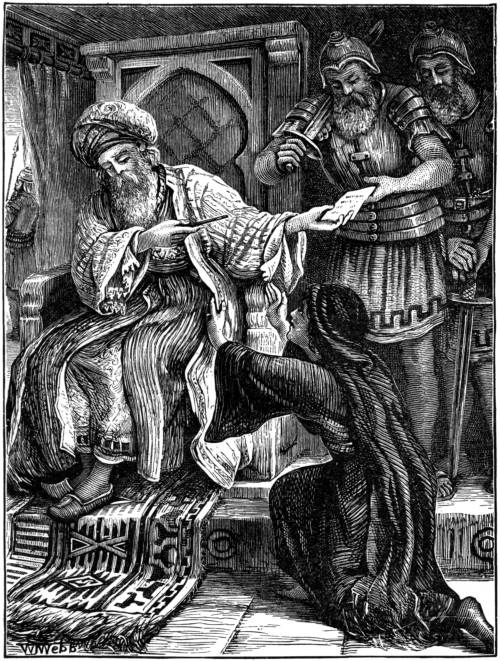
In a certain city there was a judge who neither feared God nor cared for man. And in the same city there was a widow that had an enemy, and he had done her an injury. And she came to the judge and implored him, saying, “Give me justice; avenge me of my adversary.” But he would not. Then the widow came to him every day and cried, “Give me justice;” but still he would not for a long while. At last he became wearied of her constant cry, and he said within himself, “Though I fear not God nor care for man, yet, because this widow troubleth me with her complaint, I will avenge her; lest by her continual coming she weary me.”
And Jesus said, “Hear what the unjust judge saith. And if he, who was an unjust judge and a wicked man, would grant the widow’s petition, because she asked so often, will not God, who is good and just, give His children what is good and right for them? Shall not God avenge His own elect, which cry day and night unto Him, though He bear long with them?”
In this parable Jesus impressed upon his disciples the truth that, although great trials might come upon them, and their lives be in peril, yet they were not to lose faith in God, or be disappointed because their prayers were not answered at once. They were to keep on praying; asking God for such things as were right, and trusting that He would preserve them amidst all their enemies; and in His own way make them to triumph over their foes. Whatever is best for His people, God will give them. He cares for the sparrows, and, even more, for those who love Him.
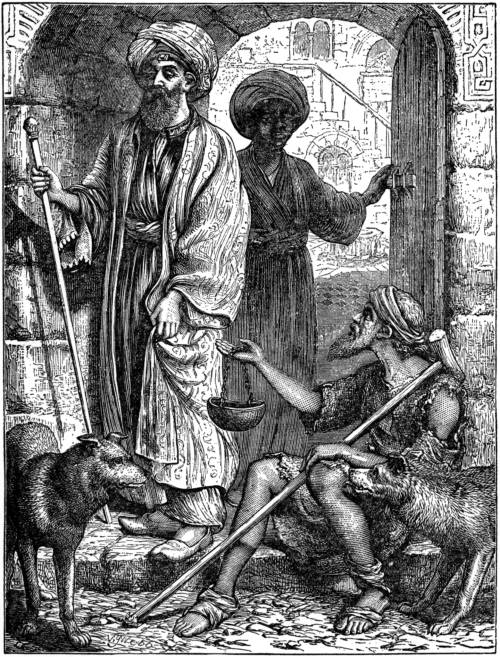
There was a certain rich man who was clothed in rich silks and fine linen, and feasted on costly food each day. There was also a poor beggar, who was ragged and hungry, and covered with sores. His name was Lazarus, and they laid him at the rich man’s gate, for he desired to be fed with the crumbs which fell from the well-supplied table. And even the dogs had pity on him, for they came and licked his sores.
And it came to pass that the beggar died, and the angels carried him away to heaven, where he was no longer clothed in rags, but in glorious array. Neither was he hungry, for he sat with Abraham and leaned upon his bosom.
The rich man also died, and was buried. He was not carried to heaven, but went to a place of torment, where he lifted up his eyes, and in the distance saw Abraham with Lazarus on his bosom. And he cried and said, “Father Abraham, have mercy on me, and send Lazarus, that he may dip the tip of his finger in water, and cool my tongue; for I am tormented in these flames.” But Abraham said, “Son, remember that thou in thy lifetime receivedst thy good things, whilst Lazarus had only evil things; and now he is comforted, and thou art tormented. Beside all this, between us and you there is a great gulf fixed.”
Then said the rich man, “I pray thee therefore, father, that thou wouldest send him to my father’s house; for I have five brethren. Let him go to them and testify unto them, that they may repent, lest they also come into this place of torment.” Abraham said unto him, “They have Moses and the prophets; let them hear them.” And he said, “Nay, father Abraham: but if one went unto them from the dead, they will repent.” But Abraham said, “If they hear not Moses and the prophets, neither will they be persuaded, though one rose from the dead.”
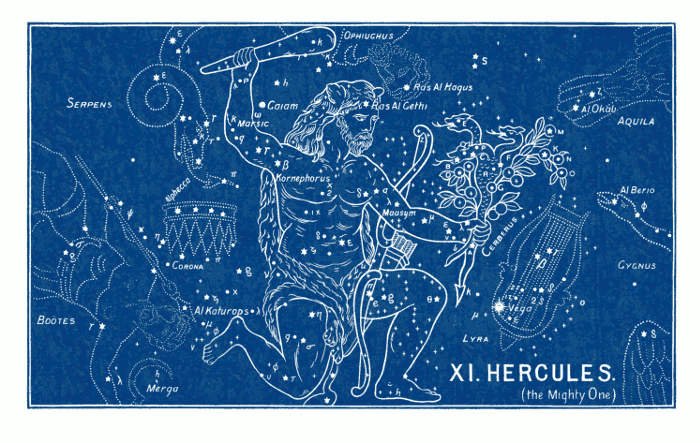
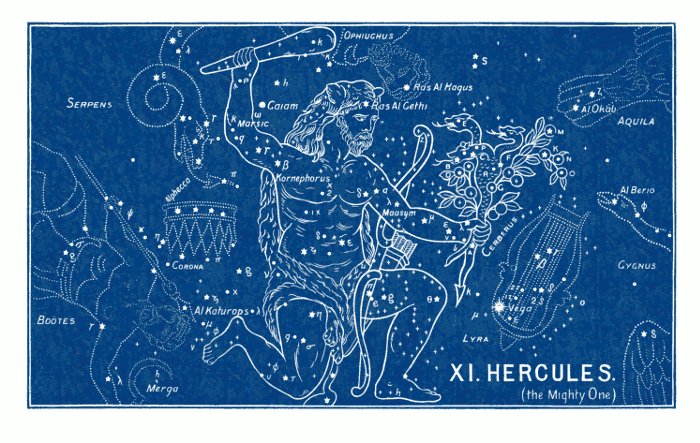
Here the mighty one, who occupies a large portion of the heavens, is seen bending on one knee, with his right heel lifted up as if it had been wounded, while his left foot is set directly over the head of the great dragon. In his right hand he wields a great club, and in his left hand he grasps a triple-headed monster (Cerberus). And he has the skin of a lion, which he has slain, thrown around him.
In the Zodiac of Denderah we have a human figure, likewise with a club. His name is Bau, which means who cometh, and is evidently intended for Him who cometh to crush the serpent’s head, and “destroy the works of the devil.”
In Arabic he is called Al Giscale, the strong one.
Plate 11: HERCULES (the Mighty One)
There are 113 stars in this constellation. Seven are of the 3rd magnitude, seventeen of the 4th, etc.
The brightest star, α (in his head), is named Ras al Gethi, and means the head of him who bruises.
The next, β (in the right arm-pit), is named Kornephorus, and means the branch, kneeling.
The star κ (in the right elbow) is called Marsic, the wounding.
The star λ (in the upper part of the left arm) is named Ma’asyn, the sin-offering.
While ω (in the lower part of the right arm) is Caiam, or Guiam, punishing; and in Arabic, treading under foot.
Thus does everything in the picture combine to set forth the mighty works of this stronger than the strong man armed!
We can easily see how the perversion of the truth by the Greeks came about, and how, when the true foreshadowings of this Mighty One had been lost, the many fables were invented to supply their place. The wiser sort of Greeks knew this perfectly well. Aristotle (in his Metaphysics, x. 8) admits, with regard to Greek mythology, that religion and philosophy had been lost, and that much had been “added after the mythical style,” while much had come down, and “may have been preserved to our times as the remains of ancient wisdom.” Religion, such as it was (Polybius confesses), was recognised as a “necessary means to political ends.” Neander says that it was “the fragments of a tradition, which transmitted the knowledge of divine things possessed in the earliest times.”
Aratus shews the same uncertainty as to the meaning of this Constellation of Hercules. He says:
“Near this, and like a toiling man, revolves
A form. Of it can no one clearly speak,
Nor what he labours at. They call him simply
‘The man upon his knees’: In desperate struggle
Like one who sinks, he seems. From both his shoulders
His arms are high-uplifted and out-stretched
As far as he can reach; and his right foot
Is planted on the coiléd Dragon’s head.”
Ancient authorities differ as to the personality of Hercules, and they disagree as to the number, nature, and order of what are sometimes called “the twelve labours of Hercules.” But there is no doubt as to the mighty foretold works which the woman’s Seed should perform.
From first to last Hercules is seen engaged in destroying some malignant foe: now it is the Nemean lion; then it is the slaying of the boar of Erymanthus; again, it is the conquest of the bull of Crete; then the killing of the three-headed hydra, by whose venom Hercules afterwards died. In the belly of the sea monster he is said to have remained “three days and three nights.” This was, doubtless, a perversion of the type of Jonah, introduced by Lycophron, who (living at the court of Ptolemy Philadelphus, under whose auspices the Hebrew Scriptures were translated into Greek) would have known of that Divine miracle, and of its application to the Coming One. Bishop Horsley believed that the fables of the Greek mythology could be traced back to the prophecies of the Messiah, of which they were a perversion from ignorance or design. This is specially true of Hercules. In his apparently impossible tasks of overthrowing gigantic enemies and delivering captives, we can see through the shadow, and discern the pure light of the truth. We can understand how the original star-picture must have been a prophetic representation of Him who shall destroy the Old Serpent and open the way again, not to fabled “apples of gold,” but to the “tree of life” itself. He it is who though suffering in the mighty conflict, and brought to His knee, going down even to “the dust of death,” shall yet, in resurrection and advent glory, wield His victorious club, subdue all His enemies, and plant His foot on the Dragon’s head. For of Him it is written:—
“Thou shalt tread upon the lion and adder;
The young lion and the dragon shalt Thou trample under foot.”
The English word “altar” in Hebrew is “mizbeach,” derived from the root word “zabach,” which means “to slaughter, kill, or slay an animal.” The altar served as the central place for sacrifices and the meeting point between God and humans.
Notice the following altars:
Building of the Altar
Reference
Noah builds an altar after the flood
(Gen. 8:20)
Abram (Abraham) builds an altar near Bethel
(Gen. 12:7)
Abraham builds an altar on Mount Moriah and called it Jehovah-jireh
(Gen. 22:9, 14)
Isaac builds an altar Beer-sheba
(Gen. 26:25)
Jacob builds an altar at Shalem
(Gen. 33:20)
Moses builds an altar and called it Jehovah-nissi
(Exod. 17:15)
Joshua builds an altar on Mount Ebal
(Josh. 8:30)
Gideon builds an altar and called it Jehovah-shalom
(Jude 6:24)
Manoah builds an altar on a rock
(Judg. 13:19-20)
King Saul builds an altar to the Lord.
(1 Sam. 14:35)
King David builds an altar and stopped a plague
(2 Sam. 24:21, 25)
Solomon built the First Temple to God in Jerusalem, placing a permanent altar in the outer court for daily sacrifices. Under the Old Covenant, three types of altars were made: one of natural stones (Joshua 8:30-32), a square brass altar (Exodus 27:1-2), and a golden altar in the holy place for burning daily incense (Exodus 30:1-3). These three altars symbolize three spiritual battles every believer will face.
Stone Altar: Abraham uses the stone altar to offer Isaac to God on Mount Moriah, symbolizing personal sacrifice and the surrender of our own will to the will of the heavenly Father. Willing to give up his best to please the Almighty, Abraham sets aside his personal feelings to serve a greater divine purpose. To understand God’s will, we must first come to this altar and confront our own desires, emotions, and self-interest.
Brass Altar: The second altar, known as the brass altar, is where the flesh of animals was offered in sacrifice. It symbolizes our willingness to take up our cross and follow Christ (Matt. 16:24) and to crucify our flesh (Gal. 5:24). Our bodies are “living sacrifices” (Rom. 12:1), with our carnal nature needing to be brought under control. Sacrifices here were bound to the four horns of the altar, representing believers standing firm in faith until God transforms them from within. The three fires constantly burning on the brass altar remind us of the Lord’s zeal that must keep burning in our hearts as we submit to God’s Spirit and bring our flesh into submission.
Golden Altar: The golden altar is where incense is burned each day, carrying the prayers of the righteous to God. It’s the place where we grow in worship and prayer.
At the stone altar, we learn obedience to God’s will; at the brass altar, we find freedom from sin and train our flesh; and at the golden altar, we embrace and practice daily prayer and worship.
Israel reaches Mount Sinai and stays there for about a year (see Exod. 19:1 and Num. 10:11). During this time, Moses ascends and descends the mountain eight times, spending forty days there on two occasions. It’s here that Moses receives the Ten Commandments from God (Exod. 20). Exodus 19 is often seen as vivid imagery of the catching away of the saints, described by Paul in 1 Thessalonians 4:16-17, and identified by some as the Rapture. Moses receiving the Law on Mount Sinai serves as a powerful preview of Christ’s coming, as revealed in the New Testament.
Moses on Mount Sinai in Exodus 19
The Rapture and Second Coming
Israel was a peculiar people Exodus19:5: Now therefore, if ye will obey my voice indeed, and keep my covenant, then ye shall be a peculiar treasure unto me above all people: for all the earth is mine:
The Church is a peculiar people 1 Pet. 2:9 But ye are a chosen generation, a royal priesthood, an holy nation, a peculiar people; that ye should shew forth the praises of him who hath called you out of darkness into his marvellous light;
Israel was a kingdom of priests Exodus 19:6 And ye shall be unto me a kingdom of priests, and an holy nation. These are the words which thou shalt speak unto the children of Israel.
The Church is kings and priests unto God Rev. 1:5-6 And from Jesus Christ, who is the faithful witness, and the first begotten of the dead, and the prince of the kings of the earth. Unto him that loved us, and washed us from our sins in his own blood, And hath made us kings and priests unto God and his Father; to him be glory and dominion for ever and ever. Amen.
The people were to be sanctified Exodus 19:10 And the Lord said unto Moses, Go unto the people, and sanctify them today and tomorrow, and let them wash their clothes,
The believers are to sanctify themselves 1 Thess. 4:3 For this is the will of God, even your sanctification, that ye should abstain from fornication:
God appeared on the third day Exodus 19:11 And be ready against the third day: for the third day the Lord will come down in the sightof all the people upon mount Sinai.
Christ was raised on the third day 1 Corinthians 15:3-4 For I delivered unto you first of all that which I also received, how that Christ died for our sins according to the scriptures; And that he was buried, and that he rose again the third day according to the scriptures:
God came down in the clouds Exodus 19:16 And it came to pass on the third day in the morning, that there were thunders and lightnings, and a thick cloud upon the mount, and the voice of the trumpet exceeding loud; so that all the people that was in the camp trembled.
He is coming in the clouds Acts 1:9-11 And when he had spoken these things, while they beheld, he was taken up; and a cloud received him out of their sight. And while they looked stedfastly toward heaven as he went up, behold, two men stood by them in white apparel; Which also said, Ye men of Galilee, why stand ye gazing up into heaven? this same Jesus, which is taken up from you into heaven, shall so come in like manner as ye have seen him go into heaven.
God came down in the lightning Exodus 19:16 And it came to pass on the third day in the morning, that there were thunders and lightnings, and a thick cloud upon the mount, and the voice of the trumpet exceeding loud; so that all the people that was in the camp trembled.
He is coming as lightning Matt. 24:27 For as the lightning cometh out of the east, and shineth even unto the west; so shall also the coming of the Son of man be.
God’s voice was as a trumpet Exodus 19:16 And it came to pass on the third day in the morning, that there were thunders and lightnings, and a thick cloud upon the mount, and the voice of the trumpet exceeding loud; so that all the people that was in the camp trembled.
The trumpet of God will sound 1 Thess. 4:16 For the Lord himself shall descend from heaven with a shout, with the voice of the archangel, and with the trump of God: and the dead in Christ shall rise first:
God came down in fire Exodus 19:18 And mount Sinai was altogether on a smoke, because the Lord descended upon it in fire: and the smoke thereof ascended as the smoke of a furnace, and the whole mount quaked greatly.
Christ returns to earth in flaming fire 2 Thess. 1:7-10 And to you who are troubled rest with us, when the Lord Jesus shall be revealed from heaven with his mighty angels, In flaming fire taking vengeance on them that know not God, and that obey not the gospel of our Lord Jesus Christ: Who shall be punished with everlasting destruction from the presence of the Lord, and from the glory of his power; When he shall come to be glorified in his saints, and to be admired in all them that believe (because our testimony among you was believed) in that day.
God answered Moses in a voice Exodus19:19 And when the voice of the trumpet sounded long, and waxed louder and louder, Moses spake, and God answered him by a voice.
The voice of the archangel 1 Thess. 4:16 For the Lord himself shall descend from heaven with a shout, with the voice of the archangel, and with the trump of God: and the dead in Christ shall rise first:
God descended from heaven Exodus 19:20 And the Lord came down upon mount Sinai, on the top of the mount: and the Lord called Moses up to the top of the mount; and Moses went up.
Christ will descend from heaven 1 Thess. 4:16 For the Lord himself shall descend from heaven with a shout, with the voice of the archangel, and with the trump of God: and the dead in Christ shall rise first:
God called Moses up Exodus 19:20 And the Lord came down upon mount Sinai, on the top of the mount: and the Lord called Moses up to the top of the mount; and Moses went up.
The saints will be caught up 1 Thess. 4:17 Then we which are alive and remain shall be caught up together with them in the clouds, to meet the Lord in the air: and so shall we ever be with the Lord.
Jeremiah predicted a “time of Jacob’s trouble” for Israel.
Jeremiah 30:7 Alas! for that day is great, so that none is like it: it is even the time of Jacob’s trouble, but he shall be saved out of it.
Many scholars think this term refers to the seven-year Tribulation, known as “Daniel’s last seven years” or “Daniel’s seventieth week,” mentioned in Daniel 9:27.
Daniel 9:27 And he shall confirm the covenant with many for one week: and in the midst of the week he shall cause the sacrifice and the oblation to cease, and for the overspreading of abominations he shall make it desolate, even until the consummation, and that determined shall be poured upon the desolate.
Jacob works for seven years, but when the time comes, his father-in-law tricks him into marrying Leah instead of his beloved Rachel. Laban then tells Jacob to “fulfill her week.”
Genesis 29:27 Fulfil her week, and we will give thee this also for the service which thou shalt serve with me yet seven other years.
The Hebrew word for week is shabuwa, and is literally a week of years, not days.
שָׁבוּעַshâbûwaʻ, shaw-boo’-ah; or שָׁבֻעַ shâbuaʻ; also (feminine) שְׁבֻעָה shᵉbuʻâh; properly, passive participle of H7650 as a denominative of H7651; literally, sevened, i.e. a week (specifically, of years):—seven, week.
This word is found four times:
Genesis 29:27 & 28
Fulfil her week, and we will give thee this also for the service which thou shalt serve with me yet seven other years.
And Jacob did so, and fulfilled her week: and he gave him Rachel his daughter to wife also.
Twice in Daniel 9:27
And he shall confirm the covenant with many for one week: and in the midst of the week he shall cause the sacrifice and the oblation to cease, and for the overspreading of abominations he shall make it desolate, even until the consummation, and that determined shall be poured upon the desolate.
The word week in Daniel 9:27 is a prediction of a seven-year covenant that the future Antichrist will sign.
Jacob’s trouble spans two periods of seven years. He worked the first seven years only to be deceived by Laban, then labored another seven years before finally marrying the wife he had chosen.
Some rabbis believe that the Jewish Holocaust, from 1938 to 1945—a span of seven years—was the fulfillment of Jacob’s trouble. However, Jacob experienced two distinct periods of “seven” in his life.
The upcoming seven-year Tribulation will mark the second and final period of seven years in Jacob’s (Israel’s) time of trouble.
After the second seven-year period, Jacob marries Rachel and eventually returns to the Promised Land, where he meets Esau and visits his father, Isaac. In the future, after a seven-year Tribulation, Christ the Messiah will return to Israel and reveal Himself as the suffering Messiah to the descendants of both Esau and Isaac.
Zechariah 13:6 And one shall say unto him, What are these wounds in thine hands? Then he shall answer, Those with which I was wounded in the house of my friends.
Jesus is the one with wounds in his hands.
John 20:25-27
The other disciples therefore said unto him, We have seen the Lord. But he said unto them, Except I shall see in his hands the print of the nails, and put my finger into the print of the nails, and thrust my hand into his side, I will not believe.
And after eight days again his disciples were within, and Thomas with them: then came Jesus, the doors being shut, and stood in the midst, and said, Peace be unto you.
Then saith he to Thomas, Reach hither thy finger, and behold my hands; and reach hither thy hand, and thrust it into my side: and be not faithless, but believing.
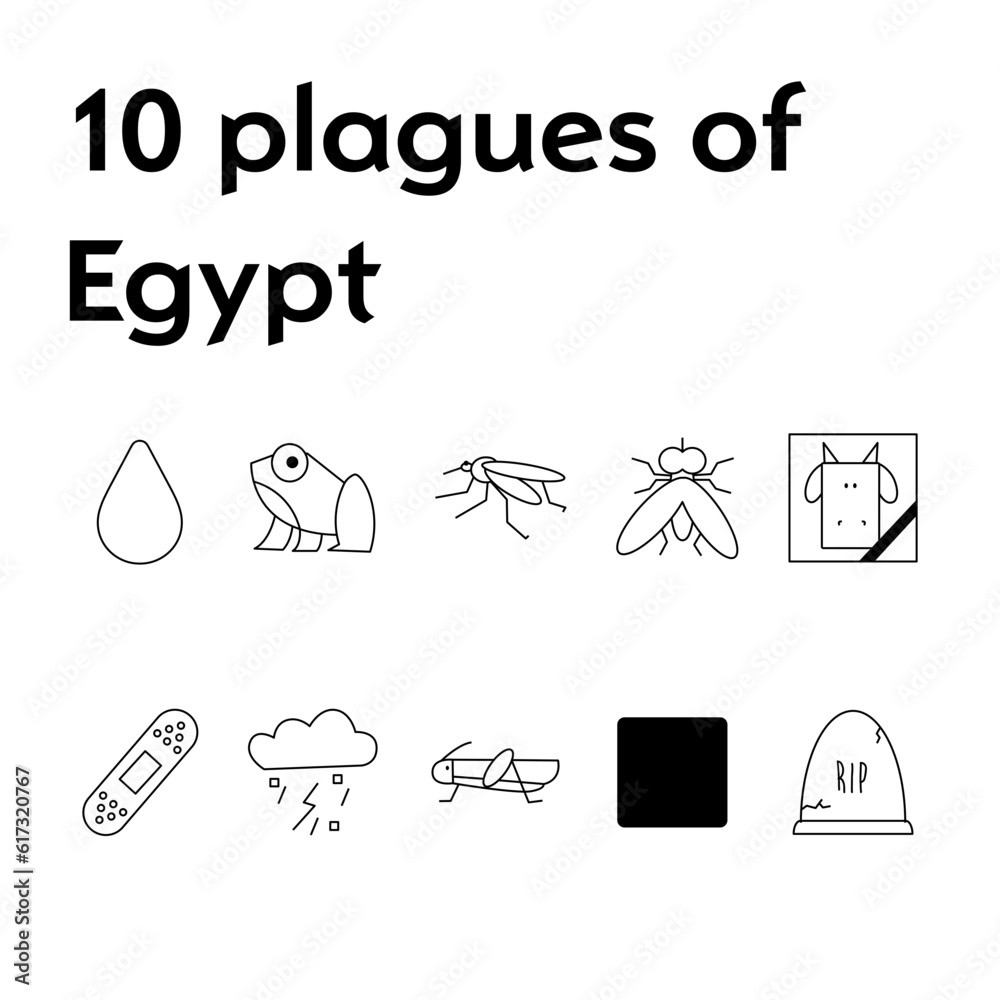
The 10 Plagues that occurred in Egypt was designed to prove to the Egyptians that God is the Lord.
Exodus 7:5 And the Egyptians shall know that I am the Lord, when I stretch forth mine hand upon Egypt, and bring out the children of Israel from among them.
Each plague was designed to prove that the Egyptian gods have no power over the judgments of the Hebrew God.
Plague sent from God
Attack Against the Egyptian Idol
the rivers and water judged (Exod. 7:14-25)
Hapi: god of the Nile
frogs (Exod. 8:1-15)
Heket: god of fertility (Heket looked like a frog)
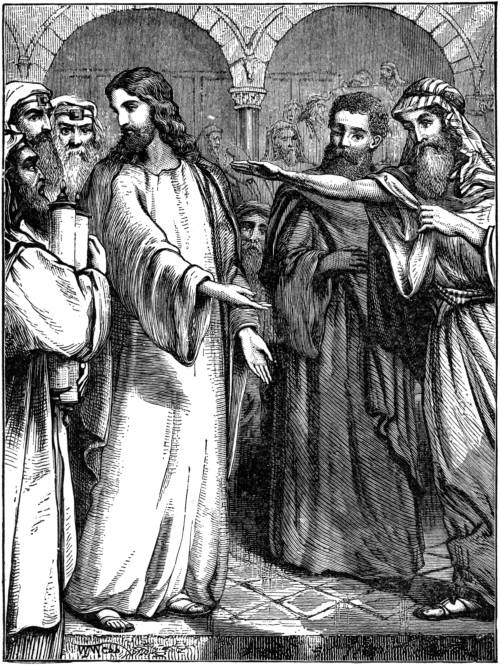
One Sabbath-day Jesus went into the synagogue, and there He saw a man that had a withered hand. By some means the muscles had lost their power, and he could neither use his hand nor stretch it out. And the Pharisees watched Jesus, to see if He would heal this man on the Sabbath, that they might bring a charge against Him of breaking the law. They asked Him, “Is it lawful to heal on the Sabbath-day?” and He replied by asking who among them, if he had a sheep which had fallen into a pit on the Sabbath-day, would not lay hold on it, and lift it out. “How much then is a man better than a sheep? Wherefore it is lawful to do good on the Sabbath-day.”
Then said He to the man, “Stretch forth thine hand.” And he stretched it forth, and it was made whole and healthy like the other.
Then the Pharisees went out and held a council against Him, to consider how they might destroy Him; but when Jesus knew it, He withdrew Himself from that part, and great multitudes followed Him, and He healed them all.
We are able to learn many things when we study the life of people who has gone on before us. It is interesting to learn about how God was able to work in the lives of the various people. Remember those that don’t learn from the past are doomed to repeat the mistakes of the past. Below is a list of Bible Studies about various people. More will be added as time goes on. Bible studies about Jesus can be found here: Exploring the Life and Teachings of Jesus.
 articlesforchristians