A place to grow your relationship with God

Posts tagged ‘faith’

The Rich Fool

THE RICH FOOL

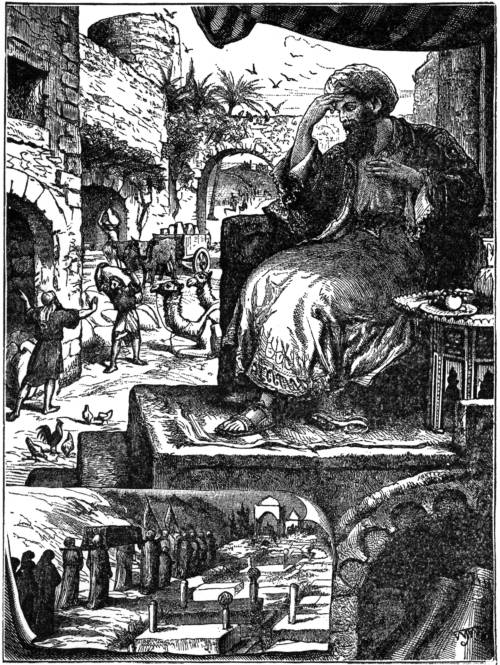
There was a certain rich man who owned much land. And his fields and vineyards were so productive that when the time of harvest came, he had not room enough to store his corn and fruits. So, after much thought he said, “This will I do. I will pull down my barns and build greater ones, and there will I store all my fruits and my goods. Then I can say to myself, ‘I have great store of goods laid up, enough for many years; now I can take mine ease, eat, drink, and be merry.'”
THE RICH FOOL

But God said unto him, “Thou fool, this night thy soul shall be required of thee; then whose shall those things be which thou hast hoarded?”

Jesus says it shall be so with all those who set their minds upon storing up riches in this world, rather than laying up treasures in heaven by pleasing God and working in His service. Death will come when they least expect it, and they will have to leave all their earthly riches, and go where no treasure has been laid up for them.

And He said unto His disciples, “Take no thought for your life, what ye shall eat; neither for the body, what ye shall put on; for the life is more than meat, and the body more than raiment. For all these things do the nations of the world seek after, and your Father knoweth that ye have need of these things. But rather seek ye the kingdom of God; and all these things shall be added unto you. Fear not, for it is the Father’s good pleasure to give you the kingdom. Sell what ye have and give alms; provide yourselves a treasure in the heavens that faileth not, where no thief approacheth, or moth corrupteth.”
The Children’s Six Minutes: The Human Kodak

THE HUMAN KODAK

I wonder how many of you have a kodak. Yes, many of you own one. What a wonderful little machine a kodak is! First we buy a film, then we open the kodak and place the film. Now pull the paper over to the empty roll and fasten, close the kodak and begin to wind. Oh, here you are, No. 1. The day is clear, for we must have a clear day to get the best picture. We hold the kodak very steady, then snap, we have it. Next we pull a little slide in the back, take a pencil and write down the date and name. Let me see, what was that picture? Oh, yes, “Chrysanthemum (is that the way to spell it?) exhibition.” Next the films are developed, and the kodak pictures are complete, all but pasting them in a big book.

For all that the kodak is a whole lot of fuss, isn’t it? But, do you know, each one of us has a kodak God has given him which works itself. We have the open circle through which the pictures are taken, our eyes, and beyond the eyes, in the brain, are thousands of films. We start out in the morning and the moment we open our eyes we begin exposing those films. We do not have to do any clicking for these pictures, one after another, click, click, click, and they are developed as fast as they are taken.

If you should say to a man who has reached three score years and ten, “Tell me the clearest picture you can remember,” he would not show a picture that was taken yesterday, or last week, or last year. He would turn back the pages of his memory book fifty, sixty years. The clearest pictures he possesses are those that were snapped in his boyhood. Every day you are taking pictures that are going to remain with you as long as you live. Let us resolve, girls and boys, that as we go out each morning and our human kodak begins clicking, we shall take only pictures that are true, pure and clean.

MEMORY VERSE, Proverbs 4: 25

“Let thine eyes look right on, and let thine eyelids look straight before thee.”

MEMORY HYMN

“O for a thousand tongues to sing My great Redeemer’s praise.”

The Red Heifer Sacrifice Compared to Jesus’ Sacrifice

THE ASHES OF THE RED HEIFER
One of the most intriguing symbols of the coming Messiah is the unique sacrifice of a red heifer, as described in Numbers chapter 19. Every detail of this special offering, both in Scripture and Jewish tradition, beautifully illustrates the suffering of the Messiah and the cleansing power of His death to purify the unclean.

First, all other sacrifices were male, and this was a female offering. Second, the color is specific.
The sacrifice of the red heifer, called in Hebrew the Parah Adumah, is perhaps the most unusual of all the required sacrifices. The Scripture emphasizes that the red heifer must be without spot or blemish and must never have worn a yoke. This entire offering is a detailed type and shadow of the future crucifixion of Christ.

  • The offering was a female sacrifice (Num. 19:2)
    • This was significant because it represents the church. Remember that Christ died and redeemed a Bride
      •  Ephesians 5:25-27Husbands, love your wives, even as Christ also loved the church, and gave himself for it; That he might sanctify and cleanse it with the washing of water by the word, That he might present it to himself a glorious church, not having spot, or wrinkle, or any such thing; but that it should be holy and without blemish.
  • The heifer was without blemish (Num, 19:2)
    • Christ was without blemish
      • 1 Peter 1:19 But with the precious blood of Christ, as of a lamb without blemish and without spot:
  • The heifer was offered (outside) the camp (Num. 19:3)
    • Christ was crucified (outside) the gate.
      • Heb. 13:11-12 For the bodies of those beasts, whose blood is brought into the sanctuary by the high priest for sin, are burned without the camp. Wherefore Jesus also, that he might sanctify the people with his own blood, suffered without the gate.
  • The priest watched while others slew it (Num. 19:3)
    • The priests looked on at the crucifixion.
      • Matthew 27:41-42 Likewise also the chief priests mocking him, with the scribes and elders, said, He saved others; himself he cannot save. If he be the King of Israel, let him now come down from the cross, and we will believe him.
  • The blood was sprinkled seven times (Num. 19:4)
    • The seven places where Christ shed His blood are:
      • On His head with the crown of thorns.
        • Matthew 27:29 And when they had platted a crown of thorns, they put it upon his head, and a reed in his right hand: and they bowed the knee before him, and mocked him, saying, Hail, King of the Jews!
      • On His back when He was scourged.
        • Mark 15:15 And so Pilate, willing to content the people, released Barabbas unto them, and delivered Jesus, when he had scourged him, to be crucified.
      • On His left hand where He was crucified.
        • John 20:27 Then saith he to Thomas, Reach hither thy finger, and behold my hands; and reach hither thy hand, and thrust it into my side: and be not faithless, but believing.
      • On His right hand where He was crucified.
        • John 20:27 Then saith he to Thomas, Reach hither thy finger, and behold my hands; and reach hither thy hand, and thrust it into my side: and be not faithless, but believing.
      • On His left foot where He was crucified.
        • Luke 24:39-40 Behold my hands and my feet, that it is I myself: handle me, and see; for a spirit hath not flesh and bones, as ye see me have. And when he had thus spoken, he shewed them his hands and his feet.
      • On His right foot where He was crucified.
        • Luke 24:39-40 Behold my hands and my feet, that it is I myself: handle me, and see; for a spirit hath not flesh and bones, as ye see me have. And when he had thus spoken, he shewed them his hands and his feet.
      • On His side after His death.
        • John 19:34 But one of the soldiers with a spear pierced his side, and forthwith came there out blood and water.
  • The entire offering was burned (Num. 19:5)
    • It is prophesied that Jesus’s body would not see corruption. It also says that his soul will not stay in Hell.
      • Palms 16:10 For thou wilt not leave my soul in hell; neither wilt thou suffer thine Holy One to see corruption.
    • Jesus taught that those in hell was tormented in flame.
      • Luke 16:22-26 And it came to pass, that the beggar died, and was carried by the angels into Abraham’s bosom: the rich man also died, and was buried; And in hell he lift up his eyes, being in torments, and seeth Abraham afar off, and Lazarus in his bosom. And he cried and said, Father Abraham, have mercy on me, and send Lazarus, that he may dip the tip of his finger in water, and cool my tongue; for I am tormented in this flame. But Abraham said, Son, remember that thou in thy lifetime receivedst thy good things, and likewise Lazarus evil things: but now he is comforted, and thou art tormented. And beside all this, between us and you there is a great gulf fixed: so that they which would pass from hence to you cannot; neither can they pass to us, that would come from thence.
    • Christ’s body was the final offering.
      • Hebrews 10:8-10 Above when he said, Sacrifice and offering and burnt offerings and offering for sin thou wouldest not, neither hadst pleasure therein; which are offered by the law; Then said he, Lo, I come to do thy will, O God. He taketh away the first, that he may establish the second. By the which will we are sanctified through the offering of the body of Jesus Christ once for all.
  • Scarlet was placed into the fire. (Num. 19.6)
    • A scarlet robe was placed on Christ.
      • Matt. 27:27-28 Then the soldiers of the governor took Jesus into the common hall, and gathered unto him the whole band of soldiers. And they stripped him, and put on him a scarlet robe.
  • Wood was placed into the fire. (Num. 19:6)
    • Christ was crucified on a wooden cross.
      • 1 Peter 2:24 Who his own self bare our sins in his own body on the tree, that we, being dead to sins, should live unto righteousness: by whose stripes ye were healed.
  • Hyssop was placed into the fire (Num. 19:6).
    • Hyssop was placed to Christ’s lips.
      • John 19:28-30 After this, Jesus knowing that all things were now accomplished, that the scripture might be fulfilled, saith, I thirst. Now there was set a vessel full of vinegar: and they filled a spunge with vinegar, and put it upon hyssop, and put it to his mouth. When Jesus therefore had received the vinegar, he said, It is finished: and he bowed his head, and gave up the ghost.
  • The ashes were for water of separation (Num. 19.9).
    • Jesus is the Word (click to learn more)
      • John 1:1 In the beginning was the Word, and the Word was with God, and the Word was God.
    • We are washed by the water of the word.
      • Ephesians 5:25-27Husbands, love your wives, even as Christ also loved the church, and gave himself for it; That he might sanctify and cleanse it with the washing of water by the word, That he might present it to himself a glorious church, not having spot, or wrinkle, or any such thing; but that it should be holy and without blemish.
    • Christ’s blood brings separation from sin.
      • 1 John 1:7 But if we walk in the light, as he is in the light, we have fellowship one with another, and the blood of Jesus Christ his Son cleanseth us from all sin.
  • The unclean were purified on the third day (Num. 19:12)
    • Christ arose victorious on the third day.
      • Matthew 16:21 From that time forth began Jesus to shew unto his disciples, how that he must go unto Jerusalem, and suffer many things of the elders and chief priests and scribes, and be killed, and be raised again the third day.
      • Matthew 28:6 He is not here: for he is risen, as he said. Come, see the place where the Lord lay.

After Christ declared, “It is finished,” the centurion pierced His side, and blood and water flowed out (John 19:34). This event holds deep significance, as these two elements were essential in the tabernacle (and later the temple) for purification. The blood from the sacrificial brass altar symbolized forgiveness and the removal of sin, while the water from the laver represented the purification or sanctification of the priest. Today, through the blood of Christ, we are both forgiven and sanctified. (See 1 Cor. 6:11 and Eph. 1:7)

Hebrews 9:11-15 But Christ being come an high priest of good things to come, by a greater and more perfect tabernacle, not made with hands, that is to say, not of this building; Neither by the blood of goats and calves, but by his own blood he entered in once into the holy place, having obtained eternal redemption for us. For if the blood of bulls and of goats, and the ashes of an heifer sprinkling the unclean, sanctifieth to the purifying of the flesh: How much more shall the blood of Christ, who through the eternal Spirit offered himself without spot to God, purge your conscience from dead works to serve the living God? And for this cause he is the mediator of the new testament, that by means of death, for the redemption of the transgressions that were under the first testament, they which are called might receive the promise of eternal inheritance.


Opinions differ on how many red heifers were sacrificed between the time of Moses and the destruction of the Second Temple in AD 70. Jewish tradition suggests that nine to twelve red heifers were offered, while the Mishnah Parah (Mishna Parah 3:4) specifically counts eight.

  • Moses as offering the first
  • Ezra offering the second,
  • Simon the just and Yochanan the High Priest offering two each
  • Elichonnai ben Hakka and Hanameel the Egyptian preparing one each

Weekly Recap of Articles for Christians posted Nov 2nd through Nov 8th

ANOINTING THE FEET OF JESUS

ANOINTING THE FEET OF JESUS

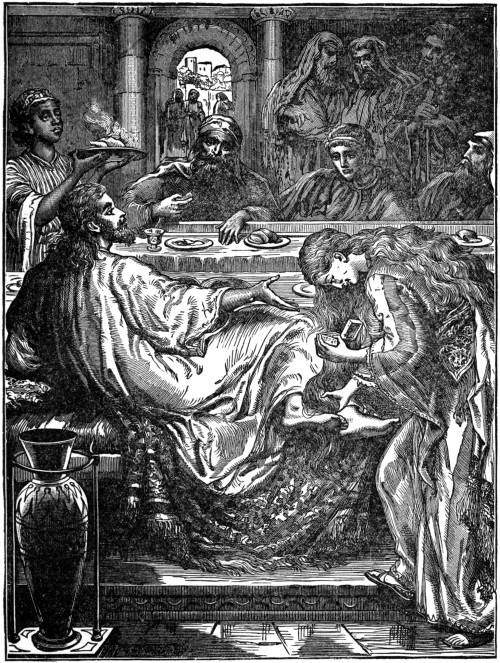
On one occasion, a proud Pharisee, whose name was Simon, invited Jesus to eat with him. But the invitation was a cold one. There was no kiss of welcome, no water to bathe His hot and dusty feet, no perfumed ointment for His head: nothing but a bare admission to a vacant place at the table was granted to Jesus. But there He reclined, His left elbow resting on a cushion, and His feet projecting beyond the edge of the couch.

Now it happened that a poor, sinful woman was passing, who, discovering that Jesus was in the house, timidly entered, and stood behind Him. She had an alabaster box of ointment, and, as she looked on Jesus, she wept. Her tears fell upon His feet; so, stooping down, she tenderly wiped them away with her long hair; then she kissed the Saviour’s feet, and anointed them with the fragrant ointment. This was done as a token of respect and love.

But an evil eye had noted the kindly act; and the proud Pharisee thought within himself, if Jesus were the prophet He professes to be, He would certainly have known that the woman was a great sinner, and would not have allowed her to touch Him. But Jesus came to save sinners. He loves them, though He hates their sins. He rebuked the haughty Simon; and showed him how he had neglected the commonest rites of hospitality towards his guest, while this poor woman had treated Jesus with the greatest reverence. Then Jesus said, “Her sins which are many are forgiven, for she loved much”; and He bade her go in peace.

ANOINTING THE FEET OF JESUS

Understanding Psalm 37:3-4 Trust and Delight in the Lord

Trust in the Lord, and do good; so shalt thou dwell in the land, and verily thou shalt be fed. Delight thyself also in the Lord: and he shall give thee the desires of thine heart Psalm 37:3-4

What does it say?

  • It says that we should trust in the Lord, do good and delight our self in the Lord.

What does it mean?

  • God is the provider
  • It means we should trust in the Lord and do good if we do this, he will give us what we need, and if we delight our self in him, he will give us our desires of our heart.

Key Words

  • Shalt
    • Will, Willing
  • Dwell: H7931
    • שָׁכַן shâkan, shaw-kan’; a primitive root (apparently akin (by transmission) to H7901 through the idea of lodging; compare H5531H7925); to reside or permanently stay (literally or figuratively):—abide, continue, (cause to, make to) dwell(-er), have habitation, inhabit, lay, place, (cause to) remain, rest, set (up).
  • Verily: H530
    • אֱמוּנָה ʼĕmûwnâh, em-oo-naw’; or (shortened) אֱמֻנָה ʼĕmunâh; feminine of H529; literally firmness; figuratively security; morally fidelity:—faith(-ful, -ly, -ness, (man)), set office, stability, steady, truly, truth, verily.
  • Fed: H7462
    • רָעָה râʻâh, raw-aw’; a primitive root; to tend a flock; i.e. pasture it; intransitively, to graze (literally or figuratively); generally to rule; by extension, to associate with (as a friend):—× break, companion, keep company with, devour, eat up, evil entreat, feed, use as a friend, make friendship with, herdman, keep (sheep) (-er), pastor, shearing house, shepherd, wander, waste.
  • Delight: H6026
    • עָנַג ʻânag, aw-nag’; a primitive root; to be soft or pliable, i.e. (figuratively) effeminate or luxurious:—delicate(-ness), (have) delight (self), sport self.
  • Desire: H4862
    • מִשְׁאָלָה mishʼâlâh, mish-aw-law’; from H7592; a request:—desire, petition.

CONTEXT

AuthorDate Who the audience Purpose
David 100 B.C.IsraelitesTo encourage the Israelites to follow God

Translations

  • Amplified Holy Bible
    • Trust [rely on and have confidence] in the Lord and do good; Dwell in the land and feed [securely] on His faithfulness. Delight yourself in the Lord, And He will give you the desires and petitions of your heart. Psalm 37 :3-4
  • Holman Holy Bible
    • Trust in the Lord and do good so shall thou dwell in the land and verily thou shalt be fed. Delight thyself also in the Lord; and he shall give thee the desire of thine heart. Psalm 37: 3-4

What going on in the verses?

The before these two verses are explaining to you that you do not need to fret or worry about wrong doers. God in his time will take care of them. In these two verses it is telling you what to do instead. You are supposed to just trust in God and do what is right in his sight.

Cross References

  • Isaiah 58:14
    • Then shalt thou delight thyself in the Lord; and I will cause thee to ride upon the high places of the earth, and feed thee with the heritage of Jacob thy father: for the mouth of the Lord hath spoken it.
  • Song of Solomon 2:3
    • As the apple tree among the trees of the wood, so is my beloved among the sons. I sat down under his shadow with great delight, and his fruit was sweet to my taste.

HEALING THE CENTURION’S SERVANT

HEALING THE CENTURION’S SERVANT

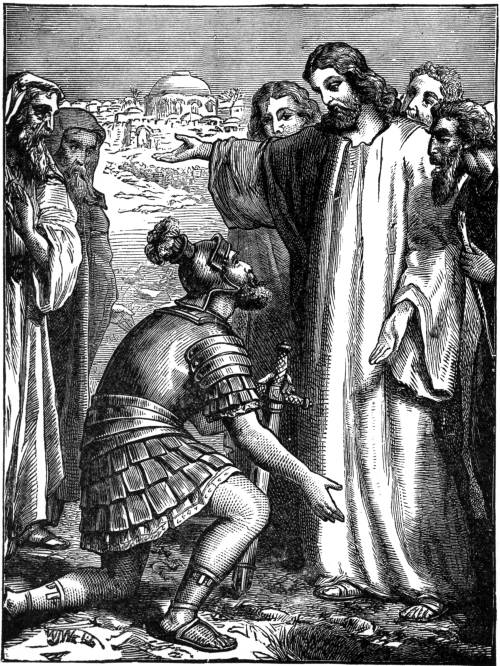
Jesus entered into Capernaum, a city by the Sea of Galilee, and while He was there a certain Centurion, or captain in the Roman army, had a favourite servant who was sick of the palsy and in great pain. When this Roman heard of Jesus, he sought the Jewish elders and implored them to go to Christ and beseech Him to cure the sick servant. And the elders came to Jesus and besought Him urgently to do this miracle, saying, “He is a worthy man, this Roman captain, for he loveth the Jews and hath built us a synagogue.”

So Jesus went with them, and when He had come near the house, the Centurion himself came to meet Him, saying, “Lord, trouble not Thyself, for I am not worthy that Thou shouldest enter my house. Speak the word only, and this sickness shall depart and my servant be made whole. For I am a man under authority of the Emperor, having many soldiers under me, and I say unto this man, ‘Go,’ and he goeth; to another, ‘Come,’ and he cometh, and to my servant, ‘Do this,’ and he doeth it. Wherefore, if I can so readily command my servants to do my bidding, I know that if Thou biddest this sickness to go out from my servant it will surely go.”

CHRIST AND THE CENTURION

Jesus marveled at the man’s words, and said to His followers, “Verily, I say unto you, I have not found so great faith, no, not in all Israel.” And to the Centurion He said, “Go thy way; and as thou hast believed, so be it done unto thee.” And his servant was healed in the selfsame hour, and when those that had been sent returned to the house, they found the servant whole that had been sick.

The Church of Pergamos

 The letter to the Church of Pergamos is found in Revelation 2:13-17.

Jesus says I know:

  • Your works, and where thou dwellest, even where Satan’s seat is
  • thou holdest fast my name, and hast not denied my faith, even in those days wherein Antipas was my faithful martyr, who was slain among you, where Satan dwelleth.

But I have a few things against thee:

  • thou hast there them that hold the doctrine of Balaam, who taught Balac to cast a stumblingblock before the children of Israel, to eat things sacrificed unto idols, and to commit fornication.
  • So hast thou also them that hold the doctrine of the Nicolaitanes, which thing I hate.

The Solution:

  • Repent; or else I will come unto thee quickly, and will fight against them with the sword of my mouth.

Words to know:

  • Balaam:  Strong’s G903
    • Βαλαάμ Balaám, bal-ah-am’; of Hebrew origin (H1109); Balaam, a Mesopotamian (symbolic of a false teacher):—Balaam.
  • Balac:  Strong’s G904
    • Βαλάκ Balák, bal-ak’; of Hebrew origin (H1111); Balak, a Moabite:—Balac.
  • Nicolaitans: Strong’s G3531
    • Νικολαΐτης Nikolaḯtēs, nik-ol-ah-ee’-tace; from G3532; a Nicolaite, i.e. adherent of Nicolaus:—Nicolaitane.

In the Old Testament Balaam was a prophet who the King Balak hired to cures the Israelites. This is found in Numbers Chapter 22. It seems that someone was teaching falsely. They were teaching that it was ok to combine pagan practices such as eating things sacrificed to idols and fornication with the teaching of Christ. Just like oil and water doesn’t mix, pagan and Christian practices don’t mix.

Looking at the etymology of the word “Nicolaitans,” it can be divided into two parts. “Nicos” comes from the Greek word “Nike,” meaning victor or victory. The second part, “laity,” has the same meaning in both Greek and English. Therefore, Nicolaitanism is understood as the act of elevating the clergy above the laity, which is considered heresy. Yes, you should respect the ministers who teach you and pray for you. However, remember Paul and the Bereans. Paul, who was a leader in the church and a well-respected teacher, did not consider it disrespectful for the Bereans to questions and diligently search out what he taught.  Acts 17:10-11 And the brethren immediately sent away Paul and Silas by night unto Berea: who coming thither went into the synagogue of the Jews. These were more noble than those in Thessalonica, in that they received the word with all readiness of mind, and searched the scriptures daily, whether those things were so. Notice it says that they were noble in that they received and searched the scriptures daily, whether those things were so. If the clergy where you are doesn’t like for you to search out the scriptures, they just might be under the influence of the doctrine of the Nicolaitans.

Today there are still false doctrines being taught and preached around the world. A few examples are:

  • The Prosperity Gospel: Often referred to as the health and wealth gospel or the Word of Faith movement, it teaches that faith leads to improved finances and health as blessings from God. Supporters believe they are entitled to riches and good health based on their interpretation of the Abrahamic Covenant, Jesus’s atonement, tithing, personal faith, and prayer.
  • The Works-Based Gospel, which believes we are saved by our works.
  • The Moralism Gospel: This fallacy teaches the Gospel was given to make us “good people.”
  • The Self-Help Gospel says Jesus died to make people better versions of themselves.

Each of these and all other false doctrine either adds to or takes away from the Bible. This is why you must read the Bible for yourself. Please obey 2 Timothy 2:15 Study to shew thyself approved unto God, a workman that needeth not to be ashamed, rightly dividing the word of truth.

He that hath an ear, let him hear what the Spirit saith unto the churches; To him that overcometh will I give to eat of the hidden manna, and will give him a white stone, and in the stone a new name written, which no man knoweth saving he that receiveth it.

God’s Ways are Higher than Ours

God’s ways are higher than our ways. God’s thoughts are higher than our thoughts.

  • Isaiah 55:8-9 says “For my thoughts are not your thoughts, neither are your ways my ways, saith the Lord. For as the heavens are higher than the earth, so are my ways higher than your ways, and my thoughts than your thoughts.”
  • 1 Corinthians 1:27 But God hath chosen the foolish things of the world to confound the wise; and God hath chosen the weak things of the world to confound the things which are mighty;
  • 2 Samuel 22:31  As for God, his way is perfect; the word of the Lord is tried: he is a buckler to all them that trust in him.

God’s directions often times doesn’t make sense in the beginning. It is only when we look back can we see the wisdom. Throughout the Bible when the people listened and obeyed His directions, it worked great. Here are some examples.

  • Walking through the Red Sea. The Lord had led them to the point where they were closed in on one side by the Red Sea. The wilderness had them trapped. The end result was the Egyptians that tried to follow and recapture the Israelites died and the Israelites went through on dry land.
    • Exodus 14:1-3 And the Lord spake unto Moses, saying, Speak unto the children of Israel, that they turn and encamp before Pihahiroth, between Migdol and the sea, over against Baalzephon: before it shall ye encamp by the sea. For Pharaoh will say of the children of Israel, They are entangled in the land, the wilderness hath shut them in.
    • Exodus 14:15-16 And the Lord said unto Moses, Wherefore criest thou unto me? speak unto the children of Israel, that they go forward: But lift thou up thy rod, and stretch out thine hand over the sea, and divide it: and the children of Israel shall go on dry ground through the midst of the sea.
  • Walking around the walls of Jerico to win the battle.
    • Joshua 6:1-5 Now Jericho was straitly shut up because of the children of Israel: none went out, and none came in. And the Lord said unto Joshua, See, I have given into thine hand Jericho, and the king thereof, and the mighty men of valour. And ye shall compass the city, all ye men of war, and go round about the city once. Thus, shalt thou do six days. And seven priests shall bear before the ark seven trumpets of rams’ horns: and the seventh day ye shall compass the city seven times, and the priests shall blow with the trumpets. And it shall come to pass, that when they make a long blast with the ram’s horn, and when ye hear the sound of the trumpet, all the people shall shout with a great shout; and the wall of the city shall fall down flat, and the people shall ascend up every man straight before him.
  • Gideon’s army– God said that there were too many soldiers.
    • Judges 7:2 And the Lord said unto Gideon, The people that are with thee are too many for me to give the Midianites into their hands, lest Israel vaunt themselves against me, saying, Mine own hand hath saved me.
    • Judges 7:7 And the Lord said unto Gideon, By the three hundred men that lapped will I save you, and deliver the Midianites into thine hand: and let all the other people go every man unto his place.
  • A boy defeating a giant– David went up against Goliath with only a few rocks, a sling shot, and a staff.
    • 1 Samuel 17:39-40 And David girded his sword upon his armour, and he assayed to go; for he had not proved it. And David said unto Saul, I cannot go with these; for I have not proved them. And David put them off him. And he took his staff in his hand, and chose him five smooth stones out of the brook, and put them in a shepherd’s bag which he had, even in a scrip; and his sling was in his hand: and he drew near to the Philistine.
    • 1 Samuel 17:48-51 And it came to pass, when the Philistine arose, and came, and drew nigh to meet David, that David hastened, and ran toward the army to meet the Philistine. And David put his hand in his bag, and took thence a stone, and slang it, and smote the Philistine in his forehead, that the stone sunk into his forehead; and he fell upon his face to the earth. So David prevailed over the Philistine with a sling and with a stone, and smote the Philistine, and slew him; but there was no sword in the hand of David. Therefore David ran, and stood upon the Philistine, and took his sword, and drew it out of the sheath thereof, and slew him, and cut off his head therewith. And when the Philistines saw their champion was dead, they fled.
  • Washing 7 times in the Jordan River to cure Naaman’s leprosy.
    • 2 Kings 5:10-14  And Elisha sent a messenger unto him, saying, Go and wash in Jordan seven times, and thy flesh shall come again to thee, and thou shalt be clean. But Naaman was wroth, and went away, and said, Behold, I thought, He will surely come out to me, and stand, and call on the name of the Lord his God, and strike his hand over the place, and recover the leper. Are not Abana and Pharpar, rivers of Damascus, better than all the waters of Israel? may I not wash in them, and be clean? So, he turned and went away in a rage. And his servants came near, and spake unto him, and said, My father, if the prophet had bid thee do some great thing, wouldest thou not have done it? how much rather then, when he saith to thee, Wash, and be clean? Then went he down, and dipped himself seven times in Jordan, according to the saying of the man of God: and his flesh came again like unto the flesh of a little child, and he was clean.
  • A King Being born in a stable: This kept Jesus safe from King Herod. King Herod did not know where to find Jesus. He was born in a stable and then he moved to a house. Later he was taken to Egypt to keep him safe until it was time for Him to complete His work.
    • Luke 2:11-18 For unto you is born this day in the city of David a Saviour, which is Christ the Lord. And this shall be a sign unto you; Ye shall find the babe wrapped in swaddling clothes, lying in a manger. And suddenly there was with the angel a multitude of the heavenly host praising God, and saying, Glory to God in the highest, and on earth peace, good will toward men. And it came to pass, as the angels were gone away from them into heaven, the shepherds said one to another, Let us now go even unto Bethlehem, and see this thing which is come to pass, which the Lord hath made known unto us. And they came with haste, and found Mary, and Joseph, and the babe lying in a manger. And when they had seen it, they made known abroad the saying which was told them concerning this child. And all they that heard it wondered at those things which were told them by the shepherds.
    • Matthew 2:9-14  When they had heard the king, they departed; and, lo, the star, which they saw in the east, went before them, till it came and stood over where the young child was. When they saw the star, they rejoiced with exceeding great joy. And when they were come into the house, they saw the young child with Mary his mother, and fell down, and worshipped him: and when they had opened their treasures, they presented unto him gifts; gold, and frankincense and myrrh. And being warned of God in a dream that they should not return to Herod, they departed into their own country another way. And when they were departed, behold, the angel of the Lord appeareth to Joseph in a dream, saying, Arise, and take the young child and his mother, and flee into Egypt, and be thou there until I bring thee word: for Herod will seek the young child to destroy him. When he arose, he took the young child and his mother by night, and departed into Egypt:

Peter and the Gentiles: Breaking Barriers

The Gospel Spreads:

  • The Gospel spread from Jerusalem, Judaea, and Samaria to the uttermost parts of the eath.
  • Acts 10 records a new turn in the history of the church.
  • Before chapter 10, the apostles preached only to the Jews.
  • But now the door is open to the Gentiles as well.
    • God had always intended on the door to be open to the Gentiles as well.
      • Isaiah 42:1-6 Behold my servant, whom I uphold; mine elect, in whom my soul delighteth; I have put my spirit upon him: he shall bring forth judgment to the Gentiles. He shall not cry, nor lift up, nor cause his voice to be heard in the street. A bruised reed shall he not break, and the smoking flax shall he not quench: he shall bring forth judgment unto truth. He shall not fail nor be discouraged, till he have set judgment in the earth: and the isles shall wait for his law. Thus saith God the Lord, he that created the heavens, and stretched them out; he that spread forth the earth, and that which cometh out of it; he that giveth breath unto the people upon it, and spirit to them that walk therein: I the Lord have called thee in righteousness, and will hold thine hand, and will keep thee, and give thee for a covenant of the people, for a light of the Gentiles;
      • Isaiah 49:6 And he said, It is a light thing that thou shouldest be my servant to raise up the tribes of Jacob, and to restore the preserved of Israel: I will also give thee for a light to the Gentiles, that thou mayest be my salvation unto the end of the earth.
    • Gentile means
      • a Greek either by nationality, whether a native of the main land or of the Greek islands or colonies
      • in a wider sense the name embraces all nations not Jews that made the language, customs, and learning of the Greeks their own; the primary reference is to a difference of religion and worship
      • גּוֹי gôwy, go’-ee; rarely (shortened) גֹּי gôy; apparently from the same root as H1465 (in the sense of massing); a foreign nation; hence, a Gentile; also (figuratively) a troop of animals, or a flight of locusts:—Gentile, heathen, nation, people.

Cornelius and the Angel

  • Cornelius, a centurion in the Roman army, was a moral man, generous to the poor, feared God, and was faithful in prayer.
  • He saw a vision, and an angel of God told him to send to Joppa for a man called Peter who would tell him what to do to be saved.
    • Acts 10:1-6 There was a certain man in Caesarea called Cornelius, a centurion of the band called the Italian band, A devout man, and one that feared God with all his house, which gave much alms to the people, and prayed to God alway. He saw in a vision evidently about the ninth hour of the day an angel of God coming in to him, and saying unto him, Cornelius. And when he looked on him, he was afraid, and said, What is it, Lord? And he said unto him, Thy prayers and thine alms are come up for a memorial before God. And now send men to Joppa, and call for one Simon, whose surname is Peter: He lodgeth with one Simon a tanner, whose house is by the sea side: he shall tell thee what thou oughtest to do.
    • Acts 11:13-14 And he shewed us how he had seen an angel in his house, which stood and said unto him, Send men to Joppa, and call for Simon, whose surname is Peter; Who shall tell thee words, whereby thou and all thy house shall be saved.

Peter on the Rooftop

  • God was preparing Peter for a ministry to the Gentiles, whom the Jews thought were unclean.
  • At this time, the messengers sent from Cornelius arrived.
  • Peter learns and declares that God is no respecter of persons.
    • Acts 10:34-35 Then Peter opened his mouth, and said, Of a truth I perceive that God is no respecter of persons: But in every nation he that feareth him, and worketh righteousness, is accepted with him.

Gentiles Receive the Holy Ghost

  • As Peter preached to Cornelius and his household, the Holy Ghost fell upon them, then Peter commanded them to be baptized in the name of the Lord.
    • Acts 10:44-48 While Peter yet spake these words, the Holy Ghost fell on all them which heard the word. And they of the circumcision which believed were astonished, as many as came with Peter, because that on the Gentiles also was poured out the gift of the Holy Ghost. For they heard them speak with tongues, and magnify God. Then answered Peter, Can any man forbid water, that these should not be baptized, which have received the Holy Ghost as well as we And he commanded them to be baptized in the name of the Lord. Then prayed they him to tarry certain days.