This second Sunday morning of the New Year I desire to talk to you about growth. The most important holiday afterthought is the thought of growth. You are going to grow every day of this year. Whenever I see a boy on his way to school, or on the field or gymnasium floor, running, romping, playing, I say to myself, “Can it be possible that this restless, energetic lad was ever a quiet, helpless little babe in the cradle!” Yes, he was, but he has grown, and he is going to keep right on growing.
It was said of the boy Jesus, “He grew.” His growth was natural. There was nothing of precociousness in the childhood of Jesus. He grew, just as every boy grows.
“A simple-hearted child was he, And he was nothing more; In summer days, like you and me, He played about the door, Or gathered, where the father toiled, The shavings from the floor.”
His growth continued. It did not stop with childhood, but right on through boyhood, youth and manhood he kept growing. Best of all his growth was balanced. He grew physically, mentally and spiritually. He had a sound body. He loved the out-of-doors. He companionshiped much with nature. Most of his graphic illustrations were taken from living, growing things. He talked, almost chiefly, about seeds, grain, harvests, trees, birds and living waters. Boys and girls, strive to grow. Be like your Master who grew inward, outward, and upward; selfward, manward, and Godward. “How can I grow?” you ask. I will tell you by passing on to you the secret as given by Maltbie Babcock.
Go Right On Working
MEMORY VERSE, Luke 2: 40
“And the child grew, and waxed strong in spirit, filled with wisdom; and the grace of God was upon him.”
The four ways that Jews worship God according to Jewish tradition are:
Daily Prayer: Jews pray three times a day, in the morning (Shaharith), afternoon (Minhah), and evening (Maariv), to honor God and reflect on their daily lives.
Shema: The Shema is recited during morning and evening prayers, emphasizing the unity of God and the importance of faith.
Tefillin and Kippah: During morning prayers, Jewish men wear tefillin (prayer boxes) and cover their heads with a kippah (skullcap) as a sign of reverence for God.
Synagogue Worship: Jewish worship in the synagogue includes daily services, special rites of passage, and the celebration of Jewish festivals, fostering a sense of collective identity and shared purpose.
These practices are integral to Jewish life and are rooted in the teachings of the Torah and the Talmud.
What are these practices and how are these practices carried over to the New Testament?
Daily Prayer:
Hours of Prayer
In Jewish tradition, prayer has its roots in the practice of the continual burnt offering, made daily at the Temple. These offerings took place at specific times that align with Jewish prayer times. Each morning began with a male lamb offered as a burnt sacrifice, and priests continued presenting lambs throughout the day. The Temple services were structured around this continual offering, setting the pattern for daily worship. Jewish prayer times remain tied to these moments, highlighting the significance of morning worship in the faith.
Psalm 55:17 ESV
Evening and morning and at noon I utter my complaint and moan, and he hears my voice.
Peter and John continued praying at the hours of prayer.
Acts 3:1
Now Peter and John were going up to the temple at the hour of prayer, the ninth hour (3:00 p.m.),
We are commanded to pray.
Colossians 4:2 ESV
Continue steadfastly in prayer, being watchful in it with thanksgiving.
1 Thessalonians 5:17 ESV
Pray without ceasing,
Shema:
The Shema prayer is one of the most well-known prayers in the Bible. It was a daily practice for the ancient Israelites and is still recited by Jewish people today. Its first appearance is in the book of Deuteronomy, and its name comes from the first Hebrew word of the prayer—“shema,” meaning “hear” or “listen.” Ancient Jewish tradition combined lines from Deuteronomy 6:4-5 with other passages from the Torah (Deut. 11:13-21; Num. 15:37-41) and recited them every morning and evening. This prayer has been a deeply influential tradition in Jewish history, serving both as a pledge of allegiance and a hymn of praise.
At the start of Deuteronomy, where this well-known prayer is first introduced, Moses speaks to the new generation of Israel as they get ready to enter the promised land. He encourages them to avoid repeating the mistakes of their parents, hoping they will enjoy the full blessings awaiting them. To achieve this, they must learn to listen to and love God wholeheartedly, above everything else. Let’s take a closer look at the powerful words of the Shema to see why it held such importance for the Jewish people and how modern Christians can also draw wisdom from this ancient prayer.
The Shema:
Hear O’ Israel, the Lord is our God, the Lord is One.
Blessed be the name of the glory of His kingdom forever and ever.
You shall love the Lord your God with all your heart, with all your soul, and with all your might. And these words which I command you today shall be upon your heart. You shall teach them thoroughly to your children, and you shall speak of them when you sit in your house and when you walk on the road, when you lie down and when you rise. You shall bind them as a sign upon your hand, and they shall be for a reminder between your eyes. And you shall write them upon the doorposts of your house and upon your gates.
And it will be, if you will diligently obey My commandments which I enjoin upon you this day, to love the Lord your G‑d and to serve Him with all your heart and with all your soul, I will give rain for your land at the proper time, the early rain and the late rain, and you will gather in your grain, your wine and your oil. And I will give grass in your fields for your cattle, and you will eat and be sated. Take care lest your heart be lured away, and you turn astray and worship alien gods and bow down to them. For then the Lord’s wrath will flare up against you, and He will close the heavens so that there will be no rain and the earth will not yield its produce, and you will swiftly perish from the good land which the Lord gives you. Therefore, place these words of Mine upon your heart and upon your soul, and bind them for a sign on your hand, and they shall be for a reminder between your eyes. You shall teach them to your children, to speak of them when you sit in your house and when you walk on the road, when you lie down and when you rise. And you shall inscribe them on the doorposts of your house and on your gates – so that your days and the days of your children may be prolonged on the land which the Lord swore to your fathers to give to them for as long as the heavens are above the earth.
The Lord spoke to Moses, saying: Speak to the children of Israel and tell them to make for themselves fringes on the corners of their garments throughout their generations, and to attach a thread of blue on the fringe of each corner. They shall be to you as tzitzit, and you shall look upon them and remember all the commandments of the Lord and fulfill them, and you will not follow after your heart and after your eyes by which you go astray – so that you may remember and fulfill all My commandments and be holy to your God. I am the Lord your God who brought you out of the land of Egypt to be your God; I, the Lord, am your God. True.
tzitzit is Fringes
Jesus quoted from the Shema
Mark 12:29
Jesus answered, “The first and most important one is: ‘Hear, O Israel, the Lord our God is one Lord;
Tefillin and Kippah:
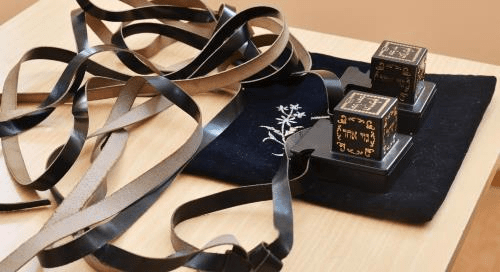
Tefillin (תְּפִלִּין) are a pair of black leather boxes containing Hebrew parchment scrolls. A set includes two—one for the head and one for the arm. Each consists of three main components: the scrolls, the box and the strap.
The Torah commands Jewish men to bind tefillin onto their head and upper arm every weekday, in fulfillment of the verse (Deut. 6:8), “You shall bind them as a sign upon your hand, and they shall be for a reminder between your eyes.”
Today the law is written on our hearts.
Jeremiah 31:33 “But this is the covenant which I will make with the house of Israel after those days,” says the Lord, “I will put My law within them, and I will write it on their hearts; and I will be their God, and they will be My people.
Hebrews 10:15-17
And the Holy Spirit also adds His testimony to us [in confirmation of this]; for after having said,
“This is the covenant that I will make with them
After those days, says the Lord:
I will imprint My laws upon their heart,
And on their mind I will inscribe them [producing an inward change],”
He then says,
“And their sins and their lawless acts
I will remember no more [no longer holding their sins against them].”
Now where there is [absolute] forgiveness and complete cancellation of the penalty of these things, there is no longer any offering [to be made to atone] for sin.
Kippah (literally: dome) (is the Hebrew word for skullcap, also referred to in Yiddish as a yarmulke, or less frequently as a koppel.
Jewish law requires men to cover their heads as a sign of respect and reverence for G‑d when praying, studying Torah, saying a blessing or entering a synagogue.
This practice has its roots in biblical times, when the priests in the Temple were instructed to cover their heads.
Traditionally, Jewish men and boys wear the kippah at all times, a symbol of their awareness of, and submission to, a “higher” entity.
Jesus is now our High Priest.
Hebrews 3:1 (Amp)
Therefore, holy brothers and sisters, who share in the heavenly calling, [thoughtfully and attentively] consider the Apostle and High Priest whom we confessed [as ours when we accepted Him as Savior], namely, Jesus;
1 Corinthians 11:3-5 (amp)
But I want you to understand that Christ is the head (authority over) of every man, and man is the head of woman, and God is the head of Christ. Every man who prays or prophesies with something on his head dishonors his head [and the One who is his head]. And every woman who prays or prophesies when she has her head uncovered disgraces her head; for she is one and the same as the woman whose head is shaved [in disgrace]
for more information on head coverings click here.
Synagogue Worship:
A synagogue (also known as a beit knesset or shul) is a place of Jewish worship. In addition to housing a sanctuary for services, synagogues often serve as the centerpoint of Jewish life. It contains seating for men and women, an ark to hold the holy Torah and a platform upon which it is read.
The word “synagogue” comes from Greek and parallels the Hebrew term beit knesset, meaning “house of gathering.” It’s also called a shul, a Yiddish word related to the English “school,” since it’s a place where the Torah is studied. Synagogues are found almost anywhere there are Jewish communities and have been in use since the Babylonian exile.
Today we are called to study the word of God. It is helpful to have teachers. It is helpful to have a place to learn God’s word.
2 Timothy 2:15
Study and do your best to present yourself to God approved, a workman [tested by trial] who has no reason to be ashamed, accurately handling and skillfully teaching the word of truth.
Paul teaches us in Romans 15:4 (ESV) For whatever was written in former days was written for our instruction, that through endurance and through the encouragement of the Scriptures we might have hope. This means that the Old Testament including the Torah (1st five books of the Old Testament) in our instructions. Those things, when we learn it, gives us hope. Notice how it is written in the KJV: For whatsoever things were written aforetime were written for our learning, that we through patience and comfort of the scriptures might have hope. This clarifies that the Old Testament was written for our learning. We are supposed to learn and be instructed by the Old Testament so that we can have hope.
Acts 19:8-10 (Amp)
And he (Paul) went into the synagogue and for three months spoke boldly, reasoning and arguing and persuading them about the kingdom of God. 9 But when some were becoming hardened and disobedient [to the word of God], discrediting and speaking evil of the Way (Jesus, Christianity) before the congregation, Paul left them, taking the disciples with him, and went on holding daily discussions in the lecture hall of Tyrannus [instead of in the synagogue]. This continued for two years, so that all the inhabitants of [the west coast province of] Asia [Minor], Jews as well as Greeks, heard the word of the Lord [concerning eternal salvation through faith in Christ].
Paul basically was a teacher at a school (lecture hall).
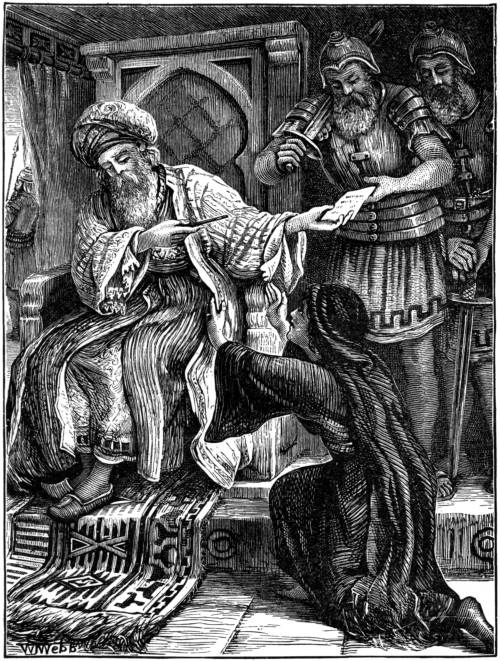
In a certain city there was a judge who neither feared God nor cared for man. And in the same city there was a widow that had an enemy, and he had done her an injury. And she came to the judge and implored him, saying, “Give me justice; avenge me of my adversary.” But he would not. Then the widow came to him every day and cried, “Give me justice;” but still he would not for a long while. At last he became wearied of her constant cry, and he said within himself, “Though I fear not God nor care for man, yet, because this widow troubleth me with her complaint, I will avenge her; lest by her continual coming she weary me.”
And Jesus said, “Hear what the unjust judge saith. And if he, who was an unjust judge and a wicked man, would grant the widow’s petition, because she asked so often, will not God, who is good and just, give His children what is good and right for them? Shall not God avenge His own elect, which cry day and night unto Him, though He bear long with them?”
In this parable Jesus impressed upon his disciples the truth that, although great trials might come upon them, and their lives be in peril, yet they were not to lose faith in God, or be disappointed because their prayers were not answered at once. They were to keep on praying; asking God for such things as were right, and trusting that He would preserve them amidst all their enemies; and in His own way make them to triumph over their foes. Whatever is best for His people, God will give them. He cares for the sparrows, and, even more, for those who love Him.
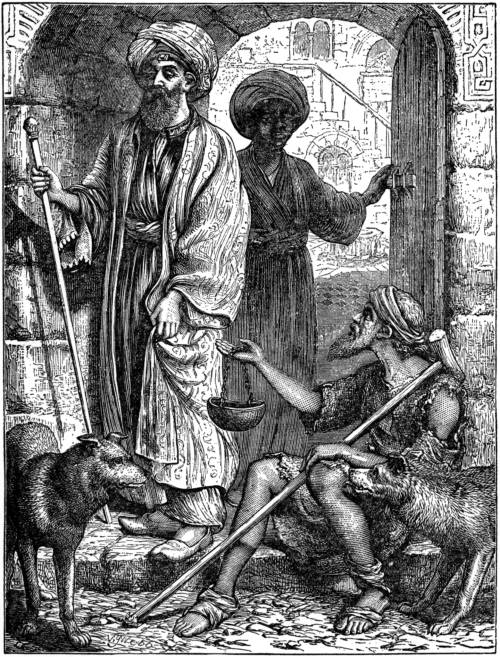
There was a certain rich man who was clothed in rich silks and fine linen, and feasted on costly food each day. There was also a poor beggar, who was ragged and hungry, and covered with sores. His name was Lazarus, and they laid him at the rich man’s gate, for he desired to be fed with the crumbs which fell from the well-supplied table. And even the dogs had pity on him, for they came and licked his sores.
And it came to pass that the beggar died, and the angels carried him away to heaven, where he was no longer clothed in rags, but in glorious array. Neither was he hungry, for he sat with Abraham and leaned upon his bosom.
The rich man also died, and was buried. He was not carried to heaven, but went to a place of torment, where he lifted up his eyes, and in the distance saw Abraham with Lazarus on his bosom. And he cried and said, “Father Abraham, have mercy on me, and send Lazarus, that he may dip the tip of his finger in water, and cool my tongue; for I am tormented in these flames.” But Abraham said, “Son, remember that thou in thy lifetime receivedst thy good things, whilst Lazarus had only evil things; and now he is comforted, and thou art tormented. Beside all this, between us and you there is a great gulf fixed.”
Then said the rich man, “I pray thee therefore, father, that thou wouldest send him to my father’s house; for I have five brethren. Let him go to them and testify unto them, that they may repent, lest they also come into this place of torment.” Abraham said unto him, “They have Moses and the prophets; let them hear them.” And he said, “Nay, father Abraham: but if one went unto them from the dead, they will repent.” But Abraham said, “If they hear not Moses and the prophets, neither will they be persuaded, though one rose from the dead.”
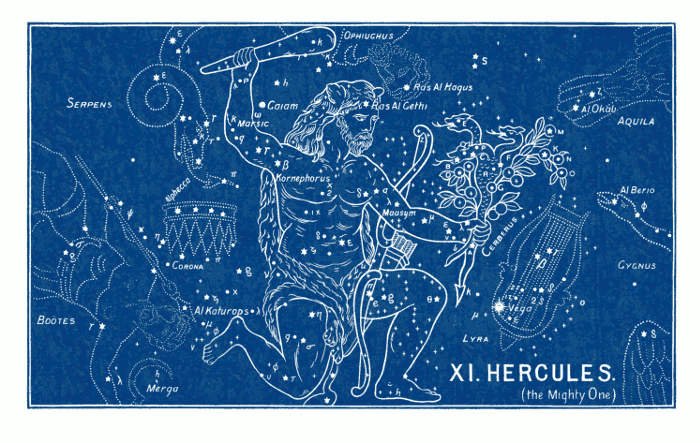
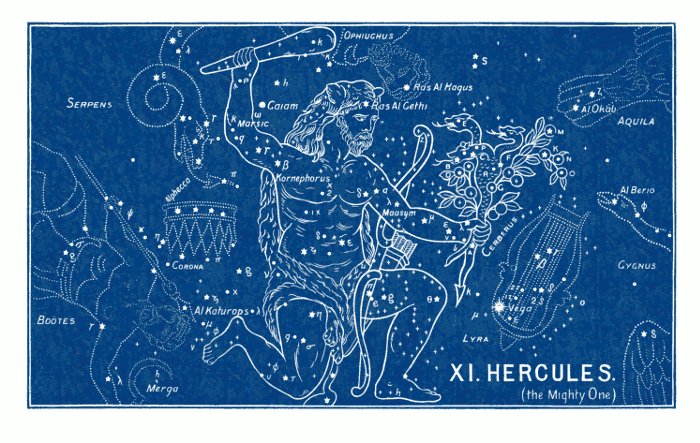
Here the mighty one, who occupies a large portion of the heavens, is seen bending on one knee, with his right heel lifted up as if it had been wounded, while his left foot is set directly over the head of the great dragon. In his right hand he wields a great club, and in his left hand he grasps a triple-headed monster (Cerberus). And he has the skin of a lion, which he has slain, thrown around him.
In the Zodiac of Denderah we have a human figure, likewise with a club. His name is Bau, which means who cometh, and is evidently intended for Him who cometh to crush the serpent’s head, and “destroy the works of the devil.”
In Arabic he is called Al Giscale, the strong one.
Plate 11: HERCULES (the Mighty One)
There are 113 stars in this constellation. Seven are of the 3rd magnitude, seventeen of the 4th, etc.
The brightest star, α (in his head), is named Ras al Gethi, and means the head of him who bruises.
The next, β (in the right arm-pit), is named Kornephorus, and means the branch, kneeling.
The star κ (in the right elbow) is called Marsic, the wounding.
The star λ (in the upper part of the left arm) is named Ma’asyn, the sin-offering.
While ω (in the lower part of the right arm) is Caiam, or Guiam, punishing; and in Arabic, treading under foot.
Thus does everything in the picture combine to set forth the mighty works of this stronger than the strong man armed!
We can easily see how the perversion of the truth by the Greeks came about, and how, when the true foreshadowings of this Mighty One had been lost, the many fables were invented to supply their place. The wiser sort of Greeks knew this perfectly well. Aristotle (in his Metaphysics, x. 8) admits, with regard to Greek mythology, that religion and philosophy had been lost, and that much had been “added after the mythical style,” while much had come down, and “may have been preserved to our times as the remains of ancient wisdom.” Religion, such as it was (Polybius confesses), was recognised as a “necessary means to political ends.” Neander says that it was “the fragments of a tradition, which transmitted the knowledge of divine things possessed in the earliest times.”
Aratus shews the same uncertainty as to the meaning of this Constellation of Hercules. He says:
“Near this, and like a toiling man, revolves
A form. Of it can no one clearly speak,
Nor what he labours at. They call him simply
‘The man upon his knees’: In desperate struggle
Like one who sinks, he seems. From both his shoulders
His arms are high-uplifted and out-stretched
As far as he can reach; and his right foot
Is planted on the coiléd Dragon’s head.”
Ancient authorities differ as to the personality of Hercules, and they disagree as to the number, nature, and order of what are sometimes called “the twelve labours of Hercules.” But there is no doubt as to the mighty foretold works which the woman’s Seed should perform.
From first to last Hercules is seen engaged in destroying some malignant foe: now it is the Nemean lion; then it is the slaying of the boar of Erymanthus; again, it is the conquest of the bull of Crete; then the killing of the three-headed hydra, by whose venom Hercules afterwards died. In the belly of the sea monster he is said to have remained “three days and three nights.” This was, doubtless, a perversion of the type of Jonah, introduced by Lycophron, who (living at the court of Ptolemy Philadelphus, under whose auspices the Hebrew Scriptures were translated into Greek) would have known of that Divine miracle, and of its application to the Coming One. Bishop Horsley believed that the fables of the Greek mythology could be traced back to the prophecies of the Messiah, of which they were a perversion from ignorance or design. This is specially true of Hercules. In his apparently impossible tasks of overthrowing gigantic enemies and delivering captives, we can see through the shadow, and discern the pure light of the truth. We can understand how the original star-picture must have been a prophetic representation of Him who shall destroy the Old Serpent and open the way again, not to fabled “apples of gold,” but to the “tree of life” itself. He it is who though suffering in the mighty conflict, and brought to His knee, going down even to “the dust of death,” shall yet, in resurrection and advent glory, wield His victorious club, subdue all His enemies, and plant His foot on the Dragon’s head. For of Him it is written:—
“Thou shalt tread upon the lion and adder;
The young lion and the dragon shalt Thou trample under foot.”
The morning of the first day of every year we enter into a contest. We see who will be the first to give that day’s greeting. Before I was awake this morning my boy ran into my room shouting, “Happy New Year! Happy New Year!” He won in the contest.
Now, however, you are in Church and it is not proper for you to speak out loud, so I am able to get ahead of you. A Happy New Year to you, every one.
Well, what will make this year a happy year for you? I will tell you. Let us take this word Happy, and instead of writing it across the page let us write it straight up and down.
H stands for Helpful. You cannot have a happy year unless you are helpful. He who does not try to be helpful is never very happy.
A for Active. I want your year to be full of activity. I hope you will be able to skate and slide down hill many days this winter, and that you will enter into all the spring and summer sports with zest and joy.
P for Playful. All work and no play makes Jack a dull boy. You will want to do something other than play, of course. You will have some home responsibilities, but sandwiched in with the work may there be a good measure of play.
P for Purposeful. Yes, early hi life you should form a purpose. Two questions will help you gain that purpose. 1st—What is it that I want to do? 2nd—What is it that God wants me to do?
Y for Youth.
Helpful Active Playful Purposeful Youth.
MEMORY VERSE, Psalm 19:14
“Let the words of my mouth, and the meditation of my heart, be acceptable in thy sight, O Lord, my strength and my redeemer.”
MEMORY HYMN
“Break, newborn year, on glad eyes break.”
1 Break, new-born year, on glad eyes break, Melodious voices move; On, rolling time; thou canst not make The Father cease to love.
2 The parted year had wingèd feet; The Saviour still doth stay: The new year comes; but, Spirit sweet, Thou goest not away.
3 Our hearts in tears may oft run o’er; But, Lord, Thy smile still beams: Our sins are swelling evermore, But pardoning grace still streams.
4 Lord, from this year more service win, More glory, more delight: O make it hours less sad with sin, Its days with Thee more bright.
5 Then we may bless its precious things If earthly cheer should come, Or gladsome mount on angel wings, If Thou wouldst take us home.
6 O golden them the hours must be; The year must needs be sweet; Yes, Lord, with happy melody Thine opening grace we greet.
Amen.
The Hymnal: Published by the authority of the General Assembly of the Presbyterian Church in the U.S.A., 1895
The English word “altar” in Hebrew is “mizbeach,” derived from the root word “zabach,” which means “to slaughter, kill, or slay an animal.” The altar served as the central place for sacrifices and the meeting point between God and humans.
Notice the following altars:
Building of the Altar
Reference
Noah builds an altar after the flood
(Gen. 8:20)
Abram (Abraham) builds an altar near Bethel
(Gen. 12:7)
Abraham builds an altar on Mount Moriah and called it Jehovah-jireh
(Gen. 22:9, 14)
Isaac builds an altar Beer-sheba
(Gen. 26:25)
Jacob builds an altar at Shalem
(Gen. 33:20)
Moses builds an altar and called it Jehovah-nissi
(Exod. 17:15)
Joshua builds an altar on Mount Ebal
(Josh. 8:30)
Gideon builds an altar and called it Jehovah-shalom
(Jude 6:24)
Manoah builds an altar on a rock
(Judg. 13:19-20)
King Saul builds an altar to the Lord.
(1 Sam. 14:35)
King David builds an altar and stopped a plague
(2 Sam. 24:21, 25)
Solomon built the First Temple to God in Jerusalem, placing a permanent altar in the outer court for daily sacrifices. Under the Old Covenant, three types of altars were made: one of natural stones (Joshua 8:30-32), a square brass altar (Exodus 27:1-2), and a golden altar in the holy place for burning daily incense (Exodus 30:1-3). These three altars symbolize three spiritual battles every believer will face.
Stone Altar: Abraham uses the stone altar to offer Isaac to God on Mount Moriah, symbolizing personal sacrifice and the surrender of our own will to the will of the heavenly Father. Willing to give up his best to please the Almighty, Abraham sets aside his personal feelings to serve a greater divine purpose. To understand God’s will, we must first come to this altar and confront our own desires, emotions, and self-interest.
Brass Altar: The second altar, known as the brass altar, is where the flesh of animals was offered in sacrifice. It symbolizes our willingness to take up our cross and follow Christ (Matt. 16:24) and to crucify our flesh (Gal. 5:24). Our bodies are “living sacrifices” (Rom. 12:1), with our carnal nature needing to be brought under control. Sacrifices here were bound to the four horns of the altar, representing believers standing firm in faith until God transforms them from within. The three fires constantly burning on the brass altar remind us of the Lord’s zeal that must keep burning in our hearts as we submit to God’s Spirit and bring our flesh into submission.
Golden Altar: The golden altar is where incense is burned each day, carrying the prayers of the righteous to God. It’s the place where we grow in worship and prayer.
At the stone altar, we learn obedience to God’s will; at the brass altar, we find freedom from sin and train our flesh; and at the golden altar, we embrace and practice daily prayer and worship.
Israel reaches Mount Sinai and stays there for about a year (see Exod. 19:1 and Num. 10:11). During this time, Moses ascends and descends the mountain eight times, spending forty days there on two occasions. It’s here that Moses receives the Ten Commandments from God (Exod. 20). Exodus 19 is often seen as vivid imagery of the catching away of the saints, described by Paul in 1 Thessalonians 4:16-17, and identified by some as the Rapture. Moses receiving the Law on Mount Sinai serves as a powerful preview of Christ’s coming, as revealed in the New Testament.
Moses on Mount Sinai in Exodus 19
The Rapture and Second Coming
Israel was a peculiar people Exodus19:5: Now therefore, if ye will obey my voice indeed, and keep my covenant, then ye shall be a peculiar treasure unto me above all people: for all the earth is mine:
The Church is a peculiar people 1 Pet. 2:9 But ye are a chosen generation, a royal priesthood, an holy nation, a peculiar people; that ye should shew forth the praises of him who hath called you out of darkness into his marvellous light;
Israel was a kingdom of priests Exodus 19:6 And ye shall be unto me a kingdom of priests, and an holy nation. These are the words which thou shalt speak unto the children of Israel.
The Church is kings and priests unto God Rev. 1:5-6 And from Jesus Christ, who is the faithful witness, and the first begotten of the dead, and the prince of the kings of the earth. Unto him that loved us, and washed us from our sins in his own blood, And hath made us kings and priests unto God and his Father; to him be glory and dominion for ever and ever. Amen.
The people were to be sanctified Exodus 19:10 And the Lord said unto Moses, Go unto the people, and sanctify them today and tomorrow, and let them wash their clothes,
The believers are to sanctify themselves 1 Thess. 4:3 For this is the will of God, even your sanctification, that ye should abstain from fornication:
God appeared on the third day Exodus 19:11 And be ready against the third day: for the third day the Lord will come down in the sightof all the people upon mount Sinai.
Christ was raised on the third day 1 Corinthians 15:3-4 For I delivered unto you first of all that which I also received, how that Christ died for our sins according to the scriptures; And that he was buried, and that he rose again the third day according to the scriptures:
God came down in the clouds Exodus 19:16 And it came to pass on the third day in the morning, that there were thunders and lightnings, and a thick cloud upon the mount, and the voice of the trumpet exceeding loud; so that all the people that was in the camp trembled.
He is coming in the clouds Acts 1:9-11 And when he had spoken these things, while they beheld, he was taken up; and a cloud received him out of their sight. And while they looked stedfastly toward heaven as he went up, behold, two men stood by them in white apparel; Which also said, Ye men of Galilee, why stand ye gazing up into heaven? this same Jesus, which is taken up from you into heaven, shall so come in like manner as ye have seen him go into heaven.
God came down in the lightning Exodus 19:16 And it came to pass on the third day in the morning, that there were thunders and lightnings, and a thick cloud upon the mount, and the voice of the trumpet exceeding loud; so that all the people that was in the camp trembled.
He is coming as lightning Matt. 24:27 For as the lightning cometh out of the east, and shineth even unto the west; so shall also the coming of the Son of man be.
God’s voice was as a trumpet Exodus 19:16 And it came to pass on the third day in the morning, that there were thunders and lightnings, and a thick cloud upon the mount, and the voice of the trumpet exceeding loud; so that all the people that was in the camp trembled.
The trumpet of God will sound 1 Thess. 4:16 For the Lord himself shall descend from heaven with a shout, with the voice of the archangel, and with the trump of God: and the dead in Christ shall rise first:
God came down in fire Exodus 19:18 And mount Sinai was altogether on a smoke, because the Lord descended upon it in fire: and the smoke thereof ascended as the smoke of a furnace, and the whole mount quaked greatly.
Christ returns to earth in flaming fire 2 Thess. 1:7-10 And to you who are troubled rest with us, when the Lord Jesus shall be revealed from heaven with his mighty angels, In flaming fire taking vengeance on them that know not God, and that obey not the gospel of our Lord Jesus Christ: Who shall be punished with everlasting destruction from the presence of the Lord, and from the glory of his power; When he shall come to be glorified in his saints, and to be admired in all them that believe (because our testimony among you was believed) in that day.
God answered Moses in a voice Exodus19:19 And when the voice of the trumpet sounded long, and waxed louder and louder, Moses spake, and God answered him by a voice.
The voice of the archangel 1 Thess. 4:16 For the Lord himself shall descend from heaven with a shout, with the voice of the archangel, and with the trump of God: and the dead in Christ shall rise first:
God descended from heaven Exodus 19:20 And the Lord came down upon mount Sinai, on the top of the mount: and the Lord called Moses up to the top of the mount; and Moses went up.
Christ will descend from heaven 1 Thess. 4:16 For the Lord himself shall descend from heaven with a shout, with the voice of the archangel, and with the trump of God: and the dead in Christ shall rise first:
God called Moses up Exodus 19:20 And the Lord came down upon mount Sinai, on the top of the mount: and the Lord called Moses up to the top of the mount; and Moses went up.
The saints will be caught up 1 Thess. 4:17 Then we which are alive and remain shall be caught up together with them in the clouds, to meet the Lord in the air: and so shall we ever be with the Lord.

 articlesforchristians