This second Sunday morning of the New Year I desire to talk to you about growth. The most important holiday afterthought is the thought of growth. You are going to grow every day of this year. Whenever I see a boy on his way to school, or on the field or gymnasium floor, running, romping, playing, I say to myself, “Can it be possible that this restless, energetic lad was ever a quiet, helpless little babe in the cradle!” Yes, he was, but he has grown, and he is going to keep right on growing.
It was said of the boy Jesus, “He grew.” His growth was natural. There was nothing of precociousness in the childhood of Jesus. He grew, just as every boy grows.
“A simple-hearted child was he, And he was nothing more; In summer days, like you and me, He played about the door, Or gathered, where the father toiled, The shavings from the floor.”
His growth continued. It did not stop with childhood, but right on through boyhood, youth and manhood he kept growing. Best of all his growth was balanced. He grew physically, mentally and spiritually. He had a sound body. He loved the out-of-doors. He companionshiped much with nature. Most of his graphic illustrations were taken from living, growing things. He talked, almost chiefly, about seeds, grain, harvests, trees, birds and living waters. Boys and girls, strive to grow. Be like your Master who grew inward, outward, and upward; selfward, manward, and Godward. “How can I grow?” you ask. I will tell you by passing on to you the secret as given by Maltbie Babcock.
Go Right On Working
MEMORY VERSE, Luke 2: 40
“And the child grew, and waxed strong in spirit, filled with wisdom; and the grace of God was upon him.”
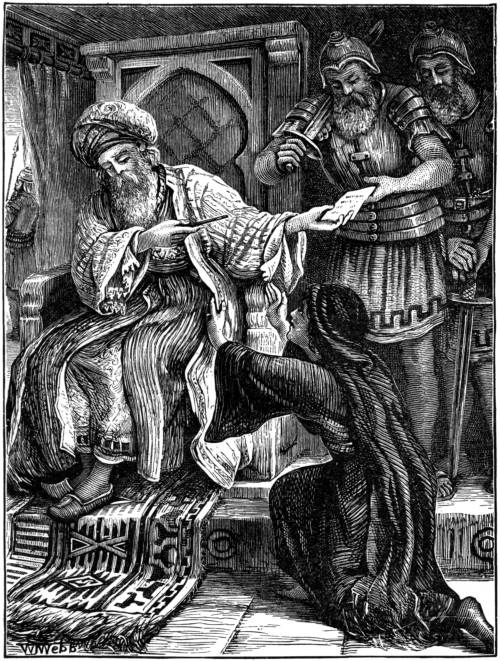
In a certain city there was a judge who neither feared God nor cared for man. And in the same city there was a widow that had an enemy, and he had done her an injury. And she came to the judge and implored him, saying, “Give me justice; avenge me of my adversary.” But he would not. Then the widow came to him every day and cried, “Give me justice;” but still he would not for a long while. At last he became wearied of her constant cry, and he said within himself, “Though I fear not God nor care for man, yet, because this widow troubleth me with her complaint, I will avenge her; lest by her continual coming she weary me.”
And Jesus said, “Hear what the unjust judge saith. And if he, who was an unjust judge and a wicked man, would grant the widow’s petition, because she asked so often, will not God, who is good and just, give His children what is good and right for them? Shall not God avenge His own elect, which cry day and night unto Him, though He bear long with them?”
In this parable Jesus impressed upon his disciples the truth that, although great trials might come upon them, and their lives be in peril, yet they were not to lose faith in God, or be disappointed because their prayers were not answered at once. They were to keep on praying; asking God for such things as were right, and trusting that He would preserve them amidst all their enemies; and in His own way make them to triumph over their foes. Whatever is best for His people, God will give them. He cares for the sparrows, and, even more, for those who love Him.
I must conclude my journal here. We can scarcely be more happy than we are, and I feel no cares about my children. Fritz is so fond of the chase and of mechanics, and Ernest of study, that they will not wish to marry; but I please myself by hoping at some time to see my dear Jack and Francis happily united to Sophia and Matilda. What remains for me to tell? The details of happiness, however sweet in enjoyment, are often tedious in recital.
I will only add, that after passing a few days with us, Mr. Willis returned to his charge, promising to visit us, and eventually to join us. The Grotto Ernestine, fitted up by Fritz and Parabery, made a pretty abode for Madame Hirtel and her daughters, and the two islanders. Minou–minou did not leave his young mammas, and was very useful to them. I must state, also, that my son Ernest, without abandoning the study of natural history, applied himself to astronomy, and mounted the large telescope belonging to the ship; he acquired considerable knowledge of this sublime science, which his mother, however, considered somewhat useless. The course of the other planets did not interest her, so long as all went on well in that which she inhabited; and nothing now was wanting to her happiness, surrounded as she was by friends.
The following year we had a visit from a Russian vessel, the Neva, commanded by Captain Krusenstern, a countryman and distant relation of mine. The celebrated Horner, of Zurich, accompanied him as astronomer. Having read the first part of our journal, sent into Europe by Captain Johnson, he had come purposely to see us. Delighted with our establishment, he did not advise us to quit it. Captain Krusenstern invited us to take a passage in his vessel; we declined his offer; but my wife, though she renounced her country for ever, was glad of the opportunity of making inquiries about her relations and friends. As she had concluded, her good mother had died some years before, blessing her absent children. My wife shed some tears, but was consoled by the certainty of her mother’s eternal felicity, and the hope of their meeting in futurity.
One of her brothers was also dead; he had left a daughter, to whom my wife had always been attached, though she was very young when we left. Henrietta Bodmer was now sixteen, and, Mr. Horner assured us, a most amiable girl. My wife wished much to have her with us.
Ernest would not leave Mr. Horner a moment, he was so delighted to meet with one so eminently skilful in his favourite science. Astronomy made them such friends, that Mr. Horner petitioned me to allow him to take my son to Europe, promising to bring him back himself in a few years. This was a great trial to us, but I felt that his taste for science required a larger field than our island. His mother was reluctant to part with him, but consoled herself with a notion, that he might bring his cousin Henrietta back with him.
Many tears were shed at our parting; indeed, the grief of his mother was so intense, that my son seemed almost inclined to give up his inclination; but Mr. Horner made some observations about the transit of Venus, so interesting that Ernest could not resist. He left us, promising to bring us back everything we wished for. In the mean time Captain Krusenstern left us a good supply of powder, provisions, seeds, and some capital tools, to the great delight of Fritz and Jack. They regretted their brother greatly, but diverted their minds from sorrow by application to mechanics, assisted by the intelligent Parabery. They have already succeeded in constructing, near the cascade, a corn-mill and a saw-mill, and have built a very good oven.
We miss Ernest very much. Though his taste for study withdrew him a good deal from us, and he was not so useful as his brothers, we found his calm and considerate advice often of value, and his mildness always spread a charm over our circle, in joy or in trouble.
Except this little affliction, we are very happy. Our labours are divided regularly. Fritz and Jack manage the Board of Works. They have opened a passage through the rock which divided us from the other side of the island; thus doubling our domain and our riches. At the same time, they formed a dwelling for Madame Hirtel near our own, from the same excavation in the rock. Fritz took great pains with it; the windows are made of oiled paper instead of glass; but we usually assemble in our large work-room, which is very well lighted.
Francis has the charge of our flocks and of the poultry, all greatly increased. For me, I preside over the grand work of agriculture. The two mothers, their two daughters, and Canda, manage the garden, spin, weave, take care of our clothes, and attend to household matters. Thus we all work, and everything prospers. Several families of the natives, pupils of Mr. Willis, have obtained leave, through him, to join us, and are settled at Falcon’s Nest, and at the Farm. These people assist us in the cultivation of our ground, and our dear missionary in the cultivation of our souls. Nothing is wanting to complete our happiness but the return of dear Ernest.
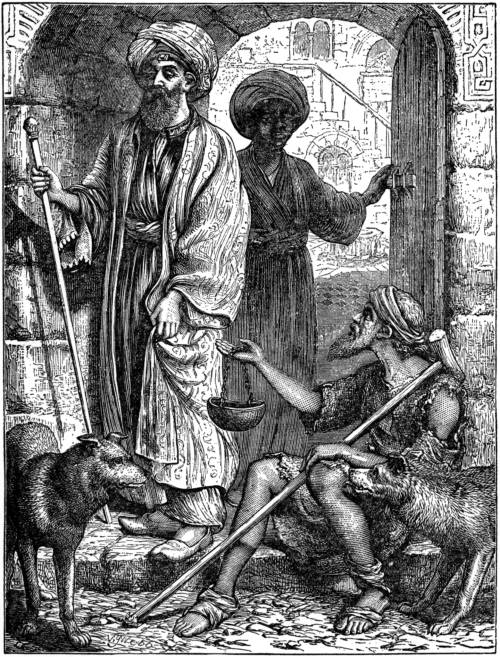
There was a certain rich man who was clothed in rich silks and fine linen, and feasted on costly food each day. There was also a poor beggar, who was ragged and hungry, and covered with sores. His name was Lazarus, and they laid him at the rich man’s gate, for he desired to be fed with the crumbs which fell from the well-supplied table. And even the dogs had pity on him, for they came and licked his sores.
And it came to pass that the beggar died, and the angels carried him away to heaven, where he was no longer clothed in rags, but in glorious array. Neither was he hungry, for he sat with Abraham and leaned upon his bosom.
The rich man also died, and was buried. He was not carried to heaven, but went to a place of torment, where he lifted up his eyes, and in the distance saw Abraham with Lazarus on his bosom. And he cried and said, “Father Abraham, have mercy on me, and send Lazarus, that he may dip the tip of his finger in water, and cool my tongue; for I am tormented in these flames.” But Abraham said, “Son, remember that thou in thy lifetime receivedst thy good things, whilst Lazarus had only evil things; and now he is comforted, and thou art tormented. Beside all this, between us and you there is a great gulf fixed.”
Then said the rich man, “I pray thee therefore, father, that thou wouldest send him to my father’s house; for I have five brethren. Let him go to them and testify unto them, that they may repent, lest they also come into this place of torment.” Abraham said unto him, “They have Moses and the prophets; let them hear them.” And he said, “Nay, father Abraham: but if one went unto them from the dead, they will repent.” But Abraham said, “If they hear not Moses and the prophets, neither will they be persuaded, though one rose from the dead.”
Oh, were you ne’er a schoolboy, And did you never train, And feel that swelling of the heart You ne’er can feel again?
Did you never meet, far down the street, With plumes and banners gay, While the kettle, for the kettledrum, Played your march, march away?
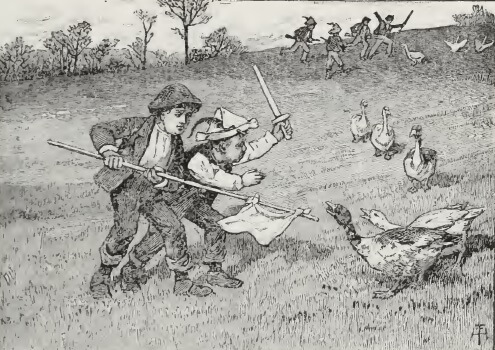
It seems to me but yesterday Nor scarce so long ago, Since all our school their muskets took, To charge the fearful foe.
Our muskets were of cedar wood, With ramrods bright and new; With bayonets forever set, And painted barrels, too.
We charged upon a flock of geese, And put them all to flight— Except one sturdy gander That thought to show us fight.
But, ah! we knew a thing or two; Our captain wheeled the van; We routed him, we scouted him, Nor lost a single man!
Our captain was as brave a lad As e’er commission bore; And brightly shone his new tin sword A paper cap he wore.
He led us up the steep hillside, Against the western wind, While the cockerel plume that decked his head Streamed bravely out behind.
We shouldered arms, we carried arms We charged the bayonet; And woe unto the mullein stalk That in our course we met!
At two o’clock the roll we called, And till the close of day, With fearless hearts, though tired limbs, We fought the mimic fray, — Till the supper bell, from out the dell, Bade us march, march away
Definitions
Kettle Drum: A drum made of a copper vessel shaped like a kettle.
Musket: A kind of gun.
Cedar: A very durable kind of wood.
Bayonet: A sharp piece of steel on the end of a gun.
Barrel: The long metal tube forming part of a gun.
Sturdy: Stubborn, bold.
Van: The front.
Routed: Put to flight.
Commission: A writing to show power.
Cockerel: A young chicken-cock.
Charged: Made an onset.
Mullein: A tall plant that grows in neglected fields.
The next day, Fritz and Ernest set out on their expedition with Parabery, in his canoe, to seek our two valued dogs. The good islander carried his canoe on his back to the shore. I saw them set off, but not without some dread, in such a frail bark, into which the water leaked through every seam. But my boys could swim well; and the kind, skilful, and bold Parabery undertook to answer for their safety. I therefore recommended them to God, and returned to the grotto, to tranquillize my wife’s fears. Jack was inconsolable that he could not form one of the party; but Sophia scolded him for wishing to leave them, to go upon the sea, which had swallowed up poor Alfred.
In the evening we had the pleasure of seeing our brave dogs enter the grotto. They leaped on us in a way that terrified the poor little girls at first, who took them for bears; but they were soon reconciled to them when they saw them fawn round us, lick our hands, and pass from one to the other to be caressed. My sons had had no difficulty in finding them; they had run to them at the first call, and seemed delighted to see their masters again.
The poor animals had subsisted on the remains of the kangaroos, but apparently had met with no fresh water, for they seemed dying with thirst, and rushed to the brook as soon as they discovered it, and returned again and again. Then they followed us to the hut of the good missionary, who had been engaged all day in visiting the dwellings of the natives, and teaching them the truths of religion. I had accompanied him, but, from ignorance of the language, could not aid him. I was, however, delighted with the simple and earnest manner in which he spoke, and the eagerness with which they heard him. He finished by a prayer, kneeling, and they all imitated him, lifting up their hands and eyes to heaven. He told me he was trying to make them celebrate the Sunday. He assembled them in his tent, which he wished to make a temple for the worship of the true God. He intended to consecrate it for this purpose, and to live in the grotto, after our departure.
The day arrived at last. Jack’s shoulder was nearly healed, and my wife, along with her happiness, recovered her strength. The pinnace had been so well guarded by Parabery and his friends that it suffered no injury. I distributed among the islanders everything I had that could please them, and made Parabery invite them to come and see us in our island, requesting we might live on friendly terms. Mr. Willis wished much to see it, and to complete our happiness he promised to accompany and spend some days with us; and Parabery said he would take him back when he wished it.
We embarked, then, after taking leave of Bara-ourou, who was very liberal in his presents, giving us, besides fruits of every kind, a whole hog roasted, which was excellent.
We were fourteen in number; sixteen, reckoning the two dogs. The missionary accompanied us, and a young islander, whom Parabery had procured to be his servant, as he was too old and too much occupied with his mission to attend to his own wants. This youth was of a good disposition and much attached to him. Parabery took him to assist in rowing when he returned.
Emily could not but feel rather affected at leaving the grotto, where she had passed four tranquil, if not happy years, fulfilling the duties of a mother. Neither could she avoid a painful sensation when she once more saw the sea that had been so fatal to her husband and son; she could scarcely subdue the fear she had of trusting all she had left to that treacherous element. She held her daughters in her arms, and prayed for the protection of Heaven. Mr. Willis and I spoke to her of the goodness of God, and pointed out to her the calmness of the water, the security of the pinnace, and the favourable state of the wind. My wife described to her our establishment, and promised her a far more beautiful grotto than the one she had left, and at last she became more reconciled.
After seven or eight hours’ voyage, we arrived at Cape Disappointment, and we agreed the bay should henceforth be called the Bay of the Happy Return.
The distance to Tent House from hence was much too great for the ladies and children to go on foot. My intention was to take them by water to the other end of the island near our house; but my elder sons had begged to be landed at the bay, to seek their live stock, and take them home. I left them there with Parabery; Jack recommended his buffalo to them, and Francis his bull, and all were found. We coasted the island, arrived at Safety Bay, and were soon at Tent House, where we found all, as we had left it, in good condition.
Notwithstanding the description my wife had given them, our new guests found our establishment far beyond their expectation. With what delight Jack and Francis ran up and down the colonnade with their young friends! What stories they had to tell of all the surprises they had prepared for their mother! They showed them Fritzia, Jackia, the Franciade, and gave their friends water from their beautiful fountain. Absence seemed to have improved everything; and I must confess I had some difficulty to refrain from demonstrating my joy as wildly as my children. Minou–minou, Parabery, and Canda, were lost in admiration, calling out continually, miti! beautiful! My wife was busied in arranging a temporary lodging for our guests. The work-room was given up to Mr. Willis; my wife and Madame Emily had our apartment, the two little girls being with them, to whom the hammocks of the elder boys were appropriated. Canda, who knew nothing about beds, was wonderfully, comfortable on the carpet. Fritz, Ernest, and the two natives, stowed themselves wherever they wished, in the colonnade, or in the kitchen; all was alike to them. I slept on moss and cotton in Mr. Willis’s room, with my two younger sons. Every one was content, waiting till our ulterior arrangements were completed.
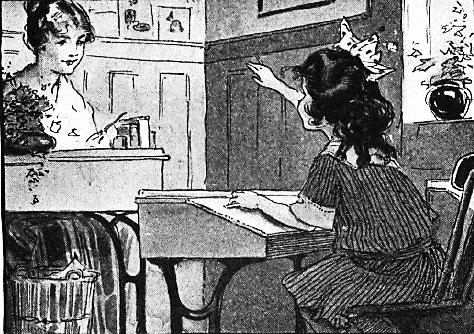
Polly liked to go to school. She had wished to go for a long time. She thought that she should like it. And, sure enough, she did.
Father had taught Polly to read. So she did not begin with the very easiest book. She began with the second reader.
It was just the same with the number work. She knew all about eight and eight, and nine and nine.
She could tell Miss Barnes, her teacher, the answer to six times four, and seven times three.
Besides, she could tell how much things cost at her father’s store. And she knew how much sugar you could buy for thirty cents, if it cost ten cents a pound.
One day, Miss Barnes said, “Now we will have our geography lesson. We will talk about our village. You may tell all the things that you have seen when I have taken you walking. Who will talk first? “
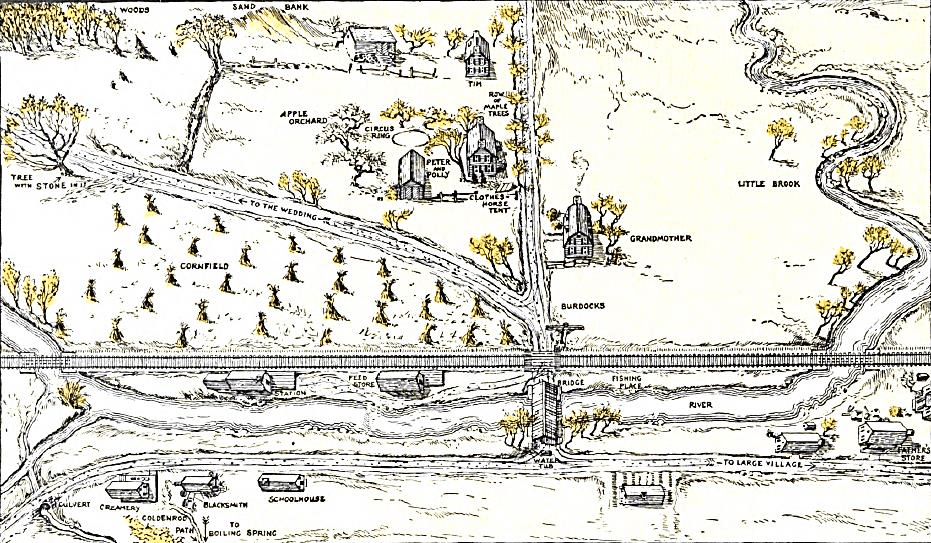
“I will,” said Polly. “I know things about our village. It is called East Village. It is in a valley. The hills are high all around it. They make good sliding places.
“There is one store and it is my father’s. The post office is in it. There is one church. It is white. I go to church.
“There is a railroad station. Peter and I have to watch for trains when we cross the tracks.”
“Where does the railroad go?” asked Miss Barnes.
“It goes to Large Village,” said Polly. “And when you get there, you can travel to many other places. I am not sure where it goes the other way.”
“I know,” said a big boy. “It goes through the White Mountains. If you ride far enough, you will reach the ocean. Once I did.”
“Good,” said Miss Barnes. “Can you tell more, Polly? “
“Oh, yes,” answered Polly. “I know about the blacksmith’s shop. I go there. The blacksmith is my friend. Next to his shop is the creamery. Some of the butter they make goes far away. I have seen boxes of it at the station.”
“They send it to Boston,” said another girl.
“There is a sawmill,” said Polly. “They make butter boxes there. Besides, they saw up big logs. I have seen them.
“I have been inside the grain shop. That is where Tim’s father buys all the grain for his Jersey cows. We get ours there, too. But we do not buy so much.”
“Have we a river?” asked Miss Barnes.
“Yes, it is the Moose River,” said Polly. “Last winter I saw men cutting ice on it. I saw them putting the cakes into the big ice house. The boys fish in the river in the summer. So does Blacky.
“It turns the wheels of the sawmill. I have seen three brooks that run into it. One goes under the road just a little way from here. Lots of other brooks must help to make it, too.”
“Where do the brooks come from?” asked Miss Barnes. “Perhaps you do not know that, Polly.”
“Oh, yes, I know,” said Polly. “Peter and I went to the boiling spring the other day. A brook comes from that. It is the one that goes under the road.”
“Can you tell us anything about our trees?” asked Miss Barnes.
“We have elm trees in our yard,” said Polly. “Our swing is in one of them. We can swing way up in the branches. The leaves are all gone now.
“We have maple trees in front of our house. They go all the way up to Tim’s. Peter and I made wreaths of their leaves. They were red and yellow.
“I know something more, too. Next spring my father will tap those trees. We can get maple sugar from their sap.
“Peter and I know where to find butter nut trees. The squirrels take most of the butternuts.
“We know where to find beech trees, too. Once Tim hunted for beechnuts under a maple.
“One of the big boys gave me some acorns and some oak leaves. I do not know where the oak trees are.”
“That is a good geography lesson, Polly,” said Miss Barnes. “Your father must have shown you a great many things. I did not show you all that you told us about. Now I have thought of something.
“I am going to give a box to each child in my room. We will call them ‘Keepsake Boxes.’
“You may put into these boxes anything about this geography lesson that you can find. I will look at your boxes next week. Do you think that will be fun?”
“Oh, yes, Miss Barnes!” shouted all the children.
And Polly said, “I can think of lots of things for my Keepsake Box this very minute. I can think of butternuts, and beechnuts, and corn from the grain shop, and a stamp from the post office. Oh, I am in a hurry to go home so that I can begin.”
Being again urged to utter a wish, he saw at last that he was saved from the power of the terrible man. He felt as if the most crushing load had fallen off him. He knew now that it was better to confess at once, when something had gone wrong, so he said: “I have also lost the paper.”
Reflecting a while, the grandmama understood and said: “That is right. Always confess what is wrong, then it can be settled. And now, what would you like to have?”
So Peter could choose everything in the world he wished. His brain got dizzy. He saw before him all the wonderful things in the fair in Mayenfeld. He had often stood there for hours, looking at the pretty red whistles and the little knives; unfortunately Peter had never possessed more than half what those objects cost.
He stood thinking, not able to decide, when a bright thought struck him.
“Ten pennies,” said Peter with decision.
“That certainly is not too much,” the old lady said with a smile, taking out of her pocket a big, round thaler, on top of which she laid twenty pennies. “Now I’ll explain this to you. Here you have as many times ten pennies as there are weeks in the year. You’ll be able to spend one every Sunday through the year.”
“All my life?” Peter asked quite innocently.
The grandmama began to laugh so heartily at this that the two men came over to join her.
Laughingly she said: “You shall have it my boy; I will put it in my will and then you will do the same, my son. Listen! Peter the goatherd shall have a ten-penny piece weekly as long as he lives.”
Mr. Sesemann nodded.
Peter, looking at his gift, said solemnly: “God be thanked!” Jumping and bounding, he ran away. His heart was so light that he felt he could fly.
A little later the whole party sat round the table holding a merry feast. After dinner, Clara, who was lively as never before, said to her father:
“Oh, Papa, if you only knew all the things grandfather did for me. It would take many days to tell you; I shall never forget them all my life. Oh, if we could please him only half as much as what he did for me.”
“It is my greatest wish, too, dear child,” said her father; “I have been trying to think of something all the time. We have to show our gratitude in some way.”
Accordingly Mr. Sesemann walked over to the old man, and began: “My dear friend, may I say one word to you. I am sure you believe me when I tell you that I have not known any real joy for years. What was my wealth to me when I could not cure my child and make her happy! With the help of the Lord you have made her well. You have given her a new life. Please tell me how to show my gratitude to you. I know I shall never be able to repay you, but what is in my power I shall do. Have you any request to make? Please let me know.”
The uncle had listened quietly and had looked at the happy father.
“Mr. Sesemann, you can be sure that I also am repaid by the great joy I experience at the recovery of Clara,” said the uncle firmly. “I thank you for your kind offer, Mr. Sesemann. As long as I live I have enough for me and the child. But I have one wish. If this could be fulfilled, my life would be free of care.”
“Speak, my dear friend,” urged Clara’s father.
“I am old,” continued the uncle, “and shall not live many years. When I die I cannot leave Heidi anything. The child has no relations except one, who even might try to take advantage of her if she could. If you would give me the assurance, Mr. Sesemann, that Heidi will never be obliged to go into the world and earn her bread, you would amply repay me for what I was able to do for you and Clara.”
“My dear friend, there is no question of that,” began Mr. Sesemann; “the child belongs to us! I promise at once that we shall look after her so that there will not be any need of her ever earning her bread. We all know that she is not fashioned for a life among strangers. Nevertheless, she has made some true friends, and one of them will be here very shortly. Dr. Classen is just now completing his last business in Frankfurt. He intends to take your advice and live here. He has never felt so happy as with you and Heidi. The child will have two protectors near her, and I hope with God’s will, that they may be spared a long, long time.”
“And may it be God’s will!” added the grandmama, who with Heidi had joined them, shaking the uncle tenderly by the hand. Putting her arms around the child, she said: “Heidi, I want to know if you also have a wish?”
“Yes indeed, I have,” said Heidi, pleased.
“Tell me what it is, child!”
“I should like to have my bed from Frankfurt with the three high pillows and the thick, warm cover. Then grandmother will be able to keep warm and won’t have to wear her shawl in bed. Oh, I’ll be so happy when she won’t have to lie with her head lower than her heels, hardly able to breathe!”
Heidi had said all this in one breath, she was so eager.
“Oh dear, I had nearly forgotten what I meant to do. I am so glad you have reminded me, Heidi. If God sends us happiness we must think of those who have many privations. I shall telegraph immediately for the bed, and if Miss Rottenmeier sends it off at once, it can be here in two days. I hope the poor blind grandmother will sleep better when it comes.”
Heidi, in her happiness, could hardly wait to bring the old woman the good news. Soon it was resolved that everybody should visit the grandmother, who had been left alone so long. Before starting, however, Mr. Sesemann revealed his plans. He proposed to travel through Switzerland with his mother and Clara. He would spend the night in the village, so as to fetch Clara from the Alm next morning for the journey. From there they would go first to Ragatz and then further. The telegram was to be mailed that night.
Clara’s feelings were divided, for she was sorry to leave the Alp, but the prospect of the trip delighted her.
When everything was settled, they all went down, the uncle carrying Clara, who could not have risked the lengthy walk. All the way down Heidi told the old lady of her friends in the hut; the cold they had to bear in winter and the little food they had.
Brigida was just hanging up Peter’s shirt to dry, when the whole company arrived. Rushing into the house, she called to her mother: “Now they are all going away. Uncle is going, too, carrying the lame child.”
“Oh, must it really be?” sighed the grandmother. “Have you seen whether they took Heidi away? Oh, if she only could give me her hand once more! Oh, I long to hear her voice once more!”
The same moment the door was flung open and Heidi held her tight.
“Grandmother, just think. My bed with the three pillows and the thick cover is coming from Frankfurt. Grandmama has said that it will be here in two days.”
Heidi thought that grandmother would be beside herself with joy, but the old woman, smiling sadly, said:
“Oh, what a good lady she must be! I know I ought to be glad she is taking you with her, Heidi, but I don’t think I shall survive it long.”
“But nobody has said so,” the grandmama, who had overheard those words, said kindly. Pressing the old woman’s hand, she continued: “It is out of the question. Heidi will stay with you and make you happy. To see Heidi again, we will come up every year to the Alm, for we have many reasons to thank the Lord there.”
Immediately the face of the grandmother lighted up, and she cried tears of joy.
“Oh, what wonderful things God is doing for me!” said the grandmother, deeply touched. “How good people are to trouble themselves about such a poor old woman as I. Nothing in this world strengthens the belief in a good Father in Heaven more than this mercy and kindness shown to a poor, useless little woman, like me.”
“My dear grandmother,” said Mrs. Sesemann, “before God in Heaven we are all equally miserable and poor; woe to us, if He should forget us!—But now we must say good-bye; next year we shall come to see you just as soon as we come up the Alp. We shall never forget you!” With that, Mrs. Sesemann shook her hand. It was some time before she was allowed to leave, however, because the grandmother thanked her over and over again, and invoked all Heaven’s blessings on her and her house.
Mr. Sesemann and his mother went on down, while Clara was carried up to spend her last night in the hut.
Next morning, Clara shed hot tears at parting from the beloved place, where such gladness had been hers. Heidi consoled her with plans for the coming summer, that was to be even more happy than this one had been. Mr. Sesemann then arrived, and a few last parting words were exchanged.
Clara, half crying, suddenly said: “Please give my love to Peter and the goats, Heidi! Please greet Schwänli especially from me, for she has helped a great deal in making me well. What could I give her?”
“You can send her salt, Clara. You know how fond she is of that,” advised little Heidi.
“Oh, I will surely do that,” Clara assented. “I’ll send her a hundred pounds of salt as a remembrance from me.”
It was time to go now, and Clara was able to ride proudly beside her father. Standing on the edge of the slope, Heidi waved her hand, her eyes following Clara till she had disappeared.
The bed has arrived. Grandmother sleeps so well every night now, that before long she will be stronger than ever. Grandmama has not forgotten the cold winter on the Alp and has sent a great many warm covers and shawls to the goatherd’s hut. Grandmother can wrap herself up now and will not have to sit shivering in a corner.
In the village a large building is in progress. The doctor has arrived and is living at present in his old quarters. He has taken the uncle’s advice and has bought the old ruins that sheltered Heidi and her grandfather the winter before. He is rebuilding for himself the portion with the fine apartment already mentioned. The other side is being prepared for Heidi and her grandfather. The doctor knows that his friend is an independent man and likes to have his own dwelling. Bärli and Schwänli, of course, are not forgotten; they will spend the winter in a good solid stable that is being built for them.
The doctor and the Alm-Uncle become better friends every day. When they overlook the progress of the building, they generally come to speak of Heidi. They both look forward to the time when they will be able to move into the house with their merry charge. They have agreed to share together the pleasure and responsibility that Heidi brings them. The uncle’s heart is filled with gratitude too deep for any words when the doctor tells him that he will make ample provision for the child. Now her grandfather’s heart is free of care, for if he is called away, another father will take care of Heidi and love her in his stead.
At the moment when our story closes, Heidi and Peter are sitting in grandmother’s hut. The little girl has so many interesting things to relate and Peter is trying so hard not to miss anything, that in their eagerness they are not aware that they are near the happy grandmother’s chair. All summer long they have hardly met, and very many wonderful things have happened. They are all glad at being together again, and it is hard to tell who is the happiest of the group. I think Brigida’s face is more radiant than any, for Heidi has just told her the story of the perpetual ten-penny piece. Finally the grandmother says: “Heidi, please read me a song of thanksgiving and praise. I feel that I must praise and thank the Lord for the blessings He has brought to us all!”
 articlesforchristians