The sun was just rising, and the Alm-Uncle was watching how mountain and dale awoke to the new day, and the clouds above grew brighter.
Next, the old man turned to go back into the hut, and softly climbed the ladder. Clara, having just a moment ago opened her eyes, looked about her in amazement. Bright sunbeams danced on her bed. Where was she? But soon she discovered her sleeping friend, and heard the grandfather’s cheery voice:
“How did you sleep? Not tired?”
Clara, feeling fresh and rested, said that she had never slept better in all her life. Heidi was soon awake, too, and lost no time in coming down to join Clara, who was already sitting in the sun.
A cool morning breeze fanned their cheeks, and the spicy fragrance from the fir-trees filled their lungs with every breath. Clara had never experienced such well-being in all her life. She had never breathed such pure, cool morning air and never felt such warm, delicious sunshine on her feet and hands. It surpassed all her expectations.
“Oh, Heidi, I wish I could always stay up here with you!” she said.
“Now you can see that everything is as beautiful as I told you,” Heidi replied triumphantly. “Up on the Alp with grandfather is the loveliest spot in all the world.”
The grandfather was just coming out of the shed with two full bowls of steaming, snow-white milk. Handing one to each of the children, he said to Clara: “This will do you good, little girl. It comes from Schwänli and will give you strength. To your health! Just drink it!” he said encouragingly, for Clara had hesitated a little. But when she saw that Heidi’s bowl was nearly empty already, she also drank without even stopping. Oh, how good it was! It tasted like cinnamon and sugar.
“We’ll take two tomorrow,” said the grandfather.
After their breakfast, Peter arrived. While the goats were rushing up to Heidi, bleating loudly, the grandfather took the boy aside.
“Just listen, and do what I tell you,” he said. “From now on you must let Schwänli go wherever she likes. She knows where to get the richest herbs, and you must follow her, even if she should go higher up than usual. It won’t do you any harm to climb a little more, and will do all the others good. I want the goats to give me splendid milk, remember. What are you looking at so furiously?”
Peter was silent, and without more ado started off, still angrily looking back now and then. As Heidi had followed a little way, Peter called to her: “You must come along, Heidi, Schwänli has to be followed everywhere.”
“No, but I can’t,” Heidi called back: “I won’t be able to come as long as Clara is with me. Grandfather has promised, though, to let us come up with you once.”
With those words Heidi returned to Clara, while the goatherd was hurrying onward, angrily shaking his fists.
The children had promised to write a letter to grandmama every day, so they immediately started on their task. Heidi brought out her own little three-legged stool, her school-books and her papers, and with these on Clara’s lap they began to write. Clara stopped after nearly every sentence, for she had to look around. Oh, how peaceful it was with the little gnats dancing in the sun and the rustling of the trees! From time to time they could hear the shouting of a shepherd re-echoed from many rocks.
The morning had passed, they knew not how, and dinner was ready. They again ate outside, for Clara had to be in the open air all day, if possible. The afternoon was spent in the cool shadow of the fir-trees. Clara had many things to relate of Frankfurt and all the people that Heidi knew. It was not long before Peter arrived with his flock, but without even answering the girls’ friendly greeting, he disappeared with a grim scowl.
While Schwänli was being milked in the shed, Clara said:
“Oh, Heidi, I feel as if I could not wait for my milk. Isn’t it funny? All my life I have only eaten because I had to. Everything always tasted to me like cod-liver oil, and I have often wished that I should never have to eat. And now I am so hungry!”
“Oh yes, I know,” Heidi replied. She had to think of the days in Frankfurt when her food seemed to stick in her throat.
When at last the full bowls were brought by the old man, Clara, seizing hers, eagerly drank the contents in one draught and even finished before Heidi.
“Please, may I have a little more?” she asked, holding out the bowl.
Nodding, much pleased, the grandfather soon refilled it. This time he also brought with him a slice of bread and butter for the children. He had gone to Maiensass that afternoon to get the butter, and his trouble was well rewarded: they enjoyed it as if it had been the rarest dish.
This evening Clara fell asleep the moment she lay down. Two or three days passed in this pleasant way. The next brought a surprise. Two strong porters came up the Alp, each carrying on his back a fresh, white bed. They also brought a letter from grandmama, in which she thanked the children for their faithful writing, and told them that the beds were meant for them. When they went to sleep that night, they found their new beds in exactly the same position as their former ones had been.
Clara’s rapture in her new life grew greater every day, and she could not write enough of the grandfather’s kindly care and of Heidi’s entertaining stories. She told her grandmama that her first thought in the morning always was: “Thank God, I am still in the Alm-hut.”
Grandmama was highly pleased at those reports, and put her projected visit off a little while, for she had found the ride pretty tiring.
The grandfather took excellent care of his little patient, and no day passed on which he did not climb around to find the most savory herbs for Schwänli. The little goat thrived so that everybody could see it in the way her eyes were flashing.
It was the third week of Clara’s stay. Every morning after the grandfather had carried her down, he said to her: “Would my Clara try to stand a little?” Clara always sighed, “Oh, it hurts me so!” but though she would cling to him, he made her stand a little longer every day.
This summer was the finest that had been for years. Day after day the sun shone on a cloudless sky, and at night it would pour its purple, rosy light down on the rocks and snow-fields till everything seemed to glow like fire.
Heidi had told Clara over and over again of all the flowers on the pasture, of the masses of golden roses and the blue-flowers that covered the ground. She had just been telling it again, when a longing seized her, and jumping up she ran over to her grandfather, who was busy carving in the shop.
“Oh, grandfather,” she cried from afar, “won’t you come with us to the pasture tomorrow? Oh, it’s so beautiful up there now.”
“All right, I will,” he replied; “but tell Clara that she must do something to please me; she must try to stand longer this evening for me.”
Heidi merrily came running with her message. Of course, Clara promised, for was it not her greatest wish to go up with Heidi to the pasture! When Peter returned this evening, he heard of the plan for the morrow. But for answer Peter only growled, nearly hitting poor Thistlefinch in his anger.
The children had just resolved to stay awake all night to talk about the coming day, when their conversation suddenly ceased and they were both peacefully slumbering. In her dreams Clara saw before her a field that was thickly strewn with light-blue flowers, while Heidi heard the eagle scream to her from above, “Come, come, come!
How often have we heard this phrase! You girls and boys use it, “Here I am, last but not least.”
When Jesus was on earth there was often a discussion among the disciples concerning rank among them. Some were fearful that they would be last. One day a mother, very proud of her two sons, as mothers are apt to be, asked Jesus to grant permission that her two sons might sit, the one on his left hand, the other on his right, in the kingdom. Then He made a very beautiful as well as perfectly true statement, “Whosoever will be chief among you, let him be your servant; even as the Son of man came not to be ministered unto, but to minister, and to give his life a ransom for many.”
There was another time, when Jesus sat at supper with his disciples, wishing to show them, by example, the utter worthlessness of station, for station’s sake, rose from the table, took a towel and basin, and began to wash the disciples’ feet. Peter objected, but when he understood, he said, “Not my feet only, but also my hands and my head.” At the last Jesus said, “Verily I say unto you, the servant is not greater than his Lord; neither he that is sent greater than he that sent him.”
Girls and boys, if you desire a high place in life, begin low. If you want to occupy a leading place you must be willing to serve in the least. It always has been so, it will never change, this great law of life, that he who would be first must be willing to be last. It is the eternal law of service.
MEMORY VERSE, Mark 10: 31
“… But many that are first shall be last; and the last first.”
We went to the grotto early in the morning, and found our two invalids much improved: my wife had slept better, and Mr. Willis found Jack’s wound going on well. Madame Mimi told her daughters to prepare breakfast: they went out and soon returned, with a native woman and a boy of four or five years old, carrying newly-made rush baskets filled with all sorts of fruit: figs, guavas, strawberries, cocoa-nuts, and the bread-fruit.
“I must introduce you,” said Emily, “to the rest of my family: this is Canda, the wife of your friend Parabery, and this is their son, Minou-minou, whom I regard as my own. Your Elizabeth is already attached to them, and bespeaks your friendship for them. They will follow us to the Happy Island.”
“Oh, if you knew,” said Francis, “what a well-behaved boyMinou is! He can climb trees, run, and leap, though he is less than I am. He must be my friend.”
“And Canda,” said Elizabeth, “shall be our assistant and friend.”
She gave her hand to Canda, I did the same, and caressed the boy, who seemed delighted with me, and, to my great surprise, spoke to me in very good German the mother, too, knew several words of the language. They busied themselves with our breakfast: opened the cocoa-nuts, and poured the milk into the shells, after separating the kernel; they arranged the fruits on the trunk of a tree, which served for a table, and did great credit to the talent of their instructress.
“I should have liked to have offered you coffee,” said Madame Hirtel, “which grows in this island, but having no utensils for roasting, grinding, or preparing it, it has been useless to me, and I have not even gathered it.”
“Do you think, my dear, that it would grow in our island?” said my wife to me, in some anxiety.
I then recollected, for the first time, how fond my wife was of coffee, which, in Europe, had always been her favourite breakfast. There would certainly be in the ship some bags, which I might have brought away; but I had never thought of it, and my unselfish wife, not seeing it, had never named it, except once wishing we had some to plant in the garden. Now that there was a probability of obtaining it, she confessed that coffee and bread were the only luxuries she regretted. I promised to try and cultivate it in our island; foreseeing, however, that it would probably not be of the best quality, I told her she must not expect Mocha; but her long privation from this delicious beverage had made her less fastidious, and she assured me it would be a treat to her. After breakfast, we begged Madame Hirtel to resume her interesting narrative. She continued:
“After the reflections on my situation, which I told you of last night, I determined only to return to the sea-shore, when our food failed us in the woods; but I acquired other means of procuring it. Encouraged by the success of my fishing, I made a sort of net from the filaments of the bark of a tree and a plant resembling hemp. With these I succeeded in catching some birds: one, resembling our thrush, was very fat, and of delicious flavour. I had the greatest difficulty in overcoming my repugnance to taking away their life; nothing but the obligation of preserving our own could have reconciled me to it. My children plucked them; I then spitted them on a slender branch and roasted them before the fire. I also found some nests of eggs, which I concluded were those of the wild ducks which frequented our stream. I made myself acquainted with all the fruits which the monkeys and parroquets eat, and which were not out of my reach. I found a sort of acorn which had the flavour of a nut. The children also discovered plenty of large strawberries, a delicious repast; and I found a quantity of honeycomb in the hollow of a tree, which I obtained by stupifying the bees with a smoking brand.
“I took care to mark down every day on the blank leaves of my pocket-book. I had now marked thirty days of my wandering life on the border of the river, for I never strayed beyond the sound of its waters. Still I kept continually advancing towards the interior of the island. I had yet met with nothing alarming, and the weather had been most favourable; but we were not long to enjoy this comfort. The rainy season came on: and one night, to my great distress, I heard it descend in torrents. We were no longer under our fig-tree, which would have sheltered us for a considerable time. The tree under which we now were had tempted me by having several cavities between the roots, filled with soft moss, which formed natural couches, but the foliage was very thin, and we were soon drenched completely. I crept near my poor children to protect them a little, but in vain; our little bed was soon filled with water, and we were compelled to leave it. Our clothes were so heavy with the rain that we could scarcely stand; and the night was so dark that we could see no road, and ran the risk of falling, or striking against some tree, if we moved. My children wept, and I trembled for their health, and for my own, which was so necessary to them. This was one of the most terrible nights of my pilgrimage. My children and I knelt down, and I prayed to our Heavenly Father for strength to bear this trial, if it was his will to continue it. I felt consolation and strength from my prayers, and rose with courage and confidence; and though the rain continued unabated, I waited with resignation the pleasure of the Almighty. I reconciled my children to our situation; and Sophia told me she had asked her father, who was near the gracious God, to entreat Him to send no more rain, but let the sun come back. I assured them God would not forget them; they began to be accustomed to the rain, only Sophia begged they might take off their clothes, and then it would be like a bath in the brook. I consented to this, thinking they would be less liable to suffer than by wearing their wet garments.
“The day began to break, and I determined to walk on without stopping, in order to warm ourselves by the motion; and to try to find some cave, some hollow tree, or some tree with thick foliage, to shelter us the next night.
“I undressed the children, and made a bundle of their clothes, which I would have carried myself, but I found they would not be too heavy for them, and I judged it best to accustom them early to the difficulties, fatigue, and labour, which would be their lot; and to attend entirely on themselves; I, therefore, divided the clothes into two unequal bundles, proportioned to their strength, and having made a knot in each, I passed a slender branch through it, and showed them how to carry it on their shoulders.
“When I saw them walking before me in this savage fashion, with their little white bodies exposed to the storm, I could not refrain from tears. I blamed myself for condemning them to such an existence, and thought of returning to the shore, where some vessel might rescue us; but we were now too far off to set about it. I continued to proceed with much more difficulty than my children, who had nothing on but their shoes and large hats. I carried the valuable box, in which I had placed the remains of our last night’s supper, an act of necessary prudence, as there was neither fishing nor hunting now.
“As the day advanced, the rain diminished, and even the sun appeared above the horizon.
“‘Look, my darlings,’ said I, ’God has heard us, and sent his sun to warm and cheer us. Let us thank him,’
“‘Papa has begged it of him!’ said Matilda. ’Oh! mamma, let us pray him to send Alfred back!’
“My poor little girl bitterly regretted the loss of her brother. Even now she can scarcely hear his name without tears. When the natives brought Francis to us, she at first took him for her brother. ’Oh, how you have grown in heaven!’ cried she; and, after she discovered he was not her brother, she often said to him, ’How I wish your name was Alfred!’
“Forgive me for dwelling so long on the details of my wretched journey, which was not without its comforts, in the pleasure I took in the development of my children’s minds, and in forming plans for their future education. Though anything relating to science, or the usual accomplishments, would be useless to them, I did not wish to bring them up like young natives; I hoped to be able to communicate much useful knowledge to them, and to give them juster ideas of this world and that to come.
“As soon as the sun had dried them, I made them put on their dresses, and we continued our walk by the brook, till we arrived at the grove which is before this rock. I removed the branches to pass through it, and saw beyond them the entrance to this grotto. It was very low and narrow; but I could not help uttering a cry of joy, for this was the only sort of retreat that could securely shelter us. I was going to enter it without thought, not reflecting there might be in it some ferocious animal, when I was arrested by a plaintive cry, more like that of a child than a wild beast; I advanced with more caution, and tried to find out what sort of an inhabitant the cave contained. It was indeed a human being! an infant, whose age I could not discover; but it seemed too young to walk, and was, besides, tied up in leaves and moss, enclosed in a piece of bark, which was much torn and rent. The poor infant uttered the most piteous cries, and I did not hesitate a moment to enter the cave, and to take the innocent little creature in my arms; it ceased its cries as soon as it felt the warmth of my cheek; but it was evidently in want of food, and I had nothing to give it but some figs, of which I pressed the juice into its mouth; this seemed to satisfy it, and, rocking it in my arms, it soon went to sleep. I had then time to examine it, and to look round the cave. From the size and form of the face, I concluded it might be older than I had first thought; and I recollected to have read that the natives carried their children swaddled up in this way, even till they could walk. The complexion of the child was a pale olive, which I have since discovered is the natural complexion of the natives, before the exposure to the heat of the sun gives them the bronze hue you have seen; the features were good, except that the lips were thicker and the mouth larger than those of the Europeans. My two girls were charmed with it, and caressed it with great joy. I left them to rock it gently in its cradle of bark, till I went round this cave, which I intended for my palace, and which I have never quitted. You see it the form is not changed; but, since Heaven has sent me a friend,” looking at the missionary, “it is adorned with furniture and utensils which have completed my comforts. But to return.
“The grotto was spacious, and irregular in form. In a hollow I found, with surprise, a sort of bed, carefully arranged with moss, dry leaves, and small twigs. I was alarmed. Was this grotto inhabited by men or by wild beasts? In either case, it was dangerous to remain here. I encouraged a hope, however, that, from the infant being here, the mother must be the inhabitant, and that, on her return, finding me nursing her child, she might be induced to share her asylum with us. I could not, however, reconcile this hope with the circumstance of the child being abandoned in this open cave.
“As I was considering whether I ought to remain, or leave the cave, I heard strange cries at a distance, mingled with the screams of my children, who came running to me for protection, bringing with them the young native, who fortunately was only half awaked, and soon went to sleep again, sucking a fig. I laid him gently on the bed of leaves, and told my daughters to remain near him in a dark corner; then, stepping cautiously, I ventured to look out to discover what was passing, without being seen. The noise approached nearer, to my great alarm, and I could perceive, through the trees, a crowd of men armed with long pointed lances, clubs, and stones; they appeared furious, and the idea that they might enter the cave froze me with terror. I had an idea of taking the little native babe, and holding it in my arms, as my best shield; but this time my fears were groundless. The whole troop passed outside the wood, without even looking on the same side as the grotto; they appeared to follow some traces they were looking out for on the ground. I heard their shouts for some time, but they died away, and I recovered from my fears. Still, the dread of meeting them overcame even hunger. I had nothing left in my box but some figs, which I kept for the infant, who was satisfied with them, and I told my daughters we must go to bed without supper. The sleeping infant amused them so much, that they readily consented to give up the figs. He awoke smiling, and they gave him the figs to suck. In the mean time, I prepared to release him from his bondage to make him more comfortable; and I then saw that the outer covering of bark was torn by the teeth of some animal, and even the skin of the child slightly grazed. I ventured to carry him to the brook, into which I plunged him two or three times, which seemed to give him great pleasure.
“I ran back to the cave, which is, you see, not more than twenty yards distant, and found Sophia and Matilda very much delighted at a treasure they had found under the dry leaves in a corner. This was a great quantity of fruits of various kinds, roots of some unknown plant, and a good supply of beautiful honey, on which the little gluttons were already feasting. They came directly to give some on their fingers to their little doll, as they called the babe. This discovery made me very thoughtful. Was it possible that we were in a bear’s den! I had read that they sometimes carried off infants and that they were very fond of fruits and of honey, of which they generally had a hoard. I remarked on the earth, and especially at the entrance, where the rain had made it soft, the impression of large paws which left me no doubt. The animal would certainly return to his den, and we were in the greatest danger; but where could we go? The sky, dark with clouds, threatened a return of the storm; and the troop of natives might still be wandering about the island. I had not courage, just as night set in, to depart with my children; nor could I leave the poor infant, who was now sleeping peacefully, after his honey and figs. His two nurses soon followed his example; but for me there was no rest; the noise of the wind among the trees, and of the rain pattering on the leaves, the murmur of the brook, the light bounds of the kangaroo, all made my heart beat with fear and terror; I fancied it was the bear returning to devour us. I had cut and broken some branches to place before the entrance; but these were but a weak defence against a furious and probably famished animal; and if he even did no other harm to my children, I was sure their terror at the sight of him would kill them. I paced backwards and forwards, from the entrance to the bed, in the darkness, envying the dear sleepers their calm and fearless rest; the dark-skinned baby slept soundly, nestled warmly between my daughters, till day broke at last, without anything terrible occurring. Then my little people awoke, and cried out with hunger. We ate of the fruits and honey brought us by our unknown friend, feeding, also, our little charge, to whom my daughters gave the pet name of Minou, which he still keeps.
A strange procession was winding up the Alm. First marched two men, carrying an open sedan chair with a young girl in it, wrapped up in many shawls. Then came a stately lady on horseback, who, talking with a young guide beside her, looked eagerly right and left. Then an empty rolling-chair, carried by a young fellow, was followed by a porter who had so many covers, shawls and furs piled up on his basket that they towered high above his head.
“They are coming! they are coming!” cried Heidi in her joy, and soon the party had arrived at the top. Great was the happiness of the children at seeing each other again. When grandmama had descended from her horse, she tenderly greeted Heidi first, and then turned to the uncle, who had approached the group. The two met like two old friends, they had heard so much about each other.
After the first words were exchanged, the grandmother exclaimed: “My dear uncle, what a wonderful residence you have. Who would have ever thought it! Kings could envy you here! Oh, how well my Heidi is looking, just like a little rose!” she continued, drawing the child closely to her side and patting her cheeks. “What glory everywhere! Clara, what do you say to it all?”
Clara, looking about her rapturously, cried: “Oh, how wonderful, how glorious! I have never dreamt it could be as beautiful as that. Oh grandmama, I wish I could stay here!”
The uncle had busied himself in the meantime with getting Clara’s rolling-chair for her. Then, going up to the girl, he gently lifted her into her seat. Putting some covers over her knees, he tucked her feet in warmly. It seemed as if the grandfather had done nothing else all his life than nurse lame people.
“My dear uncle,” said the grandmama, surprised, “please tell me where you learned that, for I shall send all the nurses I know here immediately.”
The uncle smiled faintly, while he replied: “It comes more from care than study.”
His face became sad. Before his eyes had risen bygone times. For that was the way he used to care for his poor wounded captain, whom he had found in Sicily after a violent battle. He alone had been allowed to nurse him till his death, and now he would take just as good care of poor, lame Clara.
When Clara had looked a long time at the cloudless sky above and all the rocky crags, she said longingly: “I wish I could walk round the hut to the fir-trees. If I only could see all the things you told me so much about!”
Heidi pushed with all her might, and behold! the chair rolled easily over the dry grass. When they had come into the little grove, Clara could not see her fill of those splendid trees that must have stood there so many, many years. Although the people had changed and vanished, they had remained the same, ever looking down into the valley.
When they passed the empty goat-shed, Clara said pitifully: “Oh grandmama, if I could only wait up here for Schwänli and Bärli! I am afraid I shan’t see Peter and his goats, if we have to go away so soon again.”
“Dear child, enjoy now what you can,” said the grandmama, who had followed.
“Oh, what wonderful flowers!” exclaimed Clara again; “whole bushes of exquisite, red blossoms. Oh, if I could only pick some of those bluebells!”
Heidi, immediately gathering a large bunch, put them in Clara’s lap.
“Clara, this is really nothing in comparison with the many flowers in the pasture. You must come up once and see them. There are so many that the ground seems golden with them. If you ever sit down among them, you will feel as if you could never get up any more, it is so beautiful.”
“Oh, grandmama, do you think I can ever go up there?” Clara asked with a wild longing in her eyes. “If I could only walk with you, Heidi, and climb round everywhere!”
“I’ll push you!” Heidi said for comfort. To show how easy it was, she pushed the chair at such a rate that it would have tumbled down the mountain, if the grandfather had not stopped it at the last moment.
It was time for dinner now. The table was spread near the bench, and soon everybody sat down. The grandmother was so overcome by the view and the delicious wind that fanned her cheek that she remarked: “What a wondrous place this is! I have never seen its like! But what do I see?” she continued. “I think you are actually eating your second piece of cheese, Clara?”
“Oh grandmama, it tastes better than all the things we get in Ragatz,” replied the child, eagerly eating the savory dish.
“Don’t stop, our mountain wind helps along where the cooking is faulty!” contentedly said the old man.
During the meal the uncle and the grandmama had soon got into a lively conversation. They seemed to agree on many things, and understood each other like old friends. A little later the grandmama looked over to the west.
“We must soon start, Clara, for the sun is already low; our guides will be here shortly.”
Clara’s face had become sad, and she entreated: “Oh, please let us stay here another hour or so. We haven’t even seen the hut yet. I wish the day were twice as long.”
The grandmama assented to Clara’s wish to go inside. When the rolling-chair was found too broad for the door, the uncle quietly lifted Clara in his strong arms and carried her in. Grandmama was eagerly looking about her, glad to see everything so neat. Then going up the little ladder to the hay-loft, she discovered Heidi’s bed. “Is that your bed, Heidi? What a delicious perfume! It must be a healthy place to sleep,” she said, looking out through the window. The grandfather, with Clara, was coming up, too, with Heidi following.
Clara was perfectly entranced. “What a lovely place to sleep! Oh, Heidi, you can look right up to the sky from your bed. What a good smell! You can hear the fir-trees roar here, can’t you? Oh, I never saw a more delightful bed-room!”
The uncle, looking at the old lady, said now: “I have an idea that it would give Clara new strength to stay up here with us a little while. Of course, I only mean if you did not object. You have brought so many wraps that we can easily make a soft bed for Clara here. My dear lady, you can easily leave the care to me. I’ll undertake it gladly.”
The children screamed for joy, and grandmama’s face was beaming.
“What a fine man you are!” she burst out. “I was just thinking myself that a stay here would strengthen the child, but then I thought of the care and trouble for you. And now you have offered to do it, as if it was nothing at all. How can I thank you enough, uncle?”
After shaking hands many times, the two prepared Clara’s bed, which, thanks to the old lady’s precautions, was soon so soft that the hay could not be felt through at all.
The uncle had carried his new patient back to her rolling-chair, and there they found her sitting, with Heidi beside her. They were eagerly talking of their plans for the coming weeks. When they were told that Clara might stay for a month or so, their faces beamed more than ever.
The guide, with the horse, and the carriers of the chair, now appeared, but the last two were not needed any more and could be sent away.
When the grandmother got ready to leave, Clara called gaily to her: “Oh grandmama, it won’t be long, for you must often come and see us.”
While the uncle was leading the horse down the steep incline, the grandmama told him that she would go back to Ragatz, for the Dörfli was too lonely for her. She also promised to come back from time to time.
Before the grandfather had returned, Peter came racing down to the hut with all his goats. Seeing Heidi, they ran up to her in haste, and so Clara made the acquaintance of Schwänli and Bärli and all the others.
Peter, however, kept away, only sending furious looks at the two girls. When they bade him good-night, he only ran away, beating the air with his stick.
The end of the joyous day had come. The two children were both lying in their beds.
“Oh, Heidi!” Clara exclaimed, “I can see so many glittering stars, and I feel as if we were driving in a high carriage straight into the sky.”
“Yes, and do you know why the stars twinkle so merrily?” inquired Heidi.
“No, but tell me.”
“Because they know that God in heaven looks after us mortals and we never need to fear. See, they twinkle and show us how to be merry, too. But Clara, we must not forget to pray to God and ask Him to think of us and keep us safe.”
Sitting up in bed, they then said their evening prayer. As soon as Heidi lay down, she fell asleep. But Clara could not sleep quite yet, it was too wonderful to see the stars from her bed.
In truth she had never seen them before, because in Frankfurt all the blinds were always down long before the stars came out, and at night she had never been outside the house. She could hardly keep her eyes shut, and had to open them again and again to watch the twinkling, glistening stars, till her eyes closed at last and she saw two big, glittering stars in her dream.
May had come. Warm sunshine was bathing the whole Alp in glorious light, and having melted the last snow, had brought the first spring flowers to the surface. A merry spring wind was blowing, drying up the damp places in the shadow. High above in the azure heaven the eagle floated peacefully.
Heidi and her grandfather were back on the Alp. The child was so happy to be home again that she jumped about among the beloved objects. Here she discovered a new spring bud, and there she watched the gay little gnats and beetles that were swarming in the sun.
The grandfather was busy in his little shop, and a sound of hammering and sawing could be heard. Heidi had to go and see what the grandfather was making. There before the door stood a neat new chair, while the old man was busy making a second.
“Oh, I know what they are for,” said Heidi gaily. “You are making them for Clara and grandmama. Oh, but we need a third—or do you think that Miss Rottenmeier won’t come, perhaps?”
“I really don’t know,” said grandfather: “but it is safer to have a chair for her, if she should come.”
Heidi, thoughtfully looking at the backless chairs, remarked: “Grandfather, I don’t think she would sit down on those.”
“Then we must invite her to sit down on the beautiful green lounge of grass,” quietly answered the old man.
While Heidi was still wondering what the grandfather had meant, Peter arrived, whistling and calling. As usual, Heidi was soon surrounded by the goats, who also seemed happy to be back on the Alp. Peter, angrily pushing the goats aside, marched up to Heidi, thrusting a letter into her hand.
“Did you get a letter for me on the pasture?” Heidi said, astonished.
“No.”
“Where did it come from?”
“From my bag.”
The letter had been given to Peter the previous evening; putting it in his lunch-bag, the boy had forgotten it there till he opened the bag for his dinner. Heidi immediately recognized Clara’s handwriting, and bounding over to her grandfather, exclaimed: “A letter has come from Clara. Wouldn’t you like me to read it to you, grandfather?”
Heidi immediately read to her two listeners, as follows:—
Dear Heidi:—
We are all packed up and shall travel in two or three days. Papa is leaving, too, but not with us, for he has to go to Paris first. The dear doctor visits us now every day, and as soon as he opens the door, he calls, ‘Away to the Alp!’ for he can hardly wait for us to go. If you only knew how he enjoyed being with you last fall! He came nearly every day this winter to tell us all about you and the grandfather and the mountains and the flowers he saw. He said that it was so quiet in the pure, delicious air, away from towns and streets, that everybody has to get well there. He is much better himself since his visit, and seems younger and happier. Oh, how I look forward to it all! The doctor’s advice is, that I shall go to Ragatz first for about six weeks, then I can go to live in the village, and from there I shall come to see you every fine day. Grandmama, who is coming with me, is looking forward to the trip too. But just think, Miss Rottenmeier does not want to go. When grandmama urges her, she always declines politely. I think Sebastian must have given her such a terrible description of the high rocks and fearful abysses, that she is afraid. I think he told her that it was not safe for anybody, and that only goats could climb such dreadful heights. She used to be so eager to go to Switzerland, but now neither Tinette nor she wants to take the risk. I can hardly wait to see you again!
Good-bye, dear Heidi, with much love from grandmama,
I am your true friend, Clara.
When Peter heard this, he swung his rod to right and left. Furiously driving the goats before him, he bounded down the hill.
Heidi visited the grandmother next day, for she had to tell her the good news. Sitting up in her corner, the old woman was spinning as usual. Her face looked sad, for Peter had already announced the near visit of Heidi’s friends, and she dreaded the result.
After having poured out her full heart, Heidi looked at the old woman. “What is it, grandmother?” said the child. “Are you not glad?”
“Oh yes, Heidi, I am glad, because you are happy.”
“But, grandmother, you seem so anxious. Do you still think Miss Rottenmeier is coming?”
“Oh no, it is nothing. Give me your hand, for I want to be sure that you are still here. I suppose it will be for the best, even if I shall not live to see the day!”
“Oh, but then I would not care about this coming,” said the child.
The grandmother had hardly slept all night for thinking of Clara’s coming. Would they take Heidi away from her, now that she was well and strong? But for the sake of the child she resolved to be brave.
“Heidi,” she said, “please read me the song that begins with ‘God will see to it.’”
Heidi immediately did as she was told; she knew nearly all the grandmother’s favorite hymns by now and always found them quickly.
“That does me good, child,” the old woman said. Already the expression of her face seemed happier and less troubled. “Please read it a few times over, child,” she entreated.
Thus evening came, and when Heidi wandered homewards, one twinkling star after another appeared in the sky. Heidi stood still every few minutes, looking up to the firmament in wonder. When she arrived home, her grandfather also was looking up to the stars, murmuring to himself: “What a wonderful month!—one day clearer than the other. The herbs will be fine and strong this year.”
The blossom month had passed, and June, with the long, long days, had come. Quantities of flowers were blooming everywhere, filling the air with perfume. The month was nearing its end, when one morning Heidi came running out of the hut, where she had already completed her duties. Suddenly she screamed so loud that the grandfather hurriedly came out to see what had happened.
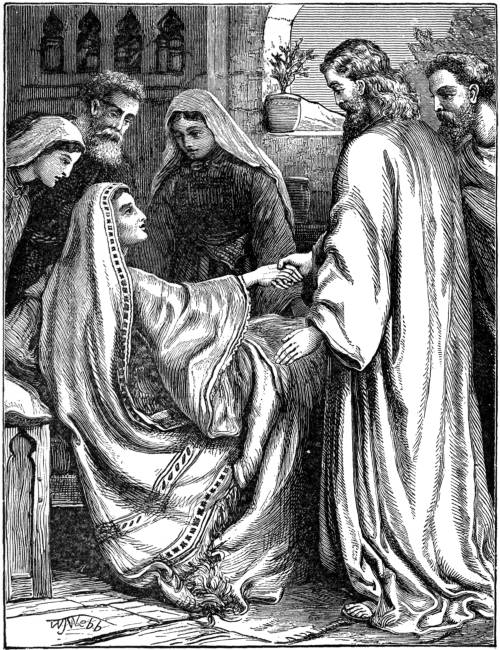
After Jesus had left the Centurion He went to the house of his disciple Peter, and there He saw Peter’s wife’s mother, laid on a bed, sick with fever. And He took her by the hand and lifted her up. The fever left her and she was cured. She rose up from her bed and attended upon them.
That evening, when the sun was setting, they brought to Jesus all those that were ill, and many that were possessed with devils. And He cast out the devils by His word, and healed all those that were sick.
“At even, ere the sun had set, The sick, O Lord, around Thee lay; Oh, in what divers pains they met, Oh, with what joy they went away!”
One morning Peter went fishing. He went all alone. He did not take Tim. He did not take Polly.
He said to himself, “Blacky went fishing all alone and she caught a fish. I shall try that way, too.”
Father had given Peter a real fishing pole. He had given him a real line and a real hook.
Peter had wished for these very much. He asked father for them.
He said, “Tim does not have to fish with a pin anymore. His father has given him a hook. I would be careful, if you gave me one.”
“Is a hook all that you need, Peter?” asked father.
“No, father. I need a line and a fishing pole, too.”
“Very well, Peter,” father said. “I will get these things for you. But you must do something for me.”
“Oh, yes,” said Peter. “I will do something for you. What is it?”
“I will show you two places where you may fish. You may go to those places all alone. And you may take other children with you. But, unless I am with you, you must always fish at those places. Will you?”
“Yes, I will, father. But why?”
“Because those are safe places. If you fall in, it will not matter much. Now remember, my son.”
“I will remember, father. And I will remember more, when I have my fishing pole and hook and line.”
He was very much pleased when his father brought these home. He said, “They are just like the ones that the big boys have. When may I go fishing?”
“Any time mother says that you may, Peter. Do you remember where the fishing places are?
“Oh, yes,” said Peter. “Yesterday I saw a sucker near one place. Perhaps I can catch it. Oh father! you forgot something.”
“What did I forget, Peter?”
“You forgot the bait. I thought that you would give me a whole box of worms. Then I should have some whenever I wished to fish.”
Father laughed. He said, “That is not just the way we do it, Peter. You cannot keep your worms very long. If you do, they are not good for bait. You must dig fresh ones every time you go fishing.”
Peter liked to fish. He liked it best of all the things that he could do in the summer. So he went often.
He never caught a fish. But he did not care about that. Every time he went, he thought that he surely should.
After Blacky brought home her fish, he said to himself, “If Blacky can catch fish, so can I. I shall go again and try.”
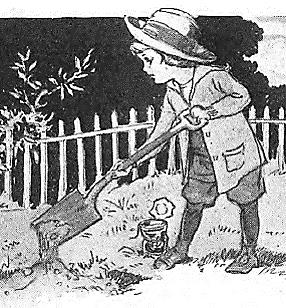
He went out into the garden. He dug one worm, he dug another. He did not like very well to put them on the hook.
So, sometimes, he took only one. But today he felt sure that he should need more. He put them carefully into a large tin can.
Then he went to a flat rock. It stuck out into the river. He put a fat worm on his hook. He dropped the hook into the water. He sat down and waited.
It was hot on the rock. The sun was very bright. Peter sat still a long, long time. He did not have a single bite.
At last he said to himself, “I will see if there are any fish here.”
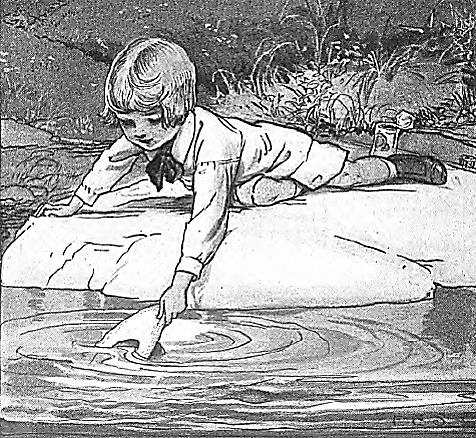
He crawled to the edge of the rock. He looked over. Yes, there were many little fish. Some were still. Some were swimming about.
He tried to catch one in his hand. But he could not. He tried to catch one in his hat. But he could not. Then he poked them with the end of his pole. This made them all swim away.
So Peter put his hook back into the water. He waited a long, long time again.
At last he lay down on the hot rock. He fell fast asleep. He slept until nearly dinner time.
What do you think woke him? Why, Blacky. She mewed and rubbed up against his face.
Perhaps she had come fishing again. Perhaps she said to him, “I can catch fish and you cannot. I am smarter than you.”
Peter got up. He started to go home. Then he remembered his fishing pole. He took it up. He pulled on the line. It felt heavy.
“Oh Blacky!” cried Peter. “I think that I have caught a fish, too!”
He pulled more on the line. In another minute, there, on the flat rock, lay a small sucker.
“I have! I have! Oh, I have!” shouted Peter.
He quickly filled his can with water. Then he took his little fish off the hook. He put it in his can. And he and Blacky went home.
On the way up the hill Peter said, “I know how to do it now, old Blacky. Just go to sleep, and the fish will bite.”
 articlesforchristians