A place to grow your relationship with God

Posts tagged ‘Jesus’

The Significance of Psalms: Themes and Lessons


Psalms 150:6 Let everything that has breath praise the LORD. Praise the LORD!

  • Authors
    • David
      • wrote 73 Psalms
      • He was a King of Israel
    • Asaph
      • wrote 73 Psalms
      • Asaph was the choir director
    • Sons of Korah
      • wrote 10 or 11 Psalms
      • Sons of Korah were music leaders in the temple
    • Solomon
      • wrote 2 Psalms
      • He was a King of Israel.
      • David’s son.
    • Ethan
      • wrote 1 Psalm
      • Ethan was a musician and singer
    • Moses
      • wrote 1 (possibly 2) Psalms
    • Heman
      • 1 Psalm
      • Heman was a chief musician and singer
    • Unknown or Anonymous
      • Many are unknown or the person chose to remain anonymous
  • Date
    • Approximately 1000-300 B.C.
  • Theme
    • Praises and Prayers
    • This book was used as a song and prayer book.
  • Purpose
    • The Hebrew meaning of the book of Psalms is praises. The English word for Psalms is derived from a Greek word meaning music of stringed instruments.
    • The book of Psalms provides poetry for the expression of praise, worship, prayer and confession to God.
    • Psalms is the longest book in the Bible and contains the longest chapter (Psalms 119), shortest chapter (Psalm 117:1,2), and the middle verse of the Bible (Psalms 118:8).
      • Psalms 118:8(NKJV)
        It is better to trust in the LORD Than to put confidence in man.
  • Content
    • Psalm was originally five separate books.
      • Book I: Psalms 1:1-41:13
        • This section is mainly written by David and expresses humans as blessed, thefallen nature and redeemed by God.
        • Psalms 41:13 Blessed be the LORD God of Israel From everlasting to everlasting! Amen and Amen.
          • Amen: sure, faithful and true
      • Book II: Psalms 42:1-72:20
        • The major theme of this section is one of recovery and restoration. God is our help in the midst of obstacles and opposition.
        • Psalms 46:1 God is our refuge and strength, A very present help in trouble.
        • Psalms 72:18 Blessed be the LORD God, the God of Israel Who only does wondrous things!
        • Psalms 72:19 And blessed be His glorious name forever! And let the whole earth be filled with His glory amen amen.
      • Book IV: Psalms 90:1-106:48
        • The major theme is of this section focuses on the relationship of God’s kingdom over powering all other nations and kingdoms.
        • Psalms 103:19 The LORD has established His throne in heaven, And His kingdom rules over all.
        • Psalms 106:48 Blessed be the LORD God of Israel From everlasting to everlasting! And let all the people say, “Amen!” Praise the LORD!
      • Book V: Psalms 107:1-150:6
        • The major theme of this section is God and His Word.
        • Psalms 119:89 Forever, O LORD, Your word is settled in heaven.
        • Psalms 150:1-6 Praise the LORD! Praise God in His sanctuary; Praise Him in His mighty firmament! Praise Him for His mighty acts; Praise Him according to His excellent greatness! Praise Him with the sound of the trumpet; Praise Him with the lute and harp! Praise Him with the timbrel and dance; Praise Him with stringed instruments and flutes! Praise Him with loud cymbals; Praise Him with clashing cymbals! Let everything that has breath praise the LORD. Praise the LORD!
  • Christ in the Book of Psalms
PsalmsReference to ChristNew Testament Fulfillment
Psalms 2:7 I will declare the decree: the Lord hath said unto me, Thou art my Son; this day have I begotten thee.The Son of GodHebrews 1:5  For unto which of the angels said he at any time, Thou art my Son, this day have I begotten thee? And again, I will be to him a Father, and he shall be to me a Son?
Psalms 16:8-10 I have set the Lord always before me: because he is at my right hand, I shall not be moved. Therefore my heart is glad, and my glory rejoiceth: my flesh also shall rest in hope. For thou wilt not leave my soul in hell; neither wilt thou suffer thine Holy One to see corruption. The ResurrectionLuke 24:5-7 And as they were afraid, and bowed down their faces to the earth, they said unto them, Why seek ye the living among the dead? He is not here, but is risen: remember how he spake unto you when he was yet in Galilee, Saying, The Son of man must be delivered into the hands of sinful men, and be crucified, and the third day rise again.
Psalms 22:1-21 My God, my God, why hast thou forsaken me? why art thou so far from helping me, and from the words of my roaring? O my God, I cry in the day time, but thou hearest not; and in the night season, and am not silent. But thou art holy, O thou that inhabitest the praises of Israel. Our fathers trusted in thee: they trusted, and thou didst deliver them. They cried unto thee, and were delivered: they trusted in thee, and were not confounded…… The CrossMatthew 26  And it came to pass, when Jesus had finished all these sayings, he said unto his disciples, Ye know that after two days is the feast of the passover, and the Son of man is betrayed to be crucified. Then assembled together the chief priests, and the scribes, and the elders of the people, unto the palace of the high priest, who was called Caiaphas, And consulted that they might take Jesus by subtilty, and kill him….
Psalms 22:18 They part my garments among them, and cast lots upon my vesture.Casting Lots for His ClothingMatthew 27:35 And they crucified him, and parted his garments, casting lots: that it might be fulfilled which was spoken by the prophet, They parted my garments among them, and upon my vesture did they cast lots.
Psalms 34:20 He keepeth all his bones: not one of them is broken.No Broken BonesJohn 19:36,37 For these things were done, that the scripture should be fulfilled, A bone of him shall not be broken.  And again another scripture saith, They shall look on him whom they pierced.
Psalms 40:6-8  Sacrifice and offering thou didst not desire; mine ears hast thou opened: burnt offering and sin offering hast thou not required. Then said I, Lo, I come: in the volume of the book it is written of me, I delight to do thy will, O my God: yea, thy law is within my heart.Doing God’s WillHebrews 10:5-7 Wherefore when he cometh into the world, he saith, Sacrifice and offering thou wouldest not, but a body hast thou prepared me: In burnt offerings and sacrifices for sin thou hast had no pleasure. Then said I, Lo, I come (in the volume of the book it is written of me,) to do thy will, O God.
Psalms 41:9 Yea, mine own familiar friend, in whom I trusted, which did eat of my bread, hath lifted up his heel against me.Betrayal John 13: Jesus answered, He it is, to whom I shall give a sop, when I have dipped it. And when he had dipped the sop, he gave it to Judas Iscariot, the son of Simon.
Luke 22:48 But Jesus said unto him, Judas, betrayest thou the Son of man with a kiss?
Psalms 45:6,7 Thy throne, O God, is for ever and ever: the sceptre of thy kingdom is a right sceptre. Thou lovest righteousness, and hatest wickedness: therefore God, thy God, hath anointed thee with the oil of gladness above thy fellows.Everlasting KingdomHebrews 1:8-9 But unto the Son he saith, Thy throne, O God, is for ever and ever: a sceptre of righteousness is the sceptre of thy kingdom. Thou hast loved righteousness, and hated iniquity; therefore God, even thy God, hath anointed thee with the oil of gladness above thy fellows.
Psalm 68:18 Thou hast ascended on high, thou hast led captivity captive: thou hast received gifts for men; yea, for the rebellious also, that the Lord God might dwell among them.AscensionEphesians 4:8-10 Wherefore he saith, When he ascended up on high, he led captivity captive, and gave gifts unto men. (Now that he ascended, what is it but that he also descended first into the lower parts of the earth?  He that descended is the same also that ascended up far above all heavens, that he might fill all things.)
Psalm 69:9  Thou hast ascended on high, thou hast led captivity captive: thou hast received gifts for men; yea, for the rebellious also, that the Lord God might dwell among them.Zeal for GodJohn 2:17 And his disciples remembered that it was written, The zeal of thine house hath eaten me up.
Psalm 69:21 They gave me also gall for my meat; and in my thirst they gave me vinegar to drink.Vinegar on the CrossMatthew 27:48
Psalm 89:3,4  I have made a covenant with my chosen, I have sworn unto David my servant, Thy seed will I establish for ever, and build up thy throne to all generations. Selah.Descendant of DavidLuke 1:31-33 And straightway one of them ran, and took a spunge, and filled it with vinegar, and put it on a reed, and gave him to drink.
Psalm 96:13 Before the Lord: for he cometh, for he cometh to judge the earth: he shall judge the world with righteousness, and the people with his truth.Righteous Judge1 Thessalonians 1:10 And to wait for his Son from heaven, whom he raised from the dead, even Jesus, which delivered us from the wrath to come.
Psalm 110:4 The Lord hath sworn, and will not repent, Thou art a priest for ever after the order of Melchizedek.Eternal Priest/KingHebrews 6:20 Whither the forerunner is for us entered, even Jesus, made an high priest for ever after the order of Melchisedec.

Prayer for a Child’s Future


Father, Your Word says that children are a gift from You and promises peace when they are taught in Your ways. Today, I dedicate (child) to You, trusting that he/she will be raised according to Your will and will follow the path You have chosen. Father, I declare Your Word over (child) today, thanking You that it will not return void but will fulfill what You have promised.

Heavenly Father, I commit myself as a parent to guide my child in the right path, trusting in Your promise that they will not stray but will grow and thrive in Your ways. I entrust the responsibility and challenges of raising them to You. I will not provoke my child but will nurture them with care and leave them in Your hands. Following Your Word, I will diligently teach my child, keeping them close to my heart and thoughts. Your grace is enough to overcome my shortcomings as a parent.

My child is obedient and honors both parents, embracing the abundant promises of Your Word for long life and prosperity. (Child) is a godly child, unashamed and unafraid to honor and follow Your Word. He/she is firmly convinced that You are the Almighty God. I am grateful that as he/she grows, he/she will remember You and cherish the opportunity for a relationship with Your Son, Jesus. Your great blessings will be upon (child) for walking in Your ways. I thank You for Your blessings in every area of (child’s) life, ensuring his/her salvation and obedience to Your ways.


Heavenly Father, I thank You for sending laborers into (child’s) life, paving the way for salvation as promised in Your Word through Your Son, Jesus. I am grateful that (child) will discern the devil’s traps and find deliverance through the purity of Your Son. You have bestowed upon (child) the grace and strength to walk the narrow path to Your Kingdom.

I pray that, just as Jesus grew in wisdom and stature, You would bless this child with the same wisdom and pour out Your favor and guidance abundantly upon him/her.

I thank You in advance for (child’s) future spouse. Lord, Your Word says You desire children to remain pure and honorable, waiting for marriage. I pray blessings over their future union and trust that (child) will be perfectly matched with their partner, creating a household rooted in godly order and the love of Jesus Christ. Please continue to shape (child) into the man/woman of God that You intend them to be.

(Child) will be diligent and hardworking, never lazy or undisciplined. Your Word promises abundant blessings to their household, ensuring they are always satisfied and continue to prosper. Godliness brings great benefit to their home, and (child) will receive the promise of life and all that lies ahead.

Father, thank You for protecting and guiding my child.
In Jesus’ name, I pray, amen

Important Scriptures:

Psalm 127:3
Isaiah 54:13
Isaiah 55:11
Proverbs 22:6
1 Peter 5:7
Ephesians 6:4
Deuteronomy 6:7
2 Corinthians 12:9
Ephesians 6:1-3
2 Timothy 1:12
Proverbs 8:17,32
Luke 19:10
Matthew 9:38
2 Corinthians 2:11
2 Timothy 2:26
Job 22:30
Matthew 7:14
Luke 2:52
Hebrews 13:4
1 Thessalonians 4:3
Ephesians 5:22-25
2 Timothy 1:13
Proverbs 13:11
Proverbs 20:13
Romans 12:11
1 Timothy 4:8
1 John 3:8
John 10:10
Matthew 18:18
John 14:13
Psalm 91:1,11

THE GOOD SHEPHERD AND THE GOOD SAMARITAN

THE GOOD SHEPHERD AND THE GOOD SAMARITAN

Soon afterward Jesus gave to the people in Jerusalem the parable or story of “The Good Shepherd.”

“Verily, verily (that is, ‘in truth, in truth’), I say to you, if any one does not go into the sheepfold by the door, but climbs up some other way, it is a sign that he is a thief and a robber. But the one who comes in by the door is a shepherd of the sheep. The porter opens the door to him, and the sheep know him, and listen to his call, for he calls his own sheep by name and leads them out to the pasture-field. And when he has led out his sheep, he goes in front of them, and the sheep follow him, for they know his voice. The sheep will not follow a stranger, for they do not know the stranger’s voice.”

The people did not understand what all this meant, and as Jesus explained it to them, he said: “Verily, verily, I say unto you, I am the door that leads to the sheepfold. If any man comes to the sheep in any other way than through me and in my name, he is a thief and a robber; but those who are the true sheep will not hear such. I am the door; if any man goes into the fold through me, he shall be saved, and shall go in and go out, and shall find pasture.

“The thief comes to the fold that he may steal and rob the sheep, and kill them; but I came to the fold that they may have life, and may have all that they need. I am the good shepherd; the good shepherd will give up his own life to save his sheep; and I will give up my life that my sheep may be saved.

“I am the good shepherd; and just as a true shepherd knows all the sheep in his fold, so I know my own, and my own know me, even as I know the Father, and the Father knows me; and I lay down my life for the sheep. And other sheep I have, which are not of this fold; them also I must lead; and they shall hear my voice; and there shall be one flock and one shepherd.”

The Jews could not understand these words of Jesus; but they became very angry with him, because he spoke of God as his Father. They took up stones to throw them at him, and tried to seize him, intending to kill him. But Jesus escaped from their hands, and went away to the land beyond Jordan, at the place called “Bethabara,” or “Bethany beyond Jordan,” the same place where he had been baptized by John the Baptist more than two years before. From this place Jesus wished to go out through the land in the east of the Jordan, a land which is called “Perea,” a word that means “beyond.” But before going out through this land, Jesus sent out seventy chosen men from among his followers to go to all the villages, and to make the people ready for his own coming afterward. He gave to these seventy the same commands that he had given to the twelve disciples when he sent them through Galilee, and sent them out in pairs, two men to travel and to preach together. He said:

“I send you forth as lambs among wolves. Carry no purse, no bag for food, no shoes except those that you are wearing. Do not stop to talk with people by the way; but go through the towns and villages, healing the sick, and preaching to the people, ‘The kingdom of God is coming,’ He that hears you, hears me; and he that refuses you, refuses me; and he that will not hear me, will not hear him that sent me.”

And after a time the seventy men came again to Jesus, saying:

“Lord, even the evil spirits obey our words in thy name!”

And Jesus said to them:

“I saw Satan, the king of the evil spirits, falling down like lightning from heaven. I have given you power to tread upon serpents and scorpions, and nothing shall harm you. Still, do not rejoice because the evil spirits obey you; but rejoice that your names are written in heaven.”

And at that time, one of the scribes—men who wrote copies of the books of the Old Testament, and studied them, and taught them—came to Jesus and asked him a question, to see what answer he would give. He said: “Master, what shall I do to have everlasting life?”

Jesus said to the scribe: “What is written in the law? You are a reader of God’s law; tell me what it says.”

Then the man gave this answer:

“Thou shalt love the Lord thy God with all thy heart, and with all thy soul, and with all thy strength, and with all thy mind; and thou shalt love thy neighbor as thyself.”

Jesus said to the man: “You have answered right; do this, and you shall have everlasting life.”

But the man was not satisfied. He asked another question: “And who is my neighbor?”

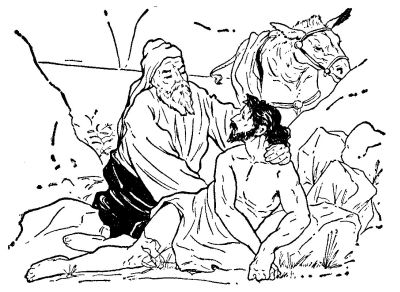
To answer this question, Jesus gave the parable or story of “The Good Samaritan.” He said: “A certain man was going down the lonely road from Jerusalem to Jericho; and he fell among robbers, who stripped him of all that he had and beat him; and then went away, leaving him almost dead. It happened that a certain priest was going down that road; and when he saw the man lying there, he passed by on the other side. And a Levite, also, when he came to the place, and saw the man, he too went by on the other side. But a certain Samaritan, as he was going down, came where this man was; and as soon as he saw him, he felt a pity for him. He came to the man, and dressed his wounds, pouring oil and wine into them. Then he lifted him up, and set him on his own beast of burden, and walked beside him to an inn. There he took care of him all night; and the next morning he took out from his purse two shillings, and gave them to the keeper of the inn, and said: ‘Take care of him; and if you need to spend more than this, do so; and when I come again I will pay it to you.'”

Then he lifted him up

“Which one of these three, do you think, showed himself a neighbor to the man who fell among the robbers?”

The scribe said: “The one who showed mercy on him.”

Then Jesus said to him: “Go and do thou likewise.”

By this parable, Jesus showed that “our neighbor” is the one who needs the help that we can give him, whoever he may be.

Overcoming Rebellion: A Parent’s Prayer Guide


Father, in the name of Jesus, I declare Your Word over my child. I commit (teen’s name) into Your hands and find joy in You. I thank You for guiding (teen) out of rebellion and into a harmonious relationship with us, his/her parents.

Father, the first commandment with a promise is for the child who obeys their parents in the Lord. You declared that all will be well with them, and they will live long on the earth. I stand on this promise for my child, asking You to grant them an obedient spirit so they may honor and value their father and mother.

Father, forgive me for the mistakes I’ve made out of my own unresolved pain or selfishness, which may have caused hurt to my teen. I ask for the anointing of Jesus to heal and bind up our broken hearts as parents and child. Grant us the grace to understand and forgive one another, just as God has forgiven us in Christ. Thank You for the Holy Spirit who guides us into all truth and helps correct any wrong perceptions about past or present situations.

Thank you for teaching us to listen to one another and giving (teen) a heart that embraces wisdom through correction. I commit to speaking words of excellence and truth, ensuring my speech aligns with righteousness. Father, I pledge to guide and train (teen) in the right path, so that as he/she grows, he/she will remain steadfast in sound teaching and doctrine, following it throughout life. In Jesus’ Name, I declare rebellion has no place in my child’s heart, and I confess that he/she is willing and obedient, ready to enjoy the blessings of your promises. (Teen) will be a source of peace, spreading it to others.

Father, in line with Your Word, we have been entrusted with the ministry of reconciliation, and I release this ministry and the message of reconciliation into this family situation. I choose not to provoke, irritate, or cause my child to fret; I will avoid being overly harsh, so they do not become discouraged or feel inferior and frustrated. I will not break their spirit, in the name of Jesus and through the power of the Holy Spirit. Father, I forgive my child for their wrongdoings and intercede for them until they come to their senses and break free from the enemy’s trap of rebellion. Thank You for fulfilling Your Word, turning and reconciling the heart of the rebellious child to their parents and the hearts of the parents to their child. Thank You for restoring my child to a healthy relationship with You and with me, so that our lives may glorify You! Amen.

Scriptures to Study

  • Psalm 55:12-14
  • 1 Peter 5:7
  • Psalm 37:4
  • John 14:6
  • Proverbs 8:6,7
  • Proverbs 22:6
  • Isaiah 1:19
  • Ephesians 6:1-3
  • 1 John 1:9
  • Isaiah 54:13
  • 2 Corinthians 5:18,19
  • Colossians 3:21
  • Isaiah 61:1
  • John 16:13
  • Proverbs 15:31
  • Proverbs 13:1
  • John 20:23
  • Ezekiel 22:30
  • Jeremiah 1:12
  • Malachi 4:6

Prayer to Nurture and Protect Your Kids

Here is a general prayer for the children in your life.


Father, in the name of Jesus, I pray and declare Your Word over my children, surrounding them with faith—faith in Your Word that You fulfill it! I believe and declare that my children are followers of Christ, taught by the Lord, and obedient to Your will. Great is the peace and calm of my children, for You, God, stand against what stands against them, providing them safety and comfort.


Father, You will take care of everything that concerns me. I entrust and release the care of my children entirely to You, Father. They are in Your hands, and I am fully convinced that You are able to protect and hold what I have entrusted to You. You are more than enough!

I believe my children respect and obey their parents in the Lord, recognizing this as just and right. They honor and cherish their parents, holding them in high regard, as this is the first commandment with a promise: that things may go well for them and they may enjoy a long life on earth. I trust that my children choose life, love the Lord, listen to His voice, and hold fast to Him, for He is their life and the length of their days. As such, my children are leaders, not followers; they rise above and are never beneath. They are blessed in their coming and going.


I believe and confess that You assign Your angels to watch over my children, to guide, protect, and keep them safe in all they do. You, Lord, are their Shelter and Stronghold, their Glory, and the One who lifts their spirits.


As parents, we won’t provoke or irritate our children. We’ll avoid being harsh or causing them to feel discouraged, frustrated, or inferior. Instead, we’ll nurture them with love, guiding them gently through discipline and advice rooted in faith. We’ll teach them the right path so that when they’re older, they won’t stray from it.


O Lord, my God, how majestic and glorious is Your name throughout all the earth! You have displayed Your glory above the heavens. From the mouths of children and infants, You have established strength to silence Your enemies and those who oppose You. I give praise to Your name, O Most High. In the name of Jesus, the enemy is driven away from my children! They grow in wisdom and find favor with God and people. Amen.


Scripture References
Jeremiah 1:12
Psalm 91:11
Isaiah 54:13
Isaiah 49:25
Psalm 91:2
Psalm 3:3
1 Peter 5:7
Colossians 3:21
2 Timothy 1:12
Ephesians 6:4
Ephesians 6:1-3
Proverbs 22:6
Deuteronomy 30:19,20
Psalm 8:1,2
Deuteronomy 28:13
Psalm 9:2,3
Deuteronomy 28:3,6
Luke 2:52

Practical Tips for Christian Living

Here are some links to practical Christian Living. This links with help you learn about various topics such as friends, enemies, and how to just generally live. More will be added to this section. If there is a topic that you would like me to add, leave it in the comments.

Biblical Tips for Loving Your Enemies

There are times when we have to deal with people who are not friendly. Sometimes they are downright rude, hateful, mean, and/or evil. What does the Bible say about what to do in these situations? It has several things to say. Most of the things go against what the world would say.

  • Love them.
    • Matthew 5:44 ESV
      • But I say to you, Love your enemies and pray for those who persecute you,
    • Matthew 5:43-48 ESV
      • “You have heard that it was said, ‘You shall love your neighbor and hate your enemy.’ But I say to you, Love your enemies and pray for those who persecute you, so that you may be sons of your Father who is in heaven. For he makes his sun rise on the evil and on the good, and sends rain on the just and on the unjust. For if you love those who love you, what reward do you have? Do not even the tax collectors do the same? And if you greet only your brothers, what more are you doing than others? Do not even the Gentiles do the same? …
    • Luke 6:27 ESV
      • “But I say to you who hear, Love your enemies, do good to those who hate you,
  • Pray for them.
    • Matthew 5:44 ESV
      • But I say to you, Love your enemies and pray for those who persecute you,
    • Luke 6:27-28 ESV / 286 helpful votes
      • “But I say to you who hear, Love your enemies, do good to those who hate you, bless those who curse you, pray for those who abuse you.
  • Forgive them.
    • Luke 23:34 ESV
      • And Jesus said, “Father, forgive them, for they know not what they do.” And they cast lots to divide his garments.
  • Be kind to them and help them when they need it.
    • Luke 6:27-28 ESV
      • “But I say to you who hear, Love your enemies, do good to those who hate you, bless those who curse you, pray for those who abuse you.
    • 1 Peter 3:9 ESV
      • Do not repay evil for evil or reviling for reviling, but on the contrary, bless, for to this you were called, that you may obtain a blessing.
    • Proverbs 25:21-22 ESV
      • If your enemy is hungry, give him bread to eat, and if he is thirsty, give him water to drink, for you will heap burning coals on his head, and the Lord will reward you.
    • Proverbs 20:22 ESV
      • Do not say, “I will repay evil”; wait for the Lord, and he will deliver you.
    • Romans 12:17-21 ESV / 4 helpful votes Helpful Not Helpful
      • Repay no one evil for evil, but give thought to do what is honorable in the sight of all. If possible, so far as it depends on you, live peaceably with all. Beloved, never avenge yourselves, but leave it to the wrath of God, for it is written, “Vengeance is mine, I will repay, says the Lord.” To the contrary, “if your enemy is hungry, feed him; if he is thirsty, give him something to drink; for by so doing you will heap burning coals on his head.” Do not be overcome by evil, but overcome evil with good.
  • Don’t rejoice in their downfall.
    • Proverbs 24:17-18 ESV
      • Do not rejoice when your enemy falls, and let not your heart be glad when he stumbles, lest the Lord see it and be displeased, and turn away his anger from him.
    • Obadiah 1:12 ESV
      • But do not gloat over the day of your brother in the day of his misfortune; do not rejoice over the people of Judah in the day of their ruin; do not boast in the day of distress.

THE STORY OF THE EMPTY TOMB

THE STORY OF THE EMPTY TOMB

After Jesus was taken before the high-priest where he was ridiculed and the people spat upon him, he was taken before the Roman Governor, Pontius Pilate, who ruled over Judea. He heard their complaints, but did not find any cause for putting him to death. But at last he yielded to their demands, although he declared Jesus was innocent of all wrong.

He heard their complaints

And so, Pontius Pilate, the Roman governor, gave command that Jesus should die by the cross. The Roman soldiers then took Jesus and beat him most cruelly; and then led him out of the city to the place of death. This was a place called “Golgotha” in the Jewish language, “Calvary” in that of the Romans; both words meaning “The Skull Place.”

With the soldiers, went out of the city a great crowd of people; some of them enemies of Jesus, glad to see him suffer; others of them friends of Jesus, and the women who had helped him, now weeping as they saw him, all covered with his blood and going out to die. But Jesus turned to them and said:

“Daughters of Jerusalem, do not weep for me, but weep for yourselves and for your children. For the days are coming when they shall count those happy who have no little ones to be slain; when they shall wish that the mountain might fall on them, and the hills might cover them, and hide them from their enemies!”

They had tried to make Jesus bear his own cross, but soon found that he was too weak from his sufferings, and could not carry it. They seized on a man who was coming out of the country into the city, a man named Simon, and they made him carry the cross to its place at Calvary.

It was the custom among the Jews to give to men about to die by the cross some medicine to deaden their feelings, so that they would not suffer so greatly. They offered this to Jesus, but when he had tasted it and found what it was, he would not take it. He knew that he would die, but he wished to have his mind clear, and to understand what was done and what was said, even though his sufferings might be greater.

At the place Calvary, they laid the cross down, and stretched Jesus upon it, and drove nails through his hands and feet to fasten him to the cross; and then they stood it upright with Jesus upon it. While the soldiers were doing this dreadful work, Jesus prayed for them to God, saying: “Father, forgive them; for they know not what they are doing.”

The soldiers also took the clothes that Jesus had worn, giving to each one a garment. But when they came to his undergarment, they found that it was woven and had no seams; so they said, “Let us not tear it, but cast lots for it, to see who shall have it.” So at the foot of the cross the soldiers threw lots for the garment of Christ.

Two men who had been robbers and had been sentenced to die by the cross, were led out to die at the same time with Jesus. One was placed on a cross at his right side, and the other at his left; and to make Jesus appear as the worst, his cross stood in the middle. Over the head of Jesus on his cross, they placed, by Pilate’s order, a sign, on which was written:

“This is Jesus of Nazareth,
The King of the Jews.”

This was written in three languages; in Hebrew, which was the language of the Jews; in Latin, the language of the Romans, and in Greek. Many of the people read this writing; but the chief priests were not pleased with it. They urged Pilate to have it changed from “The King of the Jews” to “He said, I am King of the Jews.” But Pilate would not change it. He said:

“What I have written, I have written.”

And the people who passed by on the road, as they looked at Jesus on the cross, mocked at him. Some called out to him:

“You that would destroy the Temple and build it in three days, save yourself. If you are the Son of God, come down from the cross!”

And the priests and scribes said:

“He saved others, but he cannot save himself. Come down from the cross, and we will believe in you!”

And one of the robbers, who was on his own cross beside that of Jesus, joined in the cry, and said: “If you are the Christ, save yourself and save us!”

But the other robber said to him: “Have you no fear of God, to speak thus, while you are suffering the same fate with this man? And we deserve to die, but this man has done nothing wrong.”

Then this man said to Jesus: “Lord, remember me when thou comest into thy kingdom!”

And Jesus answered him, as they were both hanging on their crosses: “To-day you shall be with me in heaven.”

Before the cross of Jesus his mother was standing, filled with sorrow for her son, and beside her was one of his disciples, John, the disciple whom he loved best. Other women besides his mother were there—his mother’s sister, Mary the wife of Cleophas, and a woman named Mary Magdalene, out of whom a year before Jesus had sent an evil spirit. Jesus wished to give his mother, now that he was leaving her, into the care of John, and he said to her, as he looked from her to John: “Woman, see your son.”

And then to John he said: “Son, see your mother.”

And on that day John took the mother of Jesus home to his own house, and cared for her as his own mother.

At about noon, a sudden darkness came over the land, and lasted for three hours. And in the middle of the afternoon, when Jesus had been on the cross six hours of terrible pain, he cried out aloud words which meant:

“My God, my God, why hast thou forsaken me!” words which are the beginning of the twenty-second psalm, a psalm which long before had spoken of many of Christ’s sufferings.

After this he spoke again, saying, “I thirst!”

And some one dipped a sponge in a cup of vinegar, and put it upon a reed, and gave him a drink of it. Then Jesus spoke his last words upon the cross:

“It is finished! Father, into thy hands I give my spirit!”

And then Jesus died. And at that moment, the veil in the Temple between the Holy Place and the Holy of Holies, was torn apart by unseen hands from the top to the bottom. And when the Roman officer, who had charge of the soldiers around the cross, saw what had taken place, and how Jesus died, he said: “Surely this was a righteous man; he was the Son of God.”

After Jesus was dead, one of the soldiers, to be sure that he was no longer living, ran his spear into the side of his dead body; and out of the wound came pouring both water and blood.

There were even among the rulers of the Jews a few who were friends of Jesus, though they did not dare to follow Jesus openly. One of these was Nicodemus, the ruler who came to see Jesus at night. Another was a rich man who came from the town of Arimathea, and was named Joseph. Joseph of Arimathea went boldly in to Pilate, and asked that the body of Jesus might be given to him. Pilate wondered that he had died so soon, for often men lived on the cross two or three days. But when he found that Jesus was really dead, he gave his body to Joseph.

Then Joseph and his friends took down the body of Jesus from the cross, and wrapped it in fine linen. And Nicodemus brought some precious spices, myrrh and aloes, which they wrapped up with the body. Then they placed the body in Joseph’s own new tomb, which was a cave dug out of the rock, in a garden near the place of the cross. And before the opening of the cave they rolled a great stone.

And Mary Magdalene, and the other Mary, and some other women, saw the tomb, and watched while they laid the body of Jesus in it. On the next morning, some of the rulers of the Jews came to Pilate, and said:

“Sir, we remember that that man Jesus of Nazareth, who deceived the people, said while he was yet alive, ‘After three days I will rise again.’ Give orders that the tomb shall be watched and made sure for three days, or else his disciples may steal his body, and then say, ‘He is risen from the dead’; and thus even after his death he may do more harm than he did while he was alive.”

Pilate said to them:

“Set a watch, and make it as sure as you can.”

Then they placed a seal upon the stone, so that no one might break it; and they set a watch of soldiers at the door.

And in the tomb the body of Jesus lay from the evening of Friday, the day when he died on the cross, to the dawn of Sunday, the first day of the week, when he arose from the dead and appeared unto his disciples.

But the brightest day in all the world was this Sunday morning. For on that day the stone was rolled away from the tomb and Jesus came forth from the dead to gladden his disciples. This he had told them he would do. On this Sunday morning, Mary Magdalene and another Mary, called Salome, came to the tomb, found the stone rolled away and an angel standing by the open tomb. He told them that Jesus was not there, but had risen.

Afterward Jesus was with his disciples for forty days, after which he was taken up into heaven.

THE STORY OF THE MIRACLE WORKER

THE STORY OF THE MIRACLE WORKER

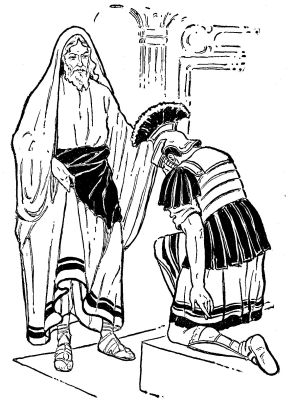
There was at Capernaum an officer of the Roman army, a man who had under him a company of a hundred men. They called him “a centurion,” a word which means “commanding a hundred”; but we should call him “a captain.” This man was not a Jew, but was what the Jews called “a Gentile,” “a foreigner”; a name which the Jews gave to all people outside their own race. All the world except the Jews themselves were Gentiles.

This Roman centurion was a good man, and he loved the Jews, because through them he had heard of God, and had learned how to worship God. Out of his love for the Jews, he had built for them with his own money a synagogue, which may have been the very synagogue in which Jesus taught on the Sabbath days.

The centurion had a young servant, a boy whom he loved greatly; and this boy was very sick with a palsy, and near to death. The centurion had heard that Jesus could cure those who were sick; and he asked the chief men of the synagogue, who were called its “elders,” to go to Jesus and ask him to come and cure his young servant.

“Speak the word and my servant shall be cured”

The elders spoke to Jesus, just as he came again to Capernaum, after the Sermon on the Mount. They asked Jesus to go with them to the centurion’s house; and they said:

“He is a worthy man, and it is fitting that you should help him, for, though a Gentile, he loves our people, and he has built for us our synagogue.”

Then Jesus said, “I will go and heal him.”

But while he was on his way—and with him were the elders, and his disciples, and a great crowd of people, who hoped to see the work of healing—the centurion sent some other friends to Jesus with this message:

“Lord, do not take the trouble to come to my house; for I am not worthy that one so high as you are should come under my roof; and I did not think that I was worthy to go and speak to you. But speak only a word where you are, and my servant shall be made well. For I also am a man under rule, and I have soldiers under me; and I say to one ‘Go,’ and he goes; and to another, ‘Come,’ and he comes; and to my servant, ‘Do this,’ and he does it. You, too, have power to speak and to be obeyed. Speak the word, and my servant shall be cured.”

When Jesus heard this, he wondered at this man’s faith. He turned to the people following him, and said:

“In truth I say to you, I have not found such faith as this in all Israel!”

Then he spoke to the friends of the centurion who had brought the word from him:

“Go and say to this man, ‘As you have believed in me, so shall it be done to you.'”

Then those who had been sent, went again to the centurion’s house, and found that in that very hour his servant had been made perfectly well.

On the day after this, Jesus with his disciples and many people went out from Capernaum, and turned southward, and came to a village called Nain. Just as Jesus and his disciples came near to the gate of the city, they were met by a company who were carrying out a dead man to be buried. He was a young man, and the only son of his mother, and she was a widow.

When the Lord Jesus saw the mother in her grief, he pitied her, and said, “Do not weep.”

He drew near, and touched the frame on which they were carrying the body, wrapped round and round with long strips of linen. The bearers looked with wonder on this stranger, and set down the frame with its body, and stood still. Standing beside the body, Jesus said:

“Young man, I say to you, Rise up!”

And in a moment the young man sat up and began to speak. Jesus gave him to his mother, who now saw that her son who had been dead, was alive again.

And Jesus went through all that part of Galilee, working miracles and preaching and teaching in all the villages, telling the people everywhere the good news of the kingdom of God.

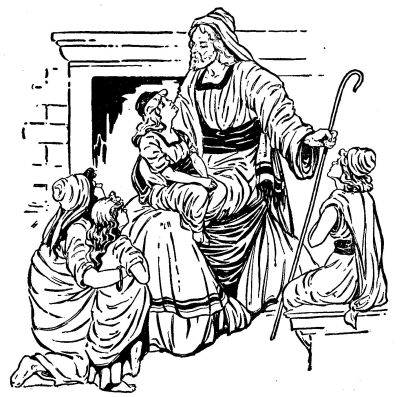
The children loved to gather around him, and when his disciples would have driven them away he said, “Suffer the little children to come unto me and forbid them not, for of such is the kingdom of heaven.”

The children loved to gather around him

One Sabbath day, as Jesus and his disciples were walking in Jerusalem, they met a blind man begging. This man in all his life had never seen; for he had been born blind. The disciples said to Jesus as they were passing him: “Master, whose fault was it that this man was born blind? Was it because he has sinned, or did his parents sin?”

For the Jews thought that when any evil came, it was caused by some one’s sin. But Jesus said:

“This man was born blind, not because of his parents’ sin, nor because of his own, but so that God might show his power in him. We must do God’s work while it is day, for the night is coming when no man can work. As long as I am in the world, I am the light of the world.”

When Jesus had said this, he spat on the ground, and mixed up the spittle with earth, making a little lump of clay. This clay Jesus spread on the eyes of the blind man; and then he said to him: “Go wash in the pool of Siloam.”

The pool of Siloam was a large cistern, or, reservoir, on the southeast of Jerusalem, outside the wall, where the valley of Gihon and the valley of Kedron come together. To go to this pool, the blind man, with two great blotches of mud on his face, must walk through the streets of the city, out of the gate, and into the valley. He went, and felt his way down the steps into the pool of Siloam. There he washed, and then at once his life-long blindness passed away, and he could see.

When the man came back to the part of the city where he lived, his neighbors could scarcely believe that he was the same man. They said: “Is not this the man who used to sit on the street begging?”

“This must be the same man,” said some; but others said: “No, it is some one who looks like him.”

But the man said, “I am the very same man who was blind!”

“Why, how did this come to pass?” they asked. “How were your eyes opened?”

“The man, named Jesus,” he answered, “mixed clay, and put it on my eyes, and said to me, ‘Go to the pool of Siloam and wash,’ and I went and washed, and then I could see.”

“Where is this man?” they asked him.

“I do not know,” said the man.

Some of the Pharisees, the men who made a show of always obeying the law, asked the man how he had been made to see. He said to them, as he had said before:

“A man put clay on my eyes, and I washed, and my sight came to me.”

Some of the Pharisees said:

“The man who did this is not a man of God, because he does not keep the Sabbath. He makes clay, and puts it on men’s eyes, working on the Sabbath day. He is a sinner!”

Others said, “How can a man who is a sinner do such wonderful works?”

And thus the people were divided in what they thought of Jesus. They asked the man who had been blind: “What do you think of this man who has opened your eyes?”

“He is a prophet of God,” said the man.

But the leading Jews would not believe that this man had gained his sight, until they had sent for his father and his mother. The Jews asked them:

“Is this your son, who you say was born blind? How is it that he can now see?”

His parents were afraid to tell all they knew; for the Jews had agreed that if any man should say Jesus was the Christ, the Saviour, he should be turned out of the synagogue, and not be allowed to worship any more with the people. So his parents said to the Jews:

“We know that this is our son, and we know that he was born blind. But how he was made to see, we do not know; or who has opened his eyes, we do not know. He is of age; ask him, and let him speak for himself.”

Then again the rulers of the Jews called the man who had been blind; and they said to him:

“Give God the praise for your sight. We know that this man who made clay on the Sabbath day is a sinner.”

“Whether that man is a sinner, or not, I do not know,” answered the man; “but one thing I do know, that once I was blind, and now I see. We know that God does not hear sinners; but God hears only those who worship him, and do his will. Never before has any one opened the eyes of a man born blind. If this man were not from God, he could not do such works as these!”

The rulers of the Jews, these Pharisees, then said to the man: “You were born in sin, and do you try to teach us?”

And they turned him out of the synagogue, and would not let any one worship with him. Jesus heard of this; and when Jesus found him, he said to him:

“Do you believe on the Son of God?”

The man said:

“And who is he, Lord, that I may believe on him?”

“You have seen him,” said Jesus, “and it is he who now talks with you!”

The man said, “Lord, I believe.”

And he fell down before Jesus and worshipped him.

The True Traits of a Good Friend

Good Friends are hard to come by. How do you know if you have a good friend? How can you be a good friend? Here is something to help you know and remember what a good friend is and does.

Good Counsel: a good friend always gives good advice.

Offers help: a good friend is there to help you when you need it.

Offers encouragement: a good friend is there to give you encouragement when you need it.

Doesn’t envy: a good friend is happy for you. They don’t envy what you have.

Forgives one another: Everyone has a bad day now and then. Everyone makes mistakes. A friend forgives.

Rejoices with you when something good happens.

Is kind and gentle.

Enjoys peace together.

Never stops loving.

Does good for each other.

Now for some scriptures.

  • Good Counsel
    • Proverbs 15:22 ESV
      • Without counsel plans fail, but with many advisers they succeed.
    • Proverbs 11:14 ESV
      • Where there is no guidance, a people falls, but in an abundance of counselors there is safety.
    • Proverbs 12:15 ESV
      • The way of a fool is right in his own eyes, but a wise man listens to advice.
    • Proverbs 24:6 ESV
      • For by wise guidance you can wage your war, and in abundance of counselors there is victory.
    • Proverbs 20:18 ESV
      • Plans are established by counsel; by wise guidance wage war.
    • Proverbs 13:10 ESV
      • By insolence comes nothing but strife, but with those who take advice is wisdom.
    • Proverbs 19:20 ESV
      • Listen to advice and accept instruction, that you may gain wisdom in the future
    • Proverbs 27:9 ESV
      • Oil and perfume make the heart glad, and the sweetness of a friend comes from his earnest counsel.
  • Offers help
    • Philippians 2:4 ESV
      • Let each of you look not only to his own interests, but also to the interests of others.
    • Hebrews 13:16 ESV
      • Do not neglect to do good and to share what you have, for such sacrifices are pleasing to God.
    • Galatians 6:2 ESV
      • Bear one another’s burdens, and so fulfill the law of Christ.
    • Proverbs 19:17 ESV
      • Whoever is generous to the poor lends to the Lord, and he will repay him for his deed.
    • Luke 6:38 ESV
      • Give, and it will be given to you. Good measure, pressed down, shaken together, running over, will be put into your lap. For with the measure you use it will be measured back to you.”
    • Acts 20:35 ESV
      • In all things I have shown you that by working hard in this way we must help the weak and remember the words of the Lord Jesus, how he himself said, ‘It is more blessed to give than to receive.’”
    • James 2:14-17 ESV
      • What good is it, my brothers, if someone says he has faith but does not have works? Can that faith save him? If a brother or sister is poorly clothed and lacking in daily food, and one of you says to them, “Go in peace, be warmed and filled,” without giving them the things needed for the body, what good is that? So also faith by itself, if it does not have works, is dead.
  • Offers encouragement
    • 1 Thessalonians 5:11 ESV
      • Therefore encourage one another and build one another up, just as you are doing.
    • Hebrews 10:25 ESV
      • Not neglecting to meet together, as is the habit of some, but encouraging one another, and all the more as you see the Day drawing near.
    • Hebrews 10:24 ESV
      • And let us consider how to stir up one another to love and good works,
  • Doesn’t envy
    • Proverbs 14:30 ESV
      • A tranquil heart gives life to the flesh, but envy makes the bones rot.
    • 1 Corinthians 13:4 ESV
      • Love is patient and kind; love does not envy or boast; it is not arrogant
    • James 3:16 ESV
      • For where jealousy and selfish ambition exist, there will be disorder and every vile practice.
    • Galatians 5:19-21 ESV
      • Now the works of the flesh are evident: sexual immorality, impurity, sensuality, idolatry, sorcery, enmity, strife, jealousy, fits of anger, rivalries, dissensions, divisions, envy, drunkenness, orgies, and things like these. I warn you, as I warned you before, that those who do such things will not inherit the kingdom of God.
    • 1 Corinthians 3:3 ESV
      • For you are still of the flesh. For while there is jealousy and strife among you, are you not of the flesh and behaving only in a human way?
    • Galatians 5:26 ESV
      • Let us not become conceited, provoking one another, envying one another.
  • Forgives
    • Ephesians 4:32 ESV
      • Be kind to one another, tenderhearted, forgiving one another, as God in Christ forgave you.
    • Mark 11:25 ESV
      • And whenever you stand praying, forgive, if you have anything against anyone, so that your Father also who is in heaven may forgive you your trespasses.”
    • 1 John 1:9 ESV
      • If we confess our sins, he is faithful and just to forgive us our sins and to cleanse us from all unrighteousness.
    • Matthew 6:15 ESV
      • But if you do not forgive others their trespasses, neither will your Father forgive your trespasses.
    • Colossians 3:13 ESV
      • Bearing with one another and, if one has a complaint against another, forgiving each other; as the Lord has forgiven you, so you also must forgive.
  • Rejoices
    • 1 Corinthians 12:26 ESV
      • If one member suffers, all suffer together; if one member is honored, all rejoice together.
    • Romans 12:15 ESV
      • Rejoice with those who rejoice, weep with those who weep.
  • Is kind and gentle
    • Ephesians 4:32 ESV
      • Be kind to one another, tenderhearted, forgiving one another, as God in Christ forgave you.
    • Galatians 5:22-23
      • But the fruit of the Spirit is love, joy, peace, patience, kindness, goodness, faithfulness, gentleness, self-control; against such things there is no law.
    • Titus 3:2 ESV
      • To speak evil of no one, to avoid quarreling, to be gentle, and to show perfect courtesy toward all people.
    • Ephesians 4:2 ESV
      • With all humility and gentleness, with patience, bearing with one another in love,
  • Enjoys peace
    • Romans 12:18 ESV
      • If possible, so far as it depends on you, live peaceably with all.
    • Psalm 34:14 ESV
      • Turn away from evil and do good; seek peace and pursue it.
    • Hebrews 12:14 ESV
      • Strive for peace with everyone, and for the holiness without which no one will see the Lord.
    • Matthew 5:9 ESV
      • “Blessed are the peacemakers, for they shall be called sons of God.
  • Never stops loving
    • John 13:34 KJV
      • A new commandment I give unto you, That ye love one another; as I have loved you, that ye also love one another.
    • 1 Peter 1:22 ESV
      • Having purified your souls by your obedience to the truth for a sincere brotherly love, love one another earnestly from a pure heart,
    • John 13:35 ESV
      • By this all people will know that you are my disciples, if you have love for one another.”
    • 1 John 4:7 ESV
      • Beloved, let us love one another, for love is from God, and whoever loves has been born of God and knows God.
  • Does good for each other
    • Galatians 6:10 ESV
      • So then, as we have opportunity, let us do good to everyone, and especially to those who are of the household of faith.
    • 1 Peter 4:9 ESV
      • Show hospitality to one another without grumbling.
    • Luke 6:35 ESV
      • But love your enemies, and do good, and lend, expecting nothing in return, and your reward will be great, and you will be sons of the Most High, for he is kind to the ungrateful and the evil.