A place to grow your relationship with God

Posts tagged ‘Jesus’

Understanding John the Baptist’s Role in Preparing for Jesus

John the Baptist

  • Old Testament prophets had predicted the coming of one who would prepare the way for the Messiah
    • Isaiah 40:3-5 (KJV) The voice of him that crieth in the wilderness, Prepare ye the way of the Lord, make straight in the desert a highway for our God. Every valley shall be exalted, and every mountain and hill shall be made low: and the crooked shall be made straight, and the rough places plain: And the glory of the Lord shall be revealed, and all flesh shall see it together: for the mouth of the Lord hath spoken it.
  • A messenger is to be sent into the world
    • Malachi 3:1 Behold, I will send my messenger, and he shall prepare the way before me: and the Lord, whom ye seek, shall suddenly come to his temple, even the messenger of the covenant, whom ye delight in: behold, he shall come, saith the Lord of hosts.
  • These predictions were fulfilled in the ministry of John the Baptist.
    • Luke 3:2-6 Annas and Caiaphas being the high priests, the word of God came unto John the son of Zacharias in the wilderness. And he came into all the country about Jordan, preaching the baptism of repentance for the remission of sins; As it is written in the book of the words of Esaias the prophet, saying, The voice of one crying in the wilderness, Prepare ye the way of the Lord, make his paths straight. Every valley shall be filled, and every mountain and hill shall be brought low; and the crooked shall be made straight, and the rough ways shall be made smooth; And all flesh shall see the salvation of God.
    • Matthew 11:10 For this is he, of whom it is written, Behold, I send my messenger before thy face, which shall prepare thy way before thee.


JOHN PREACHED REPENTANCE AND BAPTISM

  • John preached repentance and water baptism for the remission of sins
    • Mark 1:2-4 (KJV) As it is written in the prophets, Behold, I send my messenger before thy face, which shall prepare thy way before thee. The voice of one crying in the wilderness, Prepare ye the way of the Lord, make his paths straight. John did baptize in the wilderness, and preach the baptism of repentance for the remission of sins.


JOHN WAS THE FORERUNNER OF JESUS CHRIST

  • John preached that he was not the Christ, but that another would come and He would be the
    One they should follow:
    • Mathew 3:11 (KJV)  I indeed baptize you with water unto repentance. but he that cometh after me is mightier than I, whose shoes I am not worthy to bear: he shall baptize you with the Holy Ghost, and with fire:
    • Mark 1:7-8 (KJV) And preached, saying, There cometh one mightier than I after me, the latchet of whose shoes I am not worthy to stoop down and unloose. I indeed have baptized you with water: but he shall baptize you with the Holy Ghost.
  • The one whom John predicted was none other than Jesus Christ.
  • John introduced Him.


JOHN REVEALED JESUS AS THE “LAMB OF GOD”

  • The next day, John saw Jesus coming and said:
    • John 1:29-34 (KJV) The next day John seeth Jesus coming unto him, and saith, Behold the Lamb of God, which taketh away the sin of the world. This is he of whom I said, After me cometh a man which is preferred before me: for he was before me. And I knew him not: but that he should be made manifest to Israel, therefore am I come baptizing with water. And John bare record, saying, I saw the Spirit descending from heaven like a dove, and it abode upon him. And I knew him not: but he that sent me to baptize with water, the same said unto me, Upon whom thou shalt see the Spirit descending, and remaining on him, the same is he which baptizeth with the Holy Ghost. And I saw, and bare record that this is the Son of God.
  • John’s statement not only identified Jesus as the Messiah, but also described the foundation of His Ministry.
  • It was revealed earlier to Joseph, Mary’s husband, what the calling of their son would be.
    • Matthew 1:20-21 (KJV) But while he thought on these things, behold, the angel of the Lord appeared unto him in a dream, saying, Joseph, thou son of David, fear not to take unto thee Mary thy wife: for that which is conceived in her is of the Holy Ghost. And she shall bring forth a son, and thou shalt call his name Jesus: for he shall save his people from their sins.
Poems and stories by Bell

The following Poems/ Stories has been written by Bell. Bell is a young poet who expresses her love for God through her inspiring poems and stories. The collection includes themes of nature, love, and faith, such as “The Snowflake,” “God’s River of Peace and Love,” and “Jesus Made Horses.” The works aim to bring joy and blessings to readers. I hope that you enjoy reading her poems as much as she has enjoyed writing them. May God richly bless you all.

If you enjoy these poems and stories, please consider buying the book.

God’s love for us

Trusting in God

Amor of God

God Shows the Way

Oh God, you show us the way when it is dark, and we don’t know the way. You shine your Light to show us the way. Oh my God you see all you know all. We need you to show us your ways. We are like sheep; we need a shepherd to show us the way to go.

As it says in our Lord Jesus’s on words, he is the way the truth, and the life. Oh lord you are the door to being save. If we go in, we shall find pasture. If we don’t know the way to turn, we pray for help, and you will show us the way. When we need you, you don’t leave our side. Oh, you shine you light upon us, oh, you shine your light. As a shepherd you lead and guide us. Oh, my Lord you leadth us in the path of righteousness.

When things look bad just praise him and he will show you the path which to take. When things look scary sing praises unto him and he will comfort thee. Oh God, you show us the way, when things look bad and when thing look scary you show us the way at any time or at any place.

So, I thank you lord for leading me and guiding me, at mad and scary times.

By Bell

Understanding the New Testament: Key Books and Authors

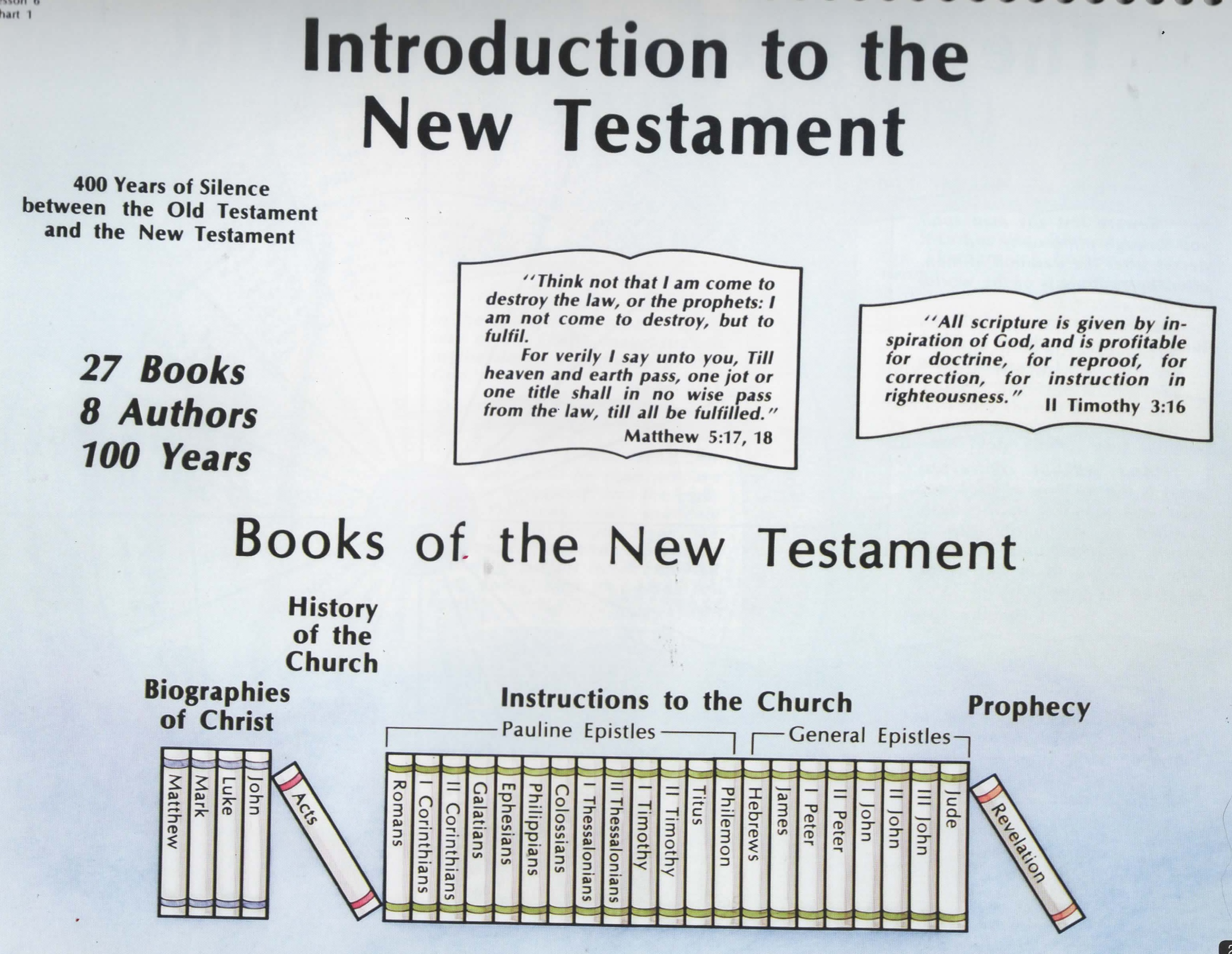
Introduction to the New Testament

New Testament books
  • The books from Matthew through Revelation are called the New Testament because they represent the new covenant that Jesus made.
  • There are twenty-seven books in the New Testament
  • These books were written by eight authors over a period of about 50 years and cover about
    100 years of history.
  • The New Testament is divided into five sections: The four Gospels, one book of history, the
    thirteen Pauline Epistles, the eight General Epistles, and one book of prophecy
    It is vitally important to recognize the purpose of each book and to whom it was originally
    addressed. This helps to interpret scripture.
  • The first four books: Matthew, Mark, Luke, and John describe the death burial, and resurrection of Jesus Christ.


MATTHEW

  • The book of Matthew addresses the Jewish readers foremost.
  • It strongly emphasizes Jesus Christ as the Messiah and king predicted in the Old Testament prophets.


MARK

  • Mark was written for the gentile readers in mind.
  • It presents Jesus as a servant who ministered to the needs of the people.
  • It stresses the supernatural power of Jesus, demonstrating His deity by the miracles he performed.
  • It emphasizes the things Jesus said by the things He did.


LUKE

  • Luke presents Jesus as the Son of God.
  • It focuses especially on the humanity of Jesus, featuring His compassion for the weak, the suffering and outcast.


THE SYNOPTIC GOSPELS

  • syn-op-tic also syn-op-ti-cal adj. 1. Of or constituting a synopsis: presenting a summary of the principal parts or a general view of the whole.
  • The first three gospels are sometimes called the Synoptic Gospels, meaning that they take a
    common view of the order of events surrounding the life of Christ.
    • Matthew had the Jews in mind
    • Mark the Romans
    • Luke the Greek
  • Matthew and Scripture
    • The Jews were diligently indoctrinated in the Scriptures.
    • They were taught to view everything from the scripture perspective.
    • Matthew quotes from the Old Testament again and again in support of the claim that Jesus is the Messiah.
  • Mark and Authority
    • The Roman mind focused on government authority and power.
    • Mark stresses the miracles of Christ, emphasizing His supernatural authority over all things.
  • Luke and the Glorious Perfection of Jesus
    • The Greek mind was attracted to culture, philosophy, wisdom, reason, beauty, and education.
    • Luke presents a complete, orderly, and classical story in what has been called, “the most beautiful book ever written.”
    • The Gospel of Luke reveals the glorious beauty and perfection of the ideal man, the Lord Jesus Christ.


JOHN AND THE DEITY OF JESUS

  • John balances the other three Gospels by its special emphasis on the deity of Jesus.
  • The book begins in much the same way as the Book of Genesis. It reveals that Jesus Christ is the Word made flesh and that He was from the very beginning God, the Creator of all
    things
    • Timothy 3:16 (KJV) And without controversy great is the mystery of godliness: God was
      manifest in the flesh, justified in the Spirit, seen of angels, preached unto the
      Gentiles, believed on in the world, received up into glory,
    • Colossians 1:12-20 (KJV) Giving thanks unto the Father, which hath made us meet to be partakers of the inheritance of the saints in light: Who hath delivered us from the power of darkness, and hath translated us into the kingdom of his dear Son: In whom we have redemption through his blood, even the forgiveness of sins: Who is the image of the invisible God, the firstborn of every creature: 16 For by him were all things created, that are in heaven, and that are in earth, visible and invisible. whether they be thrones, or dominions, or principalities, or powers: all things were created by him, and for him: And he is before all things, and by him all things consist. And he is the head of the body, the church: who is the beginning, the firstborn from the dead; that in all things he might have the preeminence. 19 For it pleased the Father that in him should all fulness dwell; And, having made peace through the blood of his cross, by him to reconcile all things unto himself; by him, I say, whether they be things in earth, or things in heaven.
    • Matthew 22:32 (KJV) I am the God of Abraham, and the God of Isaac, and the God of Jacob? God is not the God of the dead, but of the living.
    • John 14:9 (KJV) Jesus saith unto him. Have I been so long time with you, and yet hast thou not known me, Philip? he that hath seen me hath seen the Father, and how sayest thou then, Show us the Father?
    • James 2:19 (KJV) Thou believest that there is one God; thou doest well: the devils also believe, and tremble.
    • Mark 12:29 (KJV) And Jesus answered him, The first of all the commandments is, Hear, O Israel; The Lord our God is one Lord:


ACTS HISTORY OF THE EARLY CHURCH

  • The book of Acts provides a historical account of the early church.
  • The first chapter continues with the last moments of Christ while He remained on earth and
    then records the establishment of the New Testament church in Jerusalem.
    There the promise of the Holy Ghost was poured out upon the waiting.
  • To understand how the church was founded and how the people entered into the early
    church it is necessary to study the Book of Acts.


THE EPISTLES

  • The next twenty-one books (Romans – Jude) are epistles (formal letters) telling the new
    Christians how to live the victorious life.
  • The epistles are not written to tell one how to be saved; they are written to people who are
    already saved. They teach how to stay saved and how to grow in the grace and knowledge
    of the Lord Jesus Christ.
  • The Pauline Epistles
    • Paul wrote thirteen of the twenty-one epistles. They are called the Pauline Epistles.
    • He wrote a letter to the church at Rome, two letters to the church of Corinth, one letter to the churches of Galatia, one to the church of Ephesus, and so forth.
    • Within the Pauline Epistles are three books commonly called the Pastoral Epistles – 1 Timothy, 2 Timothy, and Titus so called because they offer instructions concerning leadership in the churches.
  • The General Epistles
    • The next eight books- Hebrews, James, 1 Peter, 2 Peter, 1 John, 2 John, 3 John, and Jude –
      • are called the General Epistles because they were written to the church at large.


PROPHECY BOOK OF REVELATION

  • The Book of Revelation stands in a class by itself.
  • It is largely prophetic in nature, although it begins with letters to seven churches in Asia Minor:
    • Asia Minor is a peninsula of western Asia between the Black Sea and the Mediterranean Sea.
  • It then goes on to tell what will happen in the end times. People are still in disagreement over many areas of the Book of Revelation. Many different beliefs exist as to how exactly the prophecies will be fulfilled.
  • Anyone reading and studying this book, should do so carefully and with an abundance of prayer asking the Holy Ghost to help you understand the meaning of the book.
    • John 16:13 But when He, the Spirit of Truth, comes, He will guide you into all the truth [full and complete truth]. For He will not speak on His own initiative, but He will speak whatever He hears [from the Father—the message regarding the Son], and He will disclose to you what is to come [in the future].
    • The Spirit of Truth is the Holy Ghost.

El Trono Celestial en Apocalipsis: Visiones y Revelaciones

He aquí, un trono establecido en el cielo (capítulos 4-5 de Apocalipsis),
Uno que estaba en el trono:
  • es como piedra de jaspe en apariencia
  • es como piedra de sardio en apariencia
  • vive por los siglos de los siglos.
Alrededor del Trono:
  • arcoíris-esmeralda en apariencia
  • 24 tronos
  • 24 ancianos
  • arpas
  • tazones de oro de incienso
  • cuatro criaturas vivientes
  • ángeles.
Desde El Trono:
  • relámpagos
  • truenos
  • voces

Ante El Trono:

  • siete lámparas de fuego, ardientes/siete espíritus/ojos de Dios
  • mar de cristal
  • como vidrio actividad: gloria, honra, acción de gracias, adoración, arrojando coronas

En Medio Del Trono y Alrededor Del Trono:

  • cuatro criaturas vivientes
  • el Cordero
Alabanza en la Sala del Trono
Santo, Santo, Santo, Señor Dios Todopoderoso
Quién fue, es y ha de venir
Oh Señor Para Recibir
Eres Digno, Gloria, Honor y Poder
Porque Tú creaste todas las cosas y por Tu voluntad existen y fueron creadas.
Eres digno de tomar el rollo y abrir sus sellos, porque fuiste inmolado
y nos has redimido para Dios con tu sangre.
De toda tribu, lengua, pueblo y nación, y nos has hecho reyes
y sacerdotes para nuestro Dios,
y reinaré en la tierra.
Digno es el Cordero que fue inmolado para recibir poder y riquezas y sabiduría,
y fuerza y honor y gloria y bendición.
Bendición y honor y gloria y poder
sean al que está sentado en el trono
y al Cordero, por los siglos de los siglos.
¡Amén!
Notas:
  • Revelación 4:8-11
  • Revelación 4:5
  • Revelación 7:10-12
  • Revelación 15:2-4
  • Revelación 19:1-7
 

Impact of Prophets on Jerusalem’s Restoration

The Return to Jerusalem

  • The first expedition to return back to Jerusalem took place after the prophetic time of 70
    years of captivity had expired.
    • This expedition took place about 536 BC and was led by Zerubbabel.
      • He brought about 50,000 Jews back to Jerusalem.
  • The second year after their return, they began to rebuild the Temple.
    • Haggai 1:1-3 (Amp) In the second year of Darius the king [of Persia], on the first day of the sixth month (Aug 29, 520 b.c.), the word of the Lord came by Haggai the prophet to Zerubbabel the son of Shealtiel, governor of Judah, and to Joshua the son of Jehozadak, the high priest, saying,  “Thus says the Lord of hosts: ‘These people say, “The time has not come that the Lord’s house (temple) should be rebuilt.” Then the word of the Lord came by Haggai the prophet, saying, “Is it time for you yourselves to live in your [expensive] paneled houses while this house [of the Lord] lies in ruins?” Now therefore, thus says the Lord of hosts, “Consider your ways and thoughtfully reflect on your conduct!

OPPOSITION

  • The Jews met with opposition from their enemies when trying to rebuild the Temple.
    • Ezra 4:4-5 (Amp) Then [the Samaritans and others of] the people of the land discouraged the people of Judah, and frightened them [to deter them] from building, and hired advisers [to work] against them to frustrate their plans during the entire time that Cyrus king of Persia reigned, [and this lasted] even until the reign of Darius king of Persia.

THE PROPHETS AND THE MESSAGE OF RESTORATION

  • The restoration period also had its prophets.
    • God sent men as Haggai, Zechariah, and Malachi to encourage and chasten (correct and discipline) the Jews.

THE OLD TESTAMENT ENDS

  • The Old Testament life of the Israelites seems to be one of continual backsliding.
  • The Old Testament ends with the people again forgetting God and His word.
    • Malachi 3:5-6 (amp)  “Then I will come near you for judgment; I will be a swift witness against sorcerers, against adulterers, against perjurers, and against those who oppress the laborer in his wages and widows and the fatherless, and against those who turn away the alien [from his right], and those who do not fear Me [with awe-filled reverence],” says the Lord of hosts. “For I am the Lord, I do not change [but remain faithful to My covenant with you]; that is why you, O sons of Jacob, have not come to an end.
  • Although they no longer practiced idolatry for the most part, most of them forgot the manifestation of HIS great power and they fell into apostasy.
  • The Old Testament ends with the Jews outside of the will of God.
  • They did not hear another prophetic message from God for about 400 years.

Lessons from the Kingdom of Israel and Judah’s Downfall


Solomon had built a great kingdom, but after his death it was divided. Solomon’s son, Rehoboam, threatened heavy taxes and the people revolted and the kingdom was divided into North and South Israel and Judah

  • THE NORTHERN KINGDOM
    • The Northern kingdom consisted of ten tribes and was known as the kingdom of Israel
    • Israel had a total of 19 kings, and all of them were wicked and spiritually depraved.
    • Because of this weak spiritual leadership, idolatry was rampant.
    • God sent many prophets to wan Israel of impending judgment.
    • The most notable prophets were: Elijah and Elisha.
    • The people refused to repent of their evil and the judgment of God came.
    • Israel fell, and the people were taken into captivity by Assyria in 721 BC.
      • Read 1 Kings chapters 12-16
  • THE SOUTHERN KINGDOM
    • The southern kingdom consisted of two tribes, Judah and Benjamin and it was known as
      Judah.
    • Judah also had 19 kings and one queen.
    • Unlike Israel, Judah did have some good kings.
    • Judah also had prophets of God such as Isaiah and Jeremiah
    • Judah also refused to repent, and in 606 BC this nation was sent into captivity by Nebuchadnezzar.
    • This captivity lasted for 70 years
      • Jeremiah 25:11-12 And this whole land shall be a desolation, and an astonishment; and these nations shall serve the king of Babylon seventy years. And it shall come to pass, when seventy years are accomplished, that I will punish the king of Babylon, and that nation, saith the LORD, for their iniquity, and the land of the Chaldeans, and will make it perpetual desolations
  • LAST-DAY PROPHECY
    • Many of the Old Testament prophecies relate to the last days.
      • The days of Israel and Judah was a period of spiritual apostasy when they worship their own gods.
      • Similarly, material things are popular idols of our times.

A Song of Thanksgiving & Praise

O Give Thanks unto the Lord for he good for his mercy is forever. Let us praise him with a thankful heart, for he is good. Let us give thanks and give praise to the Lord of Lords.

I will Praise thee with my whole heart: before the gods will I sing praise unto thee; with a thankful heart. O Give Thanks unto thee for he is good for his mercy is forever. Thank him for all living things, animals, plants, and people too.

He doesn’t forget us so don’t forget him. So, give thanks unto the Lord for he is good. Praise him in the morning, praise him in the evening, with a thankful heart.

O my God you know all, and you see all. Even when we are at our lowest you raise us up so we can praise you, O my God and thank you for all of your wonders of the world. If we don’t praise you the rocks and trees will sing a loud to thee. O Lord, so we sing songs of thanksgiving and praise to thee.

by Bell

The Rise and Fall of Israel’s Kings: Saul, David, Solomon

The United Kingdom

  • ISRAEL DEMANDS A KING
    • The prophet Samuel ruled over Israel, but they were not satisfied with his leadership
    • They wanted to have kings like the heathen nations around them had.
    • Israel rejected the invisible God for a man whom they could display before other nations.
    • If people want to have their own way, God will let them have it.
      • Psalms 106:15 And he gave them their request, but sent leanness into their soul,
    • Jesus always prayed that not His will, but the Father’s will be done.
      • Luke 22:42 Saying, Father, if thou be willing, remove this cup from me nevertheless not my will, but thine, be done.
  • THE THREE KINGS
    • The united kingdom of Israel had three kings
    • Each king reigned for forty years.
      • The three kings were Saul, David, and Solomon
  • Saul
    • Saul was a humble man at first, but his character changed drastically after he received power
      and authority of his new office.
    • Saul forgot his place with God and power corrupted his thinking.
    • Saul also disobeyed Samuel who told him to destroy everything.
    • Saul brought back king Agag alive along with sheep and cattle.
    • Samuel rebuked him saying
      • 1 Sam 15:22 And Samuel said, Hath the LORD as great delight in burnt offerings and
        sacrifices, as in obeying the voice of the LORD? Behold, to obey is better than
        sacrifice, and to hearken than the fat of rams.
    • Because of Saul’s rebellious nature, the spirit of God left him.
      • 1 Sam 16:23 And it came to pass, when the evil spirit from God was upon Saul, that David
        took an harp, and played with his hand: so, Saul was refreshed, and was well, and the
        evil spirit departed from him,
    • God had chosen another king for Israel, David, a man after God’s own heart.
      • Saul became so jealous of David that he tried to kill him twice.
      • He spent much time in pursuit of David.
    • Saul’s life ended when he fell upon his own sword.
      • 1 Samuel 31:4 Then said Saul unto his armourbearer, Draw thy sword, and thrust me through therewith; lest these uncircumcised come and thrust me through, and abuse me. But his armourbearer would not; for he was sore afraid. Therefore Saul took a sword, and fell upon it.
  • David
    • The second king of the United Kingdom of Israel was David. He was anointed by king Samuel when he was just a young man.
      • 1 Sam 16:13 Then Samuel took the horn of oil, and anointed him in the midst of his brethren and the spirit of the LORD came upon David from that day forward. So Samuel rose up, and went to Ramah
    • Possibly the highest thing that can be said of David is:
      • Although David sinned, he repented because he had a desire to serve God with all his heart
        • Acts 13:22 And when he had removed him, he raised up unto them David to be their king; to whom also he gave their testimony, and said, I have found David the son of Jesse, a man after mine own heart, which shall fulfil all my will.
    • David Slays Goliath (Read 1 Samuel 17)
      • While David was a shepherd caring for sheep, he fought a bear and a lion that threatened his flock
        • The spirit of the Lord came upon him, and he quickly destroyed the animals.
      • When David went to see how his brothers were doing in the battle against the Philistines, David was enraged by the boasting of Goliath, and by the cowardice of Israel.
      • Goliath was over nine feet tall. Goliath taunted the Israelites and challenged them to fight him.
        • 1 Sam 17:3-11 And the Philistines stood on a mountain on the one side, and Israel stood on a mountain on the other side: and there was a valley between them. And there went out a champion out of the camp of the Philistines, named Goliath, of Gath, whose height was six cubits and a span. And he had an helmet of brass upon his head and he was armed with a coat of mail: and the weight of the coat was five thousand shekels of brass. And he had greaves of brass upon his legs, and a target of brass between his shoulders. And the staff of his spear was like a weaver’s beam; and his spear’s head weighed six hundred shekels of iron: and one bearing a shield went before him. And he stood and cried unto the armies of Israel, and said unto them Why are ye come out to set your battle in array? am not I a Philistine, and ye servants to Saul? choose you a man for you, and let him come down to me. If he be able to fight with me, and to kill me, then will we be your servants: but if prevail against him, and kill him, then shall ye he our servants, and serve us. And the Philistine said, I defy the armies of Israel this day; give me a man, that we may fight together. When Saul and all Israel heard those words of the Philistine, they were dismayed, and greatly afraid.
      • Although David was a youth, he had faith in God.
        • 1 Sam 17:26 And David spake to the men that stood by him, saying, What shall be done. the man that killeth this Philistine, and taketh away the reproach from Israel? for who is this uncircumcised Philistine, that he should defy the armies of the living God?
      • David used the Name of the Lord for his victory.
        • 1 Sam 17:45-46 Then said David to the Philistine. Thou comest to me with a sword, and with a spear, and with a shield: but I come to thee in the name of the LORD of hosts, the God of the armies of Israel, whom thou hast defied. 46 This day will the LORD deliver thee into mine hand; and I will smite thee, and take thine head from thee: and I will give the carcases of the host of the Philistines this day unto the fowls of the air, and to the wild beasts of the earth; that all the earth may know that there is a God in Israel,
        • He used a single stone, and the Name of the Lord to kill Goliath.
    • David’s Problems and Victories
      • After David sinned, God did not overlook it. He sent a prophet to expose David’s sin.
        • 2 Samuel 12:1-7 (KJV) And the LORD sent Nathan unto David. And he came unto him, and said unto him. There were two men in one city; the one rich, and the other poor. The rich man had exceeding many flecks and herds: But the poor man had nothing, save one little ewe lamb, which he had bought and nourished up: and grew up together with him, and with his children; it did cat of his own meat, and drank of his own cup, and lay in his bosom, and was unto him as a daughter. And there came a traveler unto the rich man, and he spared to take of his own flock and of his own herd, to dress for the wayfaring man that was come unto him; but took the poor man’s lamb, and dressed it for the man that was come to him. And David’s anger was greatly kindled against the man; and he said to Nathan, As the LORD liveth, the man that hath done this thing shall surely die: And he shall restore the lamb fourfold, because he did this thing, and because he had no pity. And Nathan said to David, Thou art the man. Thus saith the LORD God of Israel, I anointed thee king over Israel, and I delivered thee out of the hand of Saul;
        • 2 Samuel 12:13 And David said unto Nathan, I have sinned against the LORD. And Nathan said unto David, The LORD also hath put away thy sin; thou shalt not die.
  • Solomon
    • God appeared to Solomon in a dream and said:
      • 1 Kings 3:5 In Gibeon the LORD appeared to Solomon in a dream by night: and God said, Ask what I shall give thee.
      • 1 Kings 3:13 And I have also given thee that which thou hast not asked, both riches, and honour: so that there shall not be any among the kings like unto thee all thy days.
    • Solomon’s Failures
      • Solomon had extreme wealth, and 1000 wives. His wives turned him away from God.
    • Solomon Builds the Temple
      • Solomon’s greatest accomplishment was building the Temple
      • It was built after a plan that his father David received from God
      • It took 7 years to build
        • Read I Kings chapter 5

The Journey to the Promised Land: Lessons from Israel

The Land of Promise

  • POSSESSING THE LAND
    • The Death of Moses (Read Deut 34:)
      • Because of unbelief, Israel reaped the judgment of God. This judgment caused them to
        wander in the wilderness for forty years.
      • Those who did not believe that God would give the land of promise to Israel died in the
        wilderness.
      • Two men, Joshua and Caleb, were the only two saved from the judgment reaped by this
        unbelieving generation.
        • Joshua became the new leader of the Israelites.
      • God instructed Moses to speak to the rock, but in Moses’ anger he struck the rock.
      • This prevented Moses from entering into the promised land.
        • Num 20:7-12 And the LORD spake unto Moses, saying, Take the rod, and gather thou
          the assembly together, thou, and Aaron thy brother, and speak ye unto the rock
          before their eyes; and it shall give forth his water, and thou shalt bring forth to them
          water out of the rock: so thou shalt give the congregation and their beasts drink. 9
          And Moses took the rod from before the LORD, as he commanded him. 10 And
          Moses and Aaron gathered the congregation together before the rock, and he said
          unto them, Hear now, ye rebels; must we fetch you water out of this rock? 11 And
          Moses lifted up his hand, and with his rod he smote the rock twice: and the water
          came out abundantly, and the congregation drank, and their beasts also. 12 And the
          LORD spake unto Moses and Aaron, Because ye believed me not, to sanctify me in
          the eyes of the children of Israel, therefore ye shall not bring this congregation into
          the land which I have given them.
    • Crossing Jordan
      • To enter the land of Canaan, the Israelites had to cross the Jordan River. The Priests went
        into the middle of Jordan and stood there until all of Israel passed over to the other side.
      • Twelve men took twelve stones from the river and built a memorial to God a Gilgal.
        • This was a sign and a reminder to future generations of what God had done.
        • Josh 4:20-24 And those twelve stones, which they took out of Jordan, did Joshua pitch in Gilgal. And he spake unto the children of Israel, saying, When your children shall ask their fathers in time to come, saying, What mean these stones? Then ye shall let your children know, saying, Israel came over this Jordan on dry land. For the LORD your God dried up the waters of Jordan from before you, until ye were passed over, as the LORD your God did to the Red sea, which he dried up from before us, until we were gone over: That all the people of the earth might know the hand of the LORD, that it is mighty: that ye might fear the LORD your God for ever.
      • They had wandered 40 years because of unbelief. Thousands perished.
      • Today, thousands are perishing because of unbelief.
    • The Battle for the Land (Read Joshua 6)
      • The promised blessing would come to Israel if they would believe and obey the Lord.
      • Israel had to fight for the land of Canaan, but God fought for them.
        • God worked miraculously to give Israel victory after victor.
        • Can you imagine the confusion of Jericho as they watched Israel marching around the walls of Jericho for six days.
        • On the seventh day, Israel gave a shout and the walls came down.
        • God will use foolish things to the world to confound the wise.
          • 1 Corinthians 1:27 But God hath chosen the foolish things of the world to confound the wise; and God hath chosen the weak things of the world to confound the things which are mighty;
          • Heb 11:30 By faith the walls of Jericho fell down, after they were compassed about seven days.
        • Israel also fought against Ai, but lost because there was sin in the camp.
          • God had told them not to take the spoils, but they did anyway
            • Josh 7:24-26 And Joshua, and all Israel with him, took Achan the son of Zerah, and the silver, and the garment, and the wedge of gold, and his sons, and his daughters, and his oxen, and his asses, and his sheep, and his tent, and all that he had: and they brought them unto the valley of Achor. And Joshua said, Why hast thou troubled us? the LORD shall trouble thee this day. And all Israel stoned him with stones, and burned them with fire, after they had stoned them with stones. And they raised over him a great heap of stones unto this day. So the LORD turned from the fierceness of his anger. Wherefore the name of that place was called, The valley of Achor, unto this day.
    • The Land Subdued (Read Joshua 14)
      • Israel, by the power of God, subdued the land, and the land was divided so the twelve tribes of Israel could each have their own areas to dwell in
      • After Joshua died, Israel fell into deep sin.
        • Sin led Israel into captivity
        • God raised up judges to lead Israel until they could appoint a king.
        • The time was about 450 years until Samuel the prophet came on the scene.
          • Acts 13:19-20 And when he had destroyed seven nations in the land of Chanaan, he divided their land to them by lot. And after that he gave unto them judges about the space of four hundred and fifty years, until Samuel the prophet.