A place to grow your relationship with God

Posts tagged ‘sermon notes’

Judgment of Mankind: Lessons from Noah’s Days

The picture shows some scriptures about the judgment of mankind with pictures of people.

Mankind Judged

 
The Days Before the flood
The flood was so significant that Jesus used its lessons to teach about His second coming.
  • Eating and Drinking
    • Note that there was no mention of God in their lives, just carnal things.
      • Mat 24:37-44 But as the days of Noe were, so shall also the coming of the Son of man be. For as in the days that were before the flood they were eating and drinking,  marrying and giving in marriage, until the day that Noe entered into the ark, And knew not until the flood came, and took them all away; so shall also the coming of the Son of man be. Then shall two be in the field; the one shall be taken, and the other left. Two women shall be grinding at the mill: the one shall be taken, and the other left. Watch therefore: for ye know not what hour your Lord doth come. But know this, that if the goodman of the house had known in what watch the thief would come, he would have watched, and would not have suffered his house to be broken up. Therefore, be ye also ready: for in such an hour as ye think not the Son of man cometh.
      • Phil 3:17-19 Brethren, be followers together of me, and mark them which walk so as ye have us for an ensample. (For many walk, of whom I have told you often, and now tell you even weeping, that they are the enemies of the cross of Christ: Whose end is destruction, whose God is their belly, and whose glory is in their shame, who mind earthly things.)
  • Marrying and Giving in Marriage
    • Some people believe that the godly line of Seth began to marry with the blood line of Cain. Others believe that this refers to angels who left their place and took the daughters of men.
      • Gen 6:1-2 And it came to pass, when men began to multiply on the face of the earth, and daughters were born unto them, That the sons of God saw the daughters of men that they were fair; and they took them wives of all which they chose. They had forgotten God’s judgment of Adam, Eve, and Cain.
      • Jude 1:6 And the angels who did not keep their positions of authority but abandoned their proper dwelling—these he has kept in darkness, bound with everlasting chains for judgment on the great Day.
      • 2 Peter 2:4 For if God did not spare angels when they sinned, but sent them to hell, putting them in chains of darkness[b] to be held for judgment;
      • 2 Pet 3:3-7 Knowing this first, that there shall come in the last days scoffers, walking after their own lusts, And saying, Where is the promise of his coming? for since the fathers fell asleep. all things continue as they were from the beginning of the creation. For this they willingly are ignorant of, that by the word of God the heavens were of old, and the earth standing out of the water and in the water:  Whereby the world that then was, being overflowed with water, perished:  But the heavens and the earth, which are now, by the same word are kept in store, reserved unto fire against the day of judgment and perdition of ungodly men.
  • Buying, Selling, Planting, and Building
    • Jesus expanded the comparison with the days immediately preceding His coming by including the days of Lot.
      • Luke 17:26-30 And as it was in the days of Noe, so shall it be also in the days of the Son of man.  They did eat, they drank, they married wives, they were given in marriage until the day that Noe entered into the ark, and the flood came, and destroyed them all.  Likewise, also as it was in the days of Lot: they did eat, they drank, they bought, they sold, they planted, they builded; But the same day that Lot went out of Sodom it rained fire and brimstone from heaven, and destroyed them all. Even thus shall it be in the day when the Son of man is revealed.
    • They knew not; So Shall also the Coming of the Son of Man Be.
      • Mat 24:39 (KJV) And knew not until the flood came, and took them all away; so shall also the coming of the Son of man be. 
      • People have been saying that Jesus is coming for years, yet the Bible says:
        • Mat 24:27 For as the lightning cometh out of the cast, and shineth even unto the west so shall also the coming of the Son of man be.
  • The same extreme Wickedness
    • Today’s wickedness is like it was in the days of Noah
    • There will be no advanced notice of Jesus’ coming.
      •  Matthew 24:36-37 “But about that day or hour no one knows, not even the angels in heaven, nor the Son, but only the Father. As it was in the days of Noah, so it will be at the coming of the Son of Man.
      • 2 Timothy 3:1-4 But mark this: There will be terrible times in the last days. People will be lovers of themselves, lovers of money, boastful, proud, abusive, disobedient to their parents, ungrateful, unholy, without love, unforgiving, slanderous, without self-control, brutal, not lovers of the good, treacherous, rash, conceited, lovers of pleasure rather than lovers of God—
  • Noah Prepared
    • There were probably many jokes about Noah as he built the ark, but when the flood came he and his family were safe inside. 
    • Those on the outside were destroyed
      • Hebrews 11:7 By faith Noah, when warned about things not yet seen, in holy fear built an ark to save his family. By his faith he condemned the world and became heir of the righteousness that is in keeping with faith.
    • As Jesus said:
      •  Matthew 16:24-27 Then he called the crowd to him along with his disciples and said: “Whoever wants to be my disciple must deny themselves and take up their cross and follow me. For whoever wants to save their life will lose it, but whoever loses their life for me and for the gospel will save it.  What good is it for someone to gain the whole world, yet forfeit their soul? Or what can anyone give in exchange for their soul?  If anyone is ashamed of me and my words in this adulterous and sinful generation, the Son of Man will be ashamed of them when he comes in his Father’s glory with the holy angels.”


Noah’s Ark: A Journey of Faith and Obedience

The picture shows the ark being built and the ark coming to rest on the mountain with a rainbow.

The Righteous Family Preserved

Faith and Obedience Required
  • While God made a way of escape for Noah, He required obedient faith.
  • God gave Noah specific instructions on how the ark was to be built.
    •  Gen 6:14-16 Make thee an ark of gopher wood; rooms shalt thou make in the ark, and shalt pitch it within and without with pitch. And this is the fashion which thou shalt make it of: The length of the ark shall be three hundred cubits, the breadth of it fifty cubits, and the height of it thirty cubits. A window shalt thou make to the ark, and in a cubit shalt thou finish it above; and the door of the ark shalt thou set in the side thereof; with lower, second, and third stories shalt thou make it.
      • Ark Features
        • 1 Door
        • 3 floors
        • 450 feet long
        • 45 feet high
        • 75 feet wide
    • Gen 7:1 And the LORD said unto Noah, come thou and all thy house into the ark; for thee have I seen righteous before me in this generation.
  • God even told Noah how many and what type of animals to take.
    • Gen 7:2 Of every clean beast thou shalt take to thee by sevens, the male and his female: and of beasts that are not clean by two, the male and his female.
One Plan of Escape
  • God has never spared those who were disobedient to His word.
    • Because of Adam and Eve’s sin, they had to leave the garden.
    • Because of Cain’s sin, a mark was upon him, and he was banished from the presence of the Lord.
  • 1 Pet 3:20 Which sometime were disobedient, when once the longsuffering of God waited in the days of Noah, while the ark was a preparing, wherein few, that is, eight souls were saved by water.
  • 2 Pet 2:5 And spared not the old world, but saved Noah the eighth person, a preacher of righteousness, bringing in the flood upon the world of the ungodly:
  • God has said,
    • Gen 6:3 And the LORD said, My spirit shall not always strive with man…
The Place of Safety
  • One week before the flood, God led Noah, the animals and his family into the ark.
  • God closed the door.
    • Gen 7:15-16 And they went in unto Noah into the ark, two and two of all flesh, wherein is the breath of life. 16 And they that went in, went in male and female of all flesh, as God had commanded him: and the LORD shut him in.
  • The rains came for 40 days; the water stayed at a level for 110 days.
  • At the end of 150 days the ark rested upon the mountains of Ararat.
  • After another 40 days, Noah opened the window and sent out a raven and a dove.

Noah Receives a Promise

  • One of the first things that Noah did upon leaving the ark was to build an altar upon which he offered burnt offerings to the Lord.
  • This was not the end of God’s communication with Noah.
  • God told Noah and his family to multiply and fill the earth.
  • God said from that time forward animals would fear humans and could be used for food.
    • Genesis 9:1-4 And God blessed Noah and his sons, and said unto them, Be fruitful, and multiply, and replenish the earth. And the fear of you and the dread of you shall be upon every beast of the earth, and upon every fowl of the air, upon all that moveth upon the earth, and upon al! the fishes of the sea; into your hand are they delivered. Every moving thing that liveth shall be meat for you; even as the green herb have, I given you all things. But flesh with the life thereof, which is the blood thereof. shall ye not eat.
    • Before this time only plants were eaten.
      • Gen 2:8-9 And the Lord God planted a garden eastward in Eden; and there he put the man whom he had formed. And out of the ground made the Lord God to grow every tree that is pleasant to the sight, and good for food; the tree of life also in the midst of the garden, and the tree of knowledge of good and evil.
      • Remember death was a result of sin. That included the death of animals. 
  • God also instituted human government
    • Gen 9:9-13 And I, behold, I establish my covenant with you, and with your seed after you; And with every living creature that is with you, of the fowl, of the cattle, and of every beast of the earth with you; from all that go out of the ark, to every beast of the earth. And I will establish my covenant with you, neither shall all flesh be cut off any more by the waters of a flood; neither shall there anymore be a flood to destroy the earth. 12 And God said, This is the token of the covenant which I make between me and you and every living creature that is with you, for perpetual generations: I do set my bow in the cloud, and it shall be for a token of a covenant between me and the earth.

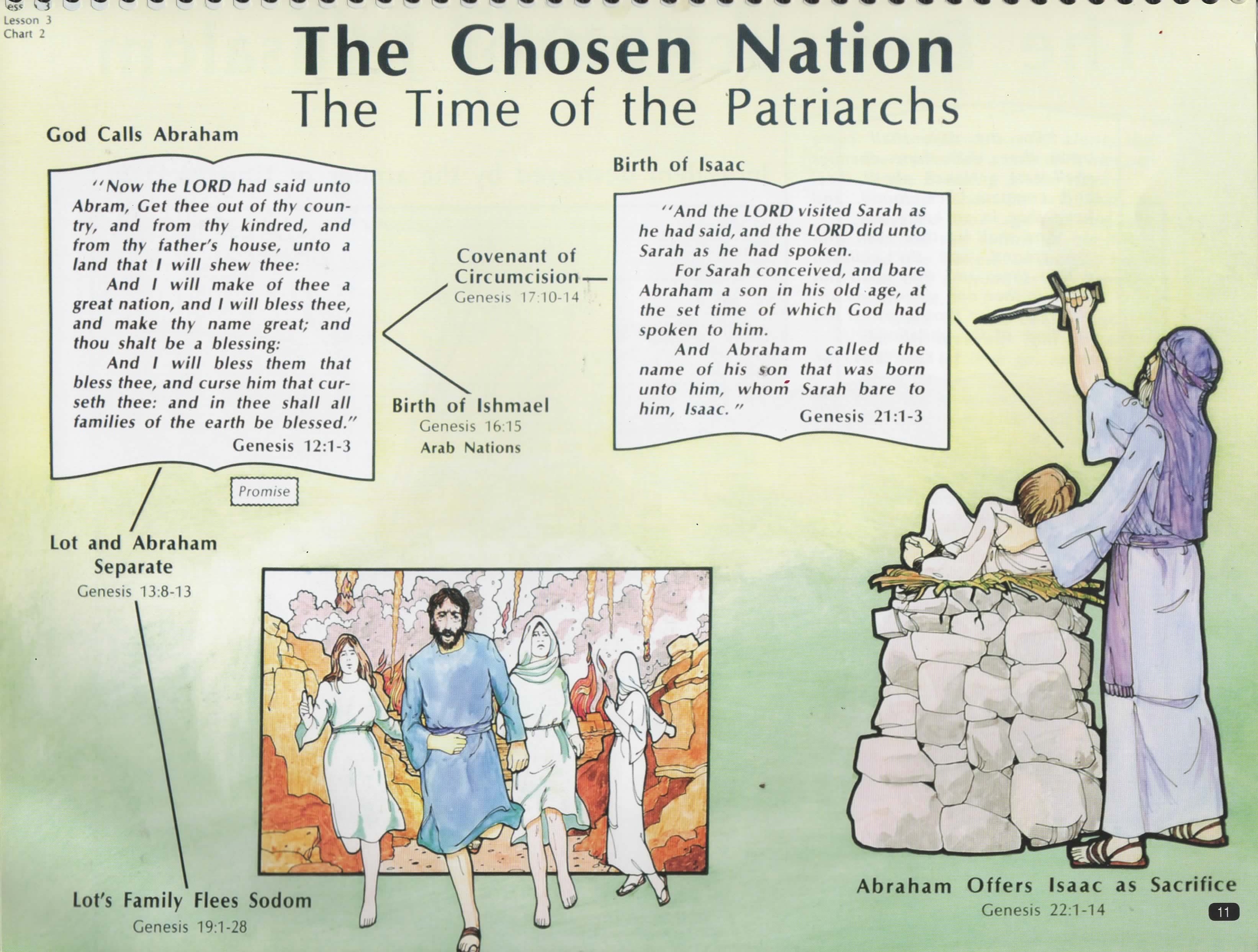
God’s Promise to Abraham: The Birth of Nations

The Time of the Patriarchs

a chart about the Patriarchs
  • Abraham
    • As in the days of Noah, God looked upon the earth and found a man with whom He could make a covenant. This man had come from Ur of the Chaldees with his father, Terah. The man’s name was Abram. The Lord told Abram to leave his country; his kindred, and his father’s house to journey to a land that God would show him. The Lord promised, “I will make of thee a great nation, and I will bless thee, and make thy name great and thou shalt be a blessing; and I will bless them that bless thee, and curse him that curseth thee: and in thee shall all families of the earth be blessed” (Genesis 12:2-3).
    • Abram obeyed the Lord and left his home in Haran when he was seventy-five years old. He took his wife, Sarai, and his nephew, Lot, and they traveled to the land of Canaan. When the Lord called Abram, he had no children. Part of God’s promise was that He would make of Abram a great nation. This promise was subsequently fulfilled, as seen in Deuteronomy 4:6; 1 Kings 3:8-9; and Joshua 21:43-45.
  • The Arab Nations
    • The days passed, however, without any physical sign that God was keeping His promise. Finally, as human beings often do, Abram and Sarai decided to take matters into their own hands. Sarai, who had an Egyptian handmaid named Hagar, said unto Abram, “Behold now, the LORD hath restrained me from bearing I pray thee, go in unto my maid, it may be that I may obtain children by her (Genesis 16:2). Abram acted on his wife’s counsel, which was according to the custom of the time and Ishmael was born of this union.
    • By trying to help God out because they could see no visible sign of His promise coming to pass, Abram and Sarai brought many sorrows to their family, Ishmael and their son, Isaac, would have conflicts. The seeds were sown for conflict between the Arabs and the Jews, nations who sprang from these two men.
  • God’s Covenant with Abraham
    • When Abram was ninety-nine years old, the Lord appeared to him and said, “I am the Almighty God; walk before me, and be thou perfect. And I will make my covenant between me and thee and will multiply thee exceedingly” (Genesis 17:1-2). As Abram fell on his face before God, the Lord continued to talk with him. God renewed His promise to make him the father of many nations and changed his name to Abraham. Abram means “high father: Abraham means “father of a multitude” He also changed Sarai’s name to Sarah. Sarai means “princess”; Sarah means “my princess” Then God gave a token of His covenant. He said. “This is my covenant, which ye shall keep between me and you and thy seed after thee: every man child among you shall be circumcised. And ye shall circumcise the flesh of your foreskin and it shall be a token betwixt me and you” (Genesis 1710-11). Abraham took his son Ishmael with all the male members of his household, and they were all circumcised the same day in obedience to God’s Word.
  • Separation
    • Strife developed between the herdsmen of Abraham’s cattle and those of Lot. The problem was that both Abraham and Lot were very rich, with many flocks herds, and tents, and the land simply was not able to bear them. Abraham said to Lot, “Let there be no strife, I pray thee, between me and thee, and between my herdsmen and thy herdsmen; for we be brethren. Is not the whole land before thee! separate thyself, I pray thee, from me: if thou wilt take the left hand, then i will go to the right; or if thou depart to the right hand, then I will go to the left” (Genesis 13:8-9)
  • Lot’s Choice
    • Abraham was very gracious in allowing his nephew to make the first choice. Lot observed the well-watered plain of Jordan and chose that for himself. He then journeyed east, separating himself from Abraham and pitching his tent in the direction of Sodom. This proved to be a mistake for Lot, for the people of Sodom were wicked and terrible sinners in the Lord’s eyes (Genesis 13:13). It is always dangerous to go in the direction of sin.
  • Judgment against Sin
    • God observed the mounting wickedness in Sodom and Gomorrah, where Abraham’s nephew, Lot, lived with his family. The Lord appeared to Abraham and informed him that the cities would be destroyed. Abraham, knowing that his relatives lived in the doomed city of Sodom, sought the Lord to spare the city. He agreed to do so, if only ten righteous people could be found. But sadly, Sodom and Gomorrah were so wicked that not even ten righteous people could be located (Genesis 18).
  • Angels of Mercy
    • The angels visited Lot and removed him, his wife, and two unmarried daughters from the city. God sent angels of mercy to Sodom that day. The prayers of Abraham did not save the cities, but they did save Lot. Lot was blessed to have an uncle who stayed close to the Lord. But Lot’s grievous error in moving into this wicked city took its toll. He had to leave behind daughters who had married men of Sodom. In disobedience to the angel’s commands his wife looked back as they were fleeing and turned into a pillar of salt. However, Lot and his two unmarried daughters fled for their lives.
    • Because of the great wickedness of these cities, God destroyed them with fire and brimstone. Today, they have been wiped off the face of the earth. Some Bible students believe the destruction of these cities may have been connected with the formation of the Dead Sea.
    • The judgment of God upon Sodom and Gomorrah stands forever as a solemn warning to any who would violate God’s Word. “And turning the cities of Sodom and Gomorrah into ashes condemned them with an overthrow making them an ensample unto those that after should live ungodly” (1 Peter 2:6).
    • As one author noted, “The teachings of Christ are not unlike a river that flows for a long time smoothly and noiselessly between its banks and then suddenly takes the tremendous plunge of the cataract. In the utterance of Jesus about the coming of His kingdom we have the cataract note of His preaching. The same lips which pronounced the Beatitudes and spake the quiet parables of growth and development tell of the coming of His kingdom and the great and terrible day of the Lord.” Judgment is coming! It is time to prepare!
  • Isaac, the Promised Son
    • At last, in God’s time, Sarah conceived and gave birth to a son. Abraham named the child Isaac and circumcised him when he was eight days old. Abraham was one hundred years old when Isaac was born. God had kept His promise, but He was not yet finished trying Abraham’s faith.
  • Abraham’s Faith Tested
    • God said to Abraham, “Take now they son, thine only son Isaac, whom thou lovest, and get thee into the land of Moriah; and offer him there for a burnt offering upon one of the mountains which I will tell thee of (Genesis 22:2). What thoughts must have gone through Abraham’s mind! God had promised him a son. The promise had taken many years to be fulfilled, and now God commanded him to sacrifice that son! Abraham was a man of great faith in God, however. He knew that Isaac was the promised son that God had given him. He believed that through Isaac God would raise up countless offspring as He had promised. He knew that, even if he offered Isaac to God, God was able to raise him up from the dead in order to keep His Word.
    • As Hebrews 11:17-19 says, “By faith Abraham, when he was tried, offered up Isaac: and he that received the promises offered up his only begotten son, of whom it was said, That in Isaac shall thy seed be called: accounting that God was able to raise him up, even from the dead; from whence also he received him in a figure”
  • Abraham’s Obedience
    • “And Abraham rose up early in the morning, and saddled his ass, and took two of his young men with him, and Isaac his son, and clave the wood for the burnt offering, and rose up, and went unto the place of which God had told him” (Genesis 22:3). On the third day of their journey, Abraham saw in the distance the mountain upon which God had commanded that he offer Isaac. He told the servants to stay behind while he and Isaac went to worship.
    • Abraham’s faith is clear in the statement that he made to his servants: “I and the lad will go yonder and worship, and come again to you” (Genesis 22:5). He believed that God had a divine purpose in the task that he hadbeen asked to perform.
  • Abraham’s Continuing Faith
    • As Abraham and Isaac traveled toward their destination, Isaac noticed that they had everything but the sacrifice. He asked, “Behold the fire and the wood: but where is the lamb for a burnt offering!” Abraham responded with statement of eternal significance: “My son, God will provide himself a lamb for a burnt offering” (Genesis 22:7-8).
    • After they had prepared the altar, Abraham bound his son and placed him on the altar. Then Abraham stretched forth his hand with the knife to slay his son. At that moment, the angel of the Lord called, “Abraham, Abraham!” “Here am I,” he answered. “Lay not thine hand upon the lad,” said the angel, “neither do thou anything unto him: for now I know that thou fearest God, seeing thou hast not withheld thy son, thine only son from me” (Genesis 22:12). Abraham’s faith had been tested by what was dear to him, and he came through the trial victoriously. After Abraham heard the voice of the angel, he turned and saw a ram caught by its horns in the thicket nearby. God had provided a sacrifice. Abraham’s statement was prophetic in that many years later Jesus Christ, who was God manifest in the flesh, came as the Lamb of God to take away the sin of the world John 1:29; 1 Timothy 3:16). What a marvelous thing is faith!
    • In the history of our country men traveled by horseback and had to cross rivers swollen by the rains. If they looked at the swirling waters around them, they would become dizzy and possibly fall from the saddle and be swept away. But if they fixed their eye upon the other bank, a tree, a large rock, or a hillside, they would rise safely through.
    • Similarly, in the storms of life, faith is the balance that gives calmness and victory. It is important to fix our eyes, not upon the shifting scene around us, but upon the solid Rock, Jesus Christ.

The Tower of Babel: Origins of Language and Nations

The picture shows the tower of Babel and is shows a map of the distribution of people

The Origin of Languages & The Beginning of Nations

After the Flood
After the flood, God commanded Noah and his sons to replenish the earth. In fulfilling this command, the human race was to spread out gradually over the face of the entire earth to repopulate it. Once again, however, the overwhelming majority of humanity disobeyed the voice of God. Instead of spreading out over the earth, they located in one specific area and decided to stay there and build a city.
The Tower of Babel
“‘And the whole earth was of one language, and of one speech. And it came to pass, as they journeyed from the east, that they found a plain in the land of Shinar; and they dwelt there. And they said one to another, Go to, let us make brick, and burn them thoroughly. And they had brick for stone, and slime had they for mortar. And they said, Go to, let us build us a city and a tower, whose top may reach unto heaven; and let us make us a name, lest we be scattered abroad upon the face of the whole earth” (Genesis 11:1-4).
  • The Self-Centeredness of the People
    • Let us notice the self-centeredness of these people and their disregard for God’s commandment. He wanted them to Scatter over the whole earth to replenish it, but they wanted to build a city and a tower as a center of humanity to prevent themselves from scattering! In other words, their desire was exactly the opposite of God’s Word.
  • Different Languages Introduced
    • Up to this time, everyone on the earth spoke the same language. Essentially, there was only one nation upon the face of the earth. This made the people’s goal of constructing a great city all the more possible.
    • But the Lord observed their disobedience and said, “Behold, the people is one, and they have all one language: and this they begin to do; and now nothing will be restrained from them, which they have imagined to do. Go to, let us go down, and there confound their language, that they may not understand one another’s speech’ (Genesis 11:6-7).
    • By introducing different languages among the people, the Lord stopped their sinful effort. They could no longer communicate sufficiently to complete such an ambitious project, and they began to spread over the face of the earth, each person finding his place with those with whom he could talk.
  • The Judgment of God in Dispersing the People
    • The judgment of God caused the origin of languages and the beginning of nations. As a result, the earth was repopulated by the descendants of Noah as follows:
      • Shem’s Sons
        • Shem’s sons were Elam, Asshur, Arphaxad, Lud, and Aram. 
        • Some of the nations that sprang from these sons were the Persians, Assyrians, Chaldeans, Hebrews, Lydians, and Syrians. 
        • They settled in Assyria, Syria, Persia, northern Arabia, and Mesopotamia.
      • Ham’s Sons
        • Ham’s sons were Cush, Mizraim, Phut, and Canaan. 
        • Some of the nations to spring from these men were the Ethiopians, Egyptians, Libyans, and Canaanites. 
        • Ham’s descendants settled in Africa and Arabia.
      • Japheth’s Sons
        • Japheth’s sons were Gomer, Magog, Madai, Javan, Tubal, Meshech, and Tiras.
        • From them came the Russians, Germans, Britons, Scythians, Medes, Ionians, Athenians, Iberians, and Thracians. 
        • They settled in Asia Minor, Caucasia, and Europe.
      • For more information on the son’s of Noah and the tower of Babel, please read what my daughter wrote on the subject


2 Kings: Lessons from the Divided Kingdom of Israel

The picture shows a map of the divided kingdom of Israel.

2 Kings

2 Kings 21:10-12(NKJV)
And the LORD Spoke by His servants the prophets, saying, Because Manasseh king of Judah has done these abominations (he has acted more wickedly than all the Amorites who were before him. and has also made Judah sin with his idols), therefore thus says the LORD God of Israel: ‘Behold, I am bringing such calamity upon Jerusalem and Judah. that whoever hears of it, both his ears will tingle.
 
Author
  • The author of 1st and 2nd Kings is unknown but the writing if these two books are attributed to Jeremiah
  • Jeremiah is also called the weeping prophet.
 
Date
  • 560-538 B.C.
Theme
  • Lessons from the ruin of Israel and Judah
  • Disobedience and Rebellion bring Captivity and Bondage
Purpose
  • The apostasy of the divided kingdom brings captivity and bondage.
  • Judgment on the kingdom of Israel came through Assyria
  • Judgment on the kingdom of Judah through Babylon.
  • The kingdoms experience short periods of revival under the rule of godly kings.
Content
  • Elijah and Elisha: 2 Kings 1:1-8:15
    • 2 Kings 2:9(NKJV) And so it was, when they had crossed over, that Eljah said to Elisha, “Ask! What may I do for you, before I am taken away from you?” Elisha said, “Please let a double portion of your spirit be upon me.”
  • Kings of Israel and Judah: 2 Kings 8:16-17:6
The picture shows a chart of the Kings of Israel and Judah
  • Israel Captive to Assyria: 2 Kings 17:7-41
    • 2 Kings 17:6-9(NKJV) In the ninth year of Hoshea, the king of Assyria took Samaria and carried Israel away to Assyria, and placed them in Halah and by the Habor, the River of Gozan, and in the cities of the Medes. For so it was that the children of Israel had sinned against the Lord their God, who had brought them up out of the land of Egypt, from under the hand of Pharaoh king of Egypt; and they had feared other gods, 8 and had walked in the statutes of the nations whom the Lord had cast out from before the children of Israel, and of the kings of Israel, which they had made. 9 Also the children of Israel secretly did against the Lord their God things that were not right, and they built for themselves [a]high places in all their cities, from watchtower to fortified city.
  • Judah Survives Assyrian Rule: 2 Kings 18:1-23:37
    • 2 Kings 18:1-7(NKJV) Now it came to pass in the third year of Hoshea the son of Elah, king of Israel, that Hezekiah the son of Ahaz, king of Judah, began to reign. 2 He was twenty-five years old when he became king, and he reigned twenty-nine years in Jerusalem. His mother’s name was Abi the daughter of Zechariah. And he did what was right in the sight of the Lord, according to all that his father David had done. He removed the [b]high places and broke the sacred pillars, cut down the [c]wooden image and broke in pieces the bronze serpent that Moses had made; for until those days the children of Israel burned incense to it, and called it Nehushtan.  He trusted in the Lord God of Israel, so that after him was none like him among all the kings of Judah, nor who were before him. 6 For he held fast to the Lord; he did not depart from following Him, but kept His commandments, which the Lord had commanded Moses.  The Lord was with him; he prospered wherever he went. And he rebelled against the king of Assyria and did not serve him.
  • Judah Captive to Babylon: 2 Kings 24:1-25:30
    • 2 Kings 24:8-12(NKJV) Jehoiachin was eighteen years old when he became king, and he reigned in Jerusalem three months. His mother’s name was Nehushta the daughter of Elnathan of Jerusalem. And he did evil in the sight of the Lord, according to all that his father had done. At that time the servants of Nebuchadnezzar king of Babylon came up against Jerusalem, and the city was besieged.  And Nebuchadnezzar king of Babylon came against the city, as his servants were besieging it. Then Jehoiachin king of Judah, his mother, his servants, his princes, and his officers went out to the king of Babylon; and the king of Babylon, in the eighth year of his reign, took him prisoner.
Christ In 2nd Kings
  • Elijah the forerunner for Christ
  • Elisha as a type of Christ
John 14:12(NKJV)
Most assuredly, I say to you, he who believes in Me, the works that I do he will do also; and greater works than these he will do, because I go to My Father.
 

Understanding 1 Kings: The Kingdom Split

The picture shows the divided Kingdom of Israel

1 Kings

1 Kings 18:21(NKJV)
And Elijah came to all the people, and said, “How long will you falter between two opinions? If the Lord is God, follow Him; but if Baal, follow him.” But the people answered him not a word.
 
Author
  • The author of 1st and 2nd Kings is unknown but the writing if these two books are attributed to Jeremiah

Date

  • 560-538 B.C.
Theme
  • Lessons from the divided kingdom
Purpose
  • The books of 1 and 2 Kings originally existed as one volume in the original Hebrew text.
  • These books cover the history of the Israelites from the death of King David to the captivity of Judah.
  • King David is presented as the good example and King Jeroboam as a bad example of godly leadership.
  • 1 Kings covers the reign of Solomon through the reign of Jehoshaphat and Ahaziah.
    • Solomon’s name means peace
Content
  • The Reign of Solomon: 1 Kings 1:1-11:43
    • 1 Kings 1:37(NKJV) As the LORD has been with my lord the king, even so may He be with Solomon, and make his throne greater than the throne of my lord King David.
    • The Prayer of Solomon
      • 1 Kings 3:5-9(NKJV) At Gibeon the LORD appeared to Solomon in a dream by night; and God said, “Ask! What shall I give you?” And Solomon said: “You have shown great mercy to Your servant David my father, because he walked before You in truth, in righteousness, and in uprightness of heart with You; You have continued this great kindness for him, and You have given him a son to sit on his throne, as it is this day. Now, O LORD My God, You have made Your servant king instead of my father David, but I am a little child: I do not know how to go out or come in. And Your servant is in the midst of Your people whom You have chosen, a great people, too numerous to be numbered or counted. Therefore, give to Your servant an understanding heart to judge Your people, that I may discern between good and evil. For who is able to judge this great people of Yours?”
    • Solomon’s Wisdom: 
      • 1 Kings 4:29-30(NKJV) And God gave Solomon wisdom and exceedingly great understanding, and largeness of heart like the sand on the seashore. Thus, Solomon’s wisdom excelled the wisdom of all the men of the East and all the wisdom of Egypt.
    • Solomon Builds the Temple
      • 1 Kings 6:1(NKJV) And it came to pass in the four hundred and eightieth year after the children of Israel had come out of the land of Egypt, in the fourth year of Solomon’s reign over Israel, in the month of Ziv, which is the second month, that he began to build the house of the LORD.
    • Solomon Turns His Heart from the Lord
      • 1 Kings 11:1-4(NKJV) But King Solomon loved many foreign women, as well as the daughter of Pharaoh: women of the Moabites, Ammonites, Edomites, Sidonians, and Hittites from the nations of whom the LORD had said to the children of Israel, “You shall not intermarry with them, nor they with you. Surely, they will turn away your hearts after their gods.” Solomon clung to these in love. And he had seven hundred wives, princesses, and three hundred concubines; and his wives turned away his heart. For it was so, when Solomon was old, that his wives turned his heart after other gods; and his heart was not loyal to the LORD his God, as was the heart of his father David.
      • Deuteronomy 17:14-17(NKJV) When you come to the land which the LORD your God is giving you, and possess it and dwell in it, and say, “I will set a king over me like all the nations that are around me,’ you shall surely set a king over you whom the LORD your God chooses; one from among your brethren you shall set as king over you; you may not set a foreigner over you, who is not your brother. But he shall not multiply horses for himself, nor cause the people to return to Egypt to multiply horses, for the LORD has said to you, you shall not return that way again. Neither shall he multiply wives for himself, lest his heart turn away; nor shall he greatly multiply silver and gold for himself.
  • Rehoboam and Jeroboam: 1 Kings 12:1-14:30
    • The Divided Kingdom
      • Rehoboam
        • Judah the Southern Kingdom
          • Judah, Benjamin, Levites
      • Jeroboam
        • Israel the Northern Kingdom
          • The other 10 Tribes
    • Kings of Israel and Judah: 1 Kings 15:1-16:34
The picture shows a chart of the Kings of Israel and Judah
  • Elijah and Ahab: 1 Kings 17:1-19:21
    • Elijha’s Mount Carmel Victory: 1 Kings 18:20-46
      • 1 Kings 18:21 And Elijah came to all the people, and said, “How long will you falter between two opinions? If the Lord is God, follow Him; but if Baal, follow him.” But the people answered him not a word.
    • Elijah and Elisha
      • 1 Kings 19:19 So he departed from there, and found Elisha the son of Shaphat, who was plowing with twelve yoke of oxen before him, and he was with the twelfth. Then Elijah passed by him and threw his mantle on him.
  • Ahab and Jezebel 1Kings 20:1-22:53
    • 1 Kings 21:7 Then Jezebel his wife said to him, “You now exercise authority over Israel! Arise, eat food, and let your heart be cheerful; I will give you the vineyard of Naboth the Jezreelite.”
Christ in the 1st Kings
  • The Need for King Jesus
    • The queen of the South will rise up in the judgment with this generation and condemn it, for she came from the ends of the earth to hear the wisdom of Solomon; and indeed a greater than Solomon is here.
  • Elijah the Forerunner for Christ
    •  
    • Matthew 11:13-14:  For all the prophets and the law prophesied until John. And if you are willing to receive it, he is Elijah who is to come.

From Eden to the Flood: Key Figures in Obedient Faith

The Picture shows Cain and Abel with their sacrifices, Seth calling out to God, and the world with water.

From the Fall to the Flood

Adam and Eve outside the Garden
  • In their new state of consciousness of good and evil, Adam and Eve began their life outside the Garden of Eden. Existence was quite different from before. Previously, in the peace of the garden, the first man and woman had been charged with dressing and keeping a true paradise. Now Adam was hewing out a living by the sweat of his brow, battling unendingly against weeds and briars.
  • Eve discovered the truth of God’s Word. He had said, “I will greatly multiply thy sorrow and thy conception; in sorrow thou shalt bring forth children” (Genesis 3:16). The first child that Eve brought into the world was a son named Cain. She said, 1 have gotten a man from the LORD'” (Genesis 4:1). Then Eve gave birth to another son, Abel. The wording here seems to suggest that the two boys may have been twins. In the other places in the Bible it also says that the man knew his wife and she conceived. Here it says, “and again she bare his brother”.
The Difference Between the two brothers
  • As often happens with brothers in the same family, these two were quite different. Abel was a keeper of sheep, but Cain was a tiler of the ground. According to Genesis 4:3-7, there were also spiritual differences between these two men.
Worship Taught
Adam and Eve had obviously taught their sons about God’s existence and about the need to worship Him and to offer sacrifices to Him. As time passed by, Cain brought of the fruit of the ground an offering unto the Lord. Abel also brought an offering of the firstborn of his flock.
 
Sacrifice Accepted and Rejected
  • The Lord accepted Abel’s offering but not that of Cain. This disturbed Cain, and he became angry. 
  • The Lord said unto Cain, Why art thou wroth? and why is thy countenance fallen? If thou doest well, shalt thou not be accepted? and if thou doest not well, sin lieth at the door. And unto thee shall be his desire, and thou shalt rule over him. Genesis 4:6-7
  • In His mercy and willingness to forgive Cain’s error, the Lord appealed to him. He told Cain that his offering could be accepted as well as that of Abel if he, too, would do the right thing. The only thing that would prevent Cain from doing right would be sin.
 Blood Sacrifice, a Requirement
  • What was wrong with Cain’s offering? Cain’s offering did not include a blood sacrifice. He had brough an offering of fruit of the ground. From the very first, God’s plan called for a blood sacrifice. 
  • In the garden, God had slain animals in order to provide skins to cover the nakedness of Adam and Eve. (See Genesis 3:21.) In other words. for sins to be covered, blood had to be shed.
    • Jesus Christ is the Lamb slain from the foundation of the world (Revelation 13:8)
    • The reason God chose a blood sacrifice is that the wages of sin is death (Romans 6:23). 
    • Without the shedding of blood, sins cannot be remitted (Hebrews 9:22). 
  • Adam must have given taught his sons or Abel would not have known what to bring. We do know that Cain brought an improper sacrifice.
  • Early in Scripture we see that sincerity alone does not put a person in right standing with God. The one thing God will honor is obedient faith, it is not enough to do what we think is right or the best we know how. We must do what God commands.
    • Abel obeyed God out of faith. Hebrews 11:4 says, “By faith Abel offered unto God a more excellent sacrifice than Caln, by which he obtained witness that he was righteous, God testifying of his gifts: and by it he being dead yet speaketh!”
The Punishment of Disobedience
  • Sadly, Cain did not accept God’s offer to try again but instead murdered his brother, Abel.
    • The Lord, who sees and knows all things, asked, “Where is Abel thy brother?””
    • Cain lied, “I know not; am I my brother’s keeper?'”
    • Then God pronounced the penalty for Cain’s sin: “What hast thou done? the voice of thy brother’s blood crieth unto me from the ground. And now art thou cursed from the earth, which hath opened her mouth to receive thy brother’s blood from thy hand; when thou tillest the ground, it shall not henceforth yield unto thee her strength; a fugitive and a vagabond shalt thou be in the earth!”
      • Scientists have discovered that DNA, which is in blood, gives off a vibration. This could be what is referred to as ” the voice of thy brother’s blood crieth unto me from the ground”.
    • Cain replied, “My punishment is greater than I can bear. Behold, thou hast driven me out this day from the face of the earth; and from thy face shall I be hid; and I shall be a fugitive and a vagabond in the earth; and it shall come to pass, that everyone that findeth me shall slay me” (Genesis 4:13-14).
    • The Lord answered, therefore whosoever slayeth Cain, vengeance shall be taken on him sevenfold” (Genesis 4:15). Then the Lord set a mark on Cain to prevent anyone who found him from killing him.
      • God still was showing mercy to Cain by setting a mark to prevent anyone from killing him. 
    • As a result of his sins of murder and refusal to obey God, Cain left the Lord’s presence and went to live in the lonely land of Nod on the east of Eden.
Men Who Walked with God
  • Seth
    • Adam and Eve had more children, but it was not until she gave birth to a son whom they named Seth that Eve said, “For God hath appointed me another seed instead of Abel, whom Cain slew” (Genesis 4:25). 
    • It was in the days of Seth, who was evidently a godly man with a desire to serve God as Abel had, that people began to call upon the name of the Lord (Genesis 4:26).
  • Enoch
    • One of the most interesting men to live in the Book of Genesis was Enoch. He loved God and was obedient to Him. The Bible says, “‘And Enoch walked with God; and he was not; for God took him’ (Genesis 5:24). 
    • Hebrews 11:5 offers further information on this unusual event: “By faith Enoch was translated that he should not see death; and was not found because God had translated him: for before his translation he had this testimony, that he pleased God!”
  • Noah
    • In the days of Enoch’s great-grandson, Noah, God saw that the wickedness of man was great on the earth and that every imagination of the thoughts of their hearts was only evil continually. They were so wicked and lawless that God was grieved for making them.
      • He said, “I will destroy man whom I have created from the face of the earth; both man, and beast, and the creeping thing, and the fowls of the air; for it repenteth me that I have made them'” (Genesis 6:7).
    • There was one man, however, who found grace in the eyes of the Lord: Noah. While others thought continually about evil things and practiced all kinds of wickedness, Noah believed in God and obeyed Him.
      • Hebrews 11:7 puts it this way: “By faith Noah, being warned of God of things not seen as yet, moved with fear, prepared an ark to the saving of his house; by the which he condemned the world, and became heir of the righteousness which is by faith.”
What did Abel, Seth, Enoch, and Noah have in common? Obedient faith. They believed God and obeyed Him. From the beginning, faith has been God’s requirement. As Hebrews 11:6 points out, “Without faith it is impossible to please him: for he that cometh to God must believe that he is, and that he is a rewarder of them that diligently seek him.”
 

Explore Fundamental Bible Stories in Home Study

The Picture shows a home.

This Home Study covers the Bible from Genesis to Revelation, teaching fundamental historical stories. The posts are on the Exploring God’s Word Home Bible Study teacher’s guide. I hope that you find it enjoyable and informative as you learn interesting facts from the Bible through this study. 

Return to the Home Page

Understanding 2 Samuel: David’s Reign and Legacy

The picture shows Old Testament scrolls in a library
2nd Samuel
2 Samuel 7:12-13(NKJV)
When your days are fulfilled and you rest with your fathers, I will set up your seed after you, who will come from your body, and I will establish his kingdom. He shall build a house for My name, and I will establish the throne of his kingdom forever.
Acts 13:22(NKJV)
And When He had removed him. He raised up for them David as king, to whom also He gave testimony and said, “I have found David the son of Jesse, a man after My Own heart, who will do all My will.”
 Author
  • The author of the book of 2 Samuel is uncertain. Samuel probably wrote portions of the book. It is possible that Abiathar the priest, Nathan the prophet, and Gad the seer also contributed to this book.
Date
  • Between 931 – 722 B.C.
Theme
  • King David the forerunner of the Messiah
Purpose
  • The book of 2 Samuel describes the history of the forty-year period of David’s reign over the nation of Israel.
  • The first portion of the book (chapters 1-4) describes his reign over Judah and the remaining chapters (5-24) his reign over all of Israel.
  • Chapters 1-10 show David’s triumphs and chapters 11-24 his troubles.
Content
  • David Appointed King of Judah: 2 Samuel 1:1-4:12
    • 2 Samuel 2:4(NKJV) Then the men of Judah came, and there they anointed David king over the house of Judah…
    • 1 Kings 2:11(NKJV) The period that David reigned over Israel was forty years; seven years he reigned in Hebron, and in Jerusalem he reigned thirty-three years.
  • David’s Kingship: 2 Samuel 5:1-24:25
    • 2 Samuel 5:3(NKJV) Therefore, all the elders of Israel came to the king at Hebron, and King David made a covenant with them at Hebron before the LORD. And they anointed David king over Israel.
    • 2 Samuel 5:12(NKJV) So David knew that the LORD had established him as king over Israel, and that He had exalted His kingdom for the sake of His people Israel. David’s Reign as King
    • David’s Reign as King

David defeats the Philistines

2 Samuel 5:17-25

David brings the Ark to Jerusalem

2 Samuel 6:1-23

David’s desire to build a

temple/Covenant

2 Samuel 7:1-29

David’s conquering and kindness

2 Samuel 8:1-10:19

David and Bathsheba

2 Samuel 11:1-27

David and Nathan the prophet

2 Samuel 12:1-25

Amnon and Tamar

2 Samuel 13:1-22

David and Absalom

2 Samuel 13:23-18:33

David’s final years as King

2 Samuel 19:1-24:25

  • Christ in the book of 2 Samuel
    • King David the forerunner for the Messiah
      • 2 Samuel 7:12-13(NKJV) When your days are fulfilled and you rest with your fathers, I will set up your seed after you, who will come from your body, and I will establish his kingdom. He shall build a house for My name, and I will establish the throne of his kingdom forever.
      • Revelation 22:16(NKJV) “I, Jesus, have sent My angel to testify to you these things in the churches. I am the Root and the Offspring of David, the Bright and Morning Star.”
    • David’s combining of the offices of prophet, priest, and king speak of Jesus as our Prophet, Priest, and King of Kings

Exploring 1 Samuel: Key Themes and Events

The picture is of Samuel anointing David the shepherd boy to be king
1 Samuel
1 Samuel 3:19-20(NKJV)
So, Samuel grew, and the LORD Was with him and let none of his words fall to the
ground. And all Israel from Dan to Beersheba knew that Samuel had been established as a
prophet of the LORD.
Samuel was a Judge, a Prophet, and a Priest
 
Author
  • The author of the book of 1 Samuel is uncertain. It was probably written by Samuel and Abiathar the priest.
Date
  • The book of 1 Samuel covers a period of time of about 140 years beginning with the birth of Samuel and ending with the death of Saul.
  • Written between 931-722 B.C.
Theme
  • God’s work in the history of Israel
Purpose
  • The book of 1 Samuel describes the transition from the rule of Judges to the appointment of Kings.
  • The three main characters in this book are Samuel, Saul, and David.
  • Originally 1 Samuel and 2 Samuel were together as one book.
Content
  • Eli the Priest & Judge/ The Birth of Samuel: 1 Samuel 1:1-4:22
    • Hannah wept bitterly for a son and Eli spoke that God had granted her petition (1 Samuel 1:17). She dedicated Samuel to the work of the Lord.
      • 1 Samuel 1:18(NKJV) And she said, “Let your maidservant find favor in your sight.” So the woman went her way and ate, and her face was no longer sad.
    • The Corruption of Eli’s sons
      • 1 Samuel 3:12, 13(NKJV) In that day I will perform against Eli all that I have spoken concerning his house, from beginning to end. For I have told him that I will judge his house forever for the iniquity which he knows, because his sons made themselves vile. and he did not restrain them.
    • The death of Eli and his sons and the capture of the Ark of Covenant
      • 1 Samuel 4:19(NKJV) Now his daughter-in-law, Phinehas’ wife, was with child, due to be delivered; and when she heard the news that the ark of God was captured, and that her father-in-law and her husband were dead, she bowed herself and gave birth, for her labor pains came upon her.
      • 1 Samuel 4:21(NKJV) Then she named the child lchabod, saying, “The glory has departed from Israel!” because the ark of God had been captured and because of her father-in-law and her husband.
  • Samuel the Leader:1 Samuel 5:1-8:22
    • The return of the Ark
      • 1 Samuel 6:11-12(NKJV) And they set the ark of the LORD on the cart, and the chest with the gold rats and the images of their tumors. Then the cows headed straight for the road to Beth Shemesh, and went along the highway, lowing as they went, and did not turn aside to the right hand or the left. And the lords of the Philistines went after them to the border of Beth Shemesh.
    • Samuel’s sone walk in disobedience
      • 1 Samuel 8:1(NKJV) Now it came to pass when Samuel was old that he made his sons judges Over Israel.
      • 1 Samuel 8:3(NKJV) But his sons did not walk in his ways; they turned aside after dishonest gain, took bribes, and perverted justice.
      • 1 Samuel 8:4, 5(NKJV) Then all the elders of Israel gathered together and came to Samuel at Ramah, and said to him, “Look, you are old, and your sons do not walk in your ways. Now make us a king to judge us like all the nations.”
  • Saul the First King: 1 Samuel 9:1-15:35
    • King after the flesh
      • 1 Samuel 9:1-2(NKJV) There was a man of Benjamin whose name was Kish the son of Abiel, the son of Zeror, the son of Bechorath, the son of Aphiah, a Benjamite, a mighty man of power. And he had a choice and handsome son whose name was Saul. There was not a more handsome person than he among the children of Israel. From his shoulders upward he was taller than any of the people.
      • 1 Samuel 15:1(NKJV) Samuel also said to Saul, “The LORD Sent me to anoint you king over His people, over Israel. Now therefore, heed the voice of the words of the LORD.
    • Saul’s disobedience was not killing all of the Amalekites and sparing King Agag
      • 1 Samuel 15:26(NKJV) But Samuel said to Saul, will not return with you, for you have rejected the word of the LORD, and the LORD has rejected you from being king over Israel.”
  • David the Second King and Saul: 1 Samuel 16:1-30:31
1 Samuel 16:7(NKJV)
But the LORD said to Samuel, “Do not look at his appearance or at his physical
stature, because l have refused him. For the LORD does not see as man sees; for man
looks at the outward appearance, but the LORD looks at the heart.”
1 Samuel 16:13(NKJV)
Then Samuel took the horn of oil and anointed him in the midst of his brothers; and
the Spirit of the Lord came upon David from that day forward. So Samuel arose and went
to Ramah.
 
    • Major Events 
      • David kills Goliath 1 Samuel 17
    • Saul becomes jealous of David
    • David’s friendship with Jonathan (Saul’s son)
    • David flees from Saul
  •  Death of Saul: 1 Samuel 31:1-13
    • Saul’s death in the battle against the Philistines
      • 1 Samuel 31:6(NKJV) So, Saul, his three sons, his armorbearer. and all his men died together that same day.
  • Christ in the Book of 1 Samuel
    • Samuel as a type of Christ
      • Both were promised children
    • Samuel was a Judge, a Prophet, and a Priest compared to the fact that was Jesus is a Prophet, the High Priest, and the King
    • David’s kingdom of the lineage of Christ’s kingdom
    • David as a shepherd and Jesus as the Chief Shepherd