Key Events in Ancient History: A Comprehensive Timeline
Ancient History is a fascinating subject. Here is a timeline of many of the major events that happened in History. An approximate date is also given next to the event. With the list of events will be links to articles giving more information about the event. Some of the resources are from secular sources such as The Story of Mankind.
- In the Beginning- the creation, Adam & Eve and the fall about 4004 BC
- Cain and Abel
- Jubal and Tubal-Cain (7 Generations after Adam)
- Understanding Cain’s Legacy: Descendants and Impact
- Noah and the Flood c. 2348 or 2349 BC
- After the Flood / Ice Age c. 2348-1600 BC
- Understanding the Lineage of Noah’s Sons
- Exploring Noah’s Descendants and Their Modern Connections
- Evidence of Ice Age in the Bible: Key Verses
- The Sumerians c. 2300 BC (Mesopotamia)
- The Story of Mankind: Mesopotamia
- The Story of Mankind: The Sumerians
- Tower of Babel c. 2242 BC (Mesopotamia)
- Nimrod c. 2300 BC (Mesopotamia)
- Epic of Gilgamesh c. 2000 BC (Mesopotamia)
- Stonehenge c. 2000 (Europe)
- Stonehenge (secular website)
- The Age of Stonehenge
- Minoan Civilization c. 2000-1200 BC (Greece)
- Egypt C 1996-1821 BC (Egypt)
- The Story of Mankind: HIEROGLYPHICS
- The Story of Mankind: The Nile Valley
- The Story of Mankind: The Rise and Fall of Egypt
- Abraham c. 1996-1821 BC (Mesopotamia and Egypt)
- Ishmael c 1800-1866 BC (Mesopotamia)
- Isaac and Rebekah
- Jacob and Esau c. 1836 BC (Israel and Egypt)
- Joseph c. 1745 BC (Israel and Egypt)
- Hammurabi 1792 BC (Mesopotamia)
- Israelites in Slavery (started after 1635, but before 1571 BC) (Egypt)
- China & the First Dynasties Xia: 2000-1600 BC and Shang: 1600-1046 BC (China)
- Moses c. 1571-1451 BC (Egypt)
- The Plagues, The Passover, The Exodus, and the Crossing of the Red Sea c. 1491 BC (Egypt)
- 10 Commandments and the Law c. 1491 BC
- Ark of the Covenant & the Tabernacle c. 1491 BC
- 12 Spies, Disobedience, and Wandering for 40 Years c. 1491-1451 BC
- Joshua & Entering the Promised Land 1451 BC (Israel)
- Mycenaean Civilization c. 1600 B. -1100 BC (Greece)
- Mitanni, or Naharin, came on the scene around 1600 BC (area of Mesopotamia)
- Elgon, King of Moab c 1200 BC (Moab)
- Ruth c. 1200 BC (Israel)
- Gideon c. 1199 BC (Israel)
- Samson and the Philistines c. 1117 BC (Israel)
- Zhou Dynasty c. 1046-256 BC (China)
- Samuel c. 1095 BC (Israel)
- Eli the priest c. 1095 BC (Israel)
- Saul- Israel’s first King c. 1095 BC (Israel)
- David the Shepherd Boy c. 1085-1015 BC (Israel)
- David – Israel’s 2nd King c. 1055 BC (Israel)
- Solomon c. 1015 BC (Israel)
- The Phoenicians c. 1000 BC (Rome)
- The Story of Mankind: The Phoenicians
- Israel Divides c. 975 BC (Israel)
- Amenhotep IV and Nefertiti c. late 900s (Egypt)
- Tutankhamen (King Tut) c. late 900s (Egypt)
- Ramses II (The Great) c. 800s BC/date unknown (Egypt)
- Elijah ‘Fiery Prophet’ c. 896 BC (Israel)
- Elisha ‘Israel’s Prophet’ c. 895 BC (Israel)
- Obadiah ‘Prophet to Edom’ c. 840s BC (Israel)
- Joel ‘Prophet to Judah’ Probably 835-805 B.C. (Israel)
- Homer c. 800-725 BC (Greece)
- India & Hinduism date unknown (India)
- Olympic Games c. 776BC-AD393 (Greece)
- Jonah c. 760 BC & Amos c. 808 BC (Israel)
- Rome is Founded c. 748 BC (Rome)
- Isaiah c. 740 BC
- Micah c. 735 BC (Israel)
- Hosea (Prophet of Israel) c. 721 BC (Israel)
- Israel Falls to Assyria c. 721 BC (Mesopotamia and Israel)
- Hezekiah and Sennacherib c. 710 BC (Israel)
- Ancient Native Americans c. 700 BC (North America)
- Athens & Sparta c. 700-500 BC (Greece)
- The Story of Mankind: Athens vs. Sparta
- Manasseh c. 677 BC (Israel)
- Powers of Mesopotamia c. 668-626 BC (Mesopotamia)
- King Josiah c. 630 BC (Israel)
- Nahum c. 630 BC and Zephaniah c. 629 BC Prophets of Josiah’s Reign (Israel)
- Jeremiah (Judah’s Prophet) c. 629 BC (Israel)
- Nineveh Destroyed (Fall of Assyria) c. 612 BC (Mesopotamia)
- Habakkuk c. 609 BC and Huldah c. 7th century BC (Israel)
- Babylonian Captivity of Judah c. 605, 599, and 588 BC (Mesopotamia and Israel)
- Understanding Lamentations: Sorrow and Hope in Jerusalem’s Fall This was written around 587 B.C.
- The Brave Hebrew Boys
- Nebuchadnezzar II and the Hanging Gardens c. 605-615 BC (Mesopotamia)
- Nebuchadnezzar’s Dream: A Prophetic Vision of Nations
- Daniel c. 607-534 BC (Mesopotamia)
- Shadrach, Meshach, and Abed-Nego c. early 600s or late 500s BC (Mesopotamia)
- Aesop’s Fables c. 600 BC (Greece)
- Ezekiel Prophet to Judah c. 595 BC (Israel and Mesopotamia)
- India and Buddhism c. 563 BC (India)
- Pythagoras/Temple of Diana (547 BC and 550 BC) (Greece)
- Confucius 551-479 BC (China)
- The Life and Legacy of Confucius Explained (coming soon)
- Belshazzar & Cyrus the Great 539-538 BC (Mesopotamia)
- Darius I and the Persian Empire 522 BC (Mesopotamia)
- Zerubbabel/Haggai & Zechariah 520 BC (Israel)
- The Roman Republic 510 BC (Rome)
- Battle of Marathon 490 BC (Greece & Mesopotamia)
- Herodotus 484 BC (Greece)
- Xerxes I and Esther 480 BC (Mesopotamia)
- Esther Before the King
- Exploring the Book of Esther: Themes and Historical Context
- The Golden Age of Athens 478-399 BC and Socrates 469-399 BC (Greece)
- Hippocrates 377BC (Greece)
- Statue of Zeus 456 BC (Greece)
- Ezra & Artaxerxes 467 BC
- Nehemiah 454BC (Mesopotamia & Israel)
- Pericles 443-429 BC / Peloponnesian War 431-404 BC (Greece)
- Malachi Prophet to Judah 397 BC (Israel)
- Plato 427-348 BC & Aristotle 384-322 BC (Greece)
- Philip II of Macedonia 359-336 BC / Mausoleum of Halicarnassus 353 BC (Greece)
- Alexander the Great (and the Division of his Empire)356-323 BC (Greece)
- The Story of Mankind: Alexander the Great
- How Alexander the Great’s Death Shaped His Empire (coming soon)
- Archimedes 287-212 BC (Greece) / Eratosthenes 276-194 BC/
- Lighthouse at Alexandria 280 BC (Egypt)
- Emperor Asoka 273-232 (India)
- The Septuagint 297 BC (Egypt)
- Colossus of Rhodes 290 BC (Greece)
- Qin Dynasty (Ch’in) 221-206 BC / Han Dynasty 206 BC-220 AD (China)
- Hannibal and the Punic Wars 218-146 BC (Rome)
- Maccabean Revolt 165 BC (Israel)
- Spartacus unknown-71BC (Rome)
- 1st Triumvirate 60BC (Rome)
- Julius Caesar 49 BC (Rome)
- 2nd Triumvirate 43 BC / Cleopatra 69-30 BC (Rome)
- Herod the Great (King of Israel) 40 BC (Israel)
- Augustus Caesar – First Emperor of Rome 27 BC (Rome)
- Zacharias the father of John the Baptist 5 BC
- John the Baptist 5 BC-25AD (Israel)
- Jesus Christ 5 or 4 B.C. to around 30 or 33 AD (Israel)
- Chronological Events in the Life of Jesus and John the Baptist: This timeline outlines key events from John the Baptist’s birth to Jesus’ ascension, including significant historical occurrences.
- Exploring the Life and Teachings of Jesus: The content explores Jesus’ life, teachings, death, and resurrection, emphasizing his role in the Bible, the significance of his identity, and the understanding of his works. There are links to many different Bible Studies about Jesus.
- The Story of Mankind: Joshua of Nazareth (Jesus)
- The Beginning of the Church and the Early Churches




 This sign however was too cumbersome and after a short while when the meaning of “heaven” was added to that of star the picture was simplified which made it even more of a puzzle.
 In the same way an ox changed from
 into
into and a fish changed from
 into
into The sun was originally a plain circle
 and became
 If we were using the Sumerian script today we would make an
 look like
 This system of writing down our ideas looks rather complicated but for more than thirty centuries it was used by the Sumerians and the Babylonians and the Assyrians and the Persians and all the different races which forced their way into the fertile valley. The story of Mesopotamia is one of endless warfare and conquest. First the Sumerians came from the North. They were a Caucasian people who had lived in the mountains. They had been accustomed to worship their gods on the tops of hills. After they had entered the plain, they constructed artificial little hills on top of which they built their altars. They did not know how to build stairs, and they therefore surrounded their towers with sloping galleries. Our engineers have borrowed this idea, as you may see in our big railroad stations where ascending galleries lead from one floor to another. We may have borrowed other ideas from the Sumerians, but we do not know it.
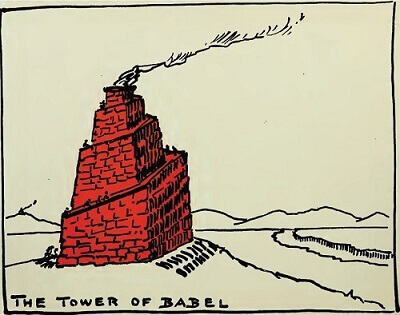 The Sumerians were entirely absorbed by those races that entered the fertile valley at a later date. Their towers however still stand amidst the ruins of Mesopotamia. The Jews saw them when they went into exile in the land of Babylon and they called them towers of Babillli, or towers of Babel. In the fortieth century before our era, the Sumerians had entered Mesopotamia. They were soon afterwards overpowered by the Akkadians, one of the many tribes from the desert of Arabia who speak a common dialect and who are known as the “Semites,” because in the olden days people believed them to be the direct descendants of Shem, one of the three sons of Noah. A thousand years later, the Akkadians were forced to submit to the rule of the Amorites, another Semitic desert tribe whose great King Hammurabi built himself a magnificent palace in the holy city of Babylon and who gave his people a set of laws which made the Babylonian state the best administered empire of the ancient world. Next the Hittites, whom you will also meet in the Old Testament, over-ran the Fertile Valley and destroyed whatever they could not carry away. They in turn were vanquished by the followers of the great desert god, Ashur, who called themselves Assyrians and who made the city of Nineveh the center of a vast and terrible empire which conquered all of western Asia and Egypt and gathered taxes from countless subject races until the end of the seventh century before the birth of Christ when the Chaldeans, also a Semitic tribe, re-established Babylon and made that city the most important capital of that day. Nebuchadnezzar, the best known of their Kings, encouraged the study of science, and our modern knowledge of astronomy and mathematics is all based upon certain first principles which were discovered by the Chaldeans. In the year 538 B.C. a crude tribe of Persian shepherds invaded this old land and overthrew the empire of the Chaldeans. Two hundred years later, they in turn were overthrown by Alexander the Great, who turned the Fertile Valley, the old melting-pot of so many Semitic races, into a Greek province. Next came the Romans and after the Romans, the Turks, and Mesopotamia, the second center of the world’s civilization, became a vast wilderness where huge mounds of earth told a story of ancient glory.
 articlesforchristians