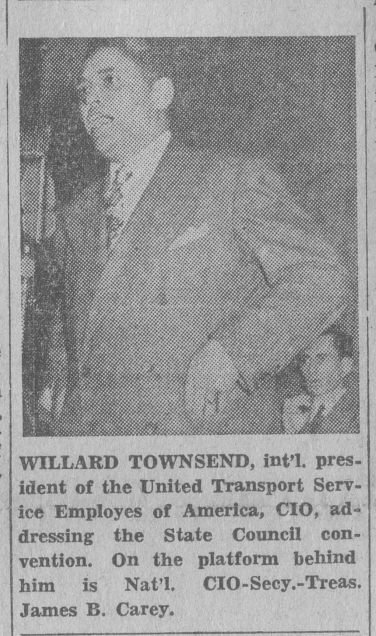
Willard Saxby Townsend was born December 4, 1895. He Died on February 3, 1957. He was one of the first black American labor leaders. He improved the wages and working conditions of redcaps (railroad baggage porters). Townsend helped redcaps gain a fixed salary, plus retirement and insurance benefits. He was inducted into the National Railroad Hall of Fame.
Early life and education
Townsend was born Cincinnati. He was the son of William Townsend and Cora Beatrice Townsend. After completing high school he worked in the Cincinnati Union Terminal. He began working as a redcap there when he was 19 years old.
In 1916, Townsend joined the United States Army and served as a lieutenant in France with the 372nd Infantry Regiment during World War I. After returning from the war, he helped form an all–African American company of the Ohio National Guard.
He began his studies at the Illinois School of Chiropody and briefly worked as a chiropodist. In January 1919, after meeting Alberta Hunter at one of her performances in Cincinnati, he married her. Later, he moved to Canada, working as a dining car waiter to support his university education. He became secretary of the Canadian Brotherhood of Railway Employees and started a premedical program at the University of Toronto, eventually studying chemistry. He graduated in 1924 but struggled to find meaningful, well-paying work.
Career
In 1929, Townsend returned to the United States and took a job at a high school in Texas. He later moved to Chicago, working as a messenger at the Adler Psychological Laboratory before becoming a railroad porter. Shocked by the tough working conditions, he joined the American Federation of Labor Auxiliary of Red Caps—railroad station porters who were mostly African American in the early 1900s. In 1936, Townsend was elected president of the AFL and, in 1940, helped form the International United Transport Service Employees. Originally called the International Brotherhood of Red Caps, the group changed its name after welcoming Pullman laundry workers to join.
Townsend got involved in politics and pushed Congress to improve conditions for workers. His efforts paid off in 1940 when the Supreme Court ruled that red caps should earn ten cents for every parcel or piece of luggage they carried to and from trains. He made sure his union members’ pay was safeguarded under the Fair Labor Standards Act of 1938 and led an appeal to the Interstate Commerce Commission under the Railway Labor Act.
In 1942, the UTSE joined the Congress of Industrial Organizations, with Townsend becoming the first African American to hold office in a national union. After Townsend’s success, the Brotherhood of Railway Clerks of the American Federation of Labor opened membership to red caps. Journalist George McCray noted Townsend was “fast becoming the most powerful Negro leader in the country.” In the wake of the 1943 Detroit race riot, Townsend declared, “America is sick,” warning that democracy would only survive if its advocates fought as hard for equality, labor, and justice as its enemies did for racism, terror, and exploitation. He also criticized the Federal Housing Administration for promoting segregated housing during and after World War II.
Townsend not only fought for equality for African Americans but also stood up for Japanese and Japanese Americans. He argued that Japanese Americans were “giving more and receiving less than many lip-service Americans.” He was chosen for a World Federation of Trade Unions (WFTU) committee to study working conditions in Japan, China, Korea, and the Philippines, and in 1947 represented the U.S. at a WFTU meeting in Tokyo. There, he urged Japanese workers to avoid political conflicts and encouraged them to visit the U.S. to learn about trade union practices. That same year, he attended the American Missionary Association’s Institute of Race Relations, where he criticized communism’s influence on the labor movement. He also served as an adviser at an International Labor Office meeting in Mexico, working to end racial discrimination, and was active in both the NAACP and the National Urban League.
Townsend studied law at Blackstone Law School in Chicago, earning his second degree in 1951. In 1955, he became vice president of the newly merged American Federation of Labor and Congress of Industrial Organizations. He passed away from a heart attack in 1957 and was later inducted into the National Railroad Hall of Fame.

 articlesforchristians
Comments on: "The Legacy of Willard Saxby Townsend in Labor Rights" (1)
[…] King, Jr. “I have a Dream Speech” Harriet Tubman: a Moses to her People The Legacy of Willard Saxby Townsend in Labor Rights ROSA LEE […]