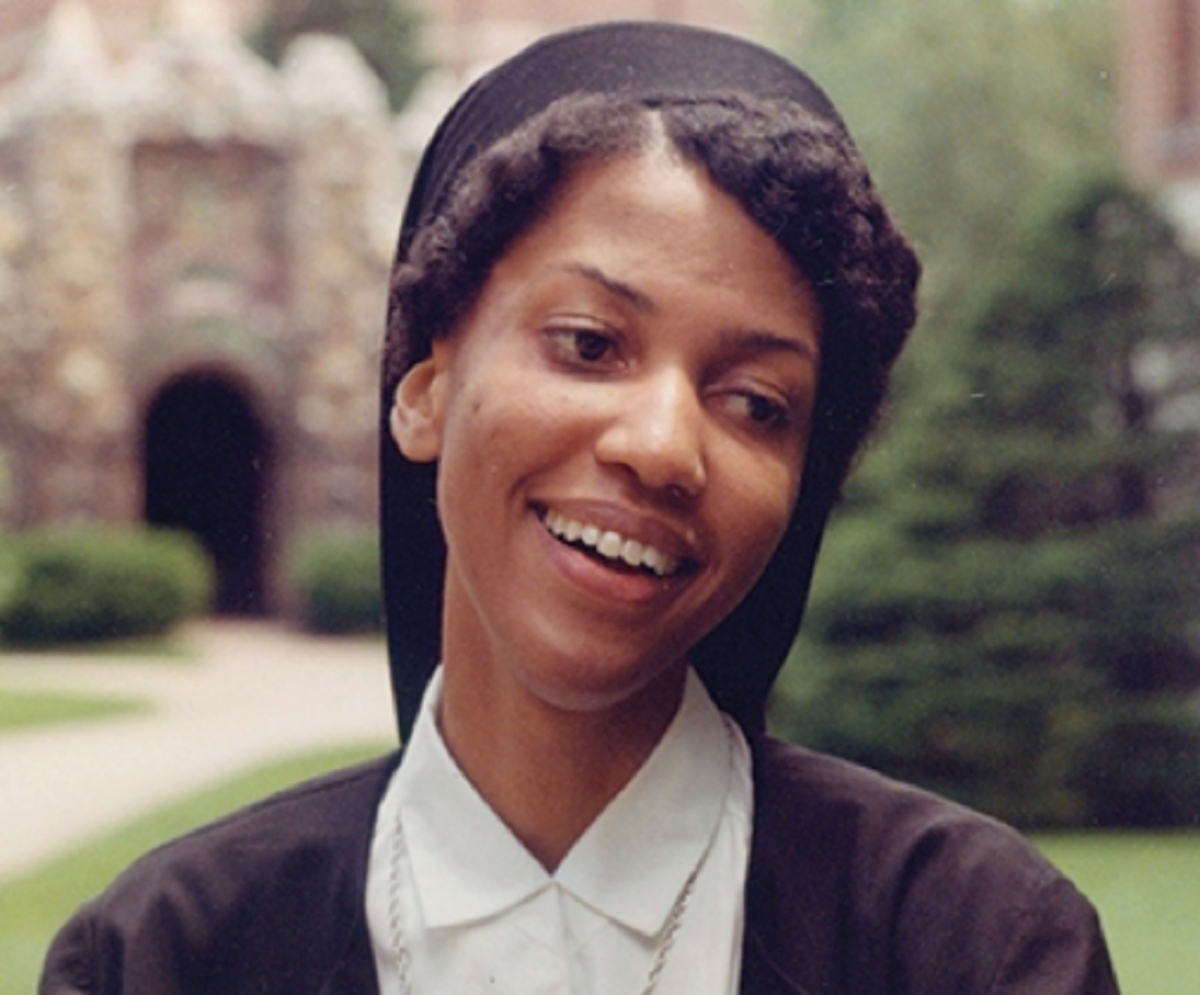
Mary Thea Bowman, FSPA (born Bertha Elizabeth Bowman; December 29, 1937 – March 30, 1990) was a Black Catholic religious sister, teacher, musician, liturgist and scholar who contributed to the ministry of the Catholic Church toward African Americans.
She became an evangelist among her people, assisted in the production of an African-American Catholic hymnal, and was a popular speaker on faith and spirituality in her final years, in addition to recording music. She also helped found the National Black Sisters’ Conference to provide support for African-American women in Catholic religious life. She died of cancer in 1990.
In 2018, the Diocese of Jackson opened her cause for sainthood, and she was designated a Servant of God.
Life
Early life
Born in Yazoo City, Mississippi, in 1937, Sis Mary Thea Bowman came from a family with a remarkable history. Her grandfather, Edward Bowman, had been born into slavery, while her father, Theon Edward Bowman, became a physician and her mother, Mary Esther Coleman, worked as a teacher. Raised in the Methodist tradition, she converted to Catholicism at the age of nine with her parents’ blessing. She attended Holy Child Jesus School in Canton, Mississippi, where she met her classmate, Flonzie Brown Wright.
At just 15, she became the first African-American to join the Franciscan Sisters of Perpetual Adoration in La Crosse, Wisconsin, defying her parents’ wishes. Bowman also played a role in the civil rights movement.
As part of her religious training, Bowman attended Viterbo University, run by her congregation, earning a B.A. in English in 1965. She later studied at The Catholic University of America in Washington, D.C., where she earned an M.A. in English in 1969 and a Ph.D. in English in 1972, completing her doctoral thesis on Thomas More, titled *The Relationship of Pathos and Style in A Dyalogue of Comforte Agaynste Tribulacyon: A Rhetorical Study*.
While working on her master’s at CUA, Bowman helped found the National Black Sisters’ Conference, launched in Pittsburgh in 1968 after Martin Luther King Jr.’s assassination. She stayed involved with the group for the rest of her life.
Educator
Bowman began her teaching career at an elementary school in La Crosse, Wisconsin, before moving on to Holy Child Jesus Catholic School, her alma mater. She later taught at her other alma maters, Viterbo College in La Crosse and the Catholic University of America in Washington, D.C., as well as Xavier University of Louisiana in New Orleans.
In his book *Eleven Modern Mystics*, meditation teacher Victor M. Parachin highlights Bowman’s influence on Catholic liturgical music, noting how she provided an intellectual, spiritual, historical, and cultural foundation for creating and validating a unique worship style for Black Catholics. As Bowman explained, “When we understand our history and culture, we can develop the rituals, music, and devotional expressions that truly fulfill us in the Church.”
In 1987, Bowman played a key role in publishing *Lead Me, Guide Me: The African American Catholic Hymnal*, the first Catholic hymnal created for the Black community. The project was coordinated by James P. Lyke, Auxiliary Bishop of Cleveland and an African American himself, who said it grew from the needs and hopes of Black Catholics. Bowman helped choose the hymns and contributed her essay, “The Gift of African American Sacred Song,” in which she called Black sacred song “soulful” and described it as holistic, participatory, genuine, spirit-filled, and life-giving.
Evangelist
After spending 16 years in education, Bowman was invited by the Bishop of Jackson to serve as a consultant for intercultural awareness. She became more deeply involved in ministry to African-Americans, giving inspiring talks to Black congregations. Her “ministry of joy” reached people as far away as Nigeria and Kenya, as well as Canada, the Virgin Islands, Hawaii, New York, and California. She encouraged Catholics to embrace their differences, preserve their cultures, and express the joy of being united in Christ. In his book Hope Sings, So Beautiful: Graced Encounters Across the Color Line, Christopher Pramuk wrote: “Arguably no person in recent memory did more to resist and transform the sad legacy of segregation and racism in the Catholic Church than Thea Bowman … who inspired millions with her singing and message of God’s love for all races and faiths. Sister Thea awakened a sense of fellowship in people both within and well beyond the Catholic world, first and foremost through her charismatic presence.”
In 1984, Bowman was diagnosed with breast cancer and began treatment, yet she kept up a busy speaking schedule. As her illness advanced, her fame continued to grow, taking her on trips abroad to places like West Africa and Lourdes, France. She also appeared on national news programs and was featured in a documentary about her life following a terminal diagnosis.
During an appearance on the show 60 Minutes with Mike Wallace, she prodded him into saying “Black is beautiful.”
In 1989, just before her passing, she was honored with an honorary doctorate from Boston College in Massachusetts, recognizing her contributions to the service of the Church.
Death
A few months before she passed away from cancer in 1989, Bowman addressed American Catholic bishops from her wheelchair, moving them deeply and earning their applause. When she finished, they stood together, linking arms, and joined her in singing the spiritual “We Shall Overcome.” That same year, Harry Belafonte met her in Mississippi with hopes of making a film about her life starring Whoopi Goldberg, though the project never came to fruition.
Just days before her passing, the University of Notre Dame announced it would honor Bowman with the 1990 Laetare Medal. The award was given posthumously during their 1990 commencement. She passed away on March 30, 1990, at the age of 52, in Canton, Mississippi, and was laid to rest with her parents in Memphis, Tennessee.
Legacy
The 25th anniversary of Bowman’s passing inspired many tributes. Her 1988 albums, *Songs of My People* and *’Round the Glory Manger*, originally released on stereo audiocassette by the Daughters of St. Paul, were reissued in 2020 for the 30th anniversary of her death under the title *Songs of My People: The Complete Collection*.
Thea Bowman AHANA and Intercultural Center
Boston College instituted the Thea Bowman AHANA and Intercultural Center (African, Hispanic, Asian, Native American).
Sister Thea Bowman Foundation
Shortly before her passing, the Sister Thea Bowman Black Catholic Educational Foundation was created to raise scholarship funds nationwide for underserved students of color seeking post-secondary education but lacking the means to attend—an effort Bowman saw as vital to uplifting Black communities. She first envisioned the foundation in 1984 and expressed its mission to students: “Walk with us. Don’t walk behind us and don’t walk in front of us; walk with us.” In 1989, founder Mary Lou Jennings brought this vision to life under Bowman’s guidance, and by 2015, it had helped more than 150 African American students earn college degrees.
Cause for canonization
In mid-2018, the Diocese of Jackson began the process for Bowman’s canonization, granting her the title “Servant of God,” the first of four steps toward being officially recognized as a saint by the Church. Later that year, during the U.S. Conference of Catholic Bishops’ Fall General Assembly, the Committee on Canonical Affairs and Church Governance gave unanimous support to moving her cause forward at the diocesan level.
As of February 9, 2026, they have spent the last 7 years gathering information and are now ready to give the information to the Pope.
The canonization process involves several key steps:
Step 1: Servant of God
- Waiting Period: After a person’s death, there is typically a five-year waiting period before the canonization process can begin. This allows for an objective assessment of the individual’s life and reputation for holiness. The pope can waive this waiting period.
- Initiation: The bishop of the diocese where the person died can initiate the cause for canonization by petitioning the Holy See. The individual is then referred to as a “Servant of God.”
Step 2: Venerable
- Investigation: A diocesan tribunal is formed to investigate the life and virtues of the Servant of God. This includes gathering testimonies and examining writings to confirm the individual’s heroic virtues or martyrdom.
- Presentation to the Pope: The findings are sent to the Congregation for the Causes of Saints in Rome. If the investigation is favorable, the pope may declare the individual “Venerable,” recognizing their heroic virtues.
Step 3: Blessed
- Miracle Requirement: To be beatified and declared “Blessed,” a miracle attributed to the intercession of the Venerable must be verified. This miracle must be rigorously investigated and confirmed.
- Beatification: Once the miracle is validated, the pope beatifies the individual, allowing for limited public veneration, typically within the diocese or religious order associated with the Blessed.
Step 4: Saint
- Second Miracle: For canonization, a second miracle must be attributed to the intercession of the Blessed. This miracle must also undergo a thorough investigation.
- Canonization: After the second miracle is confirmed, the pope canonizes the individual, officially declaring them a saint and allowing for universal veneration within the Church.
Additional Notes
- Martyrs: If the individual is a martyr, they may be beatified without the need for a miracle, as their martyrdom is considered sufficient proof of holiness. However, a miracle is still required for canonization.
- Role of the Congregation for the Causes of Saints: This body oversees the canonization process, ensuring that all investigations and verifications are conducted according to Church law.
These steps illustrate the thorough and careful process the Catholic Church follows to recognize individuals as saints, ensuring that only those with a proven reputation for holiness are canonized.

 articlesforchristians
Comments on: "The Life and Legacy of Sister Thea Bowman" (1)
[…] A Historian of Hope and a Witness to Black Catholic Faith {Coming soon} The Life and Legacy of Sister Thea Bowman Mother Mary Lange: A Pioneer of Faith, Education, and Courage {Coming […]