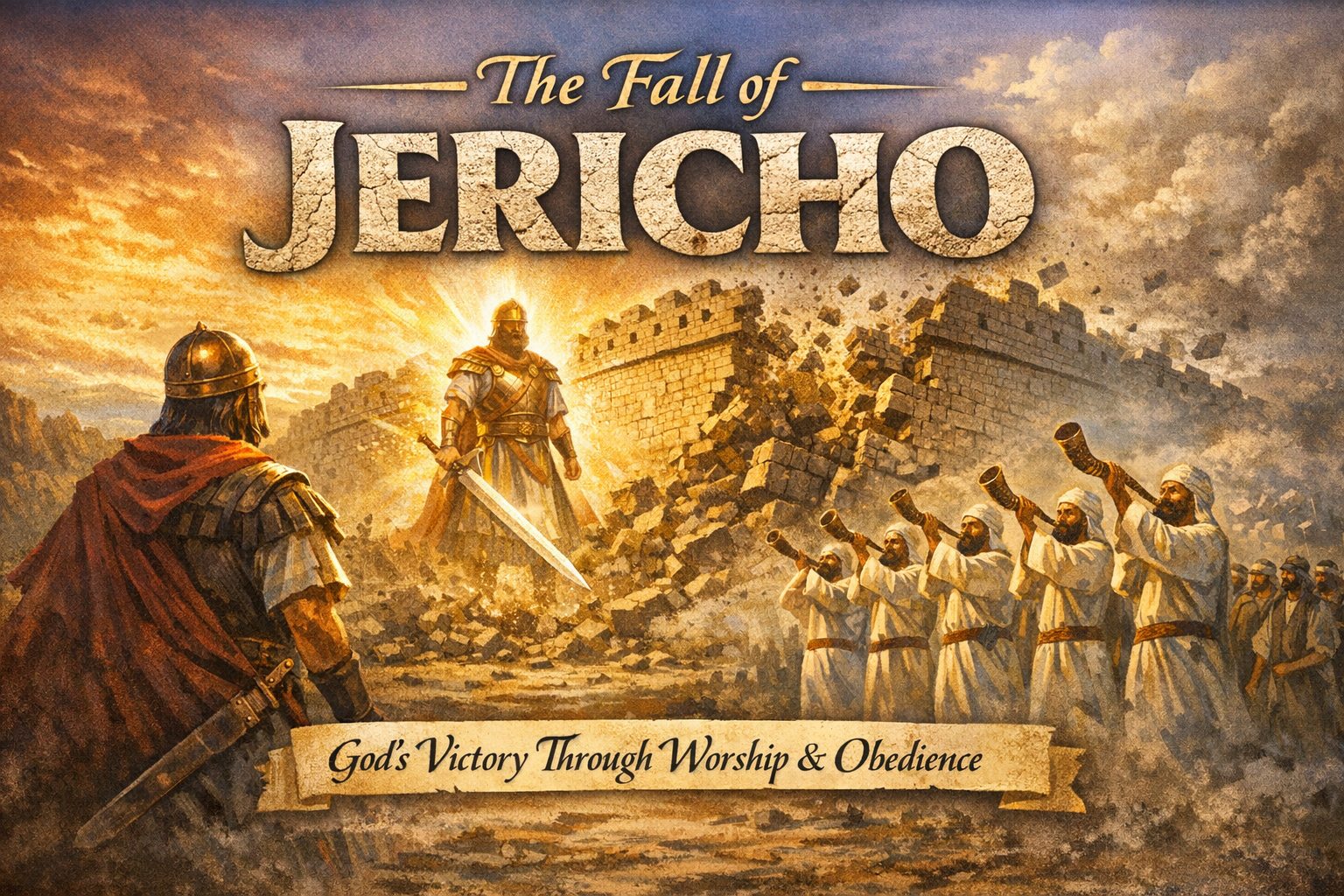
Teaching Outline: The Fall of Jericho — God’s Victory Through Worship, Obedience, and Holy Silence
I. The Setting: An Impossible Wall and an Inexperienced People
- Jericho’s walls were humanly unbeatable.
- Israel had no siege experience after 40 years in the wilderness.
- God intentionally chose a plan that required no military skill and total dependence.
- “See, I have given into thine hand Jericho…” (Joshua 6:2) — victory was already decided.
Teaching Point:
God sometimes leads us into battles where our strength is irrelevant so His glory becomes unmistakable.
II. The Captain of the Lord’s Host: Victory Begins with Worship
- Joshua encounters a mysterious warrior with a drawn sword (Joshua 5:13–15).
- Joshua falls in worship; the ground becomes holy.
- The figure identifies Himself as Captain of the Lord’s Host — a pre‑incarnate appearance of Christ.
- The figure accepts worship.
- This is widely understood as a Christophany — a pre‑incarnate appearance of Christ.
- Supporting Scriptures
- Similar to the “Angel of the Lord” who speaks as God (Exodus 3:2–6)
- Jesus as commander of heaven’s armies (Revelation 19:11–14)
- Before any marching, shouting, or strategy, Joshua must remove his sandals.
Teaching Point:
Israel does not fight for God — God fights for Israel. Victory begins with surrender and worship.
III. The Number Seven: God’s Pattern of Completion
Jericho is saturated with sevens:
- 7 priests
- 7 trumpets
- 7 days
- 7 circuits on the 7th day
Seven symbolizes:
- completion
- covenant
- God’s finished work
This mirrors:
- the 7 days of creation
- 7 feasts
- 7-fold sprinklings
- 7 trumpets in Revelation
Teaching Point:
Jericho is not just a battle — it is a covenant ceremony acted out in motion.
More information on the number 7: The Divine Significance of Seven in Scripture.
IV. The Sabbath Question: Was the March “Work”?
A. Holy war was God’s work, not Israel’s
In the Old Testament, holy war was considered God’s action, not human labor.
- “The battle is the Lord’s” (1 Samuel 17:47)
- “The Lord shall fight for you, and ye shall hold your peace” (Exodus 14:14)
Marching was obedience, not labor for personal gain.
B. Priestly Actions Were Permitted on the Sabbath
Jesus Himself explains this principle:
- “The priests in the temple profane the sabbath, and are blameless.” (Matthew 12:5)
Priestly service — including blowing trumpets, carrying the ark, and performing ritual acts — was not considered a violation.
C. Jericho’s march was a priestly procession
- The ark was present.
- Priests led the way.
- Trumpets were blown continually.
This was worship, not warfare.
D. God Himself commanded it
If God commands an action on the Sabbath, it is by definition lawful.
Teaching Point:
Jericho was not a military march — it was a liturgical procession, a moving act of worship under divine command.
V. Two Sounds in the March: Priestly Sound and People’s Silence
This is where the story becomes deeply symbolic.
A. The Priests: continual trumpet blowing
- “The priests blew with the trumpets continually.” (Joshua 6:13)
- This was not noise — it was holy proclamation.
- The trumpets represented God’s voice, God’s presence, and God’s leadership.
B. The People: total silence
- “Ye shall not shout… nor make any noise… neither shall any word proceed out of your mouth…” (Joshua 6:10)
- No whispering, no murmuring, no battle cry.
- Their silence symbolized dependence, surrender, and humility.
C. The meaning of the contrast
- God’s voice was heard continually.
- Human voices were withheld completely.
- The march preached a message:
God leads. We follow. God speaks. We obey. God fights. We trust.
Teaching Point:
The trumpets declared God’s presence; the silence declared Israel’s dependence.
VI. The Pattern: God’s Voice First, Our Voice Last
For six days:
- God’s voice (trumpets)
- No human voice
On the seventh day:
- God’s long blast
- THEN the people shout
This is the same pattern seen throughout Scripture:
- God initiates → the church follows
- God speaks → creation responds
- God commands → Israel obeys
- God calls → prophets answer
Teaching Point:
The final shout was not the cause of victory — it was the response to God’s timing.
VII. The Fall of the Walls: God’s Power, Not Human Effort
- The Hebrew phrase says the wall “fell beneath itself.”
- This was supernatural, not the result of vibration or erosion.
- “By faith the walls of Jericho fell down…” (Hebrews 11:30)
Teaching Point:
Faith is obedient action in response to God’s word, even when the command makes no earthly sense.
VIII. The Whole Story in One Sentence
Jericho teaches that God brings victory not through human strength, but through worship, obedience, and His own presence leading the way.
