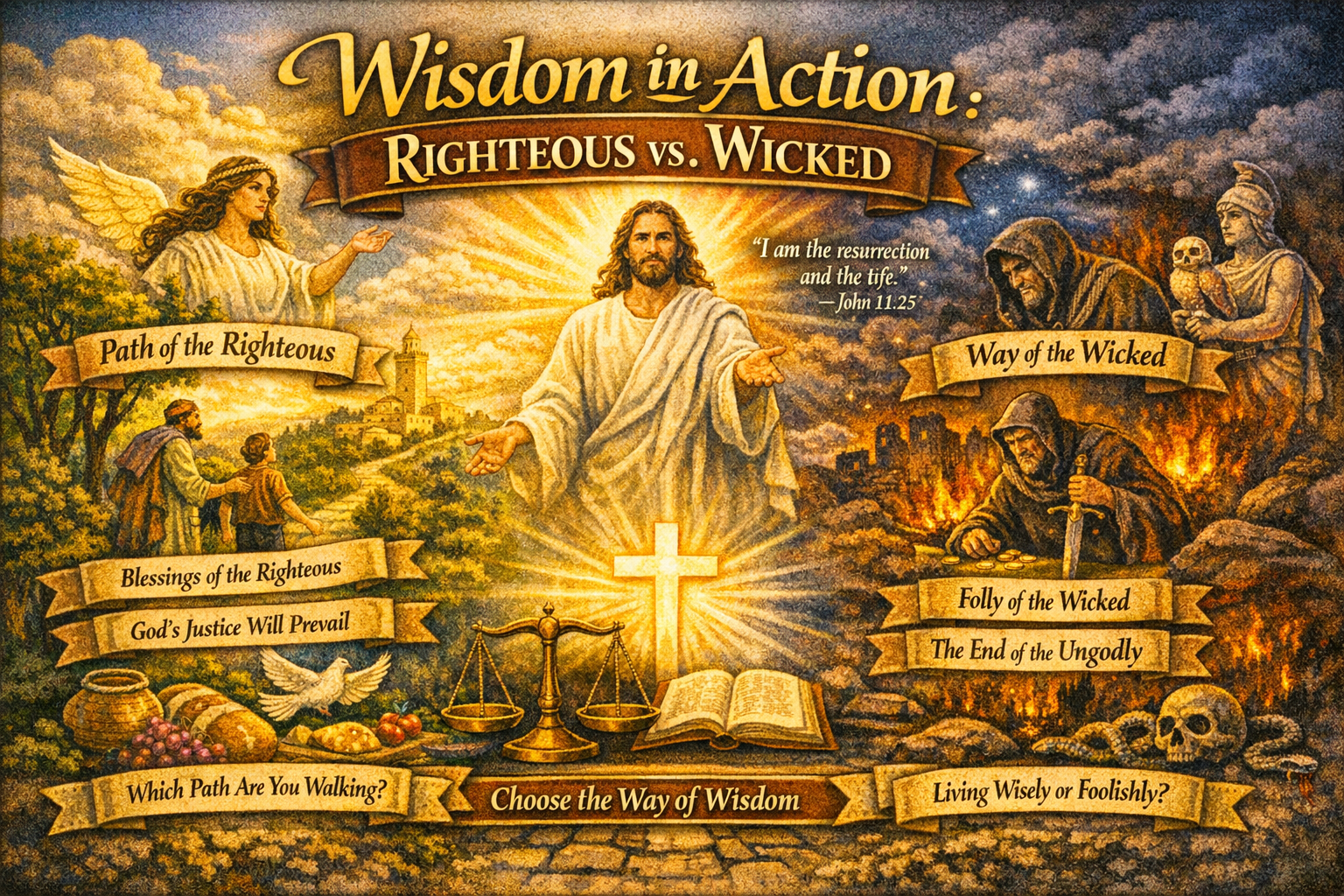
Core Scriptures
Proverbs 10:2–3 — “Treasures of wickedness profit nothing, but righteousness delivers from death. The Lord will not allow the righteous soul to famish, but He casts away the desire of the wicked.”
Wisdom 1:15–16 — “Righteousness is immortal, but ungodly men with their works and words called death to them.”
Psalm 1:1–6 — “The Lord knows the way of the righteous, but the way of the ungodly shall perish.”
Romans 2:6–8 — “God will render to each one according to his deeds: eternal life to those who by patient continuance in doing good seek glory, honor, and immortality.”
🌿 Goals
- Compare moral teaching across Proverbs, Wisdom of Solomon, and Scripture
- Show continuity in God’s call to righteousness
- Apply wisdom to real-life choices and relationships
📖 Teaching Commentary
1. The Two Paths
From Genesis onward, Scripture presents two ways: the way of life and the way of death.
Proverbs 10–15 paints this contrast vividly — the righteous walk in light; the wicked stumble in darkness.
Psalm 1 summarizes it: the righteous delight in God’s law; the wicked follow their own counsel.
The Wisdom of Solomon echoes this same truth: righteousness leads to immortality, wickedness to ruin.
Key insight: Wisdom is not neutral — every choice moves us toward life or away from it.
2. Righteousness as Relationship
In Hebrew thought, righteousness (ṣedeq) means right relationship — with God, others, and creation.
It’s not perfection but alignment with God’s covenant.
The righteous person seeks justice, mercy, and humility.
- He hath shewed thee, O man, what is good; and what doth the Lord require of thee, but to do justly, and to love mercy, and to walk humbly with thy God? (Micah 6:8).
The wicked reject God’s order and live for self.
Application: Wisdom in action means living relationally — honoring God and others in every decision.
3. The Fruit of Each Path
Proverbs 11:18 says, “The wicked man does deceptive work, but he who sows righteousness will have a sure reward.”
The Wisdom of Solomon expands this: righteousness is immortal because it participates in God’s life.
Wickedness, by contrast, is self-destructive — it invites death through pride and injustice.
Connection: The moral law is not arbitrary; it reflects the structure of creation.
Living wisely means cooperating with how God designed life to flourish.
4. God’s Justice in Time and Eternity
Romans 2:6–8 affirms that God’s justice is both present and future.
He rewards righteousness and judges wickedness — not out of vengeance, but out of truth.
The Wisdom of Solomon reminds us that even when the wicked seem to prosper, their end is emptiness. Wisdom 5:7–13 (KJV) “We wearied ourselves in the way of wickedness and destruction… what hath pride profited us? or what good hath riches with our vaunting brought us? All those things are passed away like a shadow… like a ship that passeth over the waves of the water… the remembrance of them is no more.”
This section portrays the emptiness of worldly prosperity without righteousness — the wicked confess that their pursuits were vain and left no lasting substance.
The righteous may suffer now, but their reward is eternal.
Encouragement: Wisdom teaches patience — trust God’s timing for justice.
5. Wisdom’s Practical Expression
Wisdom in action looks like:
- Integrity in speech and work (Prov 12:22)
- Compassion for the poor (Prov 14:31)
- Humility before God (Prov 15:33)
- Peace-making and forgiveness (James 3:17–18)
These are not abstract virtues; they are daily habits that reveal the heart of the righteous.
Key insight: Wisdom is visible — it shows in how we speak, serve, and respond to others.
6. Alignment and Divergence
| Aligned with Scripture | Divergent from Scripture |
|---|---|
| Moral contrast between righteous and wicked | Philosophical tone rather than covenantal |
| Emphasis on divine justice | Less focus on repentance and grace |
| Righteousness as life-giving | Overemphasis on moral perfection |
| Wickedness as self-destruction | Limited view of redemption through mercy |
Summary: The Wisdom of Solomon captures the moral truth of righteousness but lacks the full redemptive picture revealed in Christ.
7. Christ: The Living Example of Righteousness
Jesus embodies perfect wisdom in action.
He lived righteousness not as rule-keeping but as love fulfilled — truth, mercy, and justice united.
Through Him, the righteous path becomes not just possible but personal.
He is the Way, the Truth, and the Life (John 14:6).
Encouragement: Following Christ is walking the path of wisdom — righteousness lived out in grace.
💬 Discussion Prompts
- How do you see the “two paths” — righteous and wicked — in today’s world?
- What does righteousness look like in your daily relationships?
- How can wisdom guide your responses to injustice or temptation?
- Which Proverbs principle speaks most to your current season of life?
🌾 Key Takeaways
- Wisdom is active — it shapes choices and character.
- Righteousness is relational, not merely moral.
- God’s justice is sure, even when delayed.
- Christ fulfills the call to righteousness and empowers us to walk wisely.
- Every decision is a step toward life or away from it — choose the path of wisdom.
