1. What the “locust” symbolizes across Scripture
Across the Old Testament and New Testament, locusts consistently represent:
- Sudden, overwhelming judgment
- Invading forces that cannot be stopped
- Destruction that comes in waves
- A sign that God has removed His protective hedge
- A tool God uses to humble the proud and call for repentance
This pattern is already established long before Revelation 9.
2. Key Old Testament patterns that define the symbol
🜂 A. Locusts as God’s army of judgment (Joel 1–2)
Joel is the clearest parallel to Revelation 9.
Joel describes:
- Locusts with military language
“Like horses prepared for battle” (Joel 2:4) - A king-like leader (Joel 2:11)
- A supernatural army that leaps on mountains, runs on walls, and cannot be wounded
- A plague that darkens the sun (Joel 2:10)
Joel’s locusts are not normal insects.
They are a divine army, unleashed when God’s people refuse to repent.
This is the closest Old Testament mirror to Revelation 9.
🜂 B. Locusts as invading nations (Jeremiah, Nahum, Judges)
Several prophets use “locusts” as a metaphor for invading armies:
- Jeremiah 51:14 – Babylon’s enemies will come “like locusts”
- Nahum 3:15–17 – Assyria’s armies and merchants are compared to locusts
- Judges 6:5; 7:12 – Midianite armies “came as locusts for multitude”
In these passages, locusts = human armies empowered by God to judge nations.
🜂 C. Locusts as a sign of covenant curse (Deuteronomy 28)
In the covenant warnings:
- Locusts devour the land when Israel rebels (Deut. 28:38, 42)
This establishes the pattern:
Locusts appear when God removes His hedge of protection.
🜂 D. Locusts as supernatural agents (Exodus 10)
The plague of locusts in Egypt was:
- Sent directly by God
- Supernatural in scale
- A judgment on a proud, hardened ruler
This becomes a template for later prophetic imagery.
3. How Revelation 9 fits the biblical pattern
Revelation 9 takes all earlier patterns and intensifies them.
🔥 A. These locusts are not insects
John says they are:
- Like horses prepared for battle
- Wearing breastplates of iron
- Having faces like men
- Hair like women
- Teeth like lions
- Wings sounding like chariots
- Tails like scorpions
This is military, supernatural, and demonic imagery—not biological insects.
🔥 B. They come from the bottomless pit
This is the strongest clue.
In Scripture, the bottomless pit (abyss) is the prison of:
- Fallen angels (2 Peter 2:4; Jude 6)
- Demonic forces (Luke 8:31)
- The Beast (Revelation 11:7; 17:8)
So the locusts in Revelation 9 = demonic forces released under God’s permission.
🔥 C. They have a king
Proverbs 30:27 says:
“The locusts have no king.”
Natural locusts have no king.
These locusts do.
Their king is:
- Abaddon (Hebrew: destruction)
- Apollyon (Greek: destroyer)
This identifies them as destroying spirits, not insects.
🔥 D. They attack only the unsealed
This matches:
- Exodus (plagues that spared Israel)
- Ezekiel 9 (mark on the forehead)
- Revelation 7 (sealing of the 144,000)
This is a targeted spiritual judgment, not a natural disaster.
4. So what are the locusts according to Scripture’s patterns?
They are a demonic army released as judgment, described in military terms, following the prophetic pattern of Joel, Exodus, and the covenant curses.
More specifically:
They are fallen angels or demonic beings temporarily released from the abyss to torment the unrepentant.
They are:
- Supernatural (from the abyss)
- Organized (they have a king)
- Militaristic (horses, armor, battle language)
- Restrained by God (limited to five months)
- Agents of judgment (not allowed to kill, only torment)
This is the fifth trumpet, the first “woe.”
5. How this fits the larger biblical storyline
A. Satan falls (Isaiah 14; Ezekiel 28; Luke 10:18)
A fallen “star” is often symbolic of a fallen angel.
Revelation 9:1 says the star was given the key—meaning God still controls the timing.
B. God removes restraint (2 Thessalonians 2)
The abyss is opened only when God allows it.
C. Demonic torment as judgment (Revelation 9; Luke 8:31)
Demons fear the abyss.
Here, they are released from it.
D. Humanity refuses to repent (Revelation 9:20–21)
This matches the pattern of Pharaoh, Israel in the wilderness, and the nations in the prophets.
6. Final synthesis
According to the patterns of Scripture, the locusts of Revelation 9 are not insects, nations, or symbols of human armies alone. They are a demonic invasion permitted by God as judgment on a world that refuses to repent.
They follow the prophetic pattern:
- Exodus – supernatural plague
- Joel – God’s army of judgment
- Prophets – invading forces described as locusts
- Revelation – demonic army released from the abyss
They are the spiritual counterpart to the human armies released in the sixth trumpet.
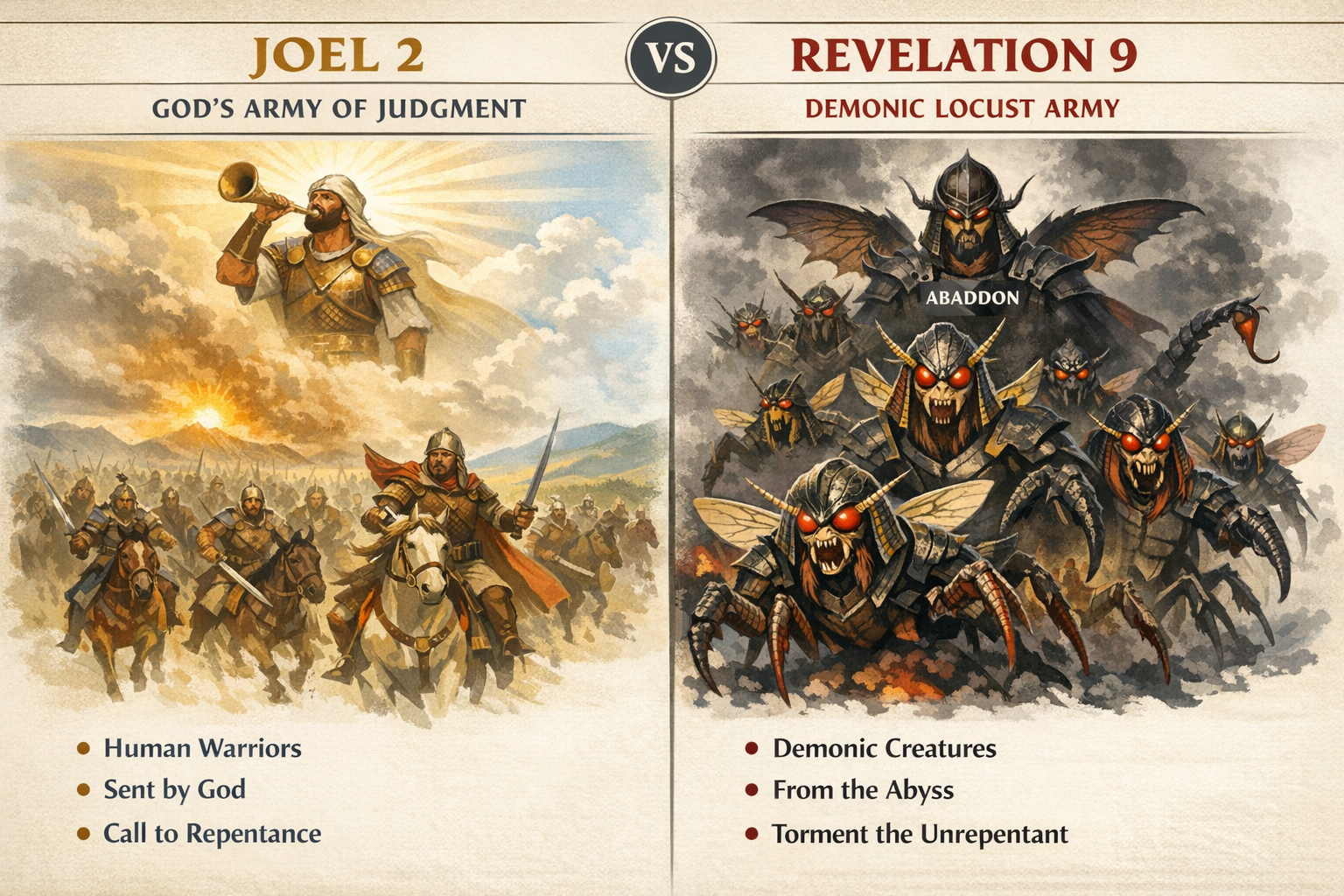
Visual Comparison Chart: Joel 2 vs. Revelation 9
1. ORIGIN OF THE ARMY
| Theme | Joel 2 | Revelation 9 |
|---|---|---|
| Source | Comes at God’s command as part of covenant judgment | Released from the bottomless pit when the abyss is opened |
| Cause | Israel’s sin and refusal to repent | Humanity’s refusal to repent (Rev. 9:20–21) |
| Nature | A devastating army described with locust imagery | A demonic army literally emerging from the abyss |
2. APPEARANCE & FORM
| Theme | Joel 2 | Revelation 9 |
|---|---|---|
| Locust imagery | “A great people and a strong… like the appearance of horses” | “Locusts… like horses prepared for battle” |
| Faces | Human-like discipline and formation | “Faces like the faces of men” |
| Hair | Not specified | “Hair like women’s hair” |
| Teeth | “A nation… whose teeth are the teeth of a lion” (Joel 1:6) | “Teeth like lions” |
| Armor | Implied military strength | “Breastplates of iron” |
| Wings / Sound | “Like the noise of chariots on the tops of mountains” | “Sound of wings like chariots of many horses running to battle” |
3. MOVEMENT & BEHAVIOR
| Theme | Joel 2 | Revelation 9 |
|---|---|---|
| Military precision | “They run like mighty men… they do not break ranks” | Move with coordinated, purposeful torment |
| Invincibility | “They shall not be wounded” | Cannot be resisted; torment is unavoidable |
| Overwhelming force | “A great people… there hath not been ever the like” | A vast demonic swarm with supernatural power |
4. EFFECT ON THE EARTH
| Theme | Joel 2 | Revelation 9 |
|---|---|---|
| Darkness | “The earth shall quake… the sun and moon shall be darkened” | Smoke from the pit darkens the sun and air |
| Destruction | Land becomes “as the garden of Eden before them, and behind them a desolate wilderness” | They do not destroy vegetation—only torment people |
| Scope | National (Israel) | Global (all unsealed humanity) |
5. TARGET OF THE JUDGMENT
| Theme | Joel 2 | Revelation 9 |
|---|---|---|
| Who is affected | Israel, calling them to repentance | “Only those who do not have the seal of God” |
| Purpose | To bring God’s people to repentance | To torment the unrepentant and expose hardened hearts |
| Protection of the faithful | God promises deliverance if they return to Him | The sealed (Rev. 7) are untouched |
6. LEADERSHIP
| Theme | Joel 2 | Revelation 9 |
|---|---|---|
| Commander | “The Lord shall utter His voice before His army” | A king: Abaddon/Apollyon, the angel of the abyss |
| Nature of leadership | Divine | Demonic |
| Authority | God directs the army | God permits the army, but the king is a destroyer |
7. PURPOSE OF THE ARMY
| Theme | Joel 2 | Revelation 9 |
|---|---|---|
| Primary purpose | Call Israel to repentance | Torment the unrepentant for five months |
| Outcome | A remnant returns to God | “They repented not” (Rev. 9:20–21) |
| Judgment type | Covenant discipline | Eschatological woe judgment |
Summary Insight
**Joel 2 and Revelation 9 share the same prophetic pattern:
a terrifying, unstoppable army used by God to expose hearts and call for repentance.**
But Revelation intensifies the pattern:
- Joel’s army = earthly + symbolic + divinely commanded
- Revelation’s army = demonic + supernatural + released from the abyss
Joel is the shadow.
Revelation is the full unveiling.
More Information
Manticore and Revelation: A Symbolic Connection

Leave a Reply