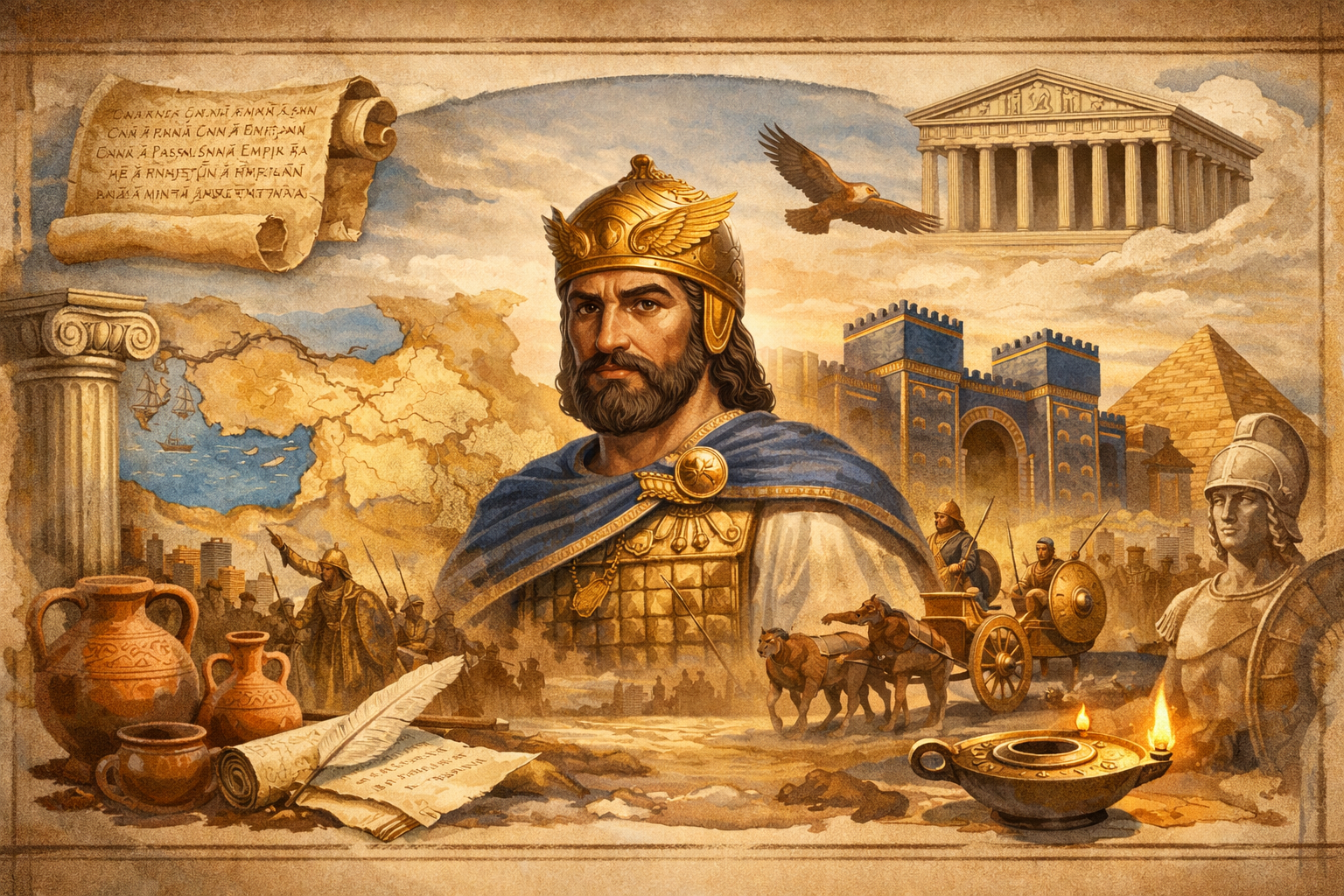
Cyrus the Great, founder of the Persian Empire, established his rule around 550 B.C. and expanded his kingdom to include most of Southwestern Asia.
Early Life and Rise to Power
Cyrus was born into a noble Persian family, the Achaemenids. In 559 B.C., he became ruler of Anshan, a region within the Median Empire.
Around 550 B.C., he overthrew King Astyages of Media, uniting the Medes and Persians. This victory made the former Median Empire the core of what would become the Persian Empire.
Expansion of the Empire
- Around 545 B.C., Cyrus defeated King Croesus of Lydia and gained control of western Asia Minor (modern western Turkey).
- He then subdued the Greek cities along the coast of Asia Minor.
- In 539 B.C., he conquered Babylonia, extending his rule across much of the Middle East, including Palestine.
Leadership and Policies
Cyrus was known for respecting local customs, religions, and traditions throughout his empire.
He famously freed the Jews from captivity in Babylon and allowed them to return to Jerusalem to rebuild the Temple.
Death
Cyrus died in battle in Central Asia around 530 B.C., leaving behind one of the largest and most influential empires of the ancient world.

Leave a Reply