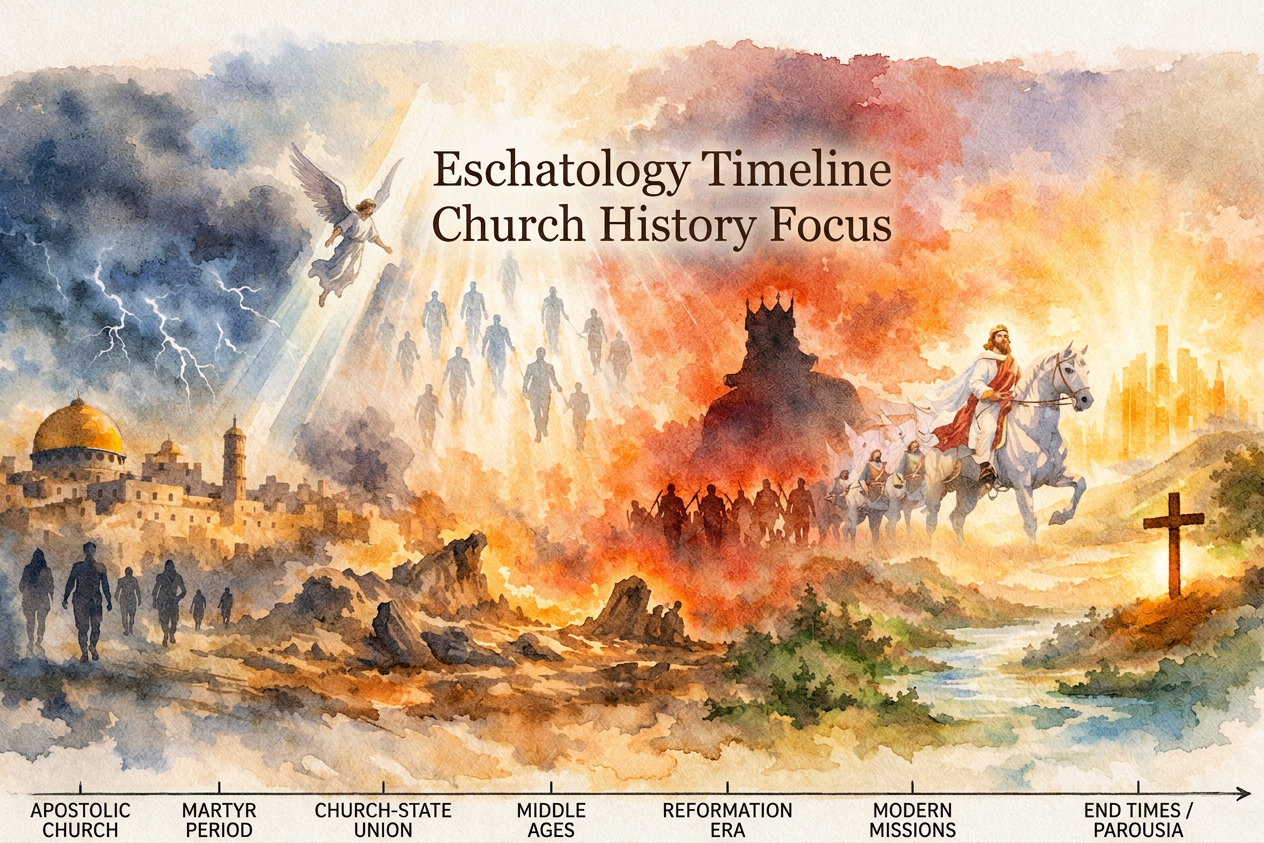
1. Apostolic Era (AD 30–100)
- Jesus’ teachings emphasized watchfulness, endurance, and readiness for persecution.
- Paul taught resurrection and gathering at Christ’s visible coming.
- John’s Revelation described believers coming out of great tribulation.
- No separation between “rapture” and “Second Coming.”
2. Early Church Fathers (AD 100–300)
Irenaeus (c. 130–200)
- Expected the church to face the Antichrist.
- Resurrection and gathering occur after tribulation.
- Strongly premillennial.
Hippolytus (c. 170–235)
- Detailed timeline of Antichrist’s 3½‑year persecution.
- Christ returns after tribulation to destroy the Antichrist.
- No pre‑tribulation escape.
Tertullian (c. 160–225)
- Believers endure trials before deliverance.
- Emphasized perseverance and holiness.
Consensus: The early church was post‑tribulational and premillennial.
3. Post‑Nicene Era (AD 300–430)
Shift Begins
- Persecution decreases after Constantine.
- Church becomes state‑supported.
- Eschatology becomes less focused on suffering.
Augustine (354–430)
- Introduces amillennialism (millennium symbolic, not literal).
- Moves away from early premillennial views.
- Tribulation becomes spiritualized rather than future persecution.
This marks a major turning point.
4. Medieval Period (AD 500–1500)
- Amillennialism dominates.
- End‑times teaching becomes allegorical.
- Little emphasis on Antichrist persecution of the church.
- Rapture doctrine does not exist yet.
5. Reformation Era (AD 1500–1700)
- Reformers (Luther, Calvin) remain amillennial.
- Some groups revive premillennialism.
- Still no pre‑tribulation rapture teaching.
6. Modern Era (1800s–Present)
John Nelson Darby (1830s)
- Introduces pre‑tribulation rapture doctrine.
- Separates “rapture” from “Second Coming.”
- Popularized through the Scofield Bible (1909).
20th Century Evangelicalism
- Pre‑tribulation rapture becomes widespread in America.
- Books like Left Behind reinforce the idea.
Today
- Multiple views exist:
- Pre‑tribulation
- Mid‑tribulation
- Post‑tribulation
- Amillennial
- Historic premillennial
But historically, the earliest Christians overwhelmingly expected endurance before deliverance.
🌿 Teaching Takeaway
The early church’s eschatology was:
- Simple
- Unified
- Focused on endurance
- Rooted in Scripture
- Prepared for suffering, not escape
This is why teaching church history helps believers avoid disillusionment and remain grounded.
