Noah — “Rest” (נֹחַ)
Patriarch, builder of the ark, son of Lamech
Noah, whose name means rest or comfort, was chosen by God to build the ark and preserve humanity during the Flood. His story appears in Genesis 5–9, and he is listed in the genealogy of Jesus Christ in Luke 3:36.
- Noah was born 1,056 years after Adam, according to Genesis timelines.
- He lived 950 years (Gen. 9:29).
- Noah was the 10th generation from Adam through Seth.
- He found grace in the eyes of the Lord — the first time the word grace appears in Scripture.
- Noah was a preacher of righteousness (2 Peter 2:5), meaning he warned people for decades before the Flood.
- Jewish tradition says Noah took 120 years to build the ark (based on Gen. 6:3).
- Noah planted a vineyard after the Flood — showing agriculture restarted quickly (Gen. 9:20).
🌿 Sons of Noah
🌱 Shem — Father of the Israelites
- Shem lived 600 years (Gen. 11:10–11).
- His line includes Eber, from whom the word Hebrew comes.
- Shem’s descendants wrote much of the Old Testament.
- Ancestor of Abraham, Isaac, Jacob, and the nation of Israel.
- Also ancestor of Jesus Christ (Luke 3:36).
His descendants lived mainly in the Middle East:
- Israel
- Syria
- Assyria
- Elam
- Arabia
Shem’s line is the “covenant line” through which God brought the Messiah.
🌍 Ham — Father of many ancient nations
- Ham’s son Canaan became the father of the Canaanite tribes Israel later encountered.
- Ham’s son Cush fathered Nimrod, a mighty hunter and builder of early cities like Babel, Nineveh, and Calah.
- Ham’s son Mizraim is the Hebrew name for Egypt.
- — Father of many ancient nations
Ham’s descendants settled in Africa, Canaan, and parts of the Middle East.
Major groups from Ham include:
- Philistines
- Canaanites
- Jebusites
- Babylon (through Cush and Nimrod)
- Assyria (Nimrod founded cities there)
- Egypt (Mizraim)
- Libya (Put)
Ham’s children became builders of powerful early civilizations.
🌏 Japheth-Father of the Gentiles
- Japheth’s name means “may God enlarge.”
- His descendants include the Greeks, Romans, Persians, Scythians, and many European tribes.
- Japheth’s line is associated with exploration and spreading across wide territories.
- Japheth’s descendants spread north and west into:
- Europe
- Asia Minor
- The coastlands
- The Greek and Roman world
- The Bible calls them “the isles of the Gentiles” (Gen. 10:5).
Japheth’s line became the ancestors of many European and Mediterranean peoples.
🌿 Identity & Background
- Noah — Son of Lamech, descendant of Adam through Seth.
- Lived in the region between the Euphrates and Tigris rivers — the cradle of early civilization.
- Described as a just man and perfect in his generations (Gen. 6:9).
🛠️ Construction of the Ark
- Built from gopher wood (a durable hardwood).
- Sealed inside and outside with pitch (tar).
- God gave exact measurements — showing divine engineering rather than human shipbuilding tradition.
Dimensions
- Length: 450 ft (300 cubits)
- Width: 75 ft (50 cubits)
- Height: 45 ft (30 cubits)
Design Notes
- The ark’s proportions created stability, preventing capsizing in violent waters.
- The Hebrew word for ark, תֵּבָה (tebah), means box, container, or place of protection — not “ship.”
- The only other time tebah is used is for Moses’ basket (Exodus 2:1–10).
- God kept both Noah and Moses safe in an ark.
🌊 Purpose of the Ark
- To preserve Noah, his family, and the animals God brought to him.
- To demonstrate God’s judgment and mercy.
- To begin humanity anew after widespread corruption.
🚢Facts about Ark
- The ark had three floors (Gen. 6:16).
- It had one door and one window, placed high for ventilation and safety.
- The ark’s volume was about 1.5 million cubic feet — similar to a modern cargo ship.
- It could hold the equivalent of 450 semi‑truck trailers worth of space.
- The ark didn’t need sails or a rudder — God guided it.
- The ark floated for 150 days before beginning to rest (Gen. 7:24).
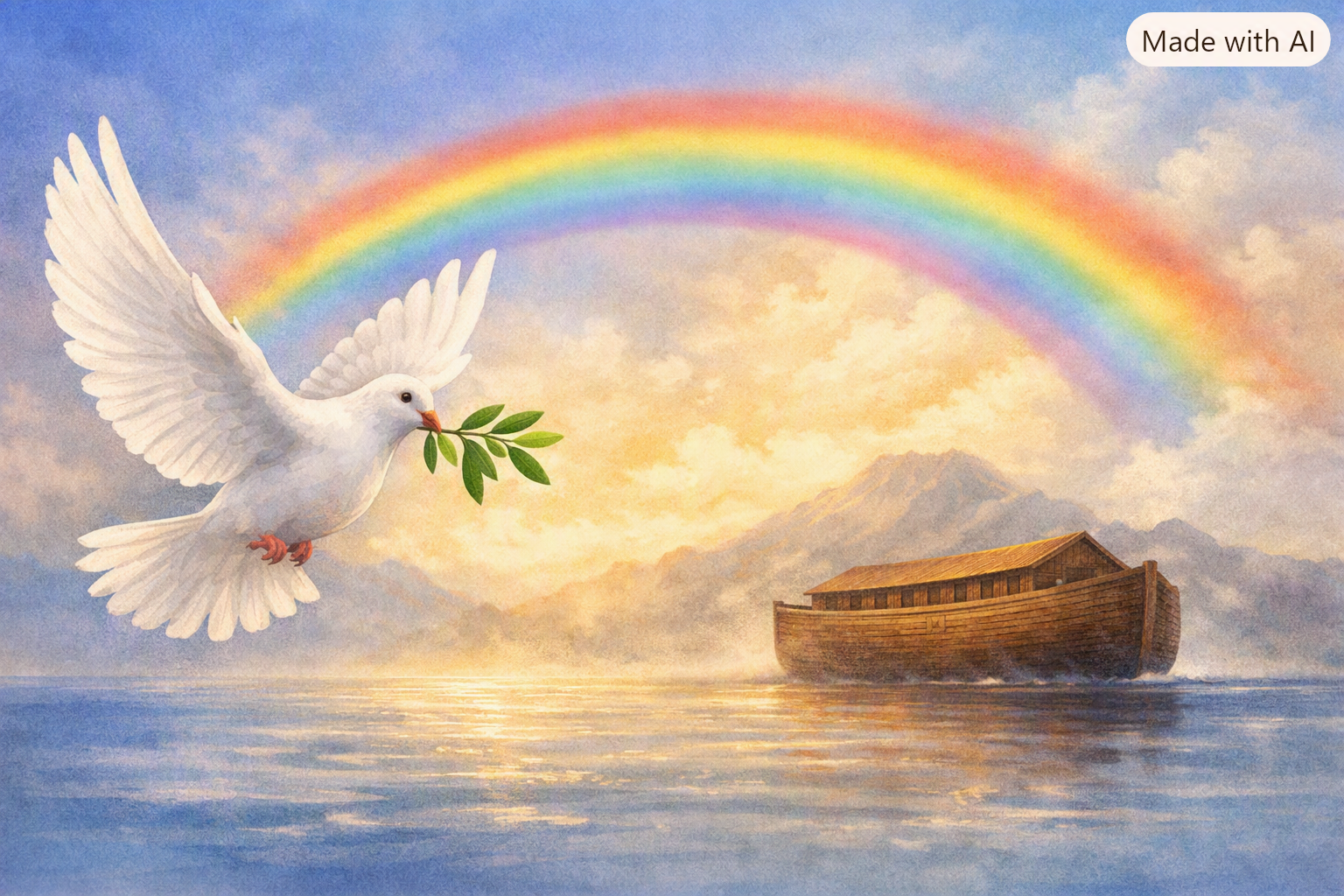
- Noah sent out a raven first, then three doves (Gen. 8:6–12).
- The dove returning with an olive leaf showed new life had begun.
🌧️ The Flood Timeline
- 40 days and 40 nights of rain (Gen. 7:12).
- Waters continued rising long after the rain stopped.
- Total time inside the ark: about one year (Gen. 7:11; 8:14).
The “fountains of the deep” broke open — meaning water came from below as well as above (Gen. 7:11).
- Many ancient cultures (over 200 worldwide) have Flood stories similar to Noah’s, showing a shared memory.
- The Flood began when Noah was 600 years old (Gen. 7:6).
- The earth was changed after the Flood — seasons, climate, and geography shifted (Gen. 8:22).
- After the Flood, God gave permission to eat meat for the first time (Gen. 9:3).
🏔️ How high is the highest mountain?
The Flood waters rose 22 feet above the highest mountains (Gen. 7:20).
The highest mountain in the world is Mount Everest.
Height
29,032 feet tall (about 5.5 miles straight up)
Location
- In the Himalayas
- On the border of Nepal and China (Tibet)
Fun Facts
- The top of Everest is so high that the air is too thin to breathe normally.
- Temperatures can drop to –60°F.
- The mountain grows a tiny bit each year because the tectonic plates beneath it are still moving.
📜 Key Scriptures
- Genesis 5:30–32 — Noah’s genealogy
- Genesis 6:8–22 — God’s instructions for the ark
- Genesis 7–10 — The Flood and aftermath
- Exodus 1:22; 2:1–10 — Moses’ ark
- Luke 3:36 — Noah in the lineage of Christ
🌟 Cool Facts
- Pitch (tar) is still used today to waterproof wooden boats.
- The ark was roughly the size of a modern cargo ship.
- Its stability ratio is recognized by shipbuilders as ideal for rough seas.
🧭 Where the Ark Rested
- The ark rested on the Mountains of Ararat in modern‑day Turkey (Gen. 8:4)
- Mount Ararat, in present‑day Turkey, about 5 months after the waters began to recede (Gen. 8:4)
- Mount Ararat is 16,854 feet tall.
- It sits near the borders of Turkey, Armenia, and Iran.
- The region is volcanic, which helps explain the rugged terrain where the ark rested.
When the Bible says
“The ark rested in the seventh month, on the seventeenth day of the month” (Gen. 8:4)
Here’s what that means in plain language:
- Before Moses, people used a different Hebrew calendar.
- In that older calendar, the seventh month was Nisan.
- Nisan comes right after Adar.
- So the ark rested on the 17th day of Nisan.
🌈 Covenant Facts
- God set the rainbow as the sign of His covenant never to flood the whole earth again (Gen. 9:13).
- God made seven promises in His covenant with Noah (Gen. 9:8–17).
- The rainbow is called “My bow” — God’s personal sign.
- The covenant is everlasting and applies to all living creatures, not just humans
🔍 Language Facts
- “Ark” (תֵּבָה tebah) means box, container, or chest — not “boat.”
- “Pitch” (כֹּפֶר kofer) is related to the word for atonement, symbolizing covering and protection.
- “Gopher wood” is likely a type of cedar or cypress, both naturally rot‑resistant.
