Overview
Isaiah was an 8th-century BC prophet whose ministry shaped the spiritual direction of Judah during a time of political upheaval, moral decline, and looming foreign invasion. His writings combine powerful warnings with some of Scripture’s most beautiful promises of redemption. The Book of Isaiah is central to both Jewish and Christian theology.
Historical Setting
Isaiah lived in Jerusalem and ministered during the reigns of four kings of Judah:
- Uzziah – Prosperity and strength
- Jotham – Stability and continued growth
- Ahaz – Crisis, fear, and idolatry
- Hezekiah – Revival and Assyrian threat
His ministry spanned approximately 740-680 BC, a period marked by:
- The rise of the Assyrian Empire
- The fall of the Northern Kingdom of Israel (722 BC)
- The siege of Jerusalem under Sennacherib (701 BC)
Isaiah’s messages addressed both immediate political dangers and long-term spiritual truths.
Isaiah’s Background
- Hebrew name: Yeshayahu (“Yahweh is salvation”)
- Likely from the tribe of Judah, based on his lifelong ministry in Jerusalem
- Son of Amoz
- Married to a woman called “the prophetess”
- Father of two sons with symbolic prophetic names:
- Shear-Jashub – “A remnant shall return”
- Maher-Shalal-Hash-Baz – “Swift is the spoil, speedy is the prey”
These names served as living signs to Judah about judgment and hope.
Verses for reference:
- Isaiah 7:3 — “Then said the Lord to Isaiah, Go forth now to meet Ahaz, thou, and Shear‑Jashub thy son…”
- This introduces Shear‑Jashub, whose name means “A remnant shall return.”
- Isaiah 8:3–4 — “And I went unto the prophetess; and she conceived, and bare a son. Then said the Lord to me, Call his name Maher‑Shalal‑Hash‑Baz. For before the child shall have knowledge to cry, My father, and my mother, the riches of Damascus and the spoil of Samaria shall be taken away before the king of Assyria.”
- This describes Isaiah’s wife as “the prophetess” and names their second son Maher‑Shalal‑Hash‑Baz, meaning “Swift is the spoil, speedy is the prey.”
The Call of Isaiah (Isaiah 6)
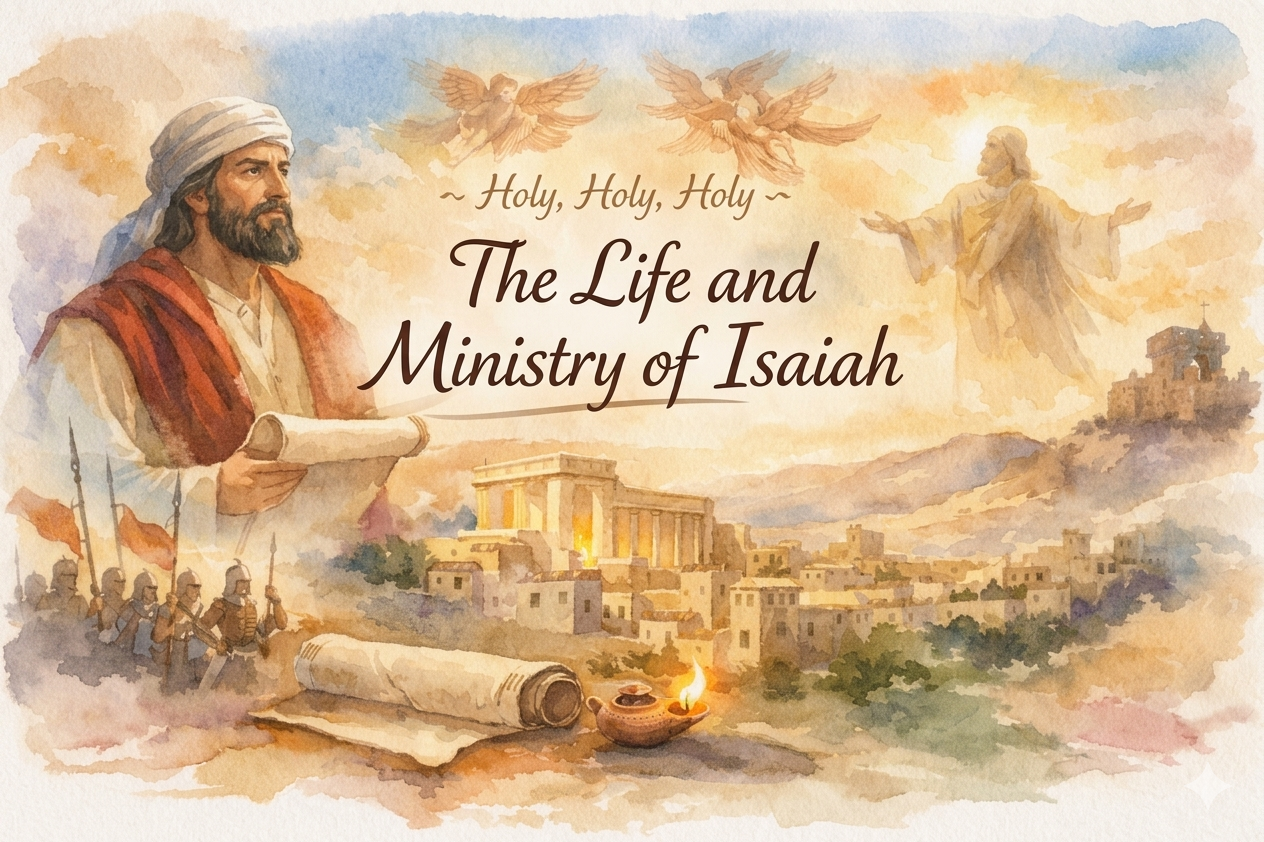
Isaiah’s prophetic ministry began with a dramatic vision in the Temple:
- He saw the Lord on His throne, exalted and holy.
- Seraphim proclaimed, “Holy, holy, holy is the Lord of hosts.”
- Isaiah confessed his sinfulness and was cleansed by a burning coal.
- God asked, “Whom shall I send?”
- Isaiah responded, “Here am I; send me.”
This moment shaped Isaiah’s lifelong mission: proclaiming God’s holiness, justice, and mercy.
Major Themes in Isaiah’s Message
1. God’s Holiness
Isaiah emphasizes God’s absolute purity and moral perfection. His vision in chapter 6 sets the tone for the entire book.
2. Judgment for Sin
Isaiah warned Judah about:
- Idolatry
- Social injustice
- Empty religious rituals
- Trusting political alliances instead of God
3. The Remnant
A recurring theme is that God preserves a faithful remnant even in times of national judgment.
4. The Messiah
Isaiah contains some of the clearest Old Testament prophecies about the coming Messiah:
- Isaiah 7:14 – A virgin shall conceive
- Isaiah 9:6-7 – A child called Wonderful Counselor, Mighty God
- Isaiah 11 – The righteous Branch from Jesse
- Isaiah 53 – The Suffering Servant
5. Future Restoration and Hope
Chapters 40-66 shift to comfort and redemption:
- God’s forgiveness
- The return from exile
- The new heavens and new earth
Structure of the Book of Isaiah
Chapters 1-39: Judgment and Warning
- Oracles against Judah and surrounding nations
- Assyrian threat
- Historical accounts of Hezekiah
Chapters 40-66: Comfort and Redemption
- God’s compassion toward His people
- The Servant Songs
- Promises of restoration
- Visions of future glory
Isaiah’s Influence in Scripture
Isaiah is one of the most quoted prophets in the New Testament. His writings shape:
- Messianic expectations
- Christian theology of salvation
- The understanding of God’s holiness and justice
Jesus read from Isaiah 61 in the synagogue (Luke 4), identifying Himself with the promised Servant.
Tradition About Isaiah’s Death
Jewish tradition suggests Isaiah was martyred under King Manasseh, possibly “sawn in two,” a story echoed in Hebrews 11:37. While not recorded directly in the Old Testament, it is part of longstanding historical commentary.
Teaching Applications
- Isaiah’s life encourages faithfulness in difficult times.
- His message highlights the importance of trusting God over political solutions.
- His prophecies deepen understanding of God’s plan of redemption.
- His writings provide rich material for devotional study, sermons, and homeschool lessons.
Key Memory Verses
- Isaiah 6:8 – “Here am I; send me.”
- Isaiah 9:6 – “For unto us a child is born…”
- Isaiah 40:31 – “They that wait upon the Lord shall renew their strength…”
- Isaiah 53:5 – “He was wounded for our transgressions…”
Discussion Questions
- What does Isaiah’s vision teach us about God’s holiness?
- How did Isaiah’s warnings relate to Judah’s political situation?
- Why are Isaiah’s Messianic prophecies important for understanding Jesus?
- What does the theme of the remnant reveal about God’s character?
- How can Isaiah’s message encourage believers today?
Summary
Isaiah’s life and ministry reveal a prophet who stood firmly for God’s truth in a time of national crisis. His writings continue to inspire, challenge, and comfort believers, pointing them to the holiness of God and the hope found in the promised Messiah.
Guided Links
isaiah.articlesforchristians.blog

Leave a Reply