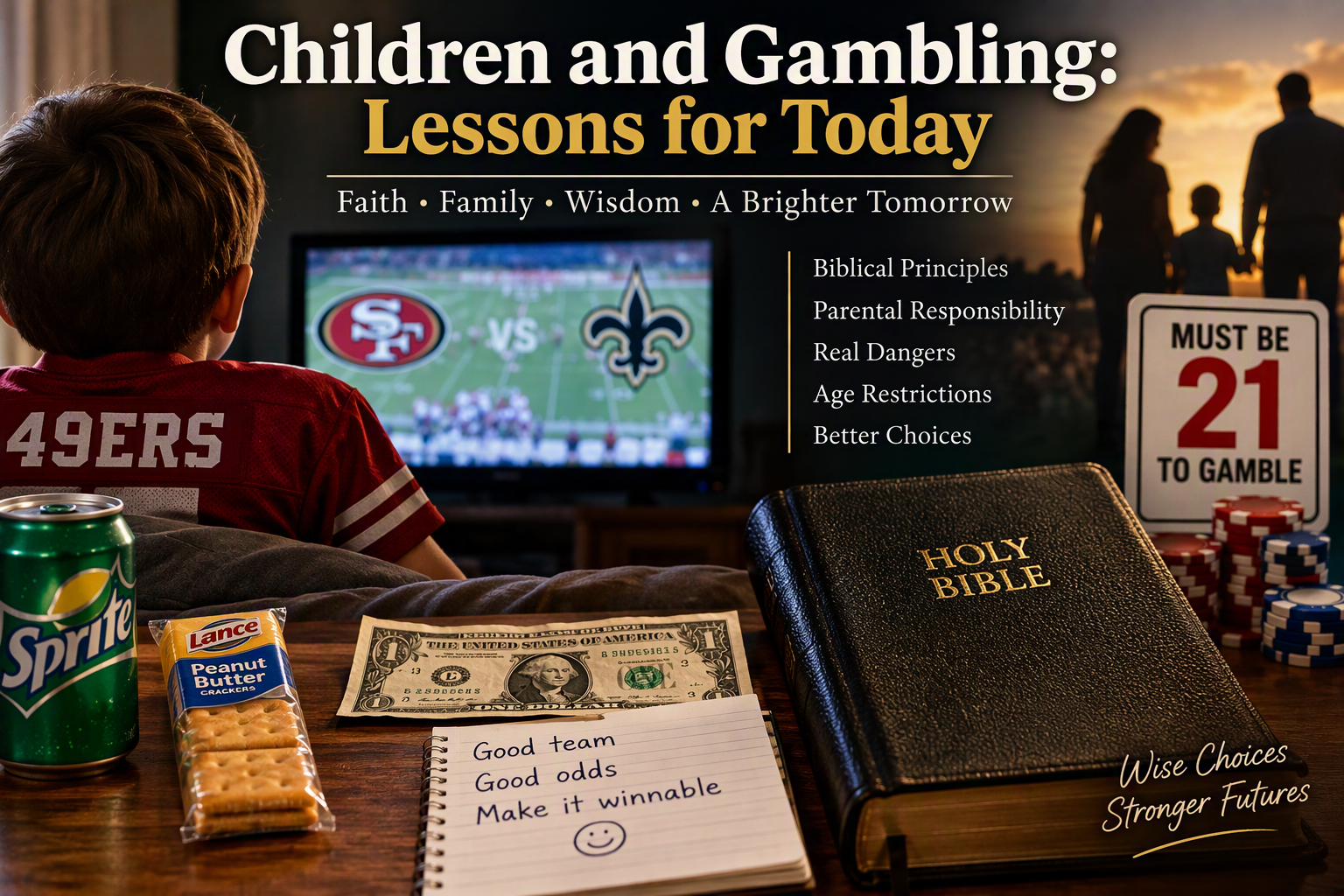
Recently I saw a news article discussing children and gambling. One thing mentioned was that some children are first introduced to gambling by members of their own families.
That immediately brought back a childhood memory.
I was about seven years old when I made my first bet. It was also my last.
My mother’s boyfriend, Jerry, was a die-hard New Orleans Saints fan. I bet him one dollar that the San Francisco 49ers would beat the Saints.
I wasn’t simply picking a team at random. Even at that age, I had watched enough football to recognize patterns. The Saints could start a game looking good, but what mattered was how they finished against strong teams. I was confident enough in what I had seen to think the 49ers were the better choice.
My bedtime came before the game ended, so I didn’t know the outcome until the next morning.
I asked who won. When I found out the 49ers had won, I said something along the lines of, “Good. I can get my dollar from Jerry.”
That was how my mother discovered the bet.
Jerry got chewed out.
My mother explained to me why gambling could be dangerous. She also gave Jerry a lecture, both because he was a grown man betting with a seven-year-old child and because his own decision hadn’t been particularly sensible. He wasn’t considering probabilities or statistics. He wanted the Saints to win because he loved the Saints.
When my dad came home from the road, my mother told him what had happened. Dad also talked to me about the dangers of gambling, although he had a hard time doing it without laughing about the whole situation. He didn’t follow football, but he didn’t live under a rock either. He knew the Saints’ reputation well enough to find it particularly funny that Jerry, a grown man, had made that bet with a seven-year-old. Then he ragged Jerry about making such a foolish bet. They were friends at that time and for many years after.
Looking back, something important stands out to me. Both of my parents used that little one-dollar bet as an opportunity to teach me. Neither one encouraged me to make another bet just because I had won the first one. They taught me about the dangers instead.
I still collected my dollar. I had normally been given five dollars a week for snacks at school, and I tended to save that money. That week I had an extra dollar, so I spent my winnings on a Sprite and peanut butter crackers.
I came out ahead financially.
More importantly, I came away understanding something about gambling.
I can laugh about my childhood experience. What is happening with children and gambling today isn’t funny.
The Bible Does Not Need to Say “Thou Shalt Not Gamble”
You will not find a verse in the Bible that simply says, “Thou shalt not gamble.” That doesn’t mean Scripture has nothing to say about it. Gambling intersects with numerous subjects that Scripture addresses plainly: the love of money, covetousness, contentment, stewardship, work, wisdom, and the temptation to become rich quickly. Christian discussions of gambling commonly draw on precisely these broader biblical principles.
Paul wrote:
“For the love of money is the root of all evil…”
1 Timothy 6:10 (KJV)
Notice that Scripture doesn’t say that money is the root of all evil. It speaks about the love of money.
Hebrews gives the opposite attitude:
“Let your conversation be without covetousness; and be content with such things as ye have…”
Hebrews 13:5 (KJV)
Gambling can appeal directly to the desire to obtain more money quickly.
That makes Proverbs 13:11 especially worth considering:
“Wealth gotten by vanity shall be diminished: but he that gathereth by labour shall increase.”
Proverbs 13:11 (KJV)
The biblical pattern is not one of pursuing sudden riches. It emphasizes labor, stewardship, contentment and wise management of what God has already provided.
That’s an important distinction.
Gambling Isn’t the Same Thing as Taking Every Kind of Risk
We should also be careful not to define every uncertain financial decision as gambling.
Life contains risk. Starting a business involves risk. Planting crops involves risk. Buying a house involves risk. Investing can involve risk.
The presence of uncertainty by itself doesn’t make something gambling.
With gambling, money or something else of value is deliberately placed at risk on an uncertain outcome in hopes of obtaining a greater return.
And Scripture repeatedly warns against the underlying desire to become rich quickly.
“He that hasteth to be rich hath an evil eye, and considereth not that poverty shall come upon him.”
Proverbs 28:22 (KJV)
That does not mean everyone who has ever made a friendly wager is secretly consumed with greed. But it does mean Christians shouldn’t ignore the principles simply because the Bible doesn’t contain the modern word gambling.
Children Should Not Be Introduced to Gambling by Adults
This is where that news article particularly bothered me.
When adults introduce children to gambling, we can present something potentially harmful as normal entertainment before children are mature enough to understand all of its consequences.
My mother understood that more than thirty years ago.
She did not blame seven-year-old me as though I had the judgment of an adult. She taught me.
Jerry was another matter.
He was an adult, and in my mother’s opinion he should have known better.
That distinction matters.
Scripture repeatedly assigns adults responsibility for what they teach children.
“Train up a child in the way he should go: and when he is old, he will not depart from it.”
Proverbs 22:6 (KJV)
Deuteronomy 6:6–7 describes parents diligently teaching God’s commands to their children throughout ordinary life.
Jesus gave an especially sobering warning about causing “little ones” to stumble in Matthew 18:6.
If we recognize something can become spiritually, financially, or behaviorally destructive, why would we deliberately introduce our children to it as entertainment?
Children learn what is normal largely by watching adults.
If gambling is a regular family activity, gambling can become part of what a child understands as ordinary adult behavior.
That deserves serious thought.
There Is a Reason Legal Gambling Has Age Restrictions
There is another point that should not be dismissed.
The law itself recognizes a distinction between children and adults when it comes to gambling.
Here in Louisiana, for example, state law prohibits persons under 21 from playing licensed casino games or slot machines. Louisiana law also specifically makes it unlawful for someone under 21 to place a wager on a sports event, including regulated sports wagering through websites and mobile applications. [legis.la.gov] [legis.la.gov]
Louisiana law goes even further in discussing internet gambling. The Legislature explicitly describes protecting children from harmful influences and specifically refers to protecting its “youngest citizens” from the pervasive nature of gambling through computers and the Internet. [legis.la.gov]
The law isn’t Scripture, and Christians don’t determine right and wrong merely by looking at what government permits or prohibits.
But the age restriction illustrates an important point: gambling is not considered an ordinary children’s activity.
Parents and other family members shouldn’t undermine that distinction by making gambling familiar to children long before they can legally participate in it themselves.
“But It’s Only a Dollar”
That’s probably one of the easiest objections to make.
My childhood bet really was only a dollar.
I won it. I bought Sprite and peanut butter crackers. I never made another bet.
But my mother didn’t know beforehand that this would become nothing more than a funny childhood memory.
She saw an opportunity to establish a principle.
That’s an important part of parenting. We don’t wait until a behavior has become destructive before teaching children about its dangers.
We teach them before that happens.
And my mother managed to make another distinction that I appreciate now. She acknowledged that I had thought about probability. Her lesson wasn’t that thinking about statistics was wrong. It was that gambling carried dangers that went far beyond whether I had made a reasonably good prediction about a football game.
Probability can tell you how likely something is to happen.
It cannot tell you whether you ought to gamble on it.
That’s a moral question, not a mathematical one.
Teach Children Stewardship Instead
There are much better lessons we can teach children about money.
Teach them to work.
Teach them to save.
Teach them to give.
Teach them to budget.
Teach them to distinguish between something they need and something they merely want.
Teach them that having more money does not necessarily bring contentment.
And above all, teach them that what God has entrusted to us should be handled wisely.
“Moreover it is required in stewards, that a man be found faithful.”
1 Corinthians 4:2 (KJV)
Looking back, I can laugh about my one-dollar bet.
I can laugh about Jerry being confident because he loved the Saints. I can laugh about being seven years old and explaining to my mother why I thought the statistics were on my side. And I certainly remember enjoying the Sprite and peanut butter crackers I bought with my winnings.
But I’m also grateful for what happened afterward.
My mother didn’t teach me how to gamble.
She taught me why I shouldn’t.
And that may be the most important part of the entire story.

Leave a Reply