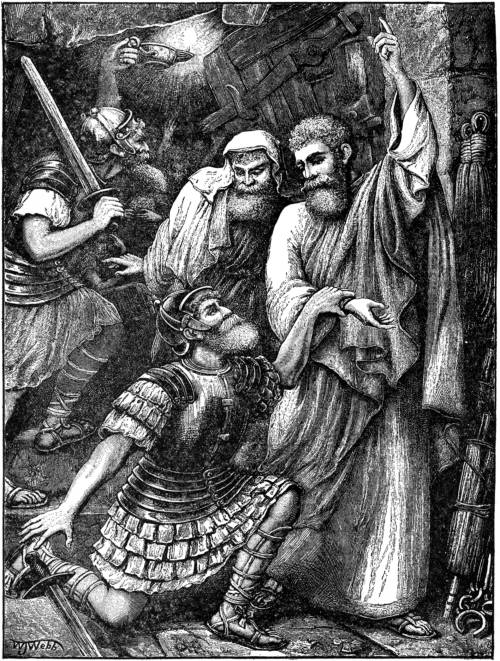
Paul and Silas were in prison. They had done no wrong, but wicked men had taken them before the magistrates; and the magistrates had caused them to be severely beaten, and afterwards had sent them to prison, where they were securely fastened in an inner dungeon, and their feet made fast in the stocks. This was a most painful position for Paul and Silas. But they were not unhappy. They prayed to God, and sang praises to Him; and they sang so heartily that the other prisoners heard them. It was midnight, and all was dark in the prison. But suddenly there was an earthquake; so that the foundations of the prison were shaken, all the doors were opened, and every one’s bonds were loosed. All the prisoners might have run away had they been minded to do so.
The keeper of the prison had been sleeping, but the earthquake awoke him. When he saw the doors open, he supposed that all the prisoners had fled; and knowing how severely he would be punished on that account, he drew his sword to kill himself. Paul knew this, and called out loudly, “Do thyself no harm, for we are all here.” Then the keeper, who but a little while before had cruelly treated Paul and Silas, came trembling, and fell down before them, and said, “Sirs, what must I do to be saved?” He was afraid because of his sins; and wanted to know how he might be saved from the fearful consequences of sin. Paul’s answer was, “Believe on the Lord Jesus Christ and thou shalt be saved.” Then Paul and Silas spoke to him about Jesus. He believed, and was baptized; and the next morning the two disciples were set at liberty.
In the First Book we have had before us the work of the Redeemer set forth as it concerned His own glorious person. In this Second Book it is presented to us as it affects others. Here we see the results of His humiliation, and conflict, and victory—“The sufferings of Christ” and the blessings they procured for His redeemed people.
In Chapter I. we have the Blessings procured.
In Chapter II. their Blessings ensured.
In Chapter III. their Blessings in abeyance.
In Chapter IV. their Blessings enjoyed.
Chapter I. The Sign CAPRICORNUS (The Sea Goat)
The Goat of Atonement Slain for the Redeemed.
It is most noteworthy that this Second Book opens with the Goat and closes with the Ram: two animals of sacrifice; while the two middle chapters are both connected with fishes. The reason for this we shall see as we proceed.
Both are combined in the first chapter, or “Sign” of Capricornus.
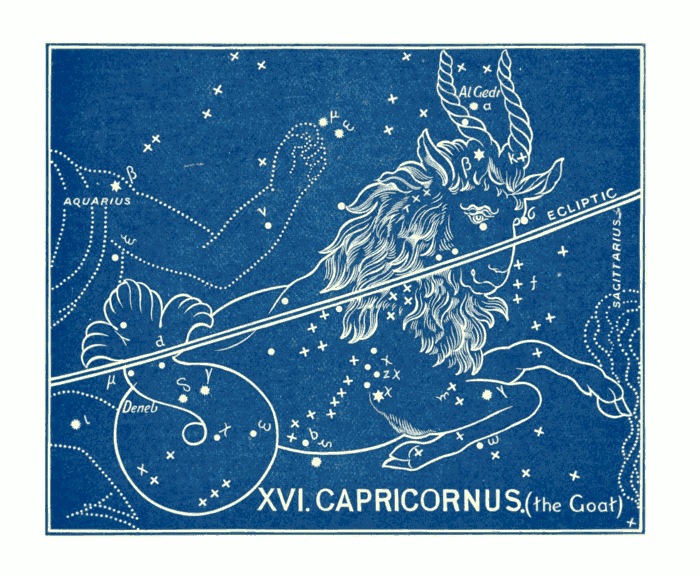
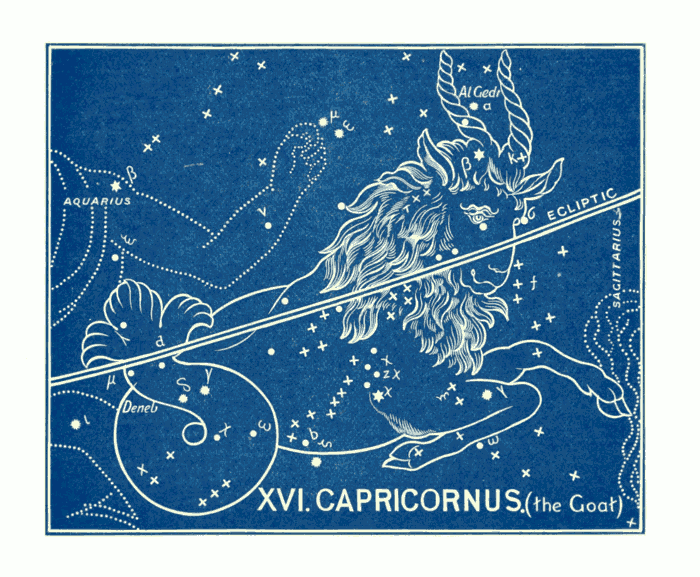
In all the ancient Zodiacs, or Planispheres, we find a goat with a fish’s tail. In the Zodiacs of Denderah and Esneh, in Egypt, it is half-goat and half-fish, and it is there called Hu-penius, which means the place of the sacrifice.
In the Indian Zodiac it is a goat passant traversed by a fish.
There can be no doubt as to the significance of this sign.
In the Goat we have the Atoning Sacrifice, in the Fish we have the people for whom the atonement is made. When we come to the sign “Pisces” we shall see more clearly that it points to the multitudes of the redeemed host.
The Goat is bowing its head as though falling down in death. The right leg is folded underneath the body, and he seems unable to rise with the left. The tail of the fish, on the other hand, seems to be full of vigour and life.
The Hebrew name of the sign is Gedi, the kid or cut off, the same as the Arabic Al Gedi. Capricornus is merely the modern (Latin) name of the sign and means goat.
Plate 16: CAPRICORNUS (the Goat)
There are 51 stars in the sign, three of which are of the 3rd magnitude, three of the 4th, etc. Five are remarkable stars, α and β in the horn and head, and the remaining three, γ, δ, and ε, in the fishy tail. The star α is named Al Gedi, the kid or goat, while the star δ is called Deneb Al Gedi, the sacrifice cometh.
Other star-names in the sign, not identified, are Dabih (Syriac), the sacrifice slain; Al Dabik and Al Dehabeh (Arabic) have the same meaning; Ma’asad, the slaying; Sa’ad al Naschira, the record of the cutting off.
Is not this exactly in accord with the Scriptures of truth? There were two goats! Of “the goat of the sin-offering” it is written, “God hath given it to you to bear the iniquity of the congregation, to make atonement for them before the Lord” (Lev. x. 16, 17): of the other goat, which was not slain, “he shall let it go into the wilderness” (Lev. xvi. 22). Here is death and resurrection. Christ was “wounded for our transgressions, and bruised for our iniquities.” “For the transgression of MY PEOPLE was He stricken” (Isa. liii.). He laid down His life for the sheep.
In the first chapter of the First Book, we had the same Blessed One presented as “a corn of wheat.” Here we see Him come to “die,” and hence not abiding alone, but bringing forth “much fruit” (John xii. 24). The living fish proceeds from the dying goat, and yet they form only one body. That picture, which has no parallel in nature, has a perfectly true counterpart in grace; and “a great multitude, which no man can number,” have been redeemed and shall obtain eternal life through the death of their Redeemer.
It is, however, not merely the actual death which is set before us here. The first chapter in each book has for its great subject the Person of the Redeemer in prophecy and promise. The last chapter in each book has for its subject the fulfilment of that prophecy in victory and triumph, in the Person of the Redeemer: while the two central chapters in each book are occupied with the work which is the accomplishment of the promise, presented in two aspects—the former connected with grace, the latter with conflict.
Thus, the structure of each of the three books is an epanodos, having for its first and last members the Person of the Redeemer (in “A” in Prophecy; in “A” in Fulfilment), while in the two central members we have the work and its accomplishment (in “B” in grace; and in “B” in conflict).
It may be thus presented to the eye:—
The First Book.
A | Virgo. The Prophecy of the Bruised Seed.
B | Libra. The work accomplished (in grace).
B | Scorpio. The work accomplished (in conflict.)
A | Sagittarius. The fulfillment of the promised victory.
The Second Book.
C | Capricornus. The Prophecy of the Promised Deliverance.
D | Aquarius. Results of the work bestowed (in grace).
D | Pisces. Results of the work enjoyed (in conflict).
C | Aries. The Fulfilment of the Promised Deliverance.
The Third Book.
E | Taurus. The Prophecy of the coming Judge of all the earth.
F | Gemini. The Redeemer’s reign. (Grace and Glory).
F | Cancer. The Redeemer’s possession (safe from all conflict).
E | Leo. The fulfilment of the promised Triumph.
Hence in Capricornus we must look for the prophecy of this Coming Sacrifice. As a matter of fact it did actually point out the time when the Sun of Righteousness should arise, and “the Light of the World” appear. For when this Promised Seed was born the Sun was actually in this sign of Capricornus! “The fulness of time was come,” and “God sent forth His Son TO REDEEM them that were under the Law” (Gal. iv. 4). The Sun was really amongst those very stars—Al Gedi, the kid, and Deneb Al Gedi, the sacrifice cometh—when this willing Sacrifice said, “Lo I come to do Thy will, O God.” The nights were at their darkest and their longest when Jesus was born. The days began immediately to lengthen when He, “the true light,” had come into the world.
Astronomers confess that the perverted legends of the Greeks give but “a lame account” of this sign, “and it offers no illustration of its ancient origin.”
Its ancient origin reveals a prophetic knowledge, which only He possessed who knew that in “the fulness of time” He would send forth His Son.
We now come to the three constellations which give us three pictures setting forth the death of this Sacrifice and of His living again.
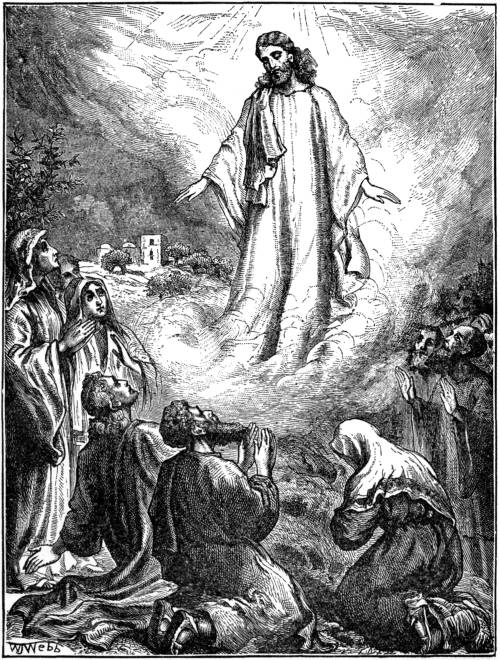
Jesus had been cruelly put to death. His hands, which had been placed on the heads of little children when He blessed them, had been nailed to a cross of wood; and cruel nails had been driven through his feet. And hanging on the cross, Jesus had died. But on the third day He had risen from the tomb, and for forty days He had remained upon the earth, meeting frequently with His disciples. At the end of that time Jesus led the eleven apostles from Jerusalem towards Bethany; and when near that village, and away from the multitude, He spoke to them, promising that they should be made bold by the Holy Spirit, and receive power to witness for Him both to the Jews and Gentiles. Then, the Bible tells us, “He lifted up His hands and blessed them. And it came to pass, while He blessed them, He was parted from them, and carried up into heaven.” And as He went up, a cloud received Him out of their sight.
The apostles fell down and worshipped Jesus, looking steadfastly after Him as He went up; and as they did so, two angels in white garments stood by them, and said, “Ye men of Galilee, why stand ye gazing up into heaven? This same Jesus, which is taken up from you into heaven, shall so come in like manner as ye have seen Him go into heaven.” Then the apostles returned to Jerusalem.
Yes, Jesus has ascended to heaven, and now He sits at the right hand of God; but He tells us that He will come again, and take those that love Him to dwell with Him in His glorious home for ever and ever. “I go to prepare a place for you,” Jesus says.
Why do the heathen rage, and the people imagine a vain thing?
The kings of the earth set themselves, and the rulers take counsel together, against the Lord, and against his anointed, saying,
Let us break their bands asunder, and cast away their cords from us.
He that sitteth in the heavens shall laugh: the Lord shall have them in derision.
Then shall he speak unto them in his wrath, and vex them in his sore displeasure.
Yet have I set my king upon my holy hill of Zion.
I will declare the decree: the Lord hath said unto me, Thou art my Son; this day have I begotten thee.
Ask of me, and I shall give thee the heathen for thine inheritance, and the uttermost parts of the earth for thy possession.
Thou shalt break them with a rod of iron; thou shalt dash them in pieces like a potter’s vessel.
Be wise now therefore, O ye kings: be instructed, ye judges of the earth.
Serve the Lord with fear, and rejoice with trembling.
Kiss the Son, lest he be angry, and ye perish from the way, when his wrath is kindled but a little. Blessed are all they that put their trust in him.
Notes:
The word translated here as “heathen” comes from the Hebrew word goyim and is often referred to as “nations,” especially the non-Jewish nations of the Gentiles that surrounded Israel. Later the word Gentile became synonymous with the word goyim for most Hebrews.
The word “image” is the Hebrew word hagah. It is the same word that in Psalm 1 that is translated as meditate. The nations around Israel were meditating on how to destroy God’s anointed.
The word “anointed” is the Hebrew word מָשִׁיחַ māšîaḥ.
מָשִׁיחַ māšîaḥ
anointed (one), usually refers to pouring or smearing sacred oil on a person in a ceremony of dedication, possibly symbolizing divine empowering to accomplish the task or office; the Anointed One, the Messiah, God’s ultimate chosen one, identified in the NT as Jesus:
Vs 2: Yet have I set my king upon my holy hill of Zion.
David captured the stronghold of Zion (see 2 Samuel 5:7)
David later constructed a tent on Mount Zion (see 1 Chron. 15:1). He then brought the Ark of the Covenant their and housed it in the tent (see 1 Chron. 16:1). By this God had set His King upon the “Holy Hill of Zion”.
2:7 I will declare the decree: the Lord hath said unto me, Thou art my Son; this day have I begotten thee.
This verse is quoted from twice:
Hebrews 1:5
For unto which of the angels said he at any time, Thou art my Son, this day have I begotten thee? And again, I will be to him a Father, and he shall be to me a Son?
Hebrews 5:5
So also Christ glorified not himself to be made an high priest; but he that said unto him, Thou art my Son, to day have I begotten thee.
Notice a few things
The word Son is used to identify the Messiah as Christ was called the “Son of God” (see Matt. 8:29; 14:33; 27:54; Mark 1:1; 3:11; Luke 1:35).
The term begotten is also used, from a Hebrew word meaning “to give birth to a child,”
It is used in the New Testament when Jesus is called the “only begotten of the Father” (John 1:14).
The phrase “only begotten” refers to an “only born.”
2:8 Ask of me, and I shall give thee the heathen for thine inheritance, and the uttermost parts of the earth for thy possession.
When Messiah (Jesus) becomes King and sets His throne in Jerusalem, He will be King over all the earth and all nations will be under His dominion; thus, He will inherit the heathen (Gentile) nations.
2:9 Thou shalt break them with a rod of iron; thou shalt dash them in pieces like a potter’s vessel.
The promise of the Messiah ruling with a rod of iron is found in both Testaments.
Isaiah 11:4 But with righteousness shall he judge the poor, and reprove with equity for the meek of the earth: and he shall smite the earth: with the rod of his mouth, and with the breath of his lips shall he slay the wicked.
The “rod” is the words of the Messiah’s mouth that slay the wicked.
This same imagery is used in Revelation 19:15.
And out of his mouth goeth a sharp sword, that with it he should smite the nations: and he shall rule them with a rod of iron: and he treadeth the winepress of the fierceness and wrath of Almighty God.
In the above verse it is with His mouth that Christ will smite the nations and rule them with a rod of iron.
Here, David says that the Messiah will break them in pieces like a clay vessel that is smashed with a rod. This refers to breaking:
the power
the influence
the will of the nations, causing them to submit to the Messiah.
2:10 Be wise now therefore, O ye kings: be instructed, ye judges of the earth.
Wisdom and instruction should be the basis for all decisions made among leaders.
It should also be the basis for decisions made by all Christians.
2:11 Serve the Lord with fear, and rejoice with trembling.
The “fear of the Lord is the beginning of wisdom”
Ps. 111:10
The fear of the Lord is the beginning of wisdom: a good understanding have all they that do his commandments: his praise endureth for ever.
The Hebrew word translated as rejoice here is giyl and means, “to spin around with emotion” or “to spin in a circle.”
In Hebrew thought, to “rejoice” does not simply mean to be happy in the Lord. Rejoicing is accompanied by a response such as shouting, spinning, or even dancing.
2:12 Kiss the Son, lest he be angry, and ye perish from the way, when his wrath is kindled but a little. Blessed are all they that put their trust in him.
The “Son” here is the King Messiah (v. 6), the begotten son (v. 7), and the one who rules with a rod of iron (v. 9).
“Kiss”: It was customary in ancient times to kiss a close friend on the cheek, or to kiss the ring or hand of the king or leader as a sign of great honor.
Those who will not honor Christ in the Millennium will experience forms of judgments on their nations (see Zech. 14:17-18).
Then on that day David delivered first this psalm to thank the Lord into the hand of Asaph and his brethren.
Give thanks unto the Lord, call upon his name, make known his deeds among the people.
Sing unto him, sing psalms unto him, talk ye of all his wondrous works.
Glory ye in his holy name: let the heart of them rejoice that seek the Lord.
Seek the Lord and his strength, seek his face continually.
Remember his marvellous works that he hath done, his wonders, and the judgments of his mouth;
O ye seed of Israel his servant, ye children of Jacob, his chosen ones.
He is the Lord our God; his judgments are in all the earth.
Be ye mindful always of his covenant; the word which he commanded to a thousand generations;
Even of the covenant which he made with Abraham, and of his oath unto Isaac;
And hath confirmed the same to Jacob for a law, and to Israel for an everlasting covenant,
Saying, Unto thee will I give the land of Canaan, the lot of your inheritance;
When ye were but few, even a few, and strangers in it.
And when they went from nation to nation, and from one kingdom to another people;
He suffered no man to do them wrong: yea, he reproved kings for their sakes,
Saying, Touch not mine anointed, and do my prophets no harm.
Sing unto the Lord, all the earth; shew forth from day to day his salvation.
Declare his glory among the heathen; his marvellous works among all nations.
For great is the Lord, and greatly to be praised: he also is to be feared above all gods.
For all the gods of the people are idols: but the Lord made the heavens.
Glory and honour are in his presence; strength and gladness are in his place.
Give unto the Lord, ye kindreds of the people, give unto the Lord glory and strength.
Give unto the Lord the glory due unto his name: bring an offering, and come before him: worship the Lord in the beauty of holiness.
Fear before him, all the earth: the world also shall be stable, that it be not moved.
Let the heavens be glad, and let the earth rejoice: and let men say among the nations, The Lord reigneth.
Let the sea roar, and the fulness thereof: let the fields rejoice, and all that is therein.
Then shall the trees of the wood sing out at the presence of the Lord, because he cometh to judge the earth.
O give thanks unto the Lord; for he is good; for his mercy endureth for ever.
And say ye, Save us, O God of our salvation, and gather us together, and deliver us from the heathen, that we may give thanks to thy holy name, and glory in thy praise.
Blessed be the Lord God of Israel for ever and ever. And all the people said, Amen, and praised the Lord.
Who was Mary? Mary was a young virgin. The daughter of the son of Heli (Luke 3:23). She must have been a righteous woman. Just look at the Greeting given to her by the angel Gabriel.
“…Hail, thou that art highly favoured, the Lord is with thee: blessed art thou among women.” Luke 1:28
And when she saw him, she was troubled at his saying, and cast in her mind what manner of salutation this should be. And the angel said unto her, “Fear not, Mary: for thou hast found favour with God.”
After being informed that she was to have a child, she humbly asked a question
Then said Mary unto the angel, How shall this be, seeing I know not a man?
After the answer was given, she was quick to believe.
And Mary said, Behold the handmaid of the Lord; be it unto me according to thy word. And the angel departed from her. (Luke 1:38)
Later when Mary arrived at Elisabeth’s house:
And it came to pass, that, when Elisabeth heard the salutation of Mary, the babe leaped in her womb; and Elisabeth was filled with the Holy Ghost:
And she spake out with a loud voice, and said, Blessed art thou among women, and blessed is the fruit of thy womb. And whence is this to me, that the mother of my Lord should come to me? For, lo, as soon as the voice of thy salutation sounded in mine ears, the babe leaped in my womb for joy. And blessed is she that believed: for there shall be a performance of those things which were told her from the Lord. (Luke 1:41-45).
Mary responds by Praising God.
“My soul doth magnify the Lord, And my spirit hath rejoiced in God my Saviour. For he hath regarded the low estate of his handmaiden: for, behold, from henceforth all generations shall call me blessed. For he that is mighty hath done to me great things; and holy is his name. And his mercy is on them that fear him from generation to generation. He hath shewed strength with his arm; he hath scattered the proud in the imagination of their hearts. He hath put down the mighty from their seats, and exalted them of low degree. He hath filled the hungry with good things; and the rich he hath sent empty away. He hath helped his servant Israel, in remembrance of his mercy; As he spake to our fathers, to Abraham, and to his seed for ever.
From all of this, it is clear that Mary was a devout woman of faith. She was quick to praise God and quick to be obedient to His Word.
Blessed is the man that walketh not in the counsel of the ungodly, nor standeth in the way of sinners, nor sitteth in the seat of the scornful.
But his delight is in the law of the Lord; and in his law doth he meditate day and night.
And he shall be like a tree planted by the rivers of water, that bringeth forth his fruit in his season; his leaf also shall not wither; and whatsoever he doeth shall prosper.
The ungodly are not so: but are like the chaff which the wind driveth away.
Therefore the ungodly shall not stand in the judgment, nor sinners in the congregation of the righteous.
For the Lord knoweth the way of the righteous: but the way of the ungodly shall perish.
The key word in the psalm is “blessed,” used here as a declaration about a certain kind of man. Essentially, the psalm teaches that the blessed, happy man is the righteous man. He avoids evil influences, deeds, and attitudes, and delights in God’s Word; as a result, God causes him to prosper. In contrast, the ungodly are like chaff, worthless and destined for judgment. The Lord’s evaluation is clear in verse 6: He knows the way of the righteous (and it will be blessed), but He also knows the way of the ungodly, and it will perish. This psalm serves as a fitting introduction to the Psalter, presenting the three main figures who appear throughout: the righteous, the ungodly, and God.
A Prayer to go with the Psalm:
Lord our God, source of blessing and justice, your Son, Jesus, lived the only true life. Through him, we can know, love, and rejoice in you. Keep us nourished by your grace and grounded in your Spirit, so our ears hear your voice, and our feet walk in your ways, giving all glory to you alone. Amen.
I believe in God, the Father Almighty, Creator of Heaven and earth; and in Jesus Christ, His only Son, Our Lord, Who was conceived by the Holy Spirit, born of the Virgin Mary, suffered under Pontius Pilate, was crucified, died, and was buried; He descended into hell; on the third day He rose again from the dead; He ascended into heaven, and is seated at the right hand of God, the Father Almighty; from there He will come to judge the living and the dead. I believe in the Holy Spirit, the holy Church, the communion of saints, the forgiveness of sins, the resurrection of the body, and life everlasting. Amen.
“To the angel (divine messenger) of the church in Sardis write:
“These are the words of Him who has the seven Spirits of God and the seven stars:
‘I know your deeds; you have a name (reputation) that you are alive, but [in reality] you are dead.
Wake up, and strengthen and reaffirm what remains [of your faithful commitment to Me], which is about to die;
for I have not found [any of] your deeds completed in the sight of My God or meeting His requirements.
So, remember and take to heart the lessons you have received and heard. Keep and obey them, and repent [change your sinful way of thinking, and demonstrate your repentance with new behavior that proves a conscious decision to turn away from sin].
So then, if you do not wake up, I will come like a thief, and you will not know at what hour I will come to you.
But you [still] have a few people in Sardis who have not soiled their clothes [that is, contaminated their character and personal integrity with sin]; and they will walk with Me [dressed] in white,
because they are worthy (righteous).
He who overcomes [the world through believing that Jesus is the Son of God] will accordingly be dressed in white clothing; and I will never blot out his name from the Book of Life, and I will confess and openly acknowledge his name before My Father and before His angels [saying that he is one of Mine].
He who has an ear, let him hear and heed what the Spirit says to the churches.’
Some History about Sardis
It is in modern Sart, Turkey.
In Roman times, was a wealthy city known for the manufacture and dyeing of woolen fabric and carpets.
Originally, it was the capital of the ancient Lydian Empire and was the first city to mint coinage (600 b.c.).
A stream that flowed through its marketplace carried gold dust from a nearby mountain.
King Croesus of Lydia (560-546 b.c.) financed the building of the great Temple of Artemis in Ephesus (550 b.c.).
The city was conquered twice, under Cyrus the Great and under Antiochus, due to lack of adequate watchfulness.
The chief idol deity was the goddess Artemis.
Artemis was worshipped as the mother goddess.
Sardis was destroyed by an earthquake in 17 AD. It was later rebuilt.
This city was known for its lack of watchfulness. It was conquered not once, but twice for the same reason. In the letter sent to the church, Jesus is telling them to wake up and pay attention. They think that they are good, but destruction is just around the corner, spiritually speaking. Most are already dead spiritually, some are just before dying spiritually, and a few are righteous. However, according to their reputation they are alive and doing well. This is similar what Jesus was trying to say to the pharisees.
“Woe to you, [self-righteous] scribes and Pharisees, hypocrites! For youare like whitewashed tombs which look beautiful on the outside, but inside arefullofdead men’s bones and everything unclean.
Don’t be self-righteous. Instead, remember and take to heart the lessons you have received and heard. Keep and obey them, and repent [change your sinful way of thinking, and demonstrate your repentance with new behavior that proves a conscious decision to turn away from sin].
Remember that spiritual deadness is the same as if you are not saved. To be saved means to be alive spiritually. Take a good hard look at yourself. Remember that if you judge yourself, God doesn’t have to.
1 Corinthians 11:31-32 amp
But if we evaluated and judged ourselves honestly [recognizing our shortcomings and correcting our behavior], we would not be judged.
But when we [fall short and] are judged by the Lord, we are disciplined [by undergoing His correction] so that we will not be condemned [to eternal punishment] along with the world.
 articlesforchristians