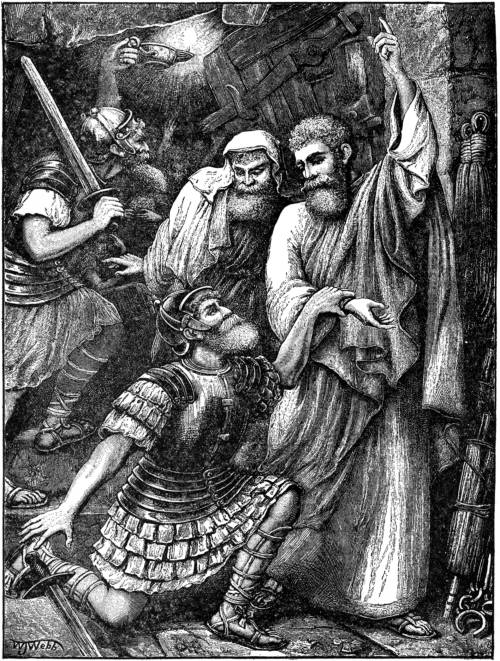
Paul and Silas were in prison. They had done no wrong, but wicked men had taken them before the magistrates; and the magistrates had caused them to be severely beaten, and afterwards had sent them to prison, where they were securely fastened in an inner dungeon, and their feet made fast in the stocks. This was a most painful position for Paul and Silas. But they were not unhappy. They prayed to God, and sang praises to Him; and they sang so heartily that the other prisoners heard them. It was midnight, and all was dark in the prison. But suddenly there was an earthquake; so that the foundations of the prison were shaken, all the doors were opened, and every one’s bonds were loosed. All the prisoners might have run away had they been minded to do so.
The keeper of the prison had been sleeping, but the earthquake awoke him. When he saw the doors open, he supposed that all the prisoners had fled; and knowing how severely he would be punished on that account, he drew his sword to kill himself. Paul knew this, and called out loudly, “Do thyself no harm, for we are all here.” Then the keeper, who but a little while before had cruelly treated Paul and Silas, came trembling, and fell down before them, and said, “Sirs, what must I do to be saved?” He was afraid because of his sins; and wanted to know how he might be saved from the fearful consequences of sin. Paul’s answer was, “Believe on the Lord Jesus Christ and thou shalt be saved.” Then Paul and Silas spoke to him about Jesus. He believed, and was baptized; and the next morning the two disciples were set at liberty.
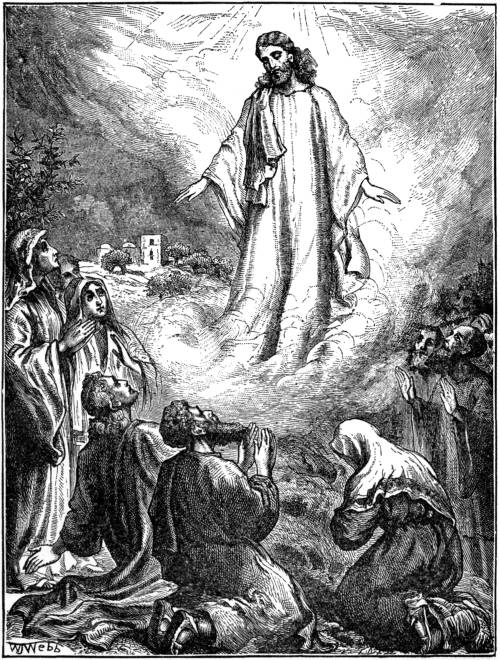
Jesus had been cruelly put to death. His hands, which had been placed on the heads of little children when He blessed them, had been nailed to a cross of wood; and cruel nails had been driven through his feet. And hanging on the cross, Jesus had died. But on the third day He had risen from the tomb, and for forty days He had remained upon the earth, meeting frequently with His disciples. At the end of that time Jesus led the eleven apostles from Jerusalem towards Bethany; and when near that village, and away from the multitude, He spoke to them, promising that they should be made bold by the Holy Spirit, and receive power to witness for Him both to the Jews and Gentiles. Then, the Bible tells us, “He lifted up His hands and blessed them. And it came to pass, while He blessed them, He was parted from them, and carried up into heaven.” And as He went up, a cloud received Him out of their sight.
The apostles fell down and worshipped Jesus, looking steadfastly after Him as He went up; and as they did so, two angels in white garments stood by them, and said, “Ye men of Galilee, why stand ye gazing up into heaven? This same Jesus, which is taken up from you into heaven, shall so come in like manner as ye have seen Him go into heaven.” Then the apostles returned to Jerusalem.
Yes, Jesus has ascended to heaven, and now He sits at the right hand of God; but He tells us that He will come again, and take those that love Him to dwell with Him in His glorious home for ever and ever. “I go to prepare a place for you,” Jesus says.
One day last week I saw a huge pair of bobs, heavily loaded with coal, being pulled up the street by two big, fine-looking horses. There were two men on the load. Their faces were black, but it was the dirt of honest toil, it was coal dust. They stopped the horses in front of the house directly across the street from me. I watched them with interest. The first thing one of the men did was to get down, take a board, go around to the front of the horses, lift up the heavy wagon tongue, place the board underneath it as a brace that the necks of the horses might be relieved of the strain of the wagon tongue. At the same time the other man took two warm blankets and covered the horses with them, tucking in the corners beneath the harness to make them tight and warm. Then the men set to work to carry the coal, basket by basket, into the cellar. That was kindness, was it not, to see that the horses were so well cared for on a cold winter day!
To my mind one of the finest acts of our city government is the way we are taught kindness to dumb animals and birds, by permitting them to make their homes and nests in the public park. What a delight it is to walk through the park and have the squirrels come running up so close, to eat from one’s hand! That is kindness.
How about kindness to people? Have you ever seen an older person walking along the street with a little child of three or four years of age, the child reaching up as far as he could to take the hand of the older person, the older one jerking, pulling, yanking, all the while saying, “Come now, hurry up, hurry up.” That is not kindness, is it?
“Howe’er it be, it seems to me’ Tis only noble to be good; Kind hearts are more than coronets, And simple faith than Norman blood.”
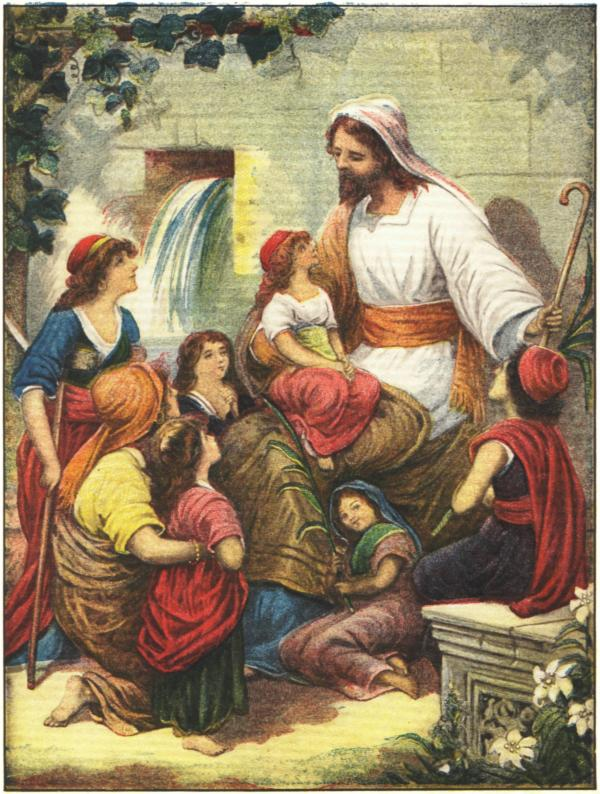
Jesus had left Galilee, and was journeying toward Jerusalem, where He was to be put to death. He was in the country beyond Jordan, called Peræa, and had been speaking some very wise words to the Pharisees, and also to His disciples, when some women came to Him, bringing infants and young children that He might put His hands upon them and pray for them. The disciples thinking probably that Jesus, who had so many important things to attend to, would not wish to be troubled by women bringing their children, rebuked them for so doing. But Jesus loved children. So, when He saw the disciples about to send them away, He was displeased; and, calling the disciples to Him, He said, “Suffer little children to come unto Me, and forbid them not: for of such is the kingdom of God.” Then, we are told, Jesus “took them up in His arms, put His hands upon them, and blessed them.” How kind was Jesus! and how willing that the little ones should be brought to Him! And He is the same now. May all our young readers learn to love Him, and find for themselves how willing He is to love and bless them.
Why do the heathen rage, and the people imagine a vain thing?
The kings of the earth set themselves, and the rulers take counsel together, against the Lord, and against his anointed, saying,
Let us break their bands asunder, and cast away their cords from us.
He that sitteth in the heavens shall laugh: the Lord shall have them in derision.
Then shall he speak unto them in his wrath, and vex them in his sore displeasure.
Yet have I set my king upon my holy hill of Zion.
I will declare the decree: the Lord hath said unto me, Thou art my Son; this day have I begotten thee.
Ask of me, and I shall give thee the heathen for thine inheritance, and the uttermost parts of the earth for thy possession.
Thou shalt break them with a rod of iron; thou shalt dash them in pieces like a potter’s vessel.
Be wise now therefore, O ye kings: be instructed, ye judges of the earth.
Serve the Lord with fear, and rejoice with trembling.
Kiss the Son, lest he be angry, and ye perish from the way, when his wrath is kindled but a little. Blessed are all they that put their trust in him.
Notes:
The word translated here as “heathen” comes from the Hebrew word goyim and is often referred to as “nations,” especially the non-Jewish nations of the Gentiles that surrounded Israel. Later the word Gentile became synonymous with the word goyim for most Hebrews.
The word “image” is the Hebrew word hagah. It is the same word that in Psalm 1 that is translated as meditate. The nations around Israel were meditating on how to destroy God’s anointed.
The word “anointed” is the Hebrew word מָשִׁיחַ māšîaḥ.
מָשִׁיחַ māšîaḥ
anointed (one), usually refers to pouring or smearing sacred oil on a person in a ceremony of dedication, possibly symbolizing divine empowering to accomplish the task or office; the Anointed One, the Messiah, God’s ultimate chosen one, identified in the NT as Jesus:
Vs 2: Yet have I set my king upon my holy hill of Zion.
David captured the stronghold of Zion (see 2 Samuel 5:7)
David later constructed a tent on Mount Zion (see 1 Chron. 15:1). He then brought the Ark of the Covenant their and housed it in the tent (see 1 Chron. 16:1). By this God had set His King upon the “Holy Hill of Zion”.
2:7 I will declare the decree: the Lord hath said unto me, Thou art my Son; this day have I begotten thee.
This verse is quoted from twice:
Hebrews 1:5
For unto which of the angels said he at any time, Thou art my Son, this day have I begotten thee? And again, I will be to him a Father, and he shall be to me a Son?
Hebrews 5:5
So also Christ glorified not himself to be made an high priest; but he that said unto him, Thou art my Son, to day have I begotten thee.
Notice a few things
The word Son is used to identify the Messiah as Christ was called the “Son of God” (see Matt. 8:29; 14:33; 27:54; Mark 1:1; 3:11; Luke 1:35).
The term begotten is also used, from a Hebrew word meaning “to give birth to a child,”
It is used in the New Testament when Jesus is called the “only begotten of the Father” (John 1:14).
The phrase “only begotten” refers to an “only born.”
2:8 Ask of me, and I shall give thee the heathen for thine inheritance, and the uttermost parts of the earth for thy possession.
When Messiah (Jesus) becomes King and sets His throne in Jerusalem, He will be King over all the earth and all nations will be under His dominion; thus, He will inherit the heathen (Gentile) nations.
2:9 Thou shalt break them with a rod of iron; thou shalt dash them in pieces like a potter’s vessel.
The promise of the Messiah ruling with a rod of iron is found in both Testaments.
Isaiah 11:4 But with righteousness shall he judge the poor, and reprove with equity for the meek of the earth: and he shall smite the earth: with the rod of his mouth, and with the breath of his lips shall he slay the wicked.
The “rod” is the words of the Messiah’s mouth that slay the wicked.
This same imagery is used in Revelation 19:15.
And out of his mouth goeth a sharp sword, that with it he should smite the nations: and he shall rule them with a rod of iron: and he treadeth the winepress of the fierceness and wrath of Almighty God.
In the above verse it is with His mouth that Christ will smite the nations and rule them with a rod of iron.
Here, David says that the Messiah will break them in pieces like a clay vessel that is smashed with a rod. This refers to breaking:
the power
the influence
the will of the nations, causing them to submit to the Messiah.
2:10 Be wise now therefore, O ye kings: be instructed, ye judges of the earth.
Wisdom and instruction should be the basis for all decisions made among leaders.
It should also be the basis for decisions made by all Christians.
2:11 Serve the Lord with fear, and rejoice with trembling.
The “fear of the Lord is the beginning of wisdom”
Ps. 111:10
The fear of the Lord is the beginning of wisdom: a good understanding have all they that do his commandments: his praise endureth for ever.
The Hebrew word translated as rejoice here is giyl and means, “to spin around with emotion” or “to spin in a circle.”
In Hebrew thought, to “rejoice” does not simply mean to be happy in the Lord. Rejoicing is accompanied by a response such as shouting, spinning, or even dancing.
2:12 Kiss the Son, lest he be angry, and ye perish from the way, when his wrath is kindled but a little. Blessed are all they that put their trust in him.
The “Son” here is the King Messiah (v. 6), the begotten son (v. 7), and the one who rules with a rod of iron (v. 9).
“Kiss”: It was customary in ancient times to kiss a close friend on the cheek, or to kiss the ring or hand of the king or leader as a sign of great honor.
Those who will not honor Christ in the Millennium will experience forms of judgments on their nations (see Zech. 14:17-18).
Instructor Note: No such letters as included in this lesson exist. This chapter features imaginary letters written by the book author, Van Loon, to convey his personal retelling of the story of Jesus.
In the autumn of the year of the city 783 (which would be 62 A.D., in our way of counting time) Aesculapius Cultellus, a Roman physician, wrote to his nephew who was with the army in Syria as follows:
My dear Nephew,
A few days ago I was called in to prescribe for a sick man named Paul. He appeared to be a Roman citizen of Jewish parentage, well-educated and of agreeable manners. I had been told that he was here in connection with a lawsuit, an appeal from one of our provincial courts, Caesarea or some such place in the eastern Mediterranean. He had been described to me as a “wild and violent” fellow who had been making speeches against the People and against the Law. I found him very intelligent and of great honesty.
A friend of mine who used to be with the army in Asia Minor tells me that he heard something about him in Ephesus where he was preaching sermons about a strange new god. I asked my patient if this were true and whether he had told the people to rebel against the will of our beloved Emperor. Paul answered me that the Kingdom of which he had spoken was not of this world and he added many strange utterances which I did not understand, but which were probably due to his fever.
His personality made a great impression upon me and I was sorry to hear that he was killed on the Ostian Road a few days ago. Therefore, I am writing this letter to you. When next you visit Jerusalem, I want you to find out something about my friend Paul and the strange Jewish prophet, who seems to have been his teacher. Our slaves are getting much excited about this so-called Messiah, and a few of them, who openly talked of the new kingdom (whatever that means) have been crucified. I would like to know the truth about all these rumors and I am
Your devoted Uncle,
AESCULAPIUS CULTELLUS.
Six weeks later, Gladius Ensa, the nephew, a captain of the VII Gallic Infantry, answered as follows:
My dear Uncle,
I received your letter and I have obeyed your instructions.
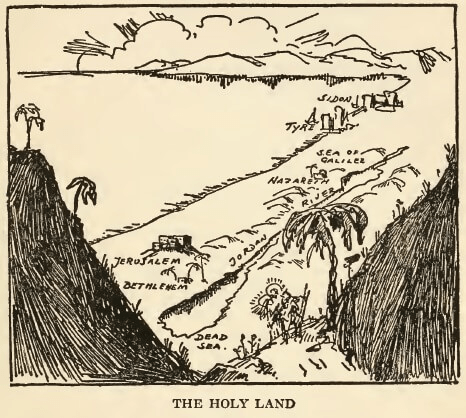
Two weeks ago our brigade was sent to Jerusalem. There have been several revolutions during the last century and there is not much left of the old city. We have been here now for a month and tomorrow we shall continue our march to Petra, where there has been trouble with some of the Arab tribes. I shall use this evening to answer your questions, but pray do not expect a detailed report.
I have talked with most of the older men in this city but few have been able to give me any definite information. A few days ago, a peddler came to the camp. I bought some of his olives and I asked him whether he had ever heard of the famous Messiah who was killed when he was young. He said that he remembered it very clearly, because his father had taken him to Golgotha (a hill just outside the city) to see the execution, and to show him what became of the enemies of the laws of the people of Judaea. He gave me the address of one Joseph, who had been a personal friend of the Messiah and told me that I had better go and see him if I wanted to know more.
This morning I went to call on Joseph. He was quite an old man. He had been a fisherman on one of the fresh-water lakes. His memory was clear, and from him at last I got a fairly definite account of what had happened during the troublesome days before I was born.
Tiberius, our great and glorious emperor, was on the throne, and an officer of the name of Pontius Pilatus was governor of Judaea and Samaria. Joseph knew little about this Pilatus. He seemed to have been an honest enough official who left a decent reputation as procurator of the province. In the year 755 or 756 (Joseph had forgotten when) Pilatus was called to Jerusalem on account of a riot. A certain young man (the son of a carpenter of Nazareth) was said to be planning a revolution against the Roman government. Strangely enough our own intelligence officers, who are usually well informed, appear to have heard nothing about it, and when they investigated the matter they reported that the carpenter was an excellent citizen and that there was no reason to proceed against him. But the old-fashioned leaders of the Jewish faith, according to Joseph, were much upset. They greatly disliked his popularity with the masses of the poorer Hebrews. The “Nazarene” (so they told Pilatus) had publicly claimed that a Greek or a Roman or even a Philistine, who tried to live a decent and honorable life, was quite as good as a Jew who spent his days studying the ancient laws of Moses. Pilatus does not seem to have been impressed by this argument, but when the crowds around the temple threatened to lynch Jesus, and kill all his followers, he decided to take the carpenter into custody to save his life.
He does not appear to have understood the real nature of the quarrel. Whenever he asked the Jewish priests to explain their grievances, they shouted “heresy” and “treason” and got terribly excited. Finally, so Joseph told me, Pilatus sent for Joshua (that was the name of the Nazarene, but the Greeks who live in this part of the world always refer to him as Jesus) to examine him personally. He talked to him for several hours. He asked him about the “dangerous doctrines” which he was said to have preached on the shores of the sea of Galilee. But Jesus answered that he never referred to politics. He was not so much interested in the bodies of men as in Man’s soul. He wanted all people to regard their neighbors as their brothers and to love one single god, who was the father of all living beings.
Pilatus, who seems to have been well versed in the doctrines of the Stoics and the other Greek philosophers, does not appear to have discovered anything seditious in the talk of Jesus. According to my informant he made another attempt to save the life of the kindly prophet. He kept putting the execution off. Meanwhile the Jewish people, lashed into fury by their priests, got frantic with rage. There had been many riots in Jerusalem before this and there were only a few Roman soldiers within calling distance. Reports were being sent to the Roman authorities in Caesarea that Pilatus had “fallen a victim to the teachings of the Nazarene.” Petitions were being circulated all through the city to have Pilatus recalled, because he was an enemy of the Emperor. You know that our governors have strict instructions to avoid an open break with their foreign subjects. To save the country from civil war, Pilatus finally sacrificed his prisoner, Joshua, who behaved with great dignity and who forgave all those who hated him. He was crucified amidst the howls and the laughter of the Jerusalem mob.
That is what Joseph told me, with tears running down his old cheeks. I gave him a gold piece when I left him, but he refused it and asked me to hand it to one poorer than himself. I also asked him a few questions about your friend Paul. He had known him slightly. He seems to have been a tent maker who gave up his profession that he might preach the words of a loving and forgiving god, who was so very different from that Jehovah of whom the Jewish priests are telling us all the time. Afterwards, Paul appears to have travelled much in Asia Minor and in Greece, telling the slaves that they were all children of one loving Father and that happiness awaits all, both rich and poor, who have tried to live honest lives and have done good to those who were suffering and miserable.
I hope that I have answered your questions to your satisfaction. The whole story seems very harmless to me as far as the safety of the state is concerned. But then, we Romans never have been able to understand the people of this province. I am sorry that they have killed your friend Paul. I wish that I were at home again, and I am, as ever,
I believe in God, the Father Almighty, Creator of Heaven and earth; and in Jesus Christ, His only Son, Our Lord, Who was conceived by the Holy Spirit, born of the Virgin Mary, suffered under Pontius Pilate, was crucified, died, and was buried; He descended into hell; on the third day He rose again from the dead; He ascended into heaven, and is seated at the right hand of God, the Father Almighty; from there He will come to judge the living and the dead. I believe in the Holy Spirit, the holy Church, the communion of saints, the forgiveness of sins, the resurrection of the body, and life everlasting. Amen.
“To the angel (divine messenger) of the church in Sardis write:
“These are the words of Him who has the seven Spirits of God and the seven stars:
‘I know your deeds; you have a name (reputation) that you are alive, but [in reality] you are dead.
Wake up, and strengthen and reaffirm what remains [of your faithful commitment to Me], which is about to die;
for I have not found [any of] your deeds completed in the sight of My God or meeting His requirements.
So, remember and take to heart the lessons you have received and heard. Keep and obey them, and repent [change your sinful way of thinking, and demonstrate your repentance with new behavior that proves a conscious decision to turn away from sin].
So then, if you do not wake up, I will come like a thief, and you will not know at what hour I will come to you.
But you [still] have a few people in Sardis who have not soiled their clothes [that is, contaminated their character and personal integrity with sin]; and they will walk with Me [dressed] in white,
because they are worthy (righteous).
He who overcomes [the world through believing that Jesus is the Son of God] will accordingly be dressed in white clothing; and I will never blot out his name from the Book of Life, and I will confess and openly acknowledge his name before My Father and before His angels [saying that he is one of Mine].
He who has an ear, let him hear and heed what the Spirit says to the churches.’
Some History about Sardis
It is in modern Sart, Turkey.
In Roman times, was a wealthy city known for the manufacture and dyeing of woolen fabric and carpets.
Originally, it was the capital of the ancient Lydian Empire and was the first city to mint coinage (600 b.c.).
A stream that flowed through its marketplace carried gold dust from a nearby mountain.
King Croesus of Lydia (560-546 b.c.) financed the building of the great Temple of Artemis in Ephesus (550 b.c.).
The city was conquered twice, under Cyrus the Great and under Antiochus, due to lack of adequate watchfulness.
The chief idol deity was the goddess Artemis.
Artemis was worshipped as the mother goddess.
Sardis was destroyed by an earthquake in 17 AD. It was later rebuilt.
This city was known for its lack of watchfulness. It was conquered not once, but twice for the same reason. In the letter sent to the church, Jesus is telling them to wake up and pay attention. They think that they are good, but destruction is just around the corner, spiritually speaking. Most are already dead spiritually, some are just before dying spiritually, and a few are righteous. However, according to their reputation they are alive and doing well. This is similar what Jesus was trying to say to the pharisees.
“Woe to you, [self-righteous] scribes and Pharisees, hypocrites! For youare like whitewashed tombs which look beautiful on the outside, but inside arefullofdead men’s bones and everything unclean.
Don’t be self-righteous. Instead, remember and take to heart the lessons you have received and heard. Keep and obey them, and repent [change your sinful way of thinking, and demonstrate your repentance with new behavior that proves a conscious decision to turn away from sin].
Remember that spiritual deadness is the same as if you are not saved. To be saved means to be alive spiritually. Take a good hard look at yourself. Remember that if you judge yourself, God doesn’t have to.
1 Corinthians 11:31-32 amp
But if we evaluated and judged ourselves honestly [recognizing our shortcomings and correcting our behavior], we would not be judged.
But when we [fall short and] are judged by the Lord, we are disciplined [by undergoing His correction] so that we will not be condemned [to eternal punishment] along with the world.
The book of Psalms is a great resource for learning the Bible. We are commanded to read and use it for teaching.
Ephesians 5:19 Speaking to yourselves in psalms and hymns and spiritual songs, singing and making melody in your heart to the Lord; Colossians 3:16 Let the word of Christ dwell in you richly in all wisdom; teaching and admonishing one another in psalms and hymns and spiritual songs, singing with grace in your hearts to the Lord.
The Hebrew name for the book of Psalms is Tehillim, meaning “songs of praise,” with individual psalms called Mizmorim, such as Mizmor Aleph (Psalm 1), Mizmor Bet (Psalm 2), and so forth. The Psalms have long served as the Bible’s prayer book. Traditionally, Tehillim is divided into five books, mirroring the five books of the Torah. Just as Moses gave Israel the Torah, David gave the Psalms—“Moses gave the path, but David gave directions.” In the Hebrew Bible, the Psalms are part of the wisdom literature within the Ketuvim (“Writings”). Each of the first four books concludes with a doxology (a usually liturgical expression of praise to God). Psalm 150 serves as a doxology for the fifth book and an appropriate conclusion to the entire Psalter.
Here is some Bible Studies from the book of Psalms.
Unveiling the Armor of God in the Old Testament: The Armor of God, detailed in Ephesians 6:11-18, is also referenced in the Old Testament, emphasizing truth, righteousness, peace, faith, and salvation as spiritual protections against evil.
The Lord’s Prayer from Psalms: The Lord’s Prayer concepts resonate throughout Psalms, emphasizing God’s glory, kingdom, provision, forgiveness, and salvation. Key verses reflect these themes, illustrating the spiritual connection between the texts.
Essential Elements for Meaningful Worship: Worship requires preparation and order, emphasizing sincerity and truth. Key elements include gathering, praise, confession, and prayer, with guidance from Psalms to facilitate a meaningful experience.
The 5 Books of Psalms
The Genesis Book concerning man: Psalms 1-41
All 41 of these psalms are ascribed to King David.
Psalms 9, 10, 25, 34, and 37 have acrostic elements.
The Righteous vs. The Ungodly: Insights from Psalm 1 (coming soon)
The Prophecy of the Anointed One in Psalm 2 (coming soon)
The Exodus Book Concerning Israel as a Nation: Psalms 42-72
Of the 31 psalms in this section,
David wrote 18
Solomon wrote 1 (Psalm 72)
The rest were written by Korach (or anonymously):
The Leviticus Book Concerning the Sanctuary: Psalms 73-89
Of the 17 psalms in this section
Asaph appears to have written most of them
David wrote Psalm 86
Heman the Ezraite wrote Psalm 88
Ethan the Ezraite wrote the 89th:
The Numbers Book concerning Israel and the Nation: Psalms 90-106
Of the 17 psalms in this section
Psalm 90 is ascribed to Moses
Psalms 101 and 103 are ascribed to David:
The Deutronomy Book concerning God and His Word: Psalms 107-150
Of the 44 psalms in this section
15 are ascribed to David
one (Psalm 127) to Solomon
the rest are anonymous.
The Hallel: (Hebrew: הַלֵּל, ‘Praise’) is a Jewish prayer, a verbatim recitation from Psalms 113–118 which is recited by observant Jews on Jewish holidays as an act of praise and thanksgiving.
It is recited during the three festivals of Pesach (Passover), Shavu’ot (Pentecost), and Sukkot (Tabernacles).
The Hallel is also recited at Rosh Chodesh (the new moon) and during the eight days of Hanukkah.
Psalm 136 is generally called “the great Hallel.”
Psalms 120-134 are referred to as “Songs of Degrees” or the Psalms of Ascent.
Exploring the Four Meanings of the Psalms of Ascent: The Psalms of Ascent (120-134), also called Pilgrim Psalms, reflect different themes such as distress, security, and unity, sung during journeys to Jerusalem, highlighting both physical and spiritual ascent.
Acrostic Psalms:
Psalm 119 is the longest Psalm, with each set of 8 pesukim (verses) beginning with one of the 22 Hebrew letters.
Other psalms that have alphabetical arrangements are Psalm 9, 10, 25, 34, 37, 111, 112, and 145.
 articlesforchristians