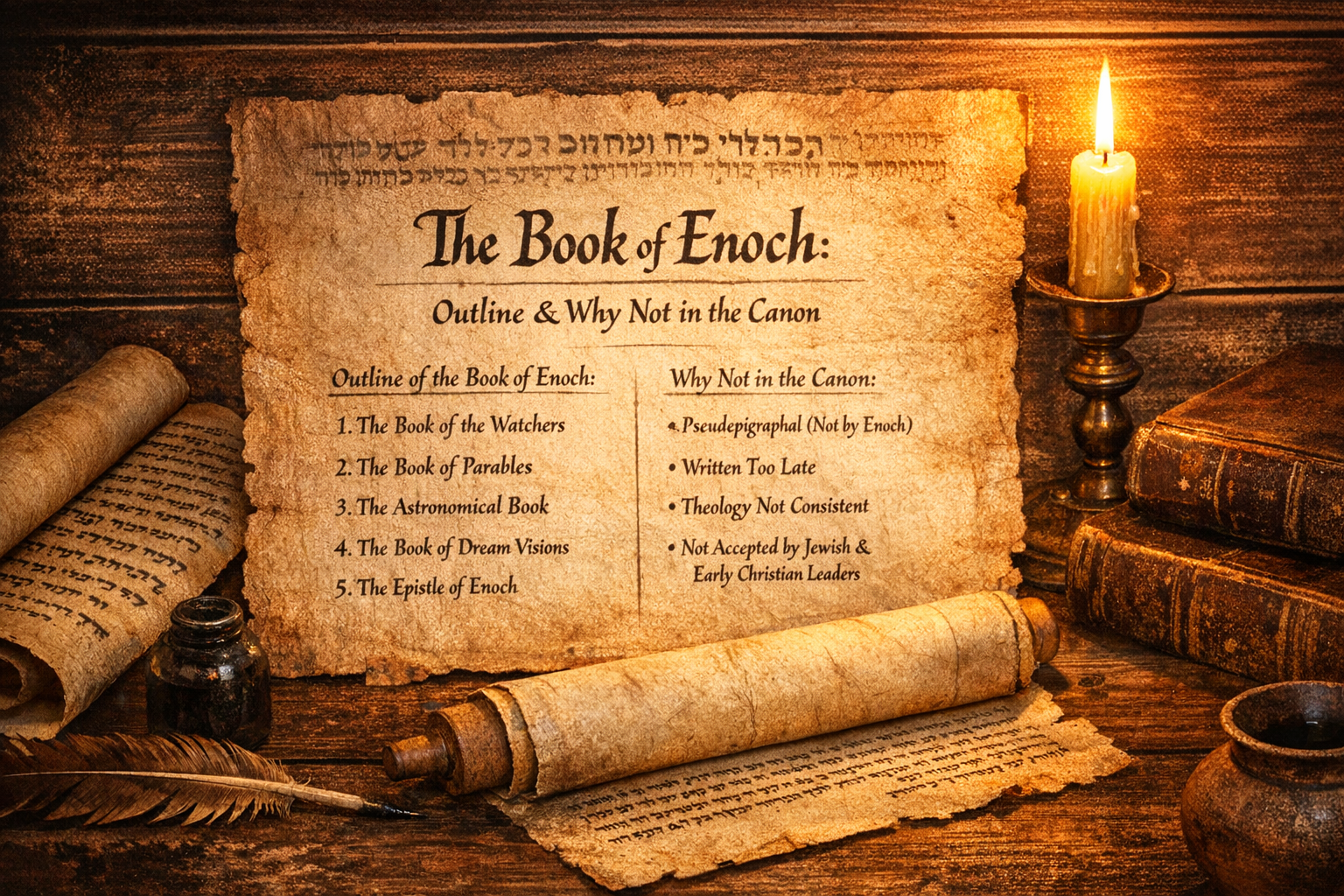
The Book of Enoch is a fascinating ancient Jewish work—rich, symbolic, and influential—but it is not accepted in the Jewish or Christian biblical canons (except in the Ethiopian Orthodox tradition) because it fails key tests of authorship, date, theological consistency, and widespread acceptance. Jude quotes it because it was well‑known, not because it was considered Scripture.
🕊️ Outline of the Book of Enoch (1 Enoch)
1. The Book of the Watchers (Chs. 1–36)
- The descent of the Watchers (fallen angels)
- Their sin with human women → the birth of the Nephilim
- Enoch’s heavenly journeys
- Pronouncements of judgment on the Watchers
- Cosmic imagery and descriptions of heaven and hell
2. The Book of Parables / Similitudes (Chs. 37–71)
- Three parables revealing heavenly mysteries
- Introduction of the “Son of Man” figure
- Judgment scenes and vindication of the righteous
- Messianic themes (highly debated among scholars)
3. The Astronomical Book (Chs. 72–82)
- Detailed descriptions of the movements of the sun, moon, and stars
- Ancient Jewish cosmology
- Emphasis on heavenly order and divine law
4. The Book of Dream Visions (Chs. 83–90)
- Symbolic animal allegories of Israel’s history
- Vision of the Flood
- Prophetic imagery of future judgment and restoration
5. The Epistle of Enoch (Chs. 91–108)
- Ethical exhortations
- Apocalyptic warnings
- Promises to the righteous
- Final judgment and the renewal of creation
📘 Why the Book of Enoch Is Not Accepted in Most Biblical Canons
1. Authorship is not genuine (pseudepigraphal)
Scholars agree the book was not written by Enoch, who lived before the Flood.
It is a collection of writings from multiple authors over several centuries (likely 3rd–1st century BC).
2. Date is too late for Old Testament canon
Even the earliest sections were written long after Enoch lived and after the recognized prophetic period closed.
Jewish leaders did not include it in the Tanakh.
3. The early church did not accept it as Scripture
To be included in the canon, early Christians looked for:
- Apostolic connection
- Widespread church use
- Doctrinal consistency
Enoch failed these tests.
4. Theology diverges from Scripture
Some teachings—especially about angels, cosmology, and the Messiah—do not align cleanly with the rest of the Bible.
Early Christians valued it but did not treat it as inspired.
5. Limited manuscript support
Only fragments of 1 Enoch were found among the Dead Sea Scrolls, not the whole book.
This raised questions about its stability and transmission.
6. Only one Christian tradition accepts it
The Ethiopian Orthodox Church includes 1 Enoch in its canon, but no other major Christian group does.
✨ Why Jude Quotes Enoch
Jude 14–15 quotes 1 Enoch because:
- It was well‑known in Second Temple Judaism
- It contained true statements, even if the book as a whole wasn’t inspired
- Biblical authors sometimes quote non‑canonical works (e.g., Paul quotes Greek poets)
Quoting something does not make the entire source Scripture.
