A place to grow your relationship with God

Archive for the ‘Fall’ Category

When the Frost is on the Pumpkin

By Jame Whitcomb Riley

When the frost is on the punkin and the fodder’s in the shock,
And you hear the kyouck and gobble of the struttin’ turkey-cock,
And the clackin’ of the guineys, and the cluckin’ of the hens,
And the rooster’s hallylooyer as he tiptoes on the fence;
O, it’s then’s the times a feller is a-feelin’ at his best,
With the risin’ sun to greet him from a night of peaceful rest,
As he leaves the house, bareheaded, and goes out to feed the stock,
When the frost is on the punkin and the fodder’s in the shock.

They’s something kindo’ harty-like about the atmusfere
When the heat of summer’s over and the coolin’ fall is here-
Of course we miss the flowers, and the blossums on the trees,
And the mumble of the hummin’-birds and buzzin’ of the bees;
But the air’s so appetizin’; and the landscape through the haze
Of a crisp and sunny morning of the airly autumn days
Is a pictur’ that no painter has the colorin’ to mock-
When the frost is on the punkin and the fodder’s in the shock.

The husky, russel of the tossels of the corn,
And the raspin’ of the tangled leaves, as golden as the morn;
The stubble in the furries-kindo’ lonesome-like, but still
A-preachin’ sermuns to us of the barns they growed to fill;
The strawstack in the medder, and the reaper in the shed;
The hosses in theyr stalls below-the clover over-head!-
O, it sets my hart a-clickin’ like the tickin’ of a clock,
When the frost is on the punkin and the fodder’s in the shock!

Then your apples all is gethered, and the ones a feller keeps
Is poured around the celler-floor in red and yeller heaps;
And your cider-makin’ ‘s over, and your wimmern-folks is through
With their mince and apple-butter, and theyr souse and saussage, too! …
I don’t know how to tell it-but ef sich a thing could be
As the Angels wantin’ boardin’, and they’d call around on me-
I’d want to ‘commodate ’em-all the whole-indurin’ flock-
When the frost is on the punkin and the fodder’s in the shock!

Delicious Turkey with Honey and Herbs

Prep: 10 min. Bake: 3½ hours Makes: 18 servings

Ingredients

  • 1 turkey (14 to 16 lbs.)
  • ¼ cup olive oil
  • 2 tsp. dried thyme
  • 1½ tsp. salt, divided
  • 1/4 tsp. pepper, divided
  • 1 cup honey
  • 1 cup corn syrup
  • 1/4 cup butter, melted
  • 2 tsp. dried rosemary, crushed
  • 1 tsp. rubbed sage
  • 1 tsp. dried basil

Directions

  1. Brush turkey with olive oil; tie the drumsticks together. Place the turkey breast side up on a rack in a roasting pan.
  2. Combine the thyme, 1 tsp. salt and 1 tsp. pepper; sprinkle evenly over turkey. Bake the turkey, uncovered, at 325° for 2 hours .
  3. In a bowl, combine the honey, corn syrup, butter, rosemary, sage, basil, and remaining salt and pepper. Brush over turkey.
  4. Bake until a thermometer inserted in thickest part of thigh reads 170°-175°, about 90 minutes longer, basting frequently with pan drippings.
  5. Cover loosely with foil if turkey browns too quickly. Remove turkey from oven. Cover and let stand for 15 minutes before carving.

Delicious Garlic Rosemary Turkey for Thanksgiving

Prep: 10 min. Bake: 1/2 hours + standing Makes: 15 servings

What you need

  • 2 Tbsp. olive oil
  • 8 to 10 garlic cloves, peeled
  • 3 Tbsp. chopped fresh rosemary or 3 tsp. dried rosemary, crushed
  • 1 tsp. salt
  • 1 tsp. paprika
  • ½ tsp. coarsely ground pepper
  • 1 bone-in turkey breast (5 lbs.)

What you need to do

  1. In a food processor, combine the olive oil, garlic cloves, rosemary, salt, paprika and pepper; cover and process until the garlic is coarsely chopped.
  2. With your fingers, carefully loosen the skin from both sides of turkey breast. Spread half the garlic mixture over the meat under the skin. Smooth skin over meat and secure to underside of breast with toothpicks. Spread remaining garlic mixture over turkey skin.
  3. Place turkey breast on a rack in a shallow roasting pan. Bake, uncovered, at 325º until a thermometer reads 170°, 12-2 hours. Let turkey stand for 15 minutes before slicing. Discard toothpicks.

Jack Frost’s Celebration

How the wind blows tonight!” said father after supper. “It whistles around the corners. It nearly whistled off my hat, when I came home.”

“I should think that you would wear a cap,” said mother.

“Fur caps will be needed soon,” father said. “The cold weather is here to stay. No more warm weather until next spring. Let’s celebrate, this evening.”

“I know what celebrate means,” said Polly. “It’s what we do on the Fourth of July and Thanksgiving and Christmas.”

“Birthdays, too,” said Peter. “I had a birthday party.”

“That is so,” Polly said. “But what shall we celebrate tonight?”

“Let us celebrate winter,” father said. “Let us give Jack Frost a party. Come now and begin.

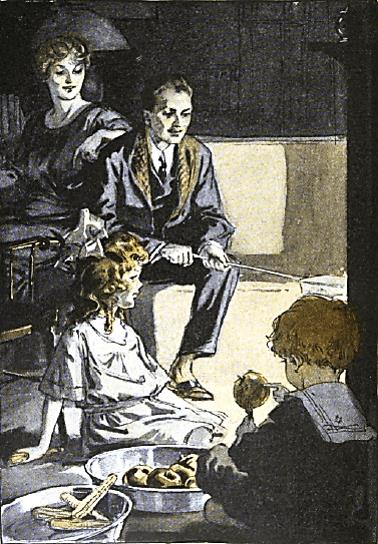
“First we will light the fire in the fireplace. Light your end, Polly. Light your end, Peter. We will see which end burns brighter.

“Mother will fix the chairs while I am down in the cellar. You two look out for sparks. That kindling wood is snapping.”

In a few minutes, father was back. Can you guess what he brought?

A pan full of apples. They came from a barrel in the cellar. They had grown out in the orchard.

Besides, he had a bag with ears of corn in it. And he had another pan, and a corn popper.

“Oh, oh, oh!” cried Peter and Polly. “How could you carry so many things?”

Father put down the pan of apples. “We will each roast one,” he said. “Pick yours out, children. Now we will put our apples on the bricks near the fire.

“Peter, you may watch them. After a while, you must turn them around. Do you know why?”

“What shall I do, father?” asked Polly.

“You may shell some corn into the popper. We cannot pop it jet. We must wait for the flames to die down a little.”

“Next week is Thanksgiving,” said mother. “Won’t it be fun to go down to grandmother’s for dinner? I wish that we might have a snowstorm before then.”

“I am thankful right now,” said Polly. “I am thankful for you and father and Peter and grandmother and this fire. I shall be thankful for popped corn, when I get some.”

“We will try it now,” said father. And he began to shake the popper over the coals.

Pop, pop, pop, pop went the corn. The white kernels hopped up and down. They seemed to be trying to get out.

“It is nearly done,” said Polly. “See! The popper is full.”

Just at that minute the corn caught fire.

“Oh, oh!” cried Polly. “It will all burn up! It will all burn up!”

It did not. Father quickly blew out the flames. Some of the kernels were black. He poured the others into the warm pan. Mother put in salt and melted butter.

Polly shelled more corn, and father popped it. Soon the pan was full. Did anything ever taste so good as that hot, buttered popped corn?

At last father said, “This celebration is almost over. I believe that it is long after bedtime.”

Polly said, “I am sure, now, that I am glad winter has come. I was not sure before. I have had a good time at our winter party.”

“So have I,” said Peter. “I am going to kiss everybody goodnight. I have had such a good time that I have lots of kisses in my face.”

“Pass them around then, my son,” said father. “Then run upstairs to bed. Jack Frost’s party is finished.”

Tim’s Football

Peter,” called Tim, “come out here.”

Tim was in Peter’s front yard. He was kicking something about.

“What are you doing?” asked Peter.

“I am playing football. Don’t you know that all the big boys play football in the autumn? My mother made me this football. It is a good one. See!”

Tim picked up his ball. He handed it to Peter. It was just a bag made of cloth. It was stuffed with rags.

“Yes, it is a good one,” said Peter. “One day I made a football out of burdock burrs. But it came to pieces, when I kicked it. Yours will not do that.”

“No,” said Tim, “it will not. My mother said that I may kick it to pieces, if I can. Then my father will bring me a real one from Large Village.”

“Let me take it a minute, Tim. Let me show it to my mother. She will make one for me.”

Mrs. Howe made Peter a football. It was just like Tim’s. It did not take her very long to do it. She made a strong bag on the sewing machine. She stuffed it with rags. Then she sewed up the end.

“There,” she said, “now you both have footballs. I think that they are very good ones. You may go to Tim’s and play with them. Tim has some leaves up at his house for you to jump in.”

Tim and Peter kicked their footballs all the way up the hill. Sometimes the balls did not go straight. Sometimes, when they tried, the boys did not kick them at all.

Once Peter kicked very hard. He did not touch his ball. He kicked so hard that he fell down.

“See all your leaves, Tim,” said Peter. “Your yard is fall of them. Let’s rake them up. Maybe we can have a bonfire.”

“We can rake them,” said Tim. “But we cannot burn them. I heard my father say that he should keep our leaves.”

“What for?” asked Peter.

“He is going to put them in a big pile,” said Tim. “He is going to cover them over.

“After he has left them in a pile for a long, long time, they will rot. Then they will be good for the garden.”

“I should rather have a bonfire,” said Peter.

“So should I,” said Tim. “But my father would not. He gets things to sell from his garden. So he has to make them grow fast.”

“My father does not,” said Peter. “He keeps a store. He has the post office, too. That is in his store. I have seen him put the letters into boxes.”

“So have I,” said Tim. “And I have had a letter, too. Let’s rake up a pile of leaves now. We can jump in them.”

“Where is my football?” asked Peter.

“I do not know, Peter. It must be somewhere in the leaves. We can find it when we rake them up. Oh, see mine!”

“There is a hole in it,” said Peter. “The insides are sticking out. Now you can have a real one, Tim. Your mother said so. Let us take it in to show her.”

When the boys came out of the house, Tim said, “Polly and I buried you in the sand the other day. Now you bury me in the leaves.”

He lay down and Peter piled leaves all over him. He even covered up his face. The leaves were very light. Tim liked the smell of them.

Soon he jumped up. He did not need anyone to dig him out. Then he covered Peter all over.

“Do not go to sleep,” he said. “If you do, we shall never get the leaves raked up. Now you have been buried long enough. Come out!”

Next, they tried to bury Collie and Wag-wag. But the dogs would not lie still. They thought that it was some kind of game. They wished to play, too.

At last the boys found Peter’s football.

“I must take this home, before I lose it again,” said Peter. “Goodbye, Tim. I have had a good time. Come and play with me this afternoon.”

Fall Themes: Bible, Cooking, Poems, and More

Here you will find diverse fall categories including Bible topics, cooking recipes, poems, stories, and educational content for kids.

How Much Canned Food from Fresh Produce?

The amount of canned food you can get from a given quantity of produce depends on the quality, maturity, variety, and size of the fruit or vegetable, whether it is whole, in halves, or in slices, or whether it is packed raw or hot. The following charts shows you the approximate yield of canned foods from the given quantities of fruits and vegetables.

Food (Fruit)Amount of FreshAmount Canned
Apples1 bu. (48 lbs.)
2½-3 lbs.
16-20 qts.
1 qt.
Berries,
except strawberries
24-qt. crate
1 1/4-3 lbs.
12-18 qts.
1 qt.
Peaches 1 bu. (48 lbs.)
2-3 lbs.
18-24 qts.
1 qt.
Pears1 bu. (48 lbs.)
2-3 lbs.
18-24 qts.
1 qt.
Plums1 bu. (56 lbs.)
1½-2½ lbs.
24-30 qts.
1 qt.
Tomatoes1 bu. (53 lbs.)
1½-3½ lbs.
15-20 qts.
1 qt.
Food (Vegetables)Amount of FreshAmount Canned
Asparagus1 bu. (45 lbs.)
2½-4½ lbs.
11 qts.
1 qt.
Beans, lima in pods1 bu. (32 lbs.)
3-5 lbs.
6-8 qts.
1 qt.
Beans, snap1 bu. (30 lbs)
1 1/2 – 2 1/2 lbs.
15-20 qts.
1 qts.
beets, without tops1 bu. (53 lbs)
2-3 lbs
17-20 qts.
1 qt
Carrots, without tops1 bu. (50 lbs)
2-3 lbs
16-20 qts.
1 qts.
Corn, sweet, in husks1 bu. (35 lbs)
6-16 ears (3-6 lbs)
8-9 qts.
1 qt
Okra1 bu. (26 lbs)
1-1 1/2 lbs
16 qts.
1 qt.
Peas, green, in pods1 bu. (30 lbs)
3-6 lbs
6-7 qts.
1 qt.
Spinach1 bu. (18 lbs)
2-6 lbs
6-9 qts.
1 qt.
Squash, summer1 bu. (40 lbs)
2-4 lbs
16-20 qts.
1 qt.
Sweet potatoes1 bu. (55 lbs)
2-3 lbs
18-22 qts.
1 qt.


How the Leaves Came Down

HOW THE LEAVES CAME DOWN

I’ll tell you how the leaves came down.
The great Tree to his children said,
“You’re getting sleepy, Yellow and Brown,
Yes, very sleepy, little Red;
It is quite time you went to bed.”

“Ah!” begged each silly, pouting leaf,
“Let us a little longer stay;
Dear Father Tree, behold our grief;
‘Tis such a very pleasant day
We do not want to go away.”

So, just for one more merry day
To the great Tree the leaflets clung,
Frolicked and danced and had their way,
Upon the autumn breezes swung,
Whispering all their sports among,—

“Perhaps the great Tree will forget,
And let us stay until the spring,
If we all beg and coax and fret.”
But the great Tree did no such thing;
He smiled to hear their whispering.

“Come, children, all to bed,” he cried;
And ere the leaves could urge their prayer
He shook his head, and far and wide,
Fluttering and rustling everywhere,
Down sped the leaflets through the air.

I saw them; on the ground they lay,
Golden and red, a huddled swarm,
Waiting till one from far away,
White bedclothes heaped upon her arm,
Should come to wrap them safe and warm.

The great bare Tree looked down and smiled,
“Good night, dear little leaves,” he said.
And from below, each sleepy child
Replied, “Good night,” and murmured,
“It is so nice to go to bed!”

—Susan Coolidge.

Copyright, 1889, by Roberts Brothers.

Playing in the Leaves

PLAYING IN THE LEAVES

One day Peter saw something that pleased him. It was a branch of red leaves on a maple tree.

He said to mother, “It will be winter soon.”

“Why do you think so, Peter?”

“I have seen red leaves,” said Peter.

“But, Peter, a few red leaves do not count. There are red leaves in the summer. You must watch until you see many red, yellow, and brown leaves.”

“What makes the leaves red and yellow, mother? Is it magic?” asked Peter. “Can you do it?”

“Perhaps it is a kind of magic, Peter. It is like the clouds turning into snow. I cannot do that.”

Then Peter watched for all the trees to turn. At last they were bright with colors.

The maples were red and yellow; the oaks a deep red. The beeches were a bright yellow.

Even the elm trees in front of the house were yellow. Now Polly liked more than ever to swing. The swing took her way up among the yellow leaves.

Then, one day, the leaves began to fall. Down they came, a few at a time. The next day more fell, and the next and the next.

Polly said, “They are prettier than the snowflakes. The snow is white. These have lovely colors. See them flying through the air.”

At last most of the trees were bare. The leaves lay on the ground.

Then Peter said, “Oh, the poor trees! They haven’t any clothes on. I am so sorry.”

Polly said, “The leaves are not clothes. They are children. Now they have gone to bed. The snow is their blanket. When it comes, it will keep them warm. If we leave them alone, they will sleep all winter. I learned it in a poem.”

“They cannot go to sleep yet,” said Peter. “I shall not let them. I shall wake them up.”

“How will you do that?” asked Polly.

“I shall run in them. That will keep them awake. I shall do it now. Come on! See if you can make as much noise as I can.”

After a while the children raked the leaves into large heaps. Then they jumped in the heaps. This scattered the leaves. But the children did not care. They raked them up again.

Once Peter jumped where the leaves were not very deep. He came to the ground with a bang. He was surprised. But he was not much hurt.

He said to mother, “My teeth shut with a noise when I went down.”

Mother said, “It is lucky that your tongue was not in the way. You would have bitten it badly.”

“Come in now, both of you. You must wash your hands and faces. Father will be home soon. You may play in the leaves to-morrow.”

The Birds’ Game of Tag

THE BIRDS’ GAME OF TAG

It is fall. Summer is really over. But it is still warm. Jack Frost has not yet begun his work.

Peter and Polly have been watching the birds. For days they have seen great flocks of them. In the summer there were not so many together.

One day they saw several robins. These were flying from tree to tree.

Peter said, “I know they are having a party. They are playing tag.”

“Perhaps they are,” said his father. “Perhaps each bird is telling something to the bird he tags.”

“What is he telling?” asked Peter.

“I think he is saying, ‘Brother bird, don’t you know that winter is coming? Soon the snow will be here. What shall we do then?

“‘We cannot get food. We shall freeze. Come, let us fly away to the South. It is warm there.'”

“What does brother bird say?” asked Peter.

“I think brother bird says, ‘It is a long way to the South. It will take many days and nights to fly there.

“‘Are our children’s wings yet strong enough? I do not like to go. But I know that we must.'”

“Doesn’t he like to go, truly?” asked Peter.

“We do not know, Peter. The robins make their nests here. They lay their blue eggs here. They hatch their little birds here. They never do this in the South.

“Besides, they sing their beautiful songs here. They never sing them in the South. We like to think that they love the North better. But, of course, we do not know.”

“How can they find their way back?” asked Polly.

“We do not know that, either, Polly. Many birds fly in the nighttime. Then they rest a part of the day.”

“I couldn’t find my way in the dark,” said Polly.

“But the birds can,” said father. “We do not know how. The winter home of some of our birds is thousands of miles from here.”

“I like to watch the swallows,” said Polly. “They sit in a line on a telephone wire. Then one flies to another wire. In a minute they all fly, too.

“I think that they are talking about going away soon. I hope they will not get lost.”

“Yes,” said father. “They will soon be gone. But perhaps some of these very birds will come back here next summer.”

“I wish we could know them,” said Polly.

“We shall have a few birds left this winter,” said father. “You know some of them. You know the chick-a-dees and the woodpeckers. And this winter I shall show you others.”

“May we hunt for nests and eggs, father?” asked Peter.

“We may hunt, Peter, but we won’t find any eggs in winter. We shall find other things. Perhaps we shall find the white-footed mouse. He sometimes makes his home in an old bird’s nest.”

“Can a mouse climb trees, father? If he lives in a bird’s nest, does he lay bird’s eggs?”

“He can climb trees, Peter. But he cannot lay eggs. We will see if we can find Mr. White-foot some day.

“But first we will watch the birds fly away and the snow come.”