A place to grow your relationship with God

Posts tagged ‘homeschool’

Math: Subtract Numbers Up to 40

STEP 1

  • Have the children write out and complete the subtraction exercises below on paper.

STEP 2

  • Assess mastery by reading aloud the listed problems and having the children mentally compute and recite the solutions.
  • If children have difficulties, have children redo their written practice with pencil and paper again and then reassess.

The Age of Stonehenge

The Age of Stonehenge

BY THE

REV. EDWARD DUKE,
M.A., F.G.S., &c.

The Age of Stonehenge

Will the precise age of the erection of Stonehenge ever be ascertained?  It seems very unlikely that it ever will be.  Perhaps it is not desirable that it should be.  The mystery which enwraps it in this respect adds not a little to the imposing grandeur of those weather-beaten stones.  But though we cannot say exactly how old this wonderful structure is, we may, I think, say with confidence that it is not later than a certain era, i.e., that when the Roman legions invaded our shores (B.C. 55) Stonehenge was standing as now in the midst of Salisbury Plain.  To the proof of this I am wishful to draw attention, inasmuch as the post-Roman theory put forth by the late Mr. James Fergusson has obtained credence with not a few intelligent persons.

Mr. Fergusson’s well-known work, “Rude Stone Monuments,” contains much interesting information on the subjects of which he treats, and the facts which he adduces we may presume to be facts collected with care.  But this proves nothing as to the truth of the inferences which he deduces from his premises.  The observing faculty and the faculty for drawing correct conclusions do not always meet in the same individual, as was notably the case in the late talented Charles Darwin with respect to his physical evolution theory.  Fergusson confidently maintains, in the work to which I refer, that “Stonehenge was erected as a monument to the memory of the British chiefs treacherously slain by Hengist.”  He supposes that its building commenced about A.D. 466, and may have been completed about A.D. 470.  And on what authority does he chiefly rely historically for this theory?  On the medieval historian Geoffrey of Monmouth, who wrote about A.D. 1140.  But what does he himself say of the credibility of this writer?  To quote his own words: “he was a fabulist of the most exuberant imagination” (p. 106), and again he says of him (p. 88), “he is a frail reed to rely upon”; and yet, strange to say, we find him building much on the uncorroborated statement of Geoffrey that Stonehenge was erected in memory of the slaughter of certain British chiefs.

But no less weak and inconclusive is his reasoning when he brings his reader within the area of Stonehenge.  He points attention to the fact that Sir R. C. Hoare had stated in his “Ancient Wilts,” I. p. 150:—“We have found in digging (within the circle) several fragments of Roman as well as coarse British pottery, part of the head and horns of deer and other animals, and a large barbed arrow-head of iron”; and he also mentions that Mr. Cunnington at an earlier date had discovered within the area some Roman pottery. From this Mr. Fergusson infers that “the building must have been erected after the Romans had settled in this island.”  But what does the fact, assuming it to be a fact, that Roman pottery was found at Stonehenge, prove?  Not that the Romans, or their successors, were the builders, but simply what no one will question, that the Romans during their stay in Britain, occupied this part of the country, and visited Stonehenge.  He omits in his argument, it should be observed, to take any notice of the fact that “ancient British pottery” was found at the same time with Roman within the temple.  Does not such an omission detract much from the fairness and force of his reasoning?  Moreover, we find that Sir R. C. Hoare in his “Ancient Wilts” repeatedly mentions that in digging within what were undoubtedly ancient British camps in South Wilts, he met with Roman pottery as well as British.  What does this indicate?  Simply that while these earthworks had been originally constructed by our Celtic forefathers they were afterwards occupied, and in many instances re-formed, by the Romans.  It indicates thus much certainly, but nothing more, and similarly the finding Roman pottery at Stonehenge is no proof that the Roman people, or their successors, had any hand whatever in its construction.  Possibly it may have happened, though I admit that we have no evidence to offer on this point, that the Romano-British ladies were accustomed to have their picnics at Stonehenge, as we do now, and “as accidents will sometimes happen” an article or two of their pottery may have been broken, and have become gradually embedded in the ground, so as to mislead some of the learned archeologists of the present day.  Evidence drawn from objects found beneath the soil is usually very inconclusive.  As in this case, there may have been diggings at different times; stones we know have been upset; earth is apt to accumulate in the lapse of time; and objects once on the surface to sink down and become buried.  Time effects many such changes, and mistakes often arise from not bearing this sufficiently in mind.

But putting aside for the present the unsatisfactory evidence on which this theory is based, let us see whether the surrounding barrows have not something to say on the question before us.  These barrows are, as everyone must have observed, more than usually numerous around Stonehenge.  There are about 300 within a radius of a mile and a-half.  They are, in fact, much more thickly conglomerated hereabouts than elsewhere on the plain.  This, I think I shall be able to show presently, is no accidental circumstance, but that it has a significant bearing on the age of this mysterious structure.

First, however, let us take notice of the contents of these particular barrows, and of the evidence thence deducible as to the era of their construction.  They are unquestionably pre-Roman.  They have all been opened, and nothing Roman, whether coins, or pottery, or ornaments, or weapons, has been found in any of them.  This we know on the authority of that very able and most careful barrow-opener, Sir R. C. Hoare, vide his “Ancient Wilts.”  In saying this, it must be borne in mind that we are speaking of the barrows which immediately surround Stonehenge.  In other parts of England, and indeed, in other parts of Wiltshire, there are tumuli of later age; but in this particular district they are all, without exception, of an era prior to the Roman occupation.

And now I need scarcely say that if only we can satisfactorily connect these barrows with Stonehenge, we shall be furnished with a clue to its age of no little value—not, indeed, to its precise or positive age, but to its age in relation to the period when the Romans occupied Britain.

Our question, then, is this—Does the position of the barrows in reference to Stonehenge, enable us to infer that they have been located with a special view to the temple which they surround so numerously?  In answering this question, we may at once admit that no regular order of position is observable.  They do not appear to be placed in concentric lines, or avenues.  This, however, will at once strike an observer, that the eminences rather than the depressions or hollows between the hills have been chosen as sites for these sepulchral mounds.  The instances are very rare indeed in which barrows are to be found in any of the numerous little valleys where they would be out of sight.

But more decided evidence than this is of course needed.  And for such evidence we have not far to seek.  The pedestrian may obtain it without any great difficulty.  Let him visit, as I have done myself, every barrow on the surrounding plain within the above-mentioned radius, and then mount to the summit of each, whether it happens to be a bowl or bell-shaped barrow, or any of the more elevated tumuli, and I can promise him a view, in almost every instance, of the old stones from the top.  There are indeed a few exceptions, but only of such a nature as in fact to “prove the rule.”  In some cases plantations, or similar modern intervening objects, hide the view.  One or two cases also I noticed in which a barrow in the foreground obstructed the view from one further back.  But this was not, as I think, that the later barrow-builders acted uncourteously towards the earlier ones, but simply that they did it inconsiderately—they did not notice that they were thus obstructing the line of view.  Again, there are other cases in which you do not perhaps get the view from the base of the barrow, but as you ascend to the top, to your surprise and pleasure you find the grand old stones suddenly burst into sight.  But do there still remain a few instances unaccounted for?  There are a few, but they are very few, and I do not think we need feel the slightest difficulty in explaining these exceptional cases.  Bear in mind that these barrows were the burying places, not of the common people, but of the chieftains and other distinguished persons, as is evidenced by their contents.  They thus represent in all probability a considerable lapse of time, during which the deceased bodies were conveyed—some it may be from long distances—to this grand unfenced cemetery.  It is therefore very probable that the interments may have occupied a considerable number of years, and may have, in some instances, even preceded the time-honoured temple of Stonehenge.  But I again repeat that these exceptions are very few in number, nor do they in any degree shake the conclusion, which really is irresistible, that these said barrows do not occupy chance positions, but that the selection of the sites, as they became needed, was governed by a sacred feeling, such as even heathens may have, that they would wish the ashes of their beloved dead to repose in view of the temple where they worshipped in their lifetime.

But there still remains to be mentioned another fact which, added to what has gone before, seems to render the evidence in favour of the pre-Roman antiquity little short of demonstrative.  It is this.  On the western side of the temple there were formerly several barrows, now, I am sorry to say, obliterated by the ruthless plough, which were opened first by Dr. Stukeley, and afterwards re-opened by Sir R. C. Hoare, in one of which were found numerous fragments, not only of the “sarsens,” which would not have been so conclusive, but also of the so-called “blue stones,” i.e., the igneous stones of the syenitic or green stone class, which could have been brought from nowhere else in the neighbourhood, and which therefore must have been chippings taken from the stones themselves, as they were being prepared for their places in the temple.  Sir R. C. Hoare says, with reference to one of these barrows:—“On removing the earth from over the cist” (and therefore from the very base of the barrow) “we found a large piece of one of the blue stones of Stonehenge, which decidedly proves that the adjoining temple was erected previous to the tumulus.”  He also says that “in opening the fine bell-shaped barrow on the north-east of Stonehenge, we found one or two pieces of the chippings of these (blue) stones, as well as in the waggon tracks round the area of the temple.”  I need not point out the satisfactory evidence which all this brings to bear on the question before us.  The surrounding barrows are all pre-Roman, and therefore, for the reasons alleged, Stonehenge must be pre-Roman also, as being older, possibly much older, than the majority of the barrows themselves.

And now what shall we say more?  The grand old temple pleads for itself.  To assign to it the later origin would be to deprive it of its well-founded claim to take rank among the most interesting of all the relics of the ancient heathen world which have come down to us.  Thus dishonoured, it would sink down into the comparatively insignificant monument of a treacherous slaughter said to have been perpetrated in the neighbourhood about A.D. 450.  But can this be all the meaning there is in this mysterious structure, which has been viewed with astonishment and veneration by such numbers of persons through successive centuries?  Only think of the time and labour—the almost superhuman efforts—which it must have cost our forefathers to convey these ponderous stones to the spot, and then to shape and to set them up.  Such sustained exertion as this, so laborious and so costly, requires a motive to account for it.  And there is no motive we know of so powerful as what may be termed “the religious instinct.”  The force of this principle of human nature, even in its sadly corrupted state as it exists in the case of the ignorant and superstitious heathen, is nevertheless the strongest principle of action in the human breast.  We see it in the tenacity with which heathen idolaters cling to their ancestral deities, or, as in India, in the enormous sums of money which have been lavished by the Hindus on the construction and adornment of their idolatrous temples.  Viewing Stonehenge, then, as a temple erected at a very early period for the worship of the Sun, or Baal, we have what may be regarded as an adequate motive for all the time and labour which must have been expended in its construction, while, on the other hand, such a sufficient motive seems to be altogether wanting on any other supposition.  It may be added that the author of “Rude Stone Monuments,” while strenuously maintaining his own view, admits, with some degree of inconsistency, that “looking at the ground plan of Stonehenge there is something singularly templar in its arrangements.”  It is also worth noticing that the utter absence of anything like ornamentation in this building is itself a very strong argument against its Roman or post-Roman age.  For we shall look in vain to find amongst the acknowledged remains of Roman architecture any example of such severe unadorned simplicity as we have here.

May we not then be suffered to retain our old belief that this is unquestionably a relic of Pagan antiquity of surpassing interest, visibly testifying as it does amidst the solitude and silence of the surrounding plain to the state in which our Celtic or Belgic forefathers were before the light of Christian truth visited our shores, and brought with it the civilization, and other inestimable blessings, which we now happily possess.

Understanding Black History Month: Significance and Milestones

Feb. 1st is the First Day of Black History Month: Black History Month is an annual celebration in February that honors the achievements and contributions of African Americans throughout history.

Black History Month is an annual observance, in February, of the past achievements and current status of black Americans. It coincides with the birthdays of the great black leader Frederick Douglass (February 14th) and of Abraham Lincoln (February 12th).


The idea for an observance honoring the accomplishments of black Americans led to the establishment of
Negro History Week in 1926. It was proposed by Carter G. Woodson, a black historian known as the Father of Black History, and others. The observance became known as Black History Week during the early 1970’s and was established as Black History Month in 1976.


The celebration is sponsored by the Association for which Woodson founded in 1915. Each year,
the Study of Afro-American Life and History (ASALH), designates a theme for the observance. Special attention has also been paid to the growth of black studies courses at high schools and colleges in most parts of the country.

The ASALH produces Black History Month Study Kits to help schools, colleges, ASALH branches, and other
organizations celebrate the observance. The ASALH also provides information about Black History Month
through its publications.

JESUS ASCENDS TO HEAVEN

JESUS ASCENDS TO HEAVEN

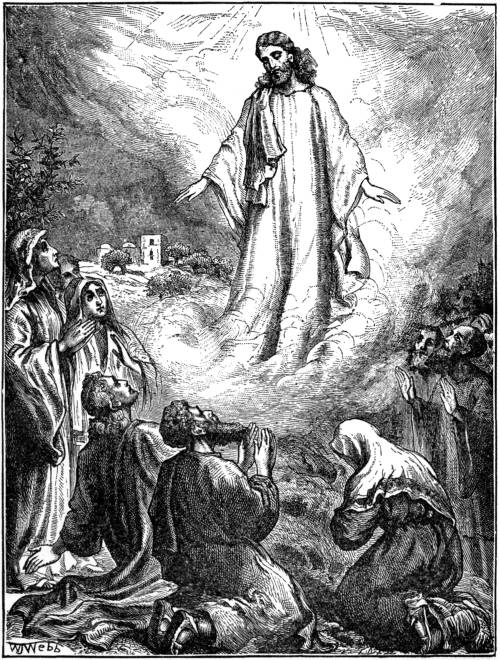
Jesus had been cruelly put to death. His hands, which had been placed on the heads of little children when He blessed them, had been nailed to a cross of wood; and cruel nails had been driven through his feet. And hanging on the cross, Jesus had died. But on the third day He had risen from the tomb, and for forty days He had remained upon the earth, meeting frequently with His disciples. At the end of that time Jesus led the eleven apostles from Jerusalem towards Bethany; and when near that village, and away from the multitude, He spoke to them, promising that they should be made bold by the Holy Spirit, and receive power to witness for Him both to the Jews and Gentiles. Then, the Bible tells us, “He lifted up His hands and blessed them. And it came to pass, while He blessed them, He was parted from them, and carried up into heaven.” And as He went up, a cloud received Him out of their sight.

The apostles fell down and worshipped Jesus, looking steadfastly after Him as He went up; and as they did so, two angels in white garments stood by them, and said, “Ye men of Galilee, why stand ye gazing up into heaven? This same Jesus, which is taken up from you into heaven, shall so come in like manner as ye have seen Him go into heaven.” Then the apostles returned to Jerusalem.

Yes, Jesus has ascended to heaven, and now He sits at the right hand of God; but He tells us that He will come again, and take those that love Him to dwell with Him in His glorious home for ever and ever. “I go to prepare a place for you,” Jesus says.

Something about the Great Civil War

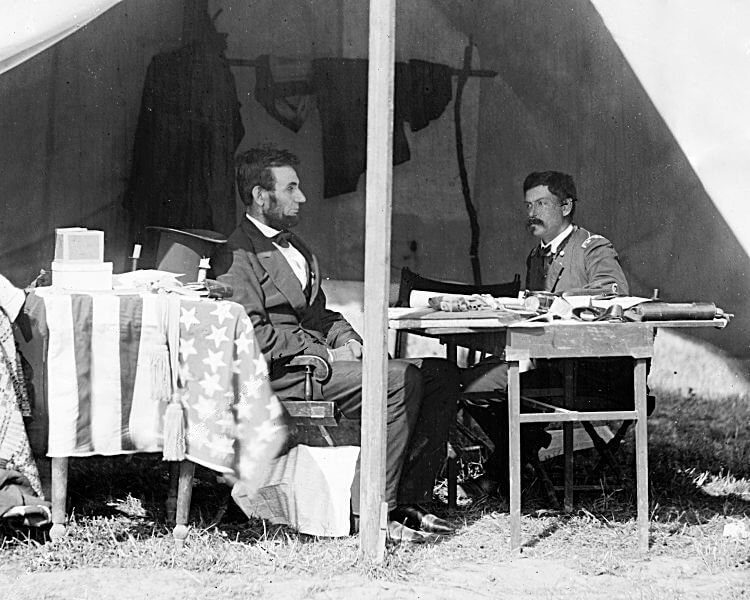
Soon after Abraham Lincoln became President, there broke out the civil war, which caused the death of many hundreds of thousands of brave men and brought sorrow to nearly every home in the United States. Perhaps none of those who study this book will ever see so sad a time. But it was also a brave time, when men gave their lives for the cause they believed to be right. Women, in those days, suffered in patience the loss of their husbands and sons, and very many of them went to nurse the wounded or toiled at home to gather supplies of nourishing food for sick soldiers in hospitals.

The war came about in this way: There had been almost from the foundation of the Government a rivalry between the Northern and Southern States. Long and angry debates took place about slavery, about the rights of the States and the government of the Territories. These had produced much bitter feeling. When a President opposed to slavery was elected, some of the Southern States claimed that they had a right to withdraw from the Union. This the Northern States denied, declaring that the Union could not be divided; but before Lincoln was inaugurated, seven States had declared themselves out of the Union. They formed a new government, which they called “the Confederate States of America,” and elected Jefferson Davis President.

President Lincoln refused to acknowledge that the Confederate States were a government. He refused to allow the United States fort in the harbor of Charleston, South Carolina, to be surrendered to the Confederates, and he sent ships with provisions for the small garrison of this fort. The Southern troops about Charleston refused to let these provisions be landed and at length opened fire on the fort. This began the war. Four other States now joined the Confederacy, making eleven in all.

It was a time of awful excitement in every part of the country. All winter long angry passions had been rising both in the North and in the South. When the first gun was fired at Sumter, in April, 1861, there was such a storm of fierce excitement as may never be seen again in America. At the North, a hundred thousand men were enlisted in three days. The excitement at the South was just as great, and a large portion of the Southern people rushed to arms. In those stormy times the drums were beating all day long in the streets; flags waved in every direction, and trains were thronged with armed men bidding farewell to friends and hastening forward to battle and death. Men and women wept in the streets as they cheered “the boys” who were hurrying away to the war. For a while, people hardly took time to sleep.

We cannot tell the story of the war here; you will study about it in larger histories. The armies on both sides became very large, and during the war there were some of the greatest conflicts ever seen in the world. The first great battle was fought at Shiloh, in Tennessee. Others took place at Murfreesboro [mur’-freze-bur’-ro], Chickamauga [chick-a-maw’-gah], and Nashville, in Tennessee; at Antietam [an-tee’-tam], in Maryland; and at Gettysburg, in Pennsylvania. Very many battles, great and small, were fought in Virginia, between Washington and Richmond.

On the side of the Union, the three most famous generals were U. S. Grant, W. T. Sherman, and Philip H. Sheridan. The three greatest generals on the Confederate side were Robert E. Lee, Joseph E. Johnston, and Thomas J. Jackson, commonly called “Stonewall Jackson.”

Both sides showed the greatest courage. The generals on both sides were very skillful. Victory was now with one party and now with the other; but, as the years passed on, the Union armies, being the stronger, gradually gained one advantage after another. By means of troops and gunboats sent down from the North under Grant and a fleet under Admiral Farragnt, which was sent around by sea to capture New Orleans, the whole of the Mississippi River was secured. Between Washington and Richmond, the Confederates won many victories, but they were at length compelled to fall back behind the fortifications of Richmond and Petersburg, where they were besieged by General Grant.

During the time of this siege, General Sherman marched directly into the heart of the Confederacy, where he was for weeks without any communication with the North. He marched across the great and fertile State of Georgia, from Atlanta to Savannah, on the sea coast, and then from Savannah northward toward Richmond. By destroying the railroads and the food by which General Lee’s army in Richmond was supplied, this march of Sherman’s made it impossible for the Confederates to continue the war.

Lee was forced to retreat from Richmond, and he surrendered his army on the 9th of April, 1865. All the other Confederate forces soon after laid down their arms. The war had lasted four years. As a result of the long struggle, slavery was abolished in all the territory of the United States.

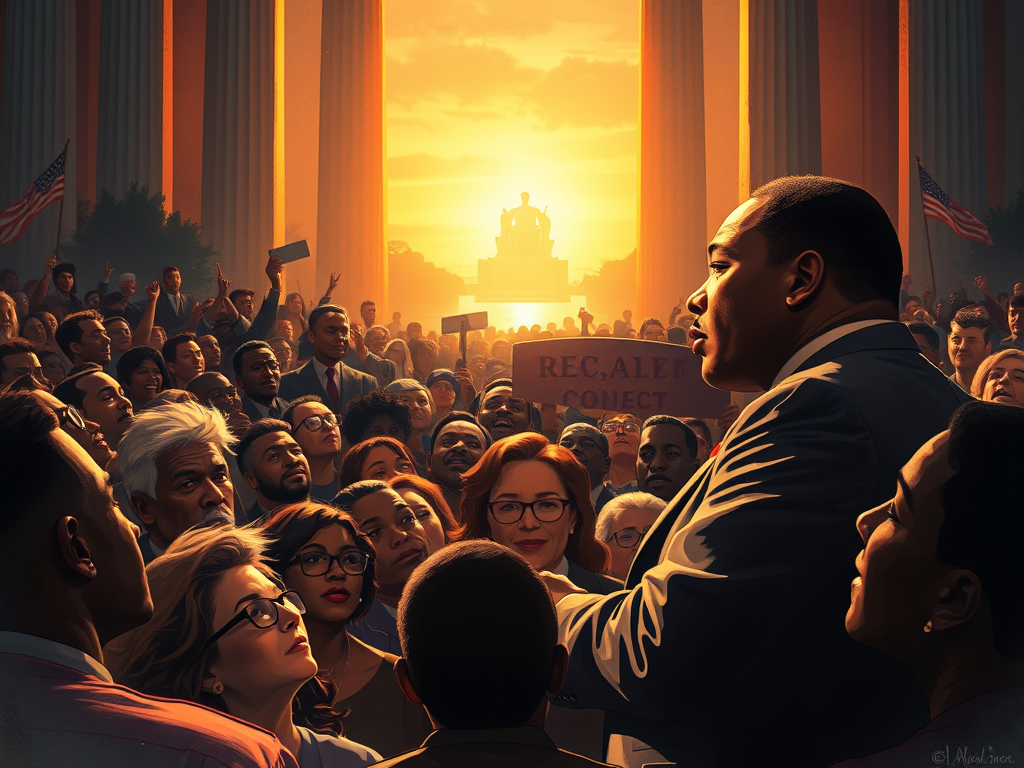
Martin Luther King, Jr. “I have a Dream Speech”

I am happy to join with you today in what will go down in history as the greatest demonstration for freedom in the history of our nation.

Five score years ago, a great American, in whose symbolic shadow we stand today, signed the Emancipation Proclamation. This momentous decree came as a great beacon light of hope to millions of Negro slaves who had been seared in the flames of withering injustice. It came as a joyous daybreak to end the long night of their captivity.

But 100 years later, the Negro still is not free. One hundred years later, the life of the Negro is still sadly crippled by the manacles of segregation and the chains of discrimination. One hundred years later, the Negro lives on a lonely island of poverty in the midst of a vast ocean of material prosperity. One hundred years later, the Negro is still languished in the corners of American society and finds himself an exile in his own land. And so we’ve come here today to dramatize a shameful condition.

In a sense we’ve come to our nation’s capital to cash a check. When the architects of our republic wrote the magnificent words of the Constitution and the Declaration of Independence, they were signing a promissory note to which every American was to fall heir. This note was a promise that all men — yes, black men as well as white men — would be guaranteed the unalienable rights of life, liberty, and the pursuit of happiness.

It is obvious today that America has defaulted on this promissory note insofar as her citizens of color are concerned. Instead of honoring this sacred obligation, America has given the Negro people a bad check, a check that has come back marked “insufficient funds.”

But we refuse to believe that the bank of justice is bankrupt. We refuse to believe that there are insufficient funds in the great vaults of opportunity of this nation. And so we’ve come to cash this check, a check that will give us upon demand the riches of freedom and security of justice. We have also come to his hallowed spot to remind America of the fierce urgency of now. This is no time to engage in the luxury of cooling off or to take the tranquilizing drug of gradualism. Now is the time to make real the promises of democracy. Now is the time to rise from the dark and desolate valley of segregation to the sunlit path of racial justice. Now is the time to lift our nation from the quicksands of racial injustice to the solid rock of brotherhood. Now is the time to make justice a reality for all of God’s children.

It would be fatal for the nation to overlook the urgency of the moment. This sweltering summer of the Negro’s legitimate discontent will not pass until there is an invigorating autumn of freedom and equality. 1963 is not an end but a beginning. Those who hoped that the Negro needed to blow off steam and will now be content will have a rude awakening if the nation returns to business as usual. There will be neither rest nor tranquility in America until the Negro is granted his citizenship rights. The whirlwinds of revolt will continue to shake the foundations of our nation until the bright day of justice emerges.

But there is something that I must say to my people who stand on the warm threshold which leads into the palace of justice. In the process of gaining our rightful place we must not be guilty of wrongful deeds. Let us not seek to satisfy our thirst for freedom by drinking from the cup of bitterness and hatred. We must forever conduct our struggle on the high plane of dignity and discipline. We must not allow our creative protest to degenerate into physical violence. Again and again we must rise to the majestic heights of meeting physical force with soul force. The marvelous new militancy which has engulfed the Negro community must not lead us to a distrust of all white people, for many of our white brothers, as evidenced by their presence here today, have come to realize that their destiny is tied up with our destiny. And they have come to realize that their freedom is inextricably bound to our freedom. We cannot walk alone.

As we walk, we must make the pledge that we shall always march ahead. We cannot turn back. There are those who are asking the devotees of civil rights, “When will you be satisfied?” We can never be satisfied as long as the Negro is the victim of the unspeakable horrors of police brutality. We can never be satisfied as long as our bodies, heavy with the fatigue of travel, cannot gain lodging in the motels of the highways and the hotels of the cities. We cannot be satisfied as long as the Negro’s basic mobility is from a smaller ghetto to a larger one. We can never be satisfied as long as our children are stripped of their selfhood and robbed of their dignity by signs stating “for whites only.” We cannot be satisfied as long as a Negro in Mississippi cannot vote and a Negro in New York believes he has nothing for which to vote. No, no we are not satisfied and we will not be satisfied until justice rolls down like waters and righteousness like a mighty stream.

I am not unmindful that some of you have come here out of great trials and tribulations. Some of you have come fresh from narrow jail cells. Some of you have come from areas where your quest for freedom left you battered by storms of persecution and staggered by the winds of police brutality. You have been the veterans of creative suffering. Continue to work with the faith that unearned suffering is redemptive.

Go back to Mississippi, go back to Alabama, go back to South Carolina, go back to Georgia, go back to Louisiana, go back to the slums and ghettos of our northern cities, knowing that somehow this situation can and will be changed.

Let us not wallow in the valley of despair. I say to you today my friends — so even though we face the difficulties of today and tomorrow, I still have a dream. It is a dream deeply rooted in the American dream.

I have a dream that one day this nation will rise up and live out the true meaning of its creed: “We hold these truths to be self-evident, that all men are created equal.”

I have a dream that one day on the red hills of Georgia the sons of former slaves and the sons of former slave owners will be able to sit down together at the table of brotherhood.

I have a dream that one day even the state of Mississippi, a state sweltering with the heat of injustice, sweltering with the heat of oppression, will be transformed into an oasis of freedom and justice.

I have a dream that my four little children will one day live in a nation where they will not be judged by the color of their skin but by the content of their character.

I have a dream today.

I have a dream that one day down in Alabama, with its vicious racists, with its governor having his lips dripping with the words of interposition and nullification — one day right there in Alabama little black boys and black girls will be able to join hands with little white boys and white girls as sisters and brothers.

I have a dream today.

I have a dream that one day every valley shall be exalted, and every hill and mountain shall be made low, the rough places will be made plain, and the crooked places will be made straight, and the glory of the Lord shall be revealed and all flesh shall see it together.

This is our hope. This is the faith that I go back to the South with. With this faith we will be able to hew out of the mountain of despair a stone of hope. With this faith we will be able to transform the jangling discords of our nation into a beautiful symphony of brotherhood. With this faith we will be able to work together, to pray together, to struggle together, to go to jail together, to stand up for freedom together, knowing that we will be free one day.

This will be the day, this will be the day when all of God’s children will be able to sing with new meaning “My country ’tis of thee, sweet land of liberty, of thee I sing. Land where my father’s died, land of the Pilgrim’s pride, from every mountainside, let freedom ring!”

And if America is to be a great nation, this must become true. And so let freedom ring from the prodigious hilltops of New Hampshire. Let freedom ring from the mighty mountains of New York. Let freedom ring from the heightening Alleghenies of Pennsylvania.

Let freedom ring from the snow-capped Rockies of Colorado. Let freedom ring from the curvaceous slopes of California.

But not only that; let freedom ring from Stone Mountain of Georgia.

Let freedom ring from Lookout Mountain of Tennessee.

Let freedom ring from every hill and molehill of Mississippi — from every mountainside.

Let freedom ring. And when this happens, and when we allow freedom ring — when we let it ring from every village and every hamlet, from every state and every city, we will be able to speed up that day when all of God’s children — black men and white men, Jews and Gentiles, Protestants and Catholics — will be able to join hands and sing in the words of the old Negro spiritual: “Free at last! Free at last! Thank God Almighty, we are free at last!”

Martin Luther King, Jr.
August 28, 1963
Lincoln Memorial, Washington, D.C., United States of America

The Story of Mankind: Mohammed

Since the days of Carthage and Hannibal we have said nothing of the Semitic people. You will remember how they filled all the chapters devoted to the story of the Ancient World. The Babylonians, the Assyrians, the Phoenicians, the Jews, the Arameans, the Chaldeans, all of them Semites, had been the rulers of western Asia for thirty or forty centuries. They had been conquered by the Indo-European Persians who had come from the east and by the Indo-European Greeks who had come from the west. A hundred years after the death of Alexander the Great, Carthage, a colony of Semitic Phoenicians, had fought the Indo-European Romans for the mastery of the Mediterranean. Carthage had been defeated and destroyed and for eight hundred years the Romans had been masters of the world. In the seventh century, however, another Semitic tribe appeared upon the scene and challenged the power of the west. They were the Arabs, peaceful shepherds who had roamed through the desert since the beginning of time without showing any signs of imperial ambitions.

Then they listened to Mohammed, mounted their horses and in less than a century they had pushed to the heart of Europe and proclaimed the glories of Allah, “the only God,” and Mohammed, “the prophet of the only God,” to the frightened peasants of France.

The story of Ahmed, the son of Abdallah and Aminah (usually known as Mohammed, or “he who will be praised,”); reads like a chapter in the “Thousand and One Nights.” He was a camel-driver, born in Mecca. He seems to have been an epileptic and he suffered from spells of unconsciousness when he dreamed strange dreams and heard the voice of the angel Gabriel, whose words were afterwards written down in a book called the Koran. His work as a caravan leader carried him all over Arabia and he was constantly falling in with Jewish merchants and with Christian traders, and he came to see that the worship of a single God was a very excellent thing. His own people, the Arabs, still revered queer stones and trunks of trees as their ancestors had done, tens of thousands of years before. In Mecca, their holy city, stood a little square building, the Kaaba, full of idols and strange odds and ends of Hoo-doo worship.

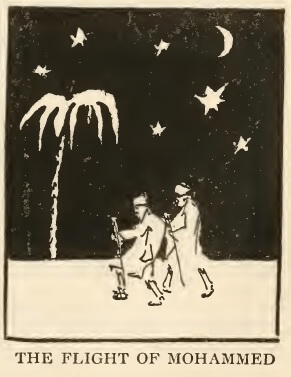
Mohammed decided to be the Moses of the Arab people. He could not well be a prophet and a camel-driver at the same time. So he made himself independent by marrying his employer, the rich widow Chadija. Then he told his neighbors in Mecca that he was the long-expected prophet sent by Allah to save the world. The neighbors laughed most heartily and when Mohammed continued to annoy them with his speeches they decided to kill him. They regarded him as a lunatic and a public bore who deserved no mercy. Mohammed heard of the plot and in the dark of night he fled to Medina together with Abu Bekr, his trusted pupil. This happened in the year 622. It is the most important date in Muslim history and is known as the Hegira—the year of the Great Flight.

In Medina, Mohammed, who was a stranger, found it easier to proclaim himself a prophet than in his home city, where everyone had known him as a simple camel-driver. Soon he was surrounded by an increasing number of followers, or Muslims, who accepted the Islam, “the submission to the will of God,” which Mohammed praised as the highest of all virtues. For seven years he preached to the people of Medina. Then he believed himself strong enough to begin a campaign against his former neighbors who had dared to sneer at him and his Holy Mission in his old camel-driving days. At the head of an army of Medinese he marched across the desert. His followers took Mecca without great difficulty, and having slaughtered a number of the inhabitants, they found it quite easy to convince the others that Mohammed was really a great prophet.

From that time on until the year of his death, Mohammed was fortunate in everything he undertook.

There are two reasons for the success of Islam. In the first place, the creed which Mohammed taught to his followers was very simple. The disciples were told that they must love Allah, the Ruler of the World, the Merciful and Compassionate. They must honor and obey their parents. They were warned against dishonesty in dealing with their neighbors and were admonished to be humble and charitable, to the poor and to the sick. Finally, they were ordered to abstain from strong drink and to be very frugal in what they ate. That was all. There were no priests, who acted as shepherds of their flocks and asked that they be supported at the common expense. The Muslim churches or mosques were merely large stone halls without benches or pictures, where the faithful could gather (if they felt so inclined) to read and discuss chapters from the Koran, the Holy Book. But the average Muslim carried his religion with him and never felt himself hemmed in by the restrictions and regulations of an established church. Five times a day he turned his face towards Mecca, the Holy City, and said a simple prayer. For the rest of the time he let Allah rule the world as he saw fit and accepted whatever fate brought him with patient resignation.

Of course such an attitude towards life did not encourage the Faithful to go forth and invent electrical machinery or bother about railroads and steamship lines. But it gave every Muslim a certain amount of contentment. It bade him be at peace with himself and with the world in which he lived and that was a very good thing.

The second reason which explains the success of the Muslims in their warfare upon the Christians, had to do with the conduct of those Muslim soldiers who went forth to do battle for the true faith. The Prophet promised that those who fell, facing the enemy, would go directly to Heaven. This made sudden death in the field preferable to a long but dreary existence upon this earth. It gave the Muslims an enormous advantage over the Crusaders who were in constant dread of a dark hereafter, and who stuck to the good things of this world as long as they possibly could. Incidentally it explains why even today Muslim soldiers will charge into the fire of European machine guns quite indifferent to the fate that awaits them and why they are such dangerous and persistent enemies.

Having put his religious house in order, Mohammed now began to enjoy his power as the undisputed ruler of a large number of Arab tribes. But success has been the undoing of a large number of men who were great in the days of adversity. He tried to gain the good will of the rich people by a number of regulations which could appeal to those of wealth. He allowed the Faithful to have four wives. As one wife was a costly investment in those olden days when brides were bought directly from the parents, four wives became a positive luxury except to those who possessed camels and dromedaries and date orchards beyond the dreams of avarice. A religion which at first had been meant for the hardy hunters of the high skied desert was gradually transformed to suit the needs of the smug merchants who lived in the bazaars of the cities. It was a regrettable change from the original program and it did very little good to the cause of Muslimism. As for the prophet himself, he went on preaching the truth of Allah and proclaiming new rules of conduct until he died, quite suddenly, of a fever on June the seventh of the year 632.

His successor as Caliph (or leader) of the Muslims was his father-in-law, Abu-Bekr, who had shared the early dangers of the prophet’s life. Two years later, Abu-Bekr died and Omar ibn Al-Khattab followed him. In less than ten years he conquered Egypt, Persia, Phoenicia, Syria and Palestine and made Damascus the capital of the first Muslim world empire.

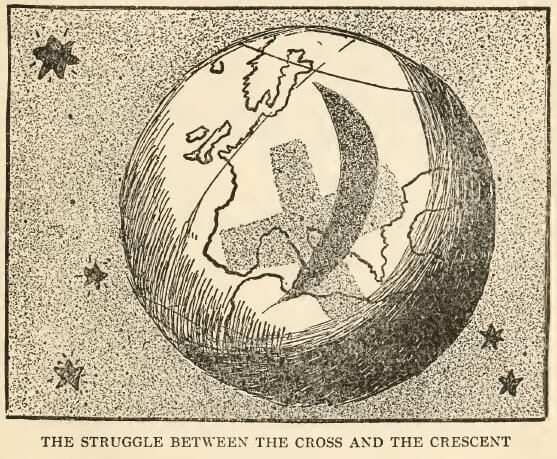
Omar was succeeded by Ali, the husband of Mohammed’s daughter, Fatima, but a quarrel broke out upon a point of Muslim doctrine and Ali was murdered. After his death, the caliphate was made hereditary and the leaders of the faithful who had begun their career as the spiritual head of a religious sect became the rulers of a vast empire. They built a new city on the shores of the Euphrates, near the ruins of Babylon and called it Bagdad, and organizing the Arab horsemen into regiments of cavalry, they set forth to bring the happiness of their Muslim faith to all unbelievers. In the year 700 A.D. a Muslim general by the name of Tarik crossed the old gates of Hercules and reached the high rock on the European side which he called the Gibel-al-tarik, the Hill of Tarik or Gibraltar.

Eleven years later in the battle of Xeres de la Frontera, he defeated the king of the Visigoths and then the Muslim army moved northward and following the route of Hannibal, they crossed the passes of the Pyrenees. They defeated the Duke of Aquitania, who tried to halt them near Bordeaux, and marched upon Paris. But in the year 732 (one hundred years after the death of the prophet,) they were beaten in a battle between Tours and Poitiers. On that day, Charles Martel (Charles with the Hammer) the Frankish chieftain, saved Europe from a Muslim conquest. He drove the Muslims out of France, but they maintained themselves in Spain where Abd-ar-Rahman founded the Caliphate of Cordova, which became the greatest center of science and art of medieval Europe.

This Moorish kingdom, so-called because the people came from Mauretania in Morocco, lasted seven centuries. It was only after the capture of Granada, the last Muslim stronghold, in the year 1492, that Columbus received the royal grant which allowed him to go upon a voyage of discovery. The Muslims soon regained their strength in the new conquests which they made in Asia and Africa. Today, the number of followers of Mohammed are second in number only to that of Christ.

The Children’s Six Minutes: Kindness

KINDNESS

One day last week I saw a huge pair of bobs, heavily loaded with coal, being pulled up the street by two big, fine-looking horses. There were two men on the load. Their faces were black, but it was the dirt of honest toil, it was coal dust. They stopped the horses in front of the house directly across the street from me. I watched them with interest. The first thing one of the men did was to get down, take a board, go around to the front of the horses, lift up the heavy wagon tongue, place the board underneath it as a brace that the necks of the horses might be relieved of the strain of the wagon tongue. At the same time the other man took two warm blankets and covered the horses with them, tucking in the corners beneath the harness to make them tight and warm. Then the men set to work to carry the coal, basket by basket, into the cellar. That was kindness, was it not, to see that the horses were so well cared for on a cold winter day!

To my mind one of the finest acts of our city government is the way we are taught kindness to dumb animals and birds, by permitting them to make their homes and nests in the public park. What a delight it is to walk through the park and have the squirrels come running up so close, to eat from one’s hand! That is kindness.

How about kindness to people? Have you ever seen an older person walking along the street with a little child of three or four years of age, the child reaching up as far as he could to take the hand of the older person, the older one jerking, pulling, yanking, all the while saying, “Come now, hurry up, hurry up.” That is not kindness, is it?

“Howe’er it be, it seems to me’ Tis only noble to be good; Kind hearts are more than coronets, And simple faith than Norman blood.”

MEMORY VERSE, Ephesians 4: 32

“Be ye kind to one another.”

MEMORY HYMN

“How sweet, how heavenly is the sight!”

Math: Subtract Numbers Up to 30

STEP 1

  • Have the children write out and complete the subtraction exercises below on paper.

STEP 2

  • Assess mastery by reading aloud the listed problems and having the children mentally compute and recite the solutions.
  • If children have difficulties, have children redo their written practice with pencil and paper again and then reassess.

Weekly Recap of Articles for Christians Jan 11th to Jan 17th