A place to grow your relationship with God

Posts tagged ‘homeschooling’

Martin Luther King, Jr. “I have a Dream Speech”

I am happy to join with you today in what will go down in history as the greatest demonstration for freedom in the history of our nation.

Five score years ago, a great American, in whose symbolic shadow we stand today, signed the Emancipation Proclamation. This momentous decree came as a great beacon light of hope to millions of Negro slaves who had been seared in the flames of withering injustice. It came as a joyous daybreak to end the long night of their captivity.

But 100 years later, the Negro still is not free. One hundred years later, the life of the Negro is still sadly crippled by the manacles of segregation and the chains of discrimination. One hundred years later, the Negro lives on a lonely island of poverty in the midst of a vast ocean of material prosperity. One hundred years later, the Negro is still languished in the corners of American society and finds himself an exile in his own land. And so we’ve come here today to dramatize a shameful condition.

In a sense we’ve come to our nation’s capital to cash a check. When the architects of our republic wrote the magnificent words of the Constitution and the Declaration of Independence, they were signing a promissory note to which every American was to fall heir. This note was a promise that all men — yes, black men as well as white men — would be guaranteed the unalienable rights of life, liberty, and the pursuit of happiness.

It is obvious today that America has defaulted on this promissory note insofar as her citizens of color are concerned. Instead of honoring this sacred obligation, America has given the Negro people a bad check, a check that has come back marked “insufficient funds.”

But we refuse to believe that the bank of justice is bankrupt. We refuse to believe that there are insufficient funds in the great vaults of opportunity of this nation. And so we’ve come to cash this check, a check that will give us upon demand the riches of freedom and security of justice. We have also come to his hallowed spot to remind America of the fierce urgency of now. This is no time to engage in the luxury of cooling off or to take the tranquilizing drug of gradualism. Now is the time to make real the promises of democracy. Now is the time to rise from the dark and desolate valley of segregation to the sunlit path of racial justice. Now is the time to lift our nation from the quicksands of racial injustice to the solid rock of brotherhood. Now is the time to make justice a reality for all of God’s children.

It would be fatal for the nation to overlook the urgency of the moment. This sweltering summer of the Negro’s legitimate discontent will not pass until there is an invigorating autumn of freedom and equality. 1963 is not an end but a beginning. Those who hoped that the Negro needed to blow off steam and will now be content will have a rude awakening if the nation returns to business as usual. There will be neither rest nor tranquility in America until the Negro is granted his citizenship rights. The whirlwinds of revolt will continue to shake the foundations of our nation until the bright day of justice emerges.

But there is something that I must say to my people who stand on the warm threshold which leads into the palace of justice. In the process of gaining our rightful place we must not be guilty of wrongful deeds. Let us not seek to satisfy our thirst for freedom by drinking from the cup of bitterness and hatred. We must forever conduct our struggle on the high plane of dignity and discipline. We must not allow our creative protest to degenerate into physical violence. Again and again we must rise to the majestic heights of meeting physical force with soul force. The marvelous new militancy which has engulfed the Negro community must not lead us to a distrust of all white people, for many of our white brothers, as evidenced by their presence here today, have come to realize that their destiny is tied up with our destiny. And they have come to realize that their freedom is inextricably bound to our freedom. We cannot walk alone.

As we walk, we must make the pledge that we shall always march ahead. We cannot turn back. There are those who are asking the devotees of civil rights, “When will you be satisfied?” We can never be satisfied as long as the Negro is the victim of the unspeakable horrors of police brutality. We can never be satisfied as long as our bodies, heavy with the fatigue of travel, cannot gain lodging in the motels of the highways and the hotels of the cities. We cannot be satisfied as long as the Negro’s basic mobility is from a smaller ghetto to a larger one. We can never be satisfied as long as our children are stripped of their selfhood and robbed of their dignity by signs stating “for whites only.” We cannot be satisfied as long as a Negro in Mississippi cannot vote and a Negro in New York believes he has nothing for which to vote. No, no we are not satisfied and we will not be satisfied until justice rolls down like waters and righteousness like a mighty stream.

I am not unmindful that some of you have come here out of great trials and tribulations. Some of you have come fresh from narrow jail cells. Some of you have come from areas where your quest for freedom left you battered by storms of persecution and staggered by the winds of police brutality. You have been the veterans of creative suffering. Continue to work with the faith that unearned suffering is redemptive.

Go back to Mississippi, go back to Alabama, go back to South Carolina, go back to Georgia, go back to Louisiana, go back to the slums and ghettos of our northern cities, knowing that somehow this situation can and will be changed.

Let us not wallow in the valley of despair. I say to you today my friends — so even though we face the difficulties of today and tomorrow, I still have a dream. It is a dream deeply rooted in the American dream.

I have a dream that one day this nation will rise up and live out the true meaning of its creed: “We hold these truths to be self-evident, that all men are created equal.”

I have a dream that one day on the red hills of Georgia the sons of former slaves and the sons of former slave owners will be able to sit down together at the table of brotherhood.

I have a dream that one day even the state of Mississippi, a state sweltering with the heat of injustice, sweltering with the heat of oppression, will be transformed into an oasis of freedom and justice.

I have a dream that my four little children will one day live in a nation where they will not be judged by the color of their skin but by the content of their character.

I have a dream today.

I have a dream that one day down in Alabama, with its vicious racists, with its governor having his lips dripping with the words of interposition and nullification — one day right there in Alabama little black boys and black girls will be able to join hands with little white boys and white girls as sisters and brothers.

I have a dream today.

I have a dream that one day every valley shall be exalted, and every hill and mountain shall be made low, the rough places will be made plain, and the crooked places will be made straight, and the glory of the Lord shall be revealed and all flesh shall see it together.

This is our hope. This is the faith that I go back to the South with. With this faith we will be able to hew out of the mountain of despair a stone of hope. With this faith we will be able to transform the jangling discords of our nation into a beautiful symphony of brotherhood. With this faith we will be able to work together, to pray together, to struggle together, to go to jail together, to stand up for freedom together, knowing that we will be free one day.

This will be the day, this will be the day when all of God’s children will be able to sing with new meaning “My country ’tis of thee, sweet land of liberty, of thee I sing. Land where my father’s died, land of the Pilgrim’s pride, from every mountainside, let freedom ring!”

And if America is to be a great nation, this must become true. And so let freedom ring from the prodigious hilltops of New Hampshire. Let freedom ring from the mighty mountains of New York. Let freedom ring from the heightening Alleghenies of Pennsylvania.

Let freedom ring from the snow-capped Rockies of Colorado. Let freedom ring from the curvaceous slopes of California.

But not only that; let freedom ring from Stone Mountain of Georgia.

Let freedom ring from Lookout Mountain of Tennessee.

Let freedom ring from every hill and molehill of Mississippi — from every mountainside.

Let freedom ring. And when this happens, and when we allow freedom ring — when we let it ring from every village and every hamlet, from every state and every city, we will be able to speed up that day when all of God’s children — black men and white men, Jews and Gentiles, Protestants and Catholics — will be able to join hands and sing in the words of the old Negro spiritual: “Free at last! Free at last! Thank God Almighty, we are free at last!”

Martin Luther King, Jr.
August 28, 1963
Lincoln Memorial, Washington, D.C., United States of America
The Story of Mankind: Mohammed

Since the days of Carthage and Hannibal we have said nothing of the Semitic people. You will remember how they filled all the chapters devoted to the story of the Ancient World. The Babylonians, the Assyrians, the Phoenicians, the Jews, the Arameans, the Chaldeans, all of them Semites, had been the rulers of western Asia for thirty or forty centuries. They had been conquered by the Indo-European Persians who had come from the east and by the Indo-European Greeks who had come from the west. A hundred years after the death of Alexander the Great, Carthage, a colony of Semitic Phoenicians, had fought the Indo-European Romans for the mastery of the Mediterranean. Carthage had been defeated and destroyed and for eight hundred years the Romans had been masters of the world. In the seventh century, however, another Semitic tribe appeared upon the scene and challenged the power of the west. They were the Arabs, peaceful shepherds who had roamed through the desert since the beginning of time without showing any signs of imperial ambitions.

Then they listened to Mohammed, mounted their horses and in less than a century they had pushed to the heart of Europe and proclaimed the glories of Allah, “the only God,” and Mohammed, “the prophet of the only God,” to the frightened peasants of France.

The story of Ahmed, the son of Abdallah and Aminah (usually known as Mohammed, or “he who will be praised,”); reads like a chapter in the “Thousand and One Nights.” He was a camel-driver, born in Mecca. He seems to have been an epileptic and he suffered from spells of unconsciousness when he dreamed strange dreams and heard the voice of the angel Gabriel, whose words were afterwards written down in a book called the Koran. His work as a caravan leader carried him all over Arabia and he was constantly falling in with Jewish merchants and with Christian traders, and he came to see that the worship of a single God was a very excellent thing. His own people, the Arabs, still revered queer stones and trunks of trees as their ancestors had done, tens of thousands of years before. In Mecca, their holy city, stood a little square building, the Kaaba, full of idols and strange odds and ends of Hoo-doo worship.

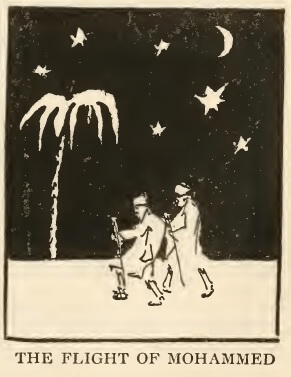
Mohammed decided to be the Moses of the Arab people. He could not well be a prophet and a camel-driver at the same time. So he made himself independent by marrying his employer, the rich widow Chadija. Then he told his neighbors in Mecca that he was the long-expected prophet sent by Allah to save the world. The neighbors laughed most heartily and when Mohammed continued to annoy them with his speeches they decided to kill him. They regarded him as a lunatic and a public bore who deserved no mercy. Mohammed heard of the plot and in the dark of night he fled to Medina together with Abu Bekr, his trusted pupil. This happened in the year 622. It is the most important date in Muslim history and is known as the Hegira—the year of the Great Flight.

In Medina, Mohammed, who was a stranger, found it easier to proclaim himself a prophet than in his home city, where everyone had known him as a simple camel-driver. Soon he was surrounded by an increasing number of followers, or Muslims, who accepted the Islam, “the submission to the will of God,” which Mohammed praised as the highest of all virtues. For seven years he preached to the people of Medina. Then he believed himself strong enough to begin a campaign against his former neighbors who had dared to sneer at him and his Holy Mission in his old camel-driving days. At the head of an army of Medinese he marched across the desert. His followers took Mecca without great difficulty, and having slaughtered a number of the inhabitants, they found it quite easy to convince the others that Mohammed was really a great prophet.

From that time on until the year of his death, Mohammed was fortunate in everything he undertook.

There are two reasons for the success of Islam. In the first place, the creed which Mohammed taught to his followers was very simple. The disciples were told that they must love Allah, the Ruler of the World, the Merciful and Compassionate. They must honor and obey their parents. They were warned against dishonesty in dealing with their neighbors and were admonished to be humble and charitable, to the poor and to the sick. Finally, they were ordered to abstain from strong drink and to be very frugal in what they ate. That was all. There were no priests, who acted as shepherds of their flocks and asked that they be supported at the common expense. The Muslim churches or mosques were merely large stone halls without benches or pictures, where the faithful could gather (if they felt so inclined) to read and discuss chapters from the Koran, the Holy Book. But the average Muslim carried his religion with him and never felt himself hemmed in by the restrictions and regulations of an established church. Five times a day he turned his face towards Mecca, the Holy City, and said a simple prayer. For the rest of the time he let Allah rule the world as he saw fit and accepted whatever fate brought him with patient resignation.

Of course such an attitude towards life did not encourage the Faithful to go forth and invent electrical machinery or bother about railroads and steamship lines. But it gave every Muslim a certain amount of contentment. It bade him be at peace with himself and with the world in which he lived and that was a very good thing.

The second reason which explains the success of the Muslims in their warfare upon the Christians, had to do with the conduct of those Muslim soldiers who went forth to do battle for the true faith. The Prophet promised that those who fell, facing the enemy, would go directly to Heaven. This made sudden death in the field preferable to a long but dreary existence upon this earth. It gave the Muslims an enormous advantage over the Crusaders who were in constant dread of a dark hereafter, and who stuck to the good things of this world as long as they possibly could. Incidentally it explains why even today Muslim soldiers will charge into the fire of European machine guns quite indifferent to the fate that awaits them and why they are such dangerous and persistent enemies.

Having put his religious house in order, Mohammed now began to enjoy his power as the undisputed ruler of a large number of Arab tribes. But success has been the undoing of a large number of men who were great in the days of adversity. He tried to gain the good will of the rich people by a number of regulations which could appeal to those of wealth. He allowed the Faithful to have four wives. As one wife was a costly investment in those olden days when brides were bought directly from the parents, four wives became a positive luxury except to those who possessed camels and dromedaries and date orchards beyond the dreams of avarice. A religion which at first had been meant for the hardy hunters of the high skied desert was gradually transformed to suit the needs of the smug merchants who lived in the bazaars of the cities. It was a regrettable change from the original program and it did very little good to the cause of Muslimism. As for the prophet himself, he went on preaching the truth of Allah and proclaiming new rules of conduct until he died, quite suddenly, of a fever on June the seventh of the year 632.

His successor as Caliph (or leader) of the Muslims was his father-in-law, Abu-Bekr, who had shared the early dangers of the prophet’s life. Two years later, Abu-Bekr died and Omar ibn Al-Khattab followed him. In less than ten years he conquered Egypt, Persia, Phoenicia, Syria and Palestine and made Damascus the capital of the first Muslim world empire.

Omar was succeeded by Ali, the husband of Mohammed’s daughter, Fatima, but a quarrel broke out upon a point of Muslim doctrine and Ali was murdered. After his death, the caliphate was made hereditary and the leaders of the faithful who had begun their career as the spiritual head of a religious sect became the rulers of a vast empire. They built a new city on the shores of the Euphrates, near the ruins of Babylon and called it Bagdad, and organizing the Arab horsemen into regiments of cavalry, they set forth to bring the happiness of their Muslim faith to all unbelievers. In the year 700 A.D. a Muslim general by the name of Tarik crossed the old gates of Hercules and reached the high rock on the European side which he called the Gibel-al-tarik, the Hill of Tarik or Gibraltar.

Eleven years later in the battle of Xeres de la Frontera, he defeated the king of the Visigoths and then the Muslim army moved northward and following the route of Hannibal, they crossed the passes of the Pyrenees. They defeated the Duke of Aquitania, who tried to halt them near Bordeaux, and marched upon Paris. But in the year 732 (one hundred years after the death of the prophet,) they were beaten in a battle between Tours and Poitiers. On that day, Charles Martel (Charles with the Hammer) the Frankish chieftain, saved Europe from a Muslim conquest. He drove the Muslims out of France, but they maintained themselves in Spain where Abd-ar-Rahman founded the Caliphate of Cordova, which became the greatest center of science and art of medieval Europe.

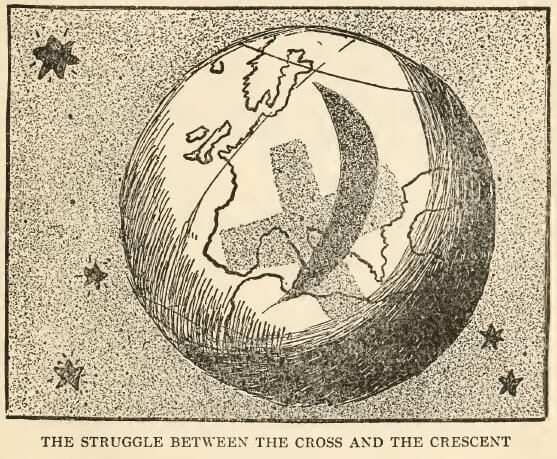
This Moorish kingdom, so-called because the people came from Mauretania in Morocco, lasted seven centuries. It was only after the capture of Granada, the last Muslim stronghold, in the year 1492, that Columbus received the royal grant which allowed him to go upon a voyage of discovery. The Muslims soon regained their strength in the new conquests which they made in Asia and Africa. Today, the number of followers of Mohammed are second in number only to that of Christ.

Math: Subtract Numbers Up to 30

STEP 1

  • Have the children write out and complete the subtraction exercises below on paper.

STEP 2

  • Assess mastery by reading aloud the listed problems and having the children mentally compute and recite the solutions.
  • If children have difficulties, have children redo their written practice with pencil and paper again and then reassess.

Weekly Recap of Articles for Christians Jan 11th to Jan 17th

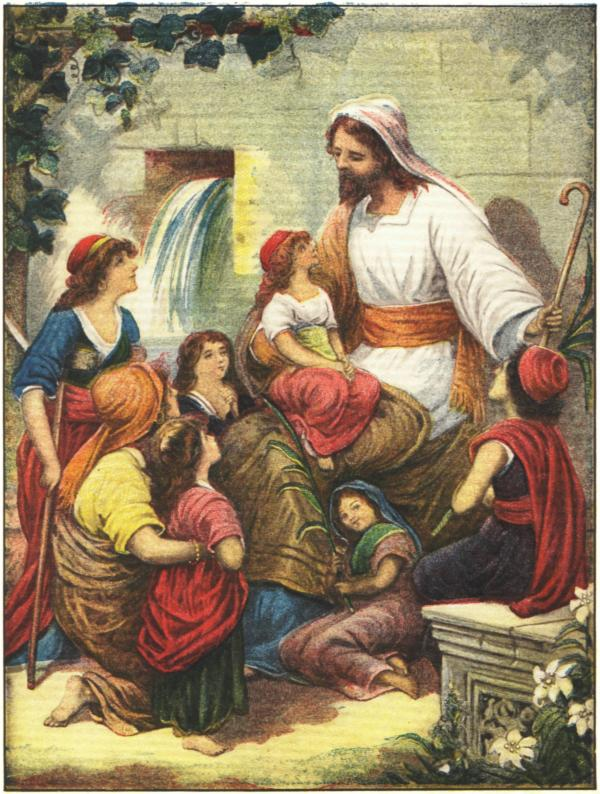
CHRIST BLESSING THE CHILDREN

Jesus had left Galilee, and was journeying toward Jerusalem, where He was to be put to death. He was in the country beyond Jordan, called Peræa, and had been speaking some very wise words to the Pharisees, and also to His disciples, when some women came to Him, bringing infants and young children that He might put His hands upon them and pray for them. The disciples thinking probably that Jesus, who had so many important things to attend to, would not wish to be troubled by women bringing their children, rebuked them for so doing. But Jesus loved children. So, when He saw the disciples about to send them away, He was displeased; and, calling the disciples to Him, He said, “Suffer little children to come unto Me, and forbid them not: for of such is the kingdom of God.” Then, we are told, Jesus “took them up in His arms, put His hands upon them, and blessed them.” How kind was Jesus! and how willing that the little ones should be brought to Him! And He is the same now. May all our young readers learn to love Him, and find for themselves how willing He is to love and bless them.

Rise of the Church

The average intelligent Roman who lived under the Empire had taken very little interest in the gods of his fathers. A few times a year he went to the temple, but merely as a matter of custom. He looked on patiently when the people celebrated a religious festival with a solemn procession. But he regarded the worship of Jupiter and Minerva and Neptune as something rather childish, a survival from the crude days of the early republic and not a fit subject of study for a person who had mastered the works of the Stoics and the Epicureans and the other great philosophers of Athens.

This attitude made the Roman a very tolerant man. The government insisted that all people, Romans, foreigners, Greeks, Babylonians, Jews, should pay a certain outward respect to the image of the Emperor which was supposed to stand in every temple, just as a picture of the President of the United States is apt to hang in an American Post Office. But this was a formality without any deeper meaning. Generally speaking everybody could honor, revere and adore whatever gods he pleased, and as a result, Rome was filled with all sorts of queer little temples and synagogues, dedicated to the worship of Egyptian and African and Asiatic divinities.

When the first disciples of Jesus reached Rome and began to preach their new doctrine of a universal concord of humanity, nobody objected. The person in the street stopped and listened. Rome, the capital of the world, had always been full of wandering preachers, each proclaiming their own “mystery.” Most of the self-appointed priests appealed to the senses—promised golden rewards and endless pleasure to the followers of their own particular god. Soon the crowd in the street noticed that the so-called Christians (the followers of the Christ or “anointed”) spoke a very different language. They did not appear to be impressed by great riches or a noble position. They extolled the beauties of poverty and humility and meekness. These were not exactly the virtues which had made Rome the mistress of the world. It was rather interesting to listen to a “mystery” which told people in the hey-day of their glory that their worldly success could not possibly bring them lasting happiness.

Besides, the preachers of the Christian mystery told dreadful stories of the fate that awaited those who refused to listen to the words of their god. It was never wise to take chances. Of course, the old Roman gods still existed, but were they strong enough to protect their friends against the powers of this new deity who had been brought to Europe from distant Asia? People began to have doubts. They returned to listen to further explanations of the new creed. After a while they began to meet the men and women who preached the words of Jesus. They found them very different from the average Roman priests. They were all dreadfully poor. They were kind to slaves and to animals. They did not try to gain riches, but gave away whatever they had. The example of their unselfish lives forced many Romans to forsake the old religion. They joined the small communities of Christians who met in the back rooms of private houses or somewhere in an open field, and the temples were deserted.

This went on year after year and the number of Christians continued to increase. Presbyters or priests (the original Greek meant “elder”) were elected to guard the interests of the small churches. A bishop was made the head of all the communities within a single province. Peter, who had followed Paul to Rome, was the first Bishop of Rome. In due time his successors (who were addressed as Father or Papa) came to be known as Popes.

The church became a powerful institution within the Empire. The Christian doctrines appealed to those who despaired of this world. They also attracted many strong men who found it impossible to make a career under the Imperial government, but who could exercise their gifts of leadership among the humble followers of the Nazarene teacher. At last the state was obliged to take notice. The Roman Empire (I have said this before) was tolerant through indifference. It allowed everybody to seek salvation after his or her own fashion. But it insisted that the different sects keep the peace among themselves and obey the wise rule of “live and let live.”

The Christian communities however, refused to practice any sort of tolerance. They publicly declared that their God, and their God alone, was the true ruler of Heaven and Earth, and that all other gods were imposters. This seemed unfair to the other sects and the police discouraged such utterances. The Christians persisted.

Soon there were further difficulties. The Christians refused to go through the formalities of paying homage to the emperor. They refused to appear when they were called upon to join the army. The Roman magistrates threatened to punish them. The Christians answered that this miserable world was only the ante-room to a very pleasant Heaven and that they were more than willing to suffer death for their principles. The Romans, puzzled by such conduct, sometimes killed the offenders, but more often they did not. There was a certain amount of lynching during the earliest years of the church, but this was the work of that part of the mob which accused their meek Christian neighbors of every conceivable crime, (such as slaughtering and eating babies, bringing about sickness and pestilence, betraying the country in times of danger) because it was a harmless sport and devoid of danger, as the Christians refused to fight back.

Meanwhile, Rome continued to be invaded by the Barbarians and when her armies failed, Christian missionaries went forth to preach their gospel of peace to the wild Teutons. They were strong men without fear of death. They spoke a language which left no doubt as to the future of unrepentant sinners. The Teutons were deeply impressed. They still had a deep respect for the wisdom of the ancient city of Rome. Those men were Romans. They probably spoke the truth. Soon the Christian missionary became a power in the savage regions of the Teutons and the Franks. Half a dozen missionaries were as valuable as a whole regiment of soldiers. The Emperors began to understand that the Christian might be of great use to them. In some of the provinces they were given equal rights with those who remained faithful to the old gods. The great change however came during the last half of the fourth century.

Constantine, sometimes (Heaven knows why) called Constantine the Great, was emperor. He was a terrible ruffian, but people of tender qualities could hardly hope to survive in that hard-fighting age. During a long and checkered career, Constantine had experienced many ups and downs. Once, when almost defeated by his enemies, he thought that he would try the power of this new Asiatic deity of whom everybody was talking. He promised that he too would become a Christian if he were successful in the coming battle. He won the victory and thereafter he was convinced of the power of the Christian God and allowed himself to be baptized.

From that moment on, the Christian church was officially recognized and this greatly strengthened the position of the new faith.

But the Christians still formed a very small minority of all the people, (not more than five or six percent,) and in order to win, they were forced to refuse all compromise. The old gods must be destroyed. For a short spell the emperor Julian, a lover of Greek wisdom, managed to save the pagan Gods from further destruction. But Julian died of his wounds during a campaign in Persia and his successor Jovian re-established the church in all its glory. One after the other the doors of the ancient temples were then closed. Then came the emperor Justinian (who built the church of Saint Sophia in Constantinople), who discontinued the school of philosophy at Athens which had been founded by Plato.

That was the end of the old Greek world, in which people had been allowed to think their own thoughts and dream their own dreams according to their desires. The somewhat vague rules of conduct of the philosophers had proved a poor compass by which to steer the ship of life after a deluge of savagery and ignorance had swept away the established order of things. There was need of something more positive and more definite. This the Church provided.

During an age when nothing was certain, the church stood like a rock and never receded from those principles which it held to be true and sacred. This steadfast courage gained the admiration of the multitudes and carried the church of Rome safely through the difficulties which destroyed the Roman state.

Math: Subtract and Borrow

STEP 1

  • Teach the children in such cases to add ten to the units of the minuend before subtracting the digit number, and to subtract one from the tens of the minuend to obtain the tens of the answer.
  • Go through several of the examples from the table below with the children, until they grasp the concept.

STEP 2

  • Have the children complete the two exercises below by copying the problems and then solving them.
Exercise 1
Exercise 2

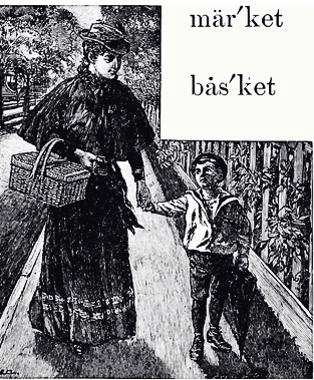
MCGUFFEY’S First ECLECTIC READER: Lesson 38: James and his mamma went to the market

Words:

  • market
  • bread
  • basket
  • bought
  • meat
  • tea
  • trying
  • tell
  • which

Lesson

James has been to market with his mamma.

She has bought some bread, some meat, and some tea, which are in the basket on her arm.

James is trying to tell his mamma what he has seen in the market.

The Fall of Rome

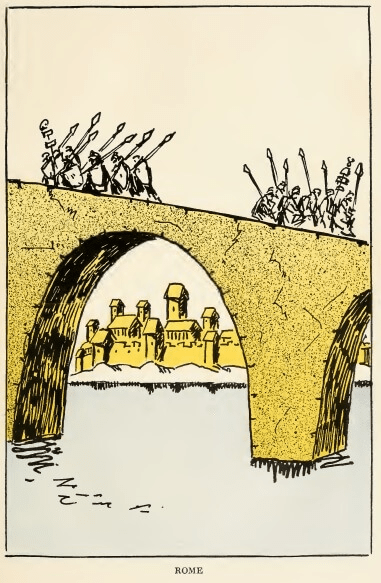
The textbooks of ancient History give the date 476 as the year in which Rome fell, because in that year the last emperor was driven off his throne. But Rome, which was not built in a day, took a long time falling. The process was so slow and so gradual that most Romans did not realize how their old world was coming to an end. They complained about the unrest of the times—they grumbled about the high prices of food and about the low wages of the workmen—they cursed the profiteers who had a monopoly of the grain and the wool and the gold coin. Occasionally they rebelled against an unusually rapacious governor. But the majority of the people during the first four centuries of our era ate and drank (whatever their purse allowed them to buy) and hated or loved (according to their nature) and went to the theater (whenever there was a free show of fighting gladiators) or starved in the slums of the big cities, utterly ignorant of the fact that their empire had outlived its usefulness and was doomed to perish.

How could they realize the threatened danger? Rome made a fine showing of outward glory. Well-paved roads connected the different provinces, the imperial police were active and showed little tenderness for highwaymen. The frontier was closely guarded against the savage tribes who seemed to be occupying the waste lands of northern Europe. The whole world was paying tribute to the mighty city of Rome, and a score of able men were working day and night to undo the mistakes of the past and bring about a return to the happier conditions of the early Republic.

But the underlying causes of the decay of the State, of which I have told you in a former chapter, had not been removed and reform therefore was impossible.

Rome was, first and last and all the time, a city-state as Athens and Corinth had been city-states in ancient Hellas. It had been able to dominate the Italian peninsula. But Rome as the ruler of the entire civilized world was a political impossibility and could not endure. Her young men were killed in her endless wars. Her farmers were ruined by long military service and by taxation. They either became professional beggars or hired themselves out to rich landowners who gave them board and lodging in exchange for their services and made them “serfs,” those unfortunate human beings who are neither slaves nor freemen, but who have become part of the soil upon which they work, like so many cows, and the trees.

The Empire, the State, had become everything. The common citizen had dwindled down to less than nothing. As for the slaves, they had heard the words that were spoken by Paul. They had accepted the message of the humble carpenter of Nazareth. They did not rebel against their masters. On the contrary, they had been taught to be meek and they obeyed their superiors. But they had lost all interest in the affairs of this world which had proved such a miserable place of abode. They were willing to fight the good fight that they might enter into the Kingdom of Heaven. But they were not willing to engage in warfare for the benefit of an ambitious emperor who aspired to glory by way of a foreign campaign in the land of the Parthians or the Numidians or the Scots.

And so conditions grew worse as the centuries went by. The first Emperors had continued the tradition of “leadership” which had given the old tribal chieftains such a hold upon their subjects. But the Emperors of the second and third centuries were Barrack-Emperors, professional soldiers, who existed by the grace of their bodyguards, the so-called Praetorians. They succeeded each other with terrifying rapidity, murdering their way into the palace and being murdered out of it as soon as their successors had become rich enough to bribe the guards into a new rebellion.

Meanwhile the barbarians were hammering at the gates of the northern frontier. As there were no longer any native Roman armies to stop their progress, foreign mercenaries had to be hired to fight the invader. As the foreign soldier happened to be of the same blood as his supposed enemy, he was apt to be quite lenient when he engaged in battle. Finally, by way of experiment, a few tribes were allowed to settle within the confines of the Empire. Others followed. Soon these tribes complained bitterly of the greedy Roman tax-gatherers, who took away their last penny. When they got no redress, they marched to Rome and loudly demanded that they be heard.

This made Rome very uncomfortable as an Imperial residence. Constantine (who ruled from 323 to 337) looked for a new capital. He chose Byzantium, the gateway for the commerce between Europe and Asia. The city was renamed Constantinople, and the court moved eastward. When Constantine died, his two sons, for the sake of a more efficient administration, divided the Empire between them. The elder lived in Rome and ruled in the west. The younger stayed in Constantinople and was master of the east.

Then came the fourth century and the terrible visitation of the Huns, those mysterious Asiatic horsemen who for more than two centuries maintained themselves in Northern Europe and continued their career of bloodshed until they were defeated near Chalons-sur-Marne in France in the year 451. As soon as the Huns had reached the Danube they had begun to press hard upon the Goths. The Goths, in order to save themselves, were thereupon obliged to invade Rome. The Emperor Valens tried to stop them, but was killed near Adrianople in the year 378. Twenty-two years later, under their king, Alaric, these same West Goths marched westward and attacked Rome. They did not plunder, and destroyed only a few palaces. Next came the Vandals, and showed less respect for the venerable traditions of the city. Then the Burgundians. Then the East Goths. Then the Alemanni. Then the Franks. There was no end to the invasions. Rome at last was at the mercy of every ambitious highway robber who could gather a few followers.

In the year 402 the Emperor fled to Ravenna, which was a sea-port and strongly fortified, and there, in the year 475, Odoacer, commander of a regiment of the German mercenaries, who wanted the farms of Italy to be divided among themselves, gently but effectively pushed Romulus Augustulus, the last of the emperors who ruled the western division, from his throne, and proclaimed himself Patriarch or ruler of Rome. The eastern Emperor, who was very busy with his own affairs, recognized him, and for ten years Odoacer ruled what was left of the western provinces.

A few years later, Theodoric, King of the East Goths, invaded the newly formed Patriciat, took Ravenna, murdered Odoacer at his own dinner table, and established a Gothic Kingdom amidst the ruins of the western part of the Empire. This Patriciate state did not last long. In the sixth century a motley crowd of Longobards and Saxons and Slavs and Avars invaded Italy, destroyed the Gothic kingdom, and established a new state of which Pavia became the capital.

Then at last the imperial city sank into a state of utter neglect and despair. The ancient palaces had been plundered time and again. The schools had been burned down. The teachers had been starved to death. The rich people had been thrown out of their villas which were now inhabited by evil-smelling and hairy barbarians. The roads had fallen into decay. The old bridges were gone and commerce had come to a standstill. Civilization—the product of thousands of years of patient labor on the part of Egyptians and Babylonians and Greeks and Romans, which had lifted people high above the most daring dreams of their earliest ancestors, threatened to perish from the western continent.

It is true that in the far east, Constantinople continued to be the center of an Empire for another thousand years. But it hardly counted as a part of the European continent. Its interests lay in the east. It began to forget its western origin. Gradually the Roman language was given up for the Greek. The Roman alphabet was discarded and Roman law was written in Greek characters and explained by Greek judges. The Emperor became an Asiatic despot, worshipped as the god-like kings of Thebes had been worshipped in the valley of the Nile, three thousand years before. When missionaries of the Byzantine church looked for fresh fields of activity, they went eastward and carried the civilization of Byzantium into the vast wilderness of Russia.

As for the west, it was left to the mercies of the Barbarians. For twelve generations, murder, war, arson, plundering were the order of the day. One thing—and one thing alone—saved Europe from complete destruction, from a return to the days of cave-men and the hyena.

This was the church—the flock of men and women who for many centuries had confessed themselves the followers of Jesus, the carpenter of Nazareth, who had been killed that the mighty Roman Empire might be saved the trouble of a street-riot in a little city (Jerusalem) somewhere along the Syrian frontier.

Math: Quarter To Times

STEP 1

Tell children the minute hand points to the 9, for (9×5 = 45) 45 minutes past the hour.

  • Show children the clock images below in order and have them recite the times (e.g. Quarter to Two, One forty-five etc.).

STEP 2

  • Point to the clock images in a random order and have children determine and speak aloud the times.

STEP 3

  • Have children draw clocks showing each of these times.