It has been making the rounds for quite some time that we need to call God and Jesus by the Hebrew names. Some say that this may not apply to everybody. Others declare that you are worshiping an idol by not calling God by His Hebrew name. I am addressing those that make this a salvation issue.
Now I want you to think about this carefully. Yes, we are supposed to worship God as he desires and not by the traditions of men. However, I want you to answer two very important questions.
Who created the languages?
Who knows man’s heart?
The answer to question #1 can be found in Genesis 11:9. Therefore, is the name of it called Babel; because the Lord did there confound the language of all the earth: and from thence did the Lord scatter them abroad upon the face of all the earth. God created the languages when he confounded the language of all the earth. Therefore, isn’t logical that since he created the languages that he also understands the languages. I am not getting into the argument that says the words were mistranslated (that is for linguistics to figure out). God knows that those that speak English use the words that are English. Learning the Bible is hard enough without having to learn a new language just to pray. Remember that on the Day of Pentecost, God poured out His Spirit.
Acts 2:4-11 And they were all filled with the Holy Ghost, and began to speak with other tongues, as the Spirit gave them utterance. And there were dwelling at Jerusalem Jews, devout men, out of every nation under heaven. Now when this was noised abroad, the multitude came together, and were confounded, because that every man heard them speak in his own language. And they were all amazed and marvelled, saying one to another, Behold, are not all these which speak Galilaeans? And how hear we every man in our own tongue, wherein we were born? Parthians, and Medes, and Elamites, and the dwellers in Mesopotamia, and in Judaea, and Cappadocia, in Pontus, and Asia, Phrygia, and Pamphylia, in Egypt, and in the parts of Libya about Cyrene, and strangers of Rome, Jews and proselytes, Cretes and Arabians, we do hear them speak in our tongues the wonderful works of God.
Notice how that God started the church by translating the wonderful works of God into many different languages.
The answer to question #2 can be found in 1 Samuel 16:7 But the Lord said unto Samuel, Look not on his countenance, or on the height of his stature; because I have refused him: for the Lord seeth not as man seeth; for man looketh on the outward appearance, but the Lord looketh on the heart. If what is in your heart is correct, then your actions will be correct. Thankfully God is all knowing. He knows what you are trying to say. He knows the intent of your heart.
Now if you have a heart’s desire to learn Hebrew, by all means learn it, but don’t make others feel bad by acting like they are dishonoring God by not learning Hebrew. I would rather that people pray in whatever language that they know and seek God with all their heart, soul, and mind than get discouraged by not knowing how to pray in Hebrew.
It is good to learn Hebrew and Greek for studying the Bible, but when it is time to witness to others, even God on the Day of Pentecost translated it into their language. He started the church by translating what needed to be translated and it wasn’t just Hebrew that he translated the words into.
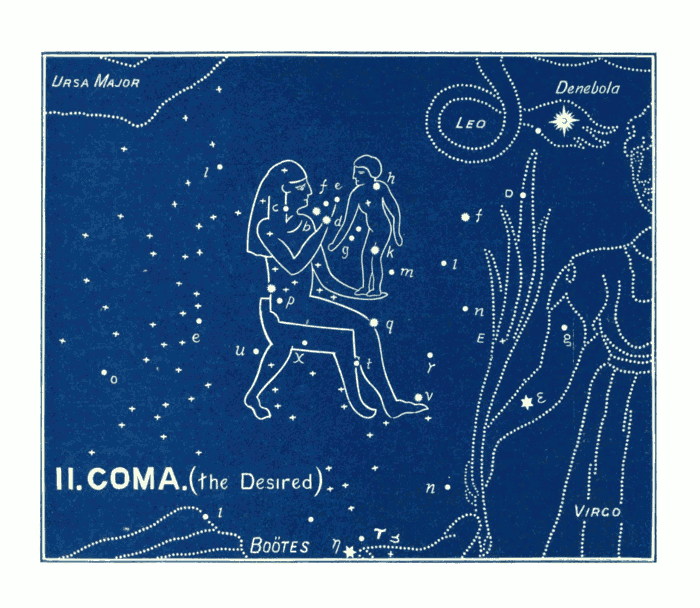
The first constellation in Virgo explains that this coming “Branch” will be a child, and that He should be the “Desire of all nations.”
The ancient name of this constellation is Comah, the desired, or the longed for. We have the word used by the Holy Spirit in this very connection, in Hag. ii. 7: “The DESIRE of all nations shall come.”
Plate 2: Coma (the Desired)
The ancient Zodiacs pictured this constellation as a woman with a child in her arms. Albumazar (or Abu Masher), an Arabian astronomer of the eighth century, says, “There arises in the first Decan, as the Persians, Chaldeans, and Egyptians, and the two Hermes and Ascalius teach, a young woman, whose Persian name denotes a pure virgin, sitting on a throne, nourishing an infant boy (the boy, I say), having a Hebrew name, by some nations called IHESU, with the signification IEZA, which in Greek is called CHRISTOS.”
But this picture is not found in any of the modern maps of the stars. There we find to-day a woman’s wig! It appears that Berenice, the wife of Euergetes (Ptolemy III.), king of Egypt in the third century b.c., when her husband once went on a dangerous expedition, vowed to consecrate her fine head of hair to Venus if he returned in safety. Her hair, which was hung up in the Temple of Venus, was subsequently stolen, and to comfort Berenice, Conon, an astronomer of Alexandria (b.c. 283-222), gave it out that Jupiter had taken it and made it a constellation!
This is a good example of how the meaning of other constellations have been perverted (ignorantly or intentionally). In this case, as in others, the transition from ancient to more modern languages helped to hide the meaning. The Hebrew name was Coma (desired). But the Greeks had a word for hair, Có-me. This again is transferred to the Latin coma, and thus “Coma Berenicæ” (the hair of Berenice) comes down to us to-day as the name of this constellation, and gives us a woman’s wig instead of that Blessed One, “the Desire of all Nations.”
In this case, however, we are able to give absolute proof that this is a perversion.
The ancient Egyptian name for this constellation was Shes-nu, the desired son!
The Zodiac in the Temple of Denderah, in Egypt, going back at least 2,000 years b.c., has no trace of any hair, but it has the figure of a woman and child. In our illustration we have given a copy of this very ancient picture, and not the wig of hair!
We have been permitted to trace it from a work on Egyptian Scenery by the late eminent astronomer, Edward J. Cooper, of Markree Castle, co. Sligo, who visited that Temple in the year 1820 with an Italian artist, Signor Bossi. The original drawing from which our tracing is made (and enlarged) was drawn by Signor Bossi on the spot, before it was taken to Paris in 1821. We thus have before us the exact representations of one of these star-pictures at least 4,000 years old.
Even Shakespeare understood the truth about this constellation picture, which has been so long covered by modern inventions. In his Titus Andronicus he speaks of an arrow being shot up to heaven to the “Good boy in Virgo’s lap.”
The constellation itself is very remarkable. Others contain one or two stars of the first or second magnitude, and then a greater or less variety of lesser stars; but this is peculiar from having no one very bright star, but contains so many stars of the 4th and 5th magnitudes. It contains 43 stars altogether, ten being of the 4th magnitude, and the remainder of the 5th, 6th, etc.
It was in all probability the constellation of Coma in which “the Star of Bethlehem” appeared. There was a traditional prophecy, well-known in the East, carefully preserved and handed down, that a new star would appear in this sign when He whom it foretold should be born.
This was, doubtless, referred to in the prophecy of Balaam, which would thus receive a double fulfilment, first of the literal “Star,” and also of the person to whom it referred. The Lord said by Balaam (Num. xxiv. 17),
“There shall come a star out of Jacob,
And a sceptre shall rise out of Israel.”
Thomas Hyde, an eminent Orientalist (1636-1703), writing on the ancient religion of the Persians, quotes from Abulfaragius (an Arab Christian Historian, 1226-1286), who says that Zoroaster, or Zerdusht, the Persian, was a pupil of Daniel the Prophet, and that he predicted to the Magians (who were the astronomers of Persia), that when they should see a new star appear it would notify the birth of a mysterious child, whom they were to adore. It is further stated in the Zend Avesta that this new star was to appear in the sign of the Virgin. Some have supposed that this passage is not genuine. But whether it was interpolated before or after the event, it is equally good evidence for our purpose here. For if it was written before the event, it is evidence of the prophetic announcement; and if it was interpolated after the event it is evidence of the historic fact.
The Book of Job shows us how Astronomy flourished in Idumea; and the Gospel according to Matthew shows that the Persian Magi, as well as others, were looking for “the Desire of all nations.”
New stars have appeared again and again. It was in 125 b.c. that a star, so bright as to be seen in the day-time, suddenly appeared. It was this that caused Hipparchus to draw up his catalogue of stars, which has been handed down to us by Ptolemy (150 a.d.).
This new star would show the latitude, passing at that time immediately overhead at midnight, every twenty-four hours; while the prophecy would give the longitude as the land of Jacob. Having these two factors, it would be only a matter of observation, and easy for the Magi to find the place where it would be vertical, and thus to locate the very spot of the birth of Him of whom it was the sign, for they emphatically called it “His Star.” There is a beautiful tradition which relates how, in their difficulty, on their way from Jerusalem to find the actual spot under the Zenith of this star, these Magi sat down beside David’s “Well of Bethlehem” to refresh themselves. There they saw the star reflected in the clear water of the well. Hence it is written that “when they saw the star they rejoiced with exceeding joy,” for they knew they were at the very spot and place of His appearing whence He was to “come forth.”
There can be little doubt that it was a new star. In the first place a new star is no unusual phenomenon. In the second place the tradition is well supported by ancient Christian writers. One speaks of its “surpassing brightness.” Another (Ignatius, Bp. of Antioch, a.d. 69) says, “At the appearance of the Lord a star shone forth brighter than all the other stars.” Ignatius, doubtless, had this from those who had actually seen it! Prudentius (4th cent. a.d.) says that not even the morning star was so fair. Archbishop Trench, who quotes these authorities, says “This star, I conceive, as so many ancients and moderns have done, to have been a new star in the heavens.”
One step more places this new star in the constellation of Coma, and with new force makes it indeed “His star”—the “Sign” of His “coming forth from Bethlehem.” Will it be “the sign of the Son of Man in heaven” (Matt. xxiv. 30) when He shall “come unto” this world again to complete the wondrous prophecies written of Him in the heavenly and earthly Revelations?
Thus does the constellation of Coma reveal that the coming “Seed of the woman” was to be a child born, a son given.
But He was to be more: He was to be God and man—two natures in one person! This is the lesson of the next picture.
Worrying about anything is the least productive thing you can do. Worry and stressing about things can cause health problems. Look at what the bible says about worrying, stressing, and being anxious.
Philippians 4:6 (amp) Do not be anxious or worried about anything, but in everything [every circumstance and situation] by prayer and petition with thanksgiving, continue to make your [specific] requests known to God.
Jesus says it like this:
Matthew 6: 25-34 “Therefore I tell you, stop being worried or anxious (perpetually uneasy, distracted) about your life, as to what you will eat or what you will drink; nor about your body, as to what you will wear. Is life not more than food, and the body more than clothing? Look at the birds of the air; they neither sow [seed] nor reap [the harvest] nor gather [the crops] into barns, and yet your heavenly Father keeps feeding them. Are you not worth much more than they? And who of you by worrying can add one hour to [the length of] his life? And why are you worried about clothes? See how the lilies and wildflowers of the field grow; they do not labor nor do they spin [wool to make clothing], yet I say to you that not even Solomon in all his glory and splendor dressed himself like one of these. But if God so clothes the grass of the field, which is alive and green today and tomorrow is [cut and] thrown [as fuel] into the furnace, will He not much more clothe you? You of little faith! Therefore, do not worry or be anxious (perpetually uneasy, distracted), saying, ‘What are we going to eat?’ or ‘What are we going to drink?’ or ‘What are we going to wear?’ For the [pagan] Gentiles eagerly seek all these things; [but do not worry,] for your heavenly Father knows that you need them. But first and most importantly seek (aim at, strive after) His kingdom and His righteousness [His way of doing and being right—the attitude and character of God], and all these things will be given to you also. “So do not worry about tomorrow; for tomorrow will worry about itself. Each day has enough trouble of its own.”
So instead of worrying do something much more productive and healthier, Pray. Take you problems to Jesus. Whatever you are concerned about, worried about, or anxious about take it to the Lord in Prayer. There is an old song that talked about what to do with your distress and grief. Here is verse 1:
Sweet hour of prayer! sweet hour of prayer!
That calls me from a world of care,
And bids me at my Father’s throne
Make all my wants and wishes known.
In seasons of distress and grief,
My soul has often found relief,
And oft escaped the tempter’s snare
By thy return, sweet hour of prayer!
Here is the whole song. Why not listen to it and then pray.
What would you do if you were asked to select a young man who should some day be president of the United States? What tests would you apply? Would you look upon the clothes that he wore? Would you consider the color of his hair? Would you insist that he should be of a certain height? Once upon a time there was a good and wise man who was asked to choose a king for his people. He started on his journey in search of the most promising youth he could find. By and by he came to a home where there were many boys. One of these boys stood before him. He was tall. He was well formed. He had a good bearing. Surely, thought the king-chooser, here is just the man. But something inside him, “the still small voice” I think it was, said to him, “No, do not choose him, he is not the one.” The father then called a second son. Like the first he was goodly to look upon. The great man commissioned to choose a king was about to select this one when the same voice inside warned him to wait. A third son was summoned. A third time the voice said, “No, he is not the one.”
How chagrined the father must have been to have all seven of his splendid sons rejected! All? No, not all. For the king-chooser said, “Have you no more sons?” “Yes, I have one other, but he is young and the keeper of the sheep. I am sure you would not think of him as a king.” “Nevertheless,” said the prophet, “send for him.” And he came, the youngest, the most unlikely one of all, at least so the father and the brothers thought. But the voice within said, “This is the one, choose him.” You will want to read all of this wonderful story and you will find it in your Bible, First Samuel the sixteenth chapter.
MEMORY VERSE, I Samuel 16: 7
“And the Lord said unto Samuel, Look not on his countenance, or on the height of his stature; for the Lord seeth not as man seeth; for the man looketh on the outward appearance, but the Lord looketh on the heart.”
Stories and Teachings on Prayer: A Comprehensive Guide: Prayer is vital and powerful, with resources, stories, and teachings available to enhance understanding and practice, emphasizing its significance in daily life and various situations.
Psalm 149:5-6 Let the saints be joyful in glory: let them sing aloud upon their beds. Let the high praises of God be in their mouth, and a two-edged sword in their hand;
מִשְׁכָּבmishkâb, mish-kawb’; from H7901; a bed (figuratively, a bier); abstractly, sleep; by euphemism, carnal intercourse:—bed(-chamber), couch, lieth (lying) with.
כָּבוֹדkâbôwd, kaw-bode’; rarely כָּבֹד kâbôd; from H3513; properly, weight, but only figuratively in a good sense, splendor or copiousness:—glorious(-ly), glory, honour(-able).
עָלַזʻâlaz, aw-laz’; a primitive root; to jump for joy, i.e. exult:—be joyful, rejoice, triumph.
WHAT ARE THE FACTS ABOUT THIS VERSE?
You wrote it?
Unknown but some people believe that David wrote it.
What was it written for?
Psalm 149 celebrates Israel’s Joyful relationship with God
Anticipates God’s Ultimate victory.
When was it written?
Unknown but it’s generally thought it was written around 600 B.C. or 500 B.C.
Where was it written?
It was written in Israel, some say around the time of David.
WHY?
God told them to write it down.
WHAT IS THE CONTEXT: CULTURE AND HISTORY?
Psalm 149 is the fourth of the final five “Hallel Psalms” forming the conclusion of Psalter in the Hebrew Bible.
It’s a hymn of praise that celebrates God’s power.
Other Translations
Holman Chrisian Standard Bible
Let the Godly Celebrate In triumphal glory; Let them shout for Joy on their their beds. Let the exaltation of God be in their mouths and a two-edged Sword in their hands, Psalm 149:5-6
Amplified Holy Bible
Let the godly ones exult in glory; Let them sing for joy on their beds. And a two-edged sword in their hands, Let the high praises of God be in their throats,
Related Verses
Job 35:10 is related to Psalm 149:5
But none saith, Where is God my maker, who giveth songs in the night;
In Psalm 149:5 it says, “let them sing aloud upon their beds.”
Hebrews 4:12 is related to Psalm 149:6
For the word of God is quick, and powerful, and sharper than any twoedged sword, piercing even to the dividing asunder of soul and spirit, and of the joints and marrow, and is a discerner of the thoughts and intents of the heart.
In Psalm 149:6 it says, “a two-edged sword”.
Biblical People who Model this Verse.
Paul and Silas
Acts 16:25 And at midnight Paul and Silas prayed and sang praises unto God: and the prisoners heard them.
Jesus’s Disciples/ Apostles
Acts 5:17-25 Then the high priest rose up, and all they that were with him, (which is the sect of the Sadducees,) and were filled with indignation, And laid their hands on the apostles, and put them in the common prison. But the angel of the Lord by night opened the prison doors, and brought them forth, and said, Go, stand and speak in the temple to the people all the words of this life. And when they heard that, they entered into the temple early in the morning, and taught. But the high priest came, and they that were with him, and called the council together, and all the senate of the children of Israel, and sent to the prison to have them brought. But when the officers came, and found them not in the prison, they returned and told, Saying, The prison truly found we shut with all safety, and the keepers standing without before the doors: but when we had opened, we found no man within. Now when the high priest and the captain of the temple and the chief priests heard these things, they doubted of them whereunto this would grow. Then came one and told them, saying, Behold, the men whom ye put in prison are standing in the temple, and teaching the people.
David
David wrote many Psalms praising God.
Psalms 100 Make a joyful noise unto the Lord, all ye lands. Serve the Lord with gladness: come before his presence with singing. Know ye that the Lord he is God: it is he that hath made us, and not we ourselves; we are his people, and the sheep of his pasture. Enter into his gates with thanksgiving, and into his courts with praise: be thankful unto him, and bless his name. For the Lord is good; his mercy is everlasting; and his truth endureth to all generations.
Stephen
Acts 7:54-60 When they heard these things, they were cut to the heart, and they gnashed on him with their teeth. But he, being full of the Holy Ghost, looked up stedfastly into heaven, and saw the glory of God, and Jesus standing on the right hand of God, And said, Behold, I see the heavens opened, and the Son of man standing on the right hand of God. Then they cried out with a loud voice, and stopped their ears, and ran upon him with one accord, And cast him out of the city, and stoned him: and the witnesses laid down their clothes at a young man’s feet, whose name was Saul. And they stoned Stephen, calling upon God, and saying, Lord Jesus, receive my spirit. And he kneeled down, and cried with a loud voice, Lord, lay not this sin to their charge. And when he had said this, he fell asleep.
How Does God Want me to apply this verse to my life?
Even if you are sick or going through a hard time, we should still be joyful and have high praise for God in our mouths.
El Apocalipsis es un libro muy complejo. Mucha gente tiene ideas diversas sobre él. Sin embargo, la mejor manera de estudiarlo es recordar algunos datos.
La Biblia siempre se interpreta a sí misma.
Que todo sea confirmado por dos o tres testigos. En otras palabras, si el principio o punto no se confirma en otra parte de la Biblia, inténtalo de nuevo.
Dios quiere que todo se haga con decencia y orden. Esto significa que el libro de Apocalipsis está escrito en el orden correcto según Dios.
En caso de duda, pregúntale a Dios. Él ha prometido que el Espíritu Santo te guiará en toda la verdad. Esto significa orar al leer la Biblia, especialmente el libro de Apocalipsis y cualquier otra parte difícil de entender.
Aquí hay algunos estudios bíblicos sobre el Apocalipsis. Próximamente habrá más estudios.
The letter to the Church of Ephesus is recorded in Revelation 2:2-7. Jesus had some good and bad things to say about this church.
Good points
their works were good
they worked hard
They had Patience. He said “you haven’t fainted”
They dislike those who are evil
They hated the deeds of the Nicolaitans
Bad Points
They had left their first love.
Correction that needed to be made:
Jesus commanded them to do their 1st works again.
Reward
To him that overcomes Jesus will give to him or her to eat from the tree of life.
This church had left its first love. Sometimes you can get so busy working that you lose sight of why. It is great to work and labor. It is wonderful to have the patience to keep going when things get tough. However, it is more important to do things with love. 1 Corinthians 13:13 And now abideth faith, hope, charity (love), these three; but the greatest of these is charity (love).
Remember How Martha was busy and careful with many things, and Mary wanted to just stop and be with Jesus. It wasn’t that Martha was doing anything wrong, she was just too busy doing everything that needed to be done to stop and spend time with Jesus.
This is an easy trap to fall into. So, make a point to remember to stop and spend quality time with Jesus. Remember that the closer you are Spiritually to Jesus the easier it is to love one another. Pray for others and yourself as Paul prayed for the church at Philippi. Philippians 1:9 And this I pray, that your love may abound yet more and more in knowledge and in all judgment; That ye may approve things that are excellent; that ye may be sincere and without offence till the day of Christ. Being filled with the fruits of righteousness, which are by Jesus Christ, unto the glory and praise of God.
The more that your love abounds the easier it will be to show the love of God to others.
Prayer is one of the most important things that you can do. It is one of the most powerful things that you can do. Here is some Bible Studies to help you understand more about Prayer.
Powerful Prayers for Diverse Life Situations: The content offers model prayers for diverse life situations, including health, intercession, children, nations, and government, emphasizing faith and support in challenging times.
Mother Stories from the New Testament: The book gathers some of the most notable New Testament stories, highlighting moral lessons and the values of faith, compassion, and kindness. It features accounts like the visit of the wise men, Jesus’ parables, his healing miracles, and his warm interactions with children.
Melchizedek and Christ: Unraveling the Theological Mystery: Melchizedek, identified as a king-priest without genealogical records, is compared to Christ in Hebrews. He symbolizes the unique priesthood aligned with Jesus, linking their roles in faith and authority.
Trust Jesus: Trusting Jesus means relying entirely on Him, as exemplified by the disciples, missionaries like George Muller, and scripture affirming God’s support in all circumstances.
Understanding Jesus as the Living Word: A Biblical Perspective: The content explores the significance of the Word of God, identifying Jesus as the embodiment of truth, light, and life, symbolizing grace and redemption through shared nourishment, ultimately conveying hope and eternal salvation.


 articlesforchristians