Here is the full, structured framework of Paul’s instructions for church gatherings — drawn from 1 Corinthians 11–14, organized into the actual categories Paul himself uses. This is the closest thing Scripture gives to a “church service blueprint.”
This is the complete framework Paul gives — not a step‑by‑step liturgy, but the guardrails that define what a Spirit‑led, orderly, edifying gathering must look like.
1. Headship & Reverence
1 Corinthians 11:2–16
Paul begins with heart posture, not activities. Before worship can be orderly, it must be submitted.
Key principles:
- Worship must reflect God’s order, not human preference.
- Men and women pray and prophesy, but with reverence and humility.
- The gathering begins with a recognition of Christ as Head.
This section sets the tone: Worship is not casual. It is sacred.
- Understanding Paul’s Teachings on Head Coverings
- Why Men Should Avoid Head Covering in Worship
2. Communion Conduct
1 Corinthians 11:17–34
Paul moves next to the Lord’s Supper, because it is the center of Christian unity.
Requirements:
- No rushing or treating communion like a meal.
- No divisions, cliques, or social favoritism.
- Self‑examination before partaking.
- Discern the Lord’s body — meaning both Christ’s sacrifice and the unity of the church.
Communion is the spiritual anchor of the gathering.
- Teaching Outline: Biblical Communion in the Home
- From Passover to Communion: God’s Covenant Journey
- The Importance of Worthy Communion Practices
3. Spiritual Gifts for Edification
1 Corinthians 12
Paul explains:
- Every believer has a gift.
- No gift is superior.
- All gifts serve one body.
- The Spirit distributes gifts as He wills, not as people demand.
This section prevents:
- showmanship
- competition
- spiritual pride
- emotional manipulation
The purpose of gifts is building up, not performance.
- The Body of Christ: Roles and Gifts Explained
- Understanding Spiritual Gifts in the Church
- The Gifts of the Holy Spirit
4. Love as the Governing Rule
1 Corinthians 13
Paul interrupts the discussion of gifts with a warning:
Without love, every gift becomes:
- noise
- self‑promotion
- spiritual vanity
Love governs:
- how we speak
- how we correct
- how we prophesy
- how we use tongues
- how we treat weaker believers
This chapter is not a wedding poem — it is the ethic of church gatherings.
5. Orderly Use of Gifts in Worship
1 Corinthians 14
This is Paul’s most detailed “church service” section.
A. Prophecy Preferred
Because it:
- edifies
- exhorts
- comforts
- strengthens the whole church
Prophecy must be:
- judged
- delivered one at a time
- clear and intelligible
B. Tongues Regulated
Tongues may be used only if:
- one speaks at a time
- there is an interpreter
- it builds up the church
- it does not interrupt preaching
- it does not create confusion
If no interpreter: “Let him keep silence in the church.”
- 🌿 The Biblical Rules of Speaking in Tongues
C. Women Not Interrupting the Service
Not a ban on speaking. Not a ban on praying or prophesying (Paul already affirmed they do both).
This is specifically about:
- interrupting
- asking questions mid‑service
- causing disorder
Paul says: “Ask your husbands at home” meaning: don’t disrupt the gathering with back‑and‑forth discussion.
D. No Competing Voices
Paul forbids:
- simultaneous tongues
- simultaneous prophecy
- shouting over one another
- chaotic “spiritual” displays
E. Everything Must Build Up
This is the rule that governs all:
- “Let all things be done unto edifying.”
- “God is not the author of confusion.”
- “Let all things be done decently and in order.”
This is the centerpiece of Paul’s church structure.
6. Authority of Scripture Over Personal Experience
1 Corinthians 14:36–38
Paul ends with a sharp warning:
If anyone claims:
- “The Spirit told me…”
- “I feel led to…”
- “I have a revelation…”
but their behavior violates Scripture, Paul says they must be ignored.
This protects the church from:
- emotionalism
- false prophecy
- spiritual manipulation
- disorder disguised as “anointing”
7. Final Command: Order & Peace
1 Corinthians 14:40
Paul concludes with the summary command:
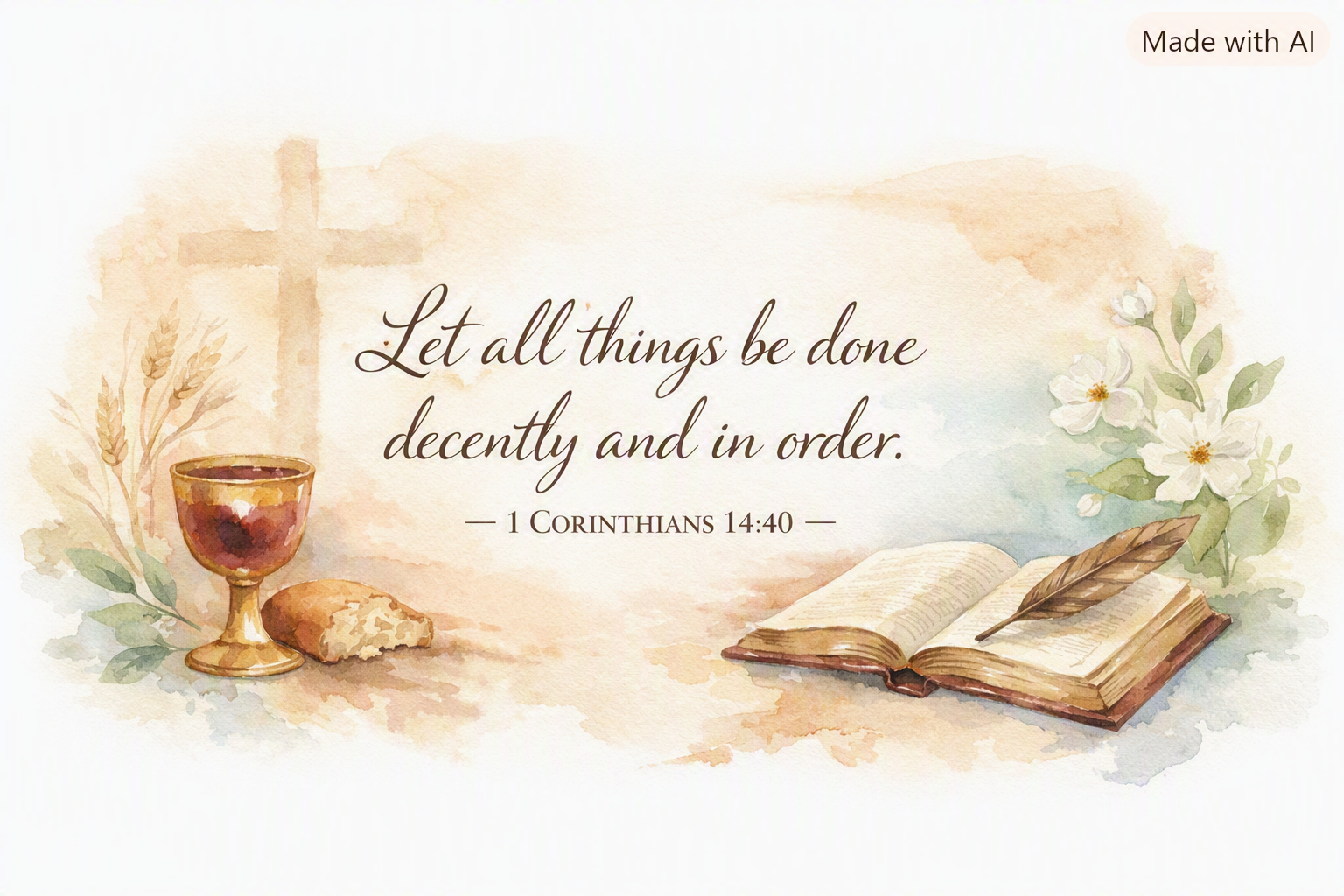
“Let all things be done decently and in order.”
This is the final guardrail.
🌿 The Full Structure in One View
Here is the complete outline:
- Headship & Reverence — posture of worship
- Communion Conduct — unity and holiness
- Spiritual Gifts — diversity serving one body
- Love — the governing ethic
- Orderly Worship
- prophecy preferred
- tongues regulated
- no interruptions
- no chaos
- everything edifying
- Scripture Over Experience
- Decency & Order — the final rule
This is the full structure Paul gave — not a liturgy, but a framework that protects the church from confusion, ego, and disorder.
